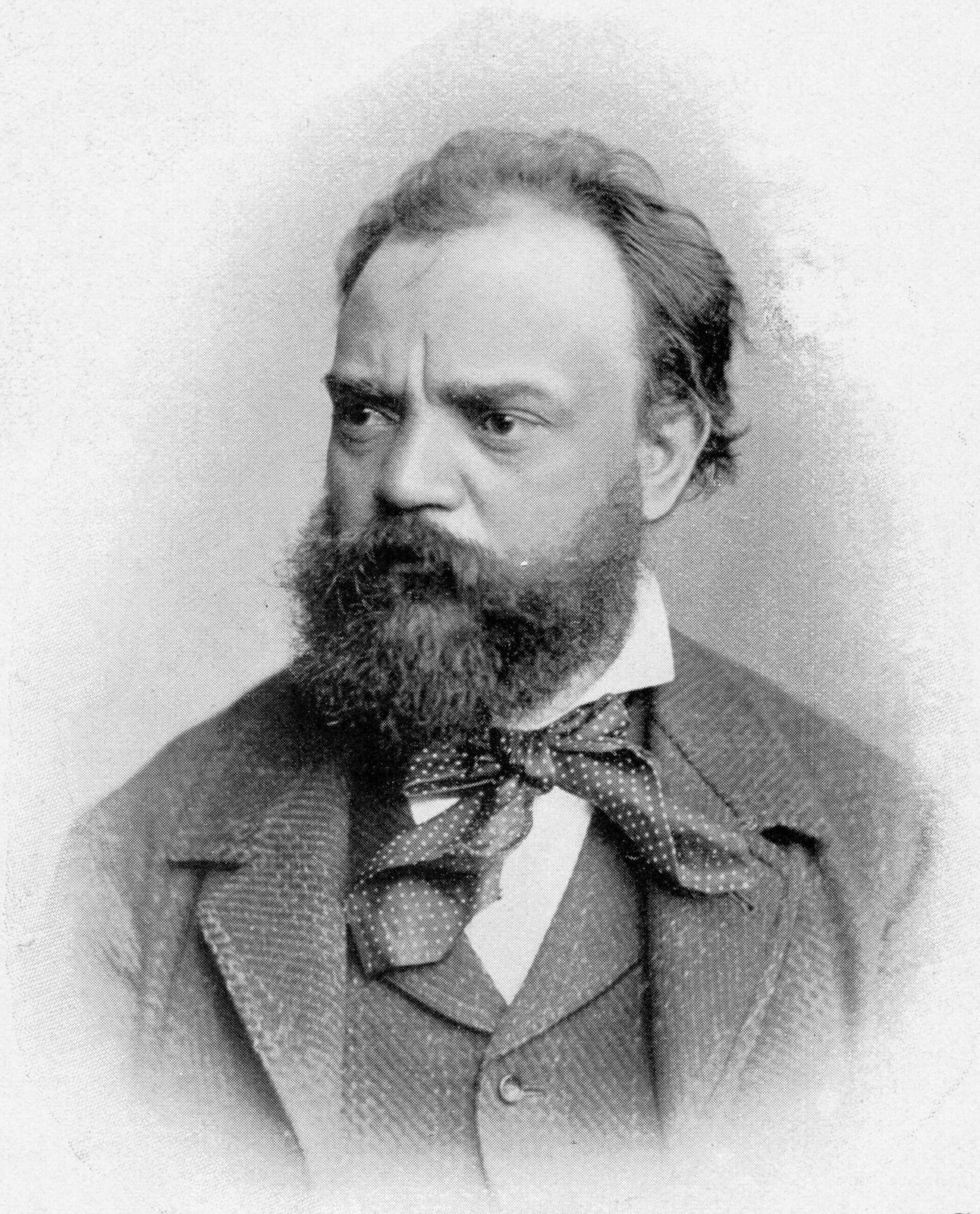
On a rainy December afternoon in 1893, New Yorkers queued outside Carnegie Hall to hear a Czech villager's answer to America's oldest musical question. The symphony Antonín Dvořák called From the New World was born inside an argument about race, nation and song that has never ended — and carries, in its famous Largo and cyclic returns, the most universally translated homesickness in music. This essay follows the work from a butcher's house on the Vltava through Gilded Age Manhattan and a Czech-speaking Iowa village to the concert halls, hymnals and screens of the whole world.
In the negro melodies of America I discover all that is needed for a great and noble school of music.Antonín Dvořák, New York Herald, 21 May 1893
The sixteenth of December
It had rained all through the previous day, a cold, vertical December rain, and still the queue outside Carnegie Hall did not break. The occasion was billed merely as a public rehearsal — the official premiere would follow on Saturday evening — but New York understood perfectly well what was being offered on the afternoon of 15 December 1893: the first hearing, anywhere in the world, of a new symphony by the most famous composer then living on American soil. People stood in the wet with their collars up because a Czech villager's son, fifteen months into his American adventure, had written a large orchestral work and given it a title that read like a promise and a provocation at once: From the New World.
The following evening, at the formal premiere, Antonín Dvořák sat not on the podium but in Box 10, slightly above the orchestra he could have conducted and chose not to. Anton Seidl — Wagner's former assistant, the most magnetic conductor in America — led the New York Philharmonic. The programme placed the new symphony between Brahms's Violin Concerto and Mendelssohn's A Midsummer Night's Dream music, which is to say between the two poles of the Austro-German tradition Dvořák had been imported, at enormous expense, to help America outgrow.
What happened next broke the etiquette of the concert hall. After the first movement the audience applauded. After the Largo they applauded at such length that the performance could not continue until Dvořák rose in his box and bowed. After the Scherzo, again. By the end the composer was receiving the kind of ovation New York otherwise reserved for visiting royalty — a comparison he reached for himself, with a villager's amused precision, in the letter he sent home to his publisher Fritz Simrock: the papers, he reported, were saying that no composer had ever had such a triumph, and he had been obliged to thank the public from his box, in his words, like a king.
The critics next morning confirmed it. W. J. Henderson in the New York Times — in a review running close to two thousand words — placed the symphony among the finest written in the form since Beethoven's death. The Herald called it a noble composition of heroic proportions; the Evening Post went further still and pronounced it the greatest symphonic work yet composed on American ground. Yet Douglas Shadle, whose 2021 study of the premiere is the sharpest recent account we have, notices the thing a modern reader might miss: Henderson spent perhaps a tenth of his column praising the music. The other nine tenths defended the composer's choices — his public insistence that the future of American music lay in the melodies of Black Americans. The symphony was born already inside an argument. It has never entirely left it.
That argument — about race, about nationhood, about who owns a country's songs — is one of the reasons this work, alone among the hundreds of symphonies written in the 1890s, still fills halls on every continent and still opens debates rather than closing them. The other reason is simpler and harder to argue with: from the first horn call to the last suspended wind chord, it contains some of the most immediately loved melody ever set down on orchestral paper. To understand how both things can be true at once, we have to go back — to a butcher's house on the Vltava, to a railway-mad church organist, and to the strangest job offer in the history of music.
The programme as argument
One detail of the premiere deserves a paragraph before the biography claims its turn, because it shows how consciously the evening was staged. Seidl framed the new symphony with Brahms's Violin Concerto before it and Mendelssohn's Midsummer Night's Dream music after — which is to say he hung the American newcomer between the reigning monarch of absolute music and the most beloved fairy-painting of the German Romantic stage. To the Austro-German party in the hall, the frame said: judge this by the highest standard we own. To Dvořák's party it said something slyer: here is the standard, and watch the Czech meet it with American materials. The symphony, as we have seen, answered both briefs at once — Brahmsian in its working, New World in its face — and the ovations registered the audience's astonishment that no choice between the two had been necessary. Programming, the premiere reminds us, is itself a form of criticism; Seidl's was the first and remains among the shrewdest this work has received.
The open rehearsal of 15 December deserves its own footnote in the work's democratic biography. Public rehearsals were the Philharmonic's cheaper, informal sittings — and so the very first audience this symphony ever had was not Saturday's society subscription but Friday's mixed city crowd, the people willing to queue in winter rain for the less expensive ticket. The reviews that mattered were filed from that afternoon as much as from the gala; the Times notice was already in type before the official premiere began. A work whose composer located the future of American music in the songs of its least privileged people was heard first, fittingly, by whoever could get in.
And then there is the question the whole evening begged, the one every listener in the dripping queue had carried in with them: how does a man come to write such a thing? The answer begins forty years earlier, in a village kitchen that smelled of brine and feathers.
A butcher's son from the Vltava valley
Antonín Dvořák was born on 8 September 1841 in Nelahozeves, a village on the Vltava some thirty kilometres north of Prague, the first of nine children of a butcher and innkeeper who expected the boy to inherit the trade. The river that would later flow through Smetana's Má vlast ran past the family windows; the village church supplied his first music; a local schoolmaster supplied his first violin lessons. What saved him from the butcher's block was the peculiar Bohemian institution of the musician-schoolteacher — the kantor — and an uncle's support that sent him, at sixteen, to the Prague Organ School. He graduated second in his class into a decade of obscurity: a viola player's chair in the band of Karel Komzák, which was absorbed in 1862 into the orchestra of the new Provisional Theatre, the first Czech-language stage Prague had ever had.
From that viola chair, for nine years, Dvořák watched the Czech national revival happen around him at the distance of an orchestra pit. When Bedřich Smetana arrived in 1866 to conduct the theatre's operas, Dvořák was playing under his baton — the future composer of From the New World and the composer of Vltava, one above the other in the same room, a fact almost too neat for fiction. By day he taught piano lessons; by night he filled notebooks with symphonies and quartets nobody asked for and nobody performed. He was over thirty, engaged to a pupil from a family considerably above his station, and essentially unknown beyond a small circle of Prague musicians.
The turn came through bureaucracy, of all things. In 1874 he applied for the Austrian State Stipendium, a Viennese grant for poor young artists, and submitted a parcel of scores. On the jury sat the most feared critic in Europe, Eduard Hanslick — and, from 1875, Johannes Brahms. Dvořák won the stipend five times. More decisively, Brahms read the parcels with growing astonishment, and in 1877 did something he did for almost no one: he wrote to his own publisher, Fritz Simrock of Berlin, telling him that this unknown Czech was the real thing and worth printing. Simrock commissioned a set of Slavonic Dances. They appeared in 1878 and sold across Europe like a fever. Within two years the viola player who could not get a symphony performed in Prague was being played in London, Vienna and New York.

The 1880s made him an international property of a very particular kind: the national composer, the man who had translated a small nation's melodic dialect into the lingua franca of the European concert hall. England adopted him with special fervour — nine visits, choral festivals in Birmingham and Leeds, an honorary doctorate at Cambridge in 1891, conferred on a man who never learned to feel at ease in formal dress and who described the ceremony's Latin with affectionate bewilderment. By 1891 he held a professorship at the Prague Conservatory, owned a beloved summer house at Vysoká with an orchard and a flock of pigeons, and had a wife, Anna, and six living children. He was fifty years old, famous, settled, and constitutionally suspicious of grand gestures.
Which is precisely the man one would least expect to answer a telegram from New York offering to upend his entire life. The telegram came in June 1891, and it was signed by a woman almost no one in Prague had heard of: Jeannette Thurber.
Mrs. Thurber's improbable conservatory
Jeannette Meyers Thurber is one of those figures American music history mislaid for a century and has only recently restored to her proper size. Daughter of a Danish immigrant violinist, educated at the Paris Conservatoire, married to a wholesale-grocery millionaire, she had concluded — against the entire grain of Gilded Age opinion — that the United States would never have a musical culture of its own so long as its talented young went to Berlin and Leipzig to be finished into imitation Germans. Her answer, founded in 1885, was the National Conservatory of Music of America: tuition support for those who could not pay, and admission — radical to the point of scandal — open to women, to students with disabilities, and to Black Americans.
What Thurber needed by 1891 was a name large enough to make the project unignorable, and a musician who had already done for one small culture what she wanted done for her enormous one. Dvořák — the Czech who had made Bohemian dance rhythms respectable in Vienna — was not the obvious choice; he was the logical one, and Thurber's logic was relentless. So, eventually, was her telegraph bill. After a year of offers, counter-offers and one famous family council at Vysoká, Dvořák signed. On 15 September 1892 he boarded the SS Saale at Bremen with Anna, their eldest daughter Otilie and son Antonín, leaving the four younger children with their grandmother in Bohemia. Nine days of Atlantic later, on 27 September, he saw New York Harbor.
He was met like a head of state and put almost immediately to work as one. His American debut at Carnegie Hall on 21 October 1892 — part of the city's quadricentennial Columbus festivities — had him conducting his own Te Deum before an audience primed by weeks of newspaper buildup. But the assignment Thurber had actually hired him for was stranger and far more interesting than directing a school. She had hired him, in effect, to answer a question America had been asking itself with increasing anxiety for half a century: what should this country's music be?

To grasp what Dvořák walked into, one has to hold the whole of 1893 in view at once — because the year itself behaves like a symphony with two violently contrasted themes played simultaneously. It was the year America staged the most dazzling self-portrait any nation had yet attempted, and the year its economy fell through the floor. Dvořák composed From the New World in the precise overlap of those two movements, between January and May of 1893, in an apartment at 327 East 17th Street, while the country outside the window was deciding what it was.
The interview that lit the fuse
Dvořák's method, on arriving, was the opposite of pronouncement: he listened. He had the Conservatory's most gifted students sing to him, asked endless questions, collected tunes the way he collected locomotive numbers. But on 21 May 1893 — three days before he finished the symphony's scoring — the New York Herald published the result of that listening under a banner headline, and pronouncement is what America got. The future music of this country, Dvořák declared, must be founded on what are called the negro melodies; in them he had discovered, as he put it in the sentence that opens this essay, everything needed for a great and noble school of music.
It is hard, from this distance, to recover how loud that sentence was. The most celebrated composer in the Western Hemisphere had just located the foundation of American art in the music of the country's most despised caste — in plantation spirituals, in the sorrow songs of the formerly enslaved — at the exact moment the legal machinery of segregation was closing around their grandchildren. The Herald, sensing circulation, cabled the statement to Europe and solicited responses from Brahms's Vienna to Paris. American composers split on regional lines that Shadle has mapped in detail: New York's critics, led by the Tribune's Henry Krehbiel — who had been studying Black folk song seriously for years — rallied to Dvořák; Boston's establishment recoiled, some on aesthetic grounds, some in language that requires no decoding. One Boston composer dismissed the spirituals as essentially foreign to America's Anglo-Saxon character; another suggested Dvořák had mistaken the music of a race for the music of a nation. The argument about the symphony had begun seven months before a note of it was heard.
The replies the Herald solicited and printed over the following weeks read today like a core sample of the Gilded Age mind. From Boston's eminences came courteous demurrals and less courteous ones — doubts that plantation song could bear symphonic weight, suggestions that the material was too narrow, too regional, or simply not theirs; from Europe, bemusement and curiosity in equal parts; from Krehbiel and the New York party, reinforcement with footnotes. Shadle's reconstruction of this paper war is one of recent musicology's services to the work: it shows that the symphony's premiere in December was not the opening of a debate but its first plebiscite — the audience in Carnegie Hall was voting, with its movement-by-movement ovations, on a question the newspapers had spent half a year framing.
He clearly did not understand the depth of controversy that this type of arrangement would elicit.

The man who sang the sorrow songs
The listening had a face and a name. Harry Thacker Burleigh was twenty-six when Dvořák arrived: a baritone from Erie, Pennsylvania, grandson of a man who had bought his own freedom, admitted to the National Conservatory on scholarship in 1892. He earned pocket money doing odd jobs, and he sang while he worked. The voice carried. Within months he was spending evenings at the Dvořák apartment on East 17th Street, singing the spirituals his grandfather had taught him — Go Down, Moses, Deep River, Swing Low, Sweet Chariot — while the composer sat at the piano or simply listened, sometimes asking him to repeat a phrase five, six times, like a man memorising a landscape.
Burleigh never formally studied composition with Dvořák, a point he was scrupulous about all his life; what passed between them was something less official and more consequential. Dvořák got the melodic dialect of the spirituals into his bloodstream from a primary source. Burleigh got something American conservatories were not then offering young Black musicians: the unembarrassed conviction of Europe's most famous melodist that the music of his grandfather's generation was great art, fit foundation for symphonies. When the parts for the new symphony were copied out in the autumn of 1893, Burleigh was one of the copyists — and he liked to recall, in later years, that the timpani part in his hand had helped announce a work whose slow movement the world would come to hear as the greatest spiritual never sung.
The rest of Burleigh's life is its own American epic, told best in recent years by Joseph Horowitz's Dvořák's Prophecy: the 1894 audition at St George's Episcopal Church, where the elder J. P. Morgan cast a deciding vote for the lone Black applicant among sixty; the half-century he then sang there; the editorship at Ricordi from 1913, where his concert arrangements of the spirituals — Deep River above all — put that repertoire on the recital programmes of the world. Dvořák's prophecy, as Horowitz argues, came true crookedly: not through the white symphonists who briefly mined 'Negro themes' after 1893, but through Burleigh himself and the Black composers who came after him — Florence Price, William Grant Still, William Levi Dawson — whose concert music answered the Herald interview a generation late, to halls that were slow to listen.

One more New Yorker belongs in this circle before the essay follows the score itself, because he was the premiere's intellectual second and the work's first deep reader.
A symphony written between two windows
The work itself took shape with the speed of a man who had been preparing for it without knowing. The first sketches are dated 10 January 1893 — a New York winter, the Conservatory term in full stride — and the continuity draft of all four movements was finished by the second week of April. Scoring went almost as fast: the full orchestration was completed on 24 May 1893, and at the foot of the last page Dvořák wrote one of the most quoted marginalia in music. Praise God, it says in Czech — finished 24 May 1893, nine o'clock in the morning — and then, because the man could not separate music from family even on a title page: the children have arrived at Southampton. A cable that morning had told him that the four younger children, left behind in Bohemia, had crossed safely and would reach New York within days. The whole household would be together for the first time in eight months. The symphony of homesickness was signed, in effect, with the news that the homesickness was about to end for a while.
Kovařík's memoirs preserve the working rhythm behind those dates. The composing happened in the early morning — the hour Dvořák defended all his life against every continent — in pencil first, into the sketchbooks that survive in Prague: single melodic lines with harmonic shorthand, themes captured at speed and interrogated later. From the sketches grew the particell, the continuity draft on a few staves where the symphony existed whole before it wore any orchestral clothing; the full score was then a craftsman's finishing stage, executed with the calligraphic neatness of a man who had once earned bread as a copyist. The speed, in other words, was not haste but ripeness: by January 1893 he had been listening to America — to Burleigh, to the Conservatory's singers, to the street and the harbour — for a full season, and the sketchbooks show ideas arriving already in the symphony's dialect.
What had he actually written in those nineteen weeks? The question sounds simple and has kept musicologists in business for a century and a quarter, because the answer involves separating three things the premiere instantly fused: what Dvořák borrowed, what he absorbed, and what he invented. He was categorical about the first: nothing is quoted. I have not actually used a single one of those melodies, he told the Herald the day before the premiere; he had written original themes embodying the peculiarities of the music he had studied, and developed them, as he put it, with all the resources of modern rhythm, counterpoint and orchestral colour. The disclaimer is technically watertight and spiritually beside the point — which is roughly what he intended.
What the melodies carry
Take the famous case first. In the opening movement, after the slow introduction's thunder, the solo flute announces a bright G-major tune whose first five notes trace the same arch as Swing Low, Sweet Chariot — the spiritual Burleigh had sung at East 17th Street more often than any other. Coincidence is mathematically possible and almost no one has ever believed it, least of all Burleigh, who said plainly in later life that Dvořák had saturated himself in the spirituals before writing the symphony and that this theme bore the trace. But notice what the theme is not: it is not a quotation, not harmonised like a spiritual, and it spends the rest of the movement being put through strict sonata combat no plantation song ever endured. It behaves, in other words, exactly like Dvořák's Czech themes had always behaved — folk-shaped surfaces over Brahmsian machinery.
The deeper borrowings are grammatical rather than melodic, and Dvořák itemised them himself: the pentatonic scale — five notes, no semitones, the shared skeleton of more folk musics than any one nation can claim; the flattened seventh degree that gives so many of the symphony's E-minor pages their modal, hymn-like gravity; syncopations that displace the beat the way the spirituals and, later, ragtime displaced it. Here the scholarship of Michael Beckerman, the dean of Dvořák studies in America, has performed a useful disenchantment: every one of those fingerprints, he points out, can be found in Bohemian and Moravian song as well. The pentatonic third, the modal seventh, even the short-long Scotch snap — they are at home on both sides of the Atlantic. Which is precisely why Dvořák could write a symphony that Americans heard as American and Czechs, from the first Prague performances onward, have heard with equal conviction as the most Czech thing he ever wrote in exile. The two hearings use the same notes. The symphony does not adjudicate between them; it is about the overlap — music written in the place where one displaced people's songs rhymed with another's.
And then there is Hiawatha. Thurber, dreaming of an American national opera, had pressed Longfellow's The Song of Hiawatha on Dvořák as a libretto; the opera never happened, but Dvořák told the Herald that two middle movements of the symphony carried its trace — the Largo shaped by the forest funeral of Minnehaha, the Scherzo sparked by the dance of Pau-Puk-Keewis at the wedding feast. Beckerman has reconstructed how literal those connections may be, down to matching the Largo's middle episode against Longfellow's famine scenes. Whether one takes the programme as blueprint or as afterglow, its meaning for Dvořák is plain: he had been asked for American music, and he reached for the three musics America itself could not stop arguing about — the sorrow songs of Black Americans, the imagined music of the continent's first peoples, and underneath both, unbanishable, the village songs of his own Bohemia.
An architecture of departure and return
Formally, the symphony is the most tightly cyclic thing Dvořák ever built. Themes do not stay in their movements: the first movement's main horn theme strides back into the Largo, the Scherzo, and the finale; the finale's coda stacks the symphony's principal melodies on top of one another like a man laying out photographs of everyone he has missed. Nineteenth-century Czech and German critics heard Beethoven's Ninth and Schubert behind the procedure; modern ears may hear something more like memory itself — the way a tune from home intrudes on whatever you are doing abroad. In a work whose title is a postcard — these are, Dvořák explained, impressions and greetings from the New World — the cyclic returns read less like a structural device than like the act of remembering set to orchestra.
The first movement opens away from all that, in stillness: cellos low and dark, a horn call answered by woodwind sighs, then the Allegro molto erupting with the arpeggiated horn theme that will haunt the entire work. The exposition's three ideas map the symphony's whole world in miniature — the E-minor horn summons, a dancing G-minor tune for flutes and oboes whose drone fifths could come off either a Bohemian bagpipe or an Appalachian porch, and the Swing Low-shaped flute melody in G major. The development treats them with a ferocity the lyrical surfaces do not prepare you for — the Swing Low flute theme, of all candidates, is the one dragged through the harmonic battlefield, fragmented, darkened, driven through remote keys by trumpet fanfares until its sweetness reads as memory under siege. The recapitulation pointedly refuses to restore order: the second and third themes return in the 'wrong', distant keys, home keys denied to homesick material, a sonata-form heresy that is also the movement's plainest poetry. The coda hammers the horn theme into E minor granite; the movement ends not in triumph but in defiance.
The Largo, or how a melody becomes a homeland
Everything in the symphony's reception, from 1893 to this afternoon, ultimately funnels into twelve minutes of D-flat major. The Largo begins with seven chords in the low brass — a harmonic gate swinging slowly open, moving by thirds from the first movement's E minor into a key as far from it as the map allows — and then the cor anglais begins to sing. Dvořák's choice of instrument was itself a stroke of genius disguised as modesty: not the cello he first sketched, not the heroic horn, but the alto oboe with its veiled, slightly grainy timbre — the closest thing in the orchestra, players have always said, to a human voice worn by use. Several of his students recalled him saying the melody was conceived in the spirit of the spirituals Burleigh sang; Burleigh himself thought the cor anglais was chosen because it sounded like him.
The movement's middle is its secret architecture. After the cor anglais has sung itself out, the music slips into C-sharp minor and begins to walk: a trudging bass under paired flute and oboe, the page Dvořák connected to Minnehaha's forest funeral, grief given a gait. Then, with one of the score's most magical non sequiturs, the walking stops and the woodwinds break into birdsong — a bright, chattering trio over trembling strings, morning inside a funeral — before the first movement's horn theme smashes through fortissimo, memory at its most unwelcome, and the cor anglais must gather the room again. The reprise it leads is thinner than the opening — solo strings, the melody passed in fragments, a famous bar where the music simply stops mid-phrase like a voice that cannot continue — and then the seven brass chords close the gate. No twelve minutes in the symphonic literature have been asked to carry more funerals, and none have proved sturdier under the weight.
What happened to that melody afterwards is one of the great feedback loops in musical history. In 1922 — eighteen years after Dvořák's death — his former student William Arms Fisher fitted words to it and published Goin' Home, a composed song in the manner of a spiritual. It was sung at gravesides, at state funerals, in churches; within a generation, much of the English-speaking world sincerely believed the tune was a genuine folk spiritual that Dvořák had borrowed, rather than an original theme a spiritual-saturated Czech had written and an American had retro-fitted into folklore. The symphony had been accused of borrowing folk music; instead it manufactured some. No tidier proof exists of what Dvořák meant when he said the foundation was there for anyone with the ears to use it — or of Beckerman's wry observation that in this symphony, the line between found and made, between America and Bohemia, between document and dream, was never meant to hold.
The Scherzo: a dance with two homelands
If the Largo is the symphony's heart, the Scherzo is its feet — and feet are harder to disguise. The movement explodes out of a gesture every concertgoer of 1893 recognised instantly: a rhythmic ignition in the timpani and winds modelled, with affectionate openness, on the Scherzo of Beethoven's Ninth — the same key of E minor, the same hammered triple-time summons. Dvořák, who revered Beethoven this side of idolatry, was not hiding the lineage; he was claiming a seat at the table. What he serves at that table, though, is his own cooking. The principal dance, all stamping cross-rhythms and whirling repetitions, is the music Dvořák told the Herald had been sparked by Longfellow's wedding feast — the dance of Pau-Puk-Keewis in The Song of Hiawatha, where the mischief-maker spins like the leaves until the dust and wind dance with him. Listeners have heard in its drone basses and pounding accents an imagined Indigenous ceremony; listeners in Prague have heard, with equal certainty, a furiant — the fierce Bohemian cross-rhythm dance Dvořák had been writing all his life.
Then come the trios, and the mask slips entirely, twice. The first trio relaxes into a lilting woodwind tune over drone fifths — pure village bagpipe music, the kind that might drift across a green at Vysoká on a saint's day; the second is gentler still, a Ländler-like swing that no programme about the American forest can quite absorb. This is the movement where the symphony's double exposure is most visible to the naked ear: an American legend danced in Bohemian shoes. The coda makes the point explicit for anyone still undecided — the first movement's horn theme strides in over the dance's last bars, memory interrupting the party, the way it interrupts everything in this work.
The Finale: every theme comes home
The last movement opens with the most cinematic gesture Dvořák ever wrote — a low string ostinato climbing by semitones, tension wound turn by turn, until the brass detonate the march theme over it like a ship's prow breaking through ice. (Twentieth-century film scoring learned this page by heart; the entire grammar of the adventure-movie main title is audible in it.) The clarinet answers with a long-breathed second theme over restless cellos, and the movement proceeds, for a while, as the most conventional sonata structure in the symphony — as if Dvořák were clearing the stage for what he actually has planned.
What he has planned is a homecoming in the technical sense. From the development onward, the finale stops being a movement and becomes a reunion: the Largo's cor anglais song returns in the winds; the Scherzo's dance flickers past; and the first movement's horn theme — which has shadowed every movement like a thought that will not be dismissed — arrives to confront the finale's own march head-on. In the coda Dvořák stacks them in counterpoint, themes from four movements sounding together, a contrapuntal family photograph. The very last bars carry the symphony's most discussed fingerprint: the final E-major chord is not stamped shut by the full orchestra but released — held in the winds alone and allowed to fade, a door left open rather than closed. Conductors have argued over that chord for a century and a quarter. Played one way it is transfiguration; played another, a question mark; played a third, simply a man looking back over his shoulder. The notation permits all three, and the work is large enough to mean them simultaneously.
The harmonic fine print of that ending repays one technical sentence. The symphony has fought its whole length in E minor, and the finale's last pages win E major — but the famous final sonority is approached not as a victory stamp but as a release: the full orchestra cuts off, and the chord is left sounding in winds alone, marked to die away, scored low and warm rather than high and bright. Where Beethoven's Ninth ends by detonating its major key, Dvořák's ends by entrusting it — handing the hard-won tonic to the instruments most like human breath and letting it go. Players speak of the bar with a certain protectiveness; audiences, for a hundred and thirty years, have been deciding individually whether they have just heard an arrival or a departure. The score's last word is the work's whole subject, suspended.
The symphony's themes do not develop so much as remember each other — its form is the shape of longing.
The orchestra as landscape
Part of the symphony's planetary success is a matter of pure sonics: it is one of the best-sounding orchestral scores ever written, by a composer who had sat inside the orchestra for a decade. Dvořák's years on the viola bench gave him a player's knowledge of where every instrument lives most comfortably, and the New World is his masterclass. The scoring is classical in size — pairs of winds, four horns, the trombones held in reserve, tuba appearing only where weight is structural — yet the canvas sounds enormous, because the space is built from registers rather than from numbers: wide-open string voicings with daylight between the parts, melodies doubled at the octave so they gleam, basses walking far below the violins with the middle deliberately thinned. Players and conductors have described the effect in geographic terms for so long that the metaphor has become analysis — the symphony does not depict the prairie; it is orchestrated like one, all horizon and weather.
The solo writing, meanwhile, is a casting director's portfolio of voices: the cor anglais as the displaced singer; the flute carrying the Swing Low arch like light catching on water; the horns as the work's conscience, summoning and warning; the timpani given actual thematic speech in the Scherzo. Even silence is scored — the Largo's seven framing brass chords are inhalations before speech, and the pauses around them are written with a precision that makes halls hold their breath on schedule. It is the orchestration, finally, that settles the tired question of whether this music is 'really' American or 'really' Czech: it is really outdoors, on whichever continent the listener keeps their childhood.
The score's most eloquent statistic concerns its quietest hire. The tuba — the orchestra's heaviest voice — plays in this symphony for roughly a dozen bars in total, and all of them are in the Largo: it exists in the work solely to deepen the solemn chords that open and close the slow movement, and is then dismissed for the evening. No louder proof exists of how precisely Dvořák budgeted weight. Trombones, similarly, are reserved for structural punctuation rather than power; the horns do the work's emotional heavy lifting; and the strings are asked for more shades of quiet than of loud. For a piece whose reputation is panoramic, the pages are astonishingly economical — the bigness is an acoustic illusion conjured by spacing, and the famous climaxes land because the orchestration has been saving up for them.

The Bierstadt canvases above are not decoration but documentation of a hearing. From the first seasons, American notices reached for the language of landscape — the phrase wide open spaces recurs across early commentary on the symphony like a refrain, attached both to what inspired the music and to what it made audiences feel. The work arrived, in other words, pre-painted: a public raised on luminist sunsets and frontier panoramas supplied the imagery the moment the horns opened the horizon. That the composer's own decisive landscape was a Bohemian orchard only completes the joke the symphony has been telling from the start — the view is supplied by the listener; the longing is supplied by the score.
Hiawatha, or the opera that never was
Behind the symphony's middle movements stands the ghost of a much larger project. Jeannette Thurber's deepest ambition was an American national opera, and she had chosen its subject before she chose her composer: Longfellow's The Song of Hiawatha, the 1855 epic that had given the continent its most famous Indigenous myth — and given Europe its image of America. Dvořák needed no persuading; he had read the poem in Czech translation as a young man, decades before Thurber's telegram, and loved it with the loyalty he gave everything from his youth. Through 1893 the opera was a live plan: librettos were solicited, scenarios discussed, and Dvořák studied what materials of Native music the era put within his reach — transcriptions, exhibition performances, the show-business versions touring the country — all of it filtered, as Beckerman's research underlines, through the period's thick romantic glass.
The opera never came. The librettos disappointed; the Conservatory's finances crumbled; the homeward pull won. What survived was sublimation: the Largo carrying, by Dvořák's own account, the forest burial of Minnehaha — famine, snowfall, the funeral fires — and the Scherzo carrying the wedding dance. Knowing the programme changes the hearing in one specific, valuable way: the Largo's middle section, where the music darkens and a trudging bass line sets in under keening winds, stops being generic melancholy and becomes a cortège; the return of the cor anglais melody afterwards lands as consolation after a death rather than mere reprise. Whether one chooses to hear Minnehaha, a Bohemian burial, or a grief with no proper noun, the structure of mourning is composed into the page — which is why the movement has accompanied a century of actual funerals without ever feeling borrowed for the purpose.
The larger irony Beckerman draws from the episode deserves its sentence: the most enduring musical monument of America's Indigenous myth contains no Indigenous music — it contains a Czech Catholic's grief, shaped by a New England poem, voiced through an instrument from the French oboe family, and sung to the world by a melody that Americans later mistook for a Black spiritual. If that sentence sounds like a confusion, it is the precise confusion the United States of 1893 was made of, and the symphony is its honest portrait.
The Largo's grief was not abstract. Behind the cor anglais stood a particular man in a particular apartment, eight months from home, counting pigeons in Central Park because his own were on the other side of an ocean. Before the essay follows the symphony out into the world, it has to follow the composer inward — because homesickness, in Dvořák's case, was not the sentimental backdrop of the American years. It was their engine, their organising principle, and very nearly their undoing.
A creature of habit in a city of noise
Dvořák's daily life in New York had the fixed orbit of a man defending himself against a continent. The apartment at 327 East 17th Street, near Stuyvesant Square and a short walk from the Conservatory; morning work from before seven; three hours of teaching; an afternoon walk. He could not afford, emotionally, to be lost, so he was never anywhere new. The walks had two fixed destinations that between them say almost everything about him. One was Central Park, where he visited the pigeon houses — at Vysoká he kept pigeons the way other men keep horses, knew them individually, wrote about them in letters with the tenderness he otherwise reserved for his children. The other was the railway. Dvořák was a locomotive enthusiast of the pure, timetable-memorising kind; in Prague he had known engines and their drivers by name. But the New York Central's platforms at Grand Central were closed to non-passengers, to his lasting indignation, so he took the longer walk to the Hudson piers instead and watched the great transatlantic steamers — which had the additional, unbearable advantage that they were pointed at Europe. He knew their sailing schedules by heart. Twice a week, one of them was going where he could not.The letters
The correspondence of the American years runs on two rails. To his publisher and professional friends, optimism, fees, premieres. To intimates in Bohemia, an unguarded counter-melody. He misses his pigeons; he misses Vysoká's orchard; he calculates, in one letter, exactly what he would be doing at that hour if he were home. The family had been split for the first winter — four of the six children left with their grandmother in Bohemia — and Anna's husband measured the Atlantic daily. When all six children finally arrived at the end of May 1893, days after the symphony was finished, the reunion set the emotional stage for the happiest chapter of the American adventure: the decision not to spend the summer in fashionable Newport or the Catskills, as New York expected of its famous guest, but in a place almost no one in New York had heard of, because his secretary had told him that there, and only there, America spoke Czech.What the homesickness was made of
It is worth being precise, because Dvořák's longing was not a generalised immigrant melancholy. He was not poor, not despised, not stranded; he was the most fêted musician on the continent, and he could go home — and did, after the second season. What he suffered was the specific ache of a man whose creative metabolism ran on rootedness: on the same walk, the same faces, the same birds, the liturgical year of a Bohemian village, mushrooms in the same woods each autumn. America offered him everything except repetition. The deepest irony of the American works — the symphony, the F-major quartet, the cello concerto begun in his final New York winter — is that this least cosmopolitan of composers produced, out of the raw material of his displacement, the most universally portable music of his life. Homesickness, it turned out, was the one feeling every nation could translate without residue. The symphony called From the New World became the world's symphony precisely because it was written by a man who wanted, with his whole body, to be somewhere else.What Vysoká meant
To measure the longing one must know its object. Vysoká, the small estate near Příbram acquired through the 1880s successes, was not a villa but a working idyll: the orchard he pruned himself, the famous pigeon-cotes, woods he walked daily and knew mushroom by mushroom, the village inn with its fixed circle of card partners, and a composing hut where the late masterpieces would eventually be written. Vysoká was where the liturgical and agricultural years still kept time together — and where, crucially, nobody treated him as a phenomenon. In New York he was an institution; at Vysoká he was a neighbour with strong views on poultry. The American letters return to the place with the specificity of a man counting fence posts from memory, and his very first summer back, in 1894, was spent there having a small chapel organ played in thanksgiving — the homecoming scored, like everything in this story, for keyboard and belief.Anna
The American decision, and the American survival, had a co-author. Anna Dvořáková — née Čermáková, the pupil he had courted while tutoring her wealthier family, the younger sister of his first, unrequited love Josefina — ran the household, the accounts and, by every domestic account, the negotiations. It was Anna who weighed Thurber's dollars against Vysoká's orchard and found the arithmetic conclusive; Anna who managed a transatlantic family split across two continents for a winter; Anna who, when the salary began arriving as promises, kept the ledger that eventually outvoted the contract. Dvořák's letters mention her with the unexamined gratitude of a man who has never once had to think about logistics. The symphony of homesickness was made possible by the one member of the household who did not have time for the condition.The faith
One more thread belongs here, because Dvořák himself would have put it first. He was a Catholic of completely unironic, daily, pre-modern devotion — the kind who wrote Praise God at the foot of finished scores as naturally as a date. In New York this faith had its own displacement: the language of the liturgy was universal Latin, but the parish life around it was not his. Part of what Spillville gave him, that summer of 1893, was something New York with all its cathedrals could not: a small stone church where the priest's sermon, the gossip on the steps afterwards, and the hymns of the old women were all in the language of his childhood. He answered it the only way he knew. On his first full morning in the village he climbed to the organ loft and played the parish into its day.Letters home, and the sound of counted days
Through all of it — the premiere, the lionising, the Iowa idyll — the letters kept their Bohemian compass. To friends in Prague Dvořák itemised America with a craftsman's fairness: the orchestras were magnificent, the press attentive beyond anything in Europe, the money (when it arrived) unarguable; and then, sentence by sentence, the ledger's other column — what he would give for a morning at Vysoká, for his pigeons, for the talk of particular friends at a particular table. The most quoted of these confessions, from the first American spring, sets the exchange rate exactly: all the New World's wonders weighed against the simple wish to be home among his own. He was not unhappy in America, and the letters are scrupulous about saying so; he was elsewhere in America, which is a different condition, and the one the symphony's every return-of-theme transcribes.
The days were counted in both directions. Each summer's sailing home was planned like a campaign; each autumn's return crossing was endured. When the second contract year closed in the spring of 1895 with the salary in ever-deeper arrears, the decision had effectively been made by accumulated mornings. What is remarkable — and what separates Dvořák's American story from the standard tragedy of the homesick émigré — is the perfect productivity of the longing. Out of thirty-one American months came the Ninth Symphony, the American Quartet, the E-flat Quintet, the Biblical Songs, the Sonatina, and the Cello Concerto: a body of work many composers would trade a lifetime for, every page of it watermarked with the wish to be elsewhere. Few artists have ever converted absence into presence at a better rate.
Spillville
The secretary was Josef Jan Kovařík, a young Czech-American violinist who had attended the Prague Conservatory and shipped home to America in Dvořák's luggage, more or less, as factotum, English-language lifeline and chess partner. His father was the schoolmaster and choirmaster of Spillville, Iowa — population somewhere around four hundred, founded by Bohemian immigrants in the 1850s, wrapped in low wooded hills along the Turkey River, with a stone church of St Wenceslaus on the rise above the main street that was already then the oldest Czech Catholic church in the United States. Kovařík described it; Dvořák, hearing of a village in the middle of America where the baker, the blacksmith and the priest all spoke Czech, made the decision with the speed of a homesick man. On 3 June 1893 the entire reunited household — composer, wife, six children, secretary, a maid, eleven trunks — boarded the train west.
The summer that followed has passed into legend, and for once the legend is mostly documentation. Dvořák rose at four, walked along the Turkey River as the mist lifted — the same dawn walk he took at Vysoká, finally restored to him — then played the 1876 Pfeffer organ for early Mass at St Wenceslaus, old Bohemian hymns the parishioners' grandparents had carried across in their heads. Days were spent among the farmers: cards and kuželky, the Czech ninepins, with men his own age who had emigrated decades earlier and still measured the world in the idiom of South Bohemian villages. He had found the impossible thing — a piece of home that happened to be located inside his exile — and his creative response was instantaneous. Within three days of arriving he had sketched an entire string quartet, the F major, Op. 96, which the world has called the American ever since; the score carries his note that he wrote it fast and thanked God it was simple. Melodies, he said that summer, were falling on him like rain. A string quintet, Op. 97, followed within weeks. The man who composed nothing at all in his first New York autumn wrote two chamber masterpieces in a Iowa June and July.
The summer had its expeditions, and one of them matters to the symphony's afterlife. On the slow September way back east came the visit to the Minnehaha Falls in Minnesota — Longfellow's falls, Hiawatha's — where, finding no paper, Dvořák famously scribbled the melody that came to him on his shirt cuff; it became the slow theme of the violin Sonatina written that winter for his children. Iowa had given him back his mornings, and the cuff is as good an emblem as any of the whole American experiment — inspiration arriving faster than the means to carry it.

The one large interruption of the village summer pointed straight at the question the symphony would soon force into the open: what does it mean for a small nation's music to stand on a world stage? In August the Dvořáks travelled to Chicago, where the Exposition's organisers — with a showman's instinct for the largest Czech community in the New World — had set aside a day of the fair for his transplanted countrymen, and a podium for him.
He came back to New York in late September 1893 a restored man, with two new chamber works in his trunk and the symphony's premiere ten weeks ahead. The autumn had one more gift and one shadow. The gift was the title: at the last moment before delivering the score to Seidl, Dvořák wrote Z nového světa — From the New World — across the title page, a postcard's inscription that he later glossed, with a shrug audible across the decades, as simply impressions and greetings from America. The shadow was financial: the Panic had reached the Thurber fortune, and the great salary was already beginning its slide from money into promise. Both — the greeting and the arithmetic — would shape everything that followed the premiere's triumph.
Anatomy of the themes: the score as evidence
Arguments about this symphony tend to float above the page; the page itself is more interesting than the arguments. Consider, as a specimen, the very first Allegro idea — the arpeggiated summons in the horns. Its skeleton is nothing but the notes of the E-minor triad with one neighbouring tone, syncopated so that the accent lands a heartbeat early: material so elemental it belongs to no nation, which is precisely what makes it infinitely combinable. Dvořák treats it as the symphony's passport — it can enter any movement, any key, any company, and be recognised instantly. The second idea, the G-minor dance for flute and oboe over a drone, is the score's most openly double-faced page: the drone fifths and short-long snap say Bohemian bagpipe to a Czech ear and say frontier fiddle to an American one, and the melody's flattened seventh — the modal note Dvořák singled out in his interviews — is the hinge both hearings swing on. And the third idea, the flute's G-major arch, performs the Swing Low resemblance discussed earlier and then immediately complicates it: its continuation is pure Dvořák lyricism, four-square and orchard-sweet, as if the spiritual's opening gesture had emigrated into a Czech folk song halfway through its first sentence.
The Largo's evidence is harmonic before it is melodic. The famous seven chords that open it are a modulation staged as a ritual — E major to D-flat major by way of harmonies that share single tones like hands passed along a chain — scored for low brass and bassoons so that the progression sounds less composed than discovered, a passage between worlds operated by ancient machinery. Musicians have noted that the progression's logic is the symphony's whole story in miniature: two keys with almost nothing in common joined by careful, patient, third-related steps. When the chords return at the movement's close, the gate swings shut the other way, and the listener has been escorted home without once being shown the border.
Add the Scherzo's hammered Beethoven summons and the finale's ostinato-launched march, and a pattern emerges that is easy to state and was revolutionary to execute: every principal theme in this symphony is built from materials simple enough to be sung by anyone, anywhere — pentatonic arches, triadic calls, drone-floored dances — and then subjected to the full Brahmsian apparatus of development, counterpoint and cyclic recall. That is the actual content of Dvořák's American prescription, demonstrated rather than argued: a national music is made by taking the people's materials seriously, with the heaviest tools the tradition owns. The themes are democratic; the treatment is aristocratic; the synthesis is why a Kranj school orchestra, a Tokyo radio orchestra and the Czech Philharmonic can all play this work as if it had been written about them.

Goin' Home: the afterlife that rewrote the origin
No page of the symphony has lived a stranger second life than the Largo's melody, and the story rewards telling in full because it reverses every assumption about how art and folklore trade. William Arms Fisher had studied with Dvořák at the National Conservatory; in 1922, by then a Boston music editor, he set words to his teacher's cor anglais theme, slowed its pulse to a processional, and published the result as Goin' Home — subtitled, with entire honesty, an adaptation. The song's idiom was the spiritual's: dialect text, call of the weary traveller, home as both Heaven and the place before sorrow. Within a few years honesty had no chance against plausibility. Choirs filed it among the spirituals; soloists announced it as a folk melody Dvořák had borrowed; reference books printed the reversal as fact. The fiction was assisted by the truth that stood behind it — Burleigh's singing really was the melody's seedbed — until the shortest accurate summary became a paradox: a Czech composer wrote an original theme under the influence of spirituals, and an American then turned it into one.
Fisher's text deserves its small quotation, because its first lines explain the entire misattribution — they fit the melody as if melody and words had been born together:
From there the melody passed wholly out of the concert hall's custody. It was sung at gravesides and state funerals, played by colliery bands and ships' orchestras, folded into hymnals on three continents; in Britain a famous bread advertisement lodged it in the memory of generations who could not have named Dvořák; in churches from Iowa to Seoul it functions, simply, as the tune for going home. Purists have sometimes mourned this as dilution. The composer, one suspects, would have filed it as proof of concept — the man who said the materials for a great school of music were lying in the people's mouths lived to have the people take one of his own melodies back into theirs. Few composers are granted so complete a demonstration of their own thesis: the Largo did not merely sound like a folk song; given thirty years, it became one.
Fisher's text itself has had a historical afterlife worth a sentence of care. He wrote it in the stage dialect his era used to signal the spiritual idiom — a convention that sat differently then than it reads now — and performers today often sing the words in standard English, an adjustment the song absorbs without strain because its sentiment was never costume. What endures beneath the orthography is the theology Fisher heard correctly in the melody: home as the place grief travels toward, not away from. It is the same hearing Burleigh's own concert arrangements taught the recital stage, and the reason the Largo's theme has served at farewells in every tradition that borrows it — the tune carries leave-taking the way a vessel carries water, whatever the label on the outside says.
Three winters, measured in works
Set out chronologically, the American catalogue maps the inner weather of the stay with almost diagrammatic clarity. The first winter, 1892–93, belongs to arrival and ambition: the Te Deum for the Columbus festivities already in the trunk, then the Ninth Symphony conceived and completed between January and May — the public answer to the public question he had been hired to pose. The summer of 1893 is the catalogue's pastoral: the American Quartet sketched in three Spillville days, the E-flat Quintet behind it, music of a man briefly returned to himself. The second winter darkens. In March 1894 word came from Bohemia of his father's death — the butcher who had wanted another butcher and lived to see what he got instead — and within days Dvořák had set down the ten Biblical Songs, settings of the Czech Psalter that are the most private music of the American years, grief conducted in his mother tongue and his mother's faith. The Sonatina for his children and the playful Humoresques belong to the same season's gentler hours. And the final winter, 1894–95, produced the farewell: the B-minor Cello Concerto, begun after hearing Victor Herbert's concerto at a New York concert, finished as Josefina's illness worsened across the ocean, its slow movement quoting her favourite among his songs. Brahms, reading those proofs too, made his famous remark of envious astonishment that a cello could be given such a concerto. Arrival, idyll, mourning, leave-taking: thirty-one months, one movement each.
The Ninth and the Czechs: nostalgia as a national export
There is, finally, the matter of how the symphony sounds at home — because the Czech relationship to this most American-branded of works is its own essay in reception. From the 1894 Prague premiere onward, Czech musicians treated Opus 95 not as a foreign report but as a letter from a beloved relative abroad: the most Czech of his symphonies precisely because it was written in the keenest absence of Bohemia. The national performing tradition that grew around it — through Talich's inter-war Czech Philharmonic, through Ančerl, whose own life had passed through the darkest of the century's valleys, through Neumann and Bělohlávek — cultivated a sound for the work that other orchestras have studied like a dialect: woodwinds voiced like village singers, rubato that breathes with the melody rather than upon it, dance rhythms played from the heel. Under occupation and behind the Iron Curtain the symphony acquired further freight: a work about longing for home, written by the national composer in a free country across the sea, required no annotation in a Prague concert hall of 1942 or 1952. Vyšehrad rock holds the composer's grave; the Vltava runs below it; and every Czech performance of the Ninth completes a circuit the score itself drew — the new world answering the old, the emigrant's letter read aloud, at last, in the room it was written for.
No figure carries that circuit's twentieth-century weight like Karel Ančerl. Deported with his family in the war, he survived Terezín and Auschwitz; his wife and small son did not. After 1950 he rebuilt the Czech Philharmonic into one of the world's great instruments and led it for eighteen years — until the tanks of August 1968 made him, in his sixties, an emigrant himself, finishing his life with the Toronto Symphony, an ocean from Vyšehrad. When a man with that biography conducted the Ninth — and his Prague recording of it remains, for many listeners, the work's moral centre of gravity — the symphony's subject and its interpreter were no longer separable. Dvořák's homesickness had been a season; the century gave the music interpreters for whom it was a life sentence, and the score proved large enough to hold them.
Myths and corrections
A work this loved accumulates legend the way a hull accumulates barnacles, and part of an essay's duty is a little careful scraping. The prettiest myth is the Spillville bathing story — that on one of his dawn walks along the Turkey River the composer surprised a young woman bathing, and that the encounter seeded Rusalka, his opera of the water nymph. The tale is told to this day in Winneshiek County with a wink that is half its meaning; no document supports it, Rusalka lay eight years and an ocean away, and it belongs to the genre of stories a village tells about its one famous summer. Let it be enjoyed and labelled.
Sturdier myths need firmer handling. No, the symphony quotes no Native American melody — Dvořák said so flatly in the Herald the day before the premiere, and a century of source-hunting has confirmed him; what he used were contours and colours filtered through transcriptions, exhibitions and Longfellow's verse, a romantic image of Indigenous music rather than the thing itself, as modern scholarship is careful to state. No, the Largo is not a spiritual — the traffic ran the other way, as the Goin' Home story above documents. No, Dvořák did not 'discover' Black music for America — Black musicians, churches and audiences had been sustaining it for generations, and what Dvořák supplied was a megaphone of European prestige at a moment when white institutions required one before listening. And the famous salary, while real, was paid in full only briefly: from late 1893 the Panic turned much of it to paper, a correction that converts the American adventure's ending from caprice into accountancy.
The deepest correction is also the most freeing. The question the premiere bequeathed — is it American or is it Czech? — turns out to be answerable only the way Beckerman answers it: yes. The symphony is not a flag planted in one soil; it is a bridge with a footing in each, and bridges are not divided by the rivers they cross.
The papers say that no composer has ever had such a triumph. I was in a box; the hall was filled with the best New York public, and the people applauded so much that I had to thank them from the box like a king.Antonín Dvořák to his publisher Fritz Simrock, after the premiere, December 1893

What the New World heard next
After Carnegie Hall the symphony moved with the speed of the railways its composer loved. Boston heard it within the month, from the Boston Symphony under Emil Paur — and Boston's critics, true to the lines drawn in May, received it with conspicuously cooler hands than New York's, praising the craft while disputing the thesis. The European premieres followed in 1894, and the score travelled with a guardian worth pausing over: when Simrock engraved the symphony in Berlin, the proofs were read by Johannes Brahms. The most exacting musical mind in Europe, who had discovered Dvořák in a grant application twenty years before, spent his evenings checking the accidentals of a symphony about Iowa and Manhattan — an act of editorial friendship that still moves anyone who has ever corrected proofs, and a quiet rebuke to every story that frames this work as a quarrel between Europe and America rather than a marriage of them.
At home in Bohemia the work arrived as a returning emigrant. The Prague premiere in October 1894 — with Dvořák, on summer leave from New York, in the audience — was a patriotic festivity; Czech musicians claimed the symphony instantly and have never surrendered the claim. The melodies Americans heard as plantation-born, Prague heard as Vysoká-born, and the philological truth, as we have seen, declines to referee. By the turn of the century the work was repertory from London to Vienna; by the centenary of its premiere it had become what it remains — by most reckonings the most frequently performed symphony in the world, the one orchestral work that conductors program when they need a hall full and hearts open.
Its popularity has been, intermittently, its critical burden. A piece whose Largo can be hummed by people who have never entered a concert hall will always tempt connoisseurs to condescension, and the twentieth century supplied plenty — most influentially from Leonard Bernstein, the symphony's great champion-antagonist, who conducted it incandescently for forty years while insisting, in lectures and on television, that there was nothing American about it at all: it was, he liked to say, pure Bohemia with a transatlantic postmark. Beckerman has shown how productive that provocation became — because the argument Bernstein restarted is the argument the symphony was built to host.
It is not really American in any way — and that is precisely where the conversation about it begins.Leonard Bernstein's long-argued position, as framed in Michael Beckerman's New York Philharmonic lectures on the symphony
To see why a symphony could host an argument for a hundred and thirty years, one has to widen the frame past Dvořák entirely — to the question he was hired to answer and the long, mostly forgotten war over it. What follows is the aesthetic battlefield as it stood when he arrived, and as his symphony redrew it.
Hearing it now
Every era has conducted its own argument with this score. The first generations, raised on Seidl's incandescence, played it as late-Romantic drama. The Czech line — Talich, Ančerl, Neumann, Bělohlávek, the Czech Philharmonic's century of ownership — has played it as homecoming, with a woodwind sound straight from the Bohemian woods. The Americans, Bernstein above all, played it as a mirror. And in our own century it has become, among much else, a work through which young orchestras and young audiences first discover what a symphony is for — which is where this essay's author must briefly step out from behind the curtain, because the performance embedded below is his own film: the symphony played by the youth orchestra of a Slovenian gymnasium, watched many millions of times by people on every continent, most of whom did not arrive through a concert hall. A work written to answer whether the New World could make this music has ended up demonstrating, a century and a quarter on, that every place is somebody's new world.
The recorded century underwrites the claim. The Ninth entered the gramophone era early and has never left the catalogue since: from acoustic-horn abridgements through the first electrical cycles, from the Czech Philharmonic's reference readings at mid-century to the digital decades in which every major orchestra on earth has set down its testimony, the work has been re-recorded at a rate only a handful of compositions sustain. Each technology found something in it to flatter — shellac loved the Largo's solo, stereo loved the antiphonal horns, streaming loves the whole — and the accumulated shelf now functions as a seismograph of changing taste: tempos broadening through the Romantic mid-century, leaning forward again in the historically-minded decades, the final chord's length a fingerprint by which collectors identify conductors blind.
Set beside it, the recorded inheritance measures how many true norths this music has. The Czech reading at mid-century fixed a standard of idiomatic warmth that every later interpreter has had to negotiate with — none more decisively than in the 1950s tapings from Prague that listeners still treat as the work's birth certificate in sound.

After America
The American chapter closed faster than anyone had planned. The Panic had hollowed the Thurber finances; the magnificent salary fell into arrears that diplomacy could only partially dress, and a third New York winter was, in the end, unimaginable — a fact Anna grasped before her husband admitted it. There was one more great work in the city first: through the winter of 1894–95, in the same room where the symphony had been written, Dvořák composed the Cello Concerto in B minor, the other unarguable summit of the American years, finished as a private requiem after news came of the grave illness of his first love, his sister-in-law Josefina. In April 1895 the family sailed for home, this time with no return ticket. He never crossed the Atlantic again.
The last nine years were Bohemian by deliberate choice: the Prague Conservatory, whose director he became in 1901; Vysoká, the pigeons, the locomotives; and a late turn away from symphonies altogether into Czech myth — the tone poems after Erben's gothic ballads, and the operas, above all Rusalka in 1901, whose moon-flooded melancholy is the Largo's true younger sister. Honours accumulated to the point of comedy for a butcher's son: a seat in the Austrian House of Lords, which he attended once, pocketed the ceremonial pencils for composing, and did not hurry back to. He died in Prague on 1 May 1904, aged sixty-two, and was buried at Vyšehrad above the Vltava, a few steps from Smetana — the river of his birth village keeping both of them company.
He was buried where the story wants him: at Vyšehrad, the legend-soaked rock above the Vltava where the national cemetery gathers the makers of the Czech revival, in the section called Slavín — the pantheon. Smetana lies a short walk away; the river of Vltava and of Nelahozeves moves below them both. The funeral on 5 May 1904 was a national event of the kind small nations stage for the men who proved them audible; the grave has been a station of pilgrimage ever since. For the purposes of this essay the address matters: the composer of From the New World chose, with his whole last decade, the oldest world he had — and the choice is the final annotation on every bar of homesickness in the symphony.
Two further hearings belong in this arc, because the work's recorded history is also a history of who has been allowed to speak it. The American line of interpretation — the symphony as self-portrait, conducted as autobiography — found its most eloquent and most conflicted voice in Bernstein, whose performances argued passionately against his own lectures. And the work's global century is best heard in the great non-Czech, non-American readings, where conductors with no stake in the ownership dispute treat the score simply as one of the supreme orchestral songs.
The fourth hearing closes the circle where this essay began: in the hall where listening becomes argument, and argument becomes love. However it is conducted, the test of the symphony has never changed — whether the last chord, that suspended breath in the winds, lands as a question the audience wants to keep asking.
A phenomenon, measured
The symphony, meanwhile, had long since begun its second life as a planetary object. Its themes crossed into hymnals, cinema, brass bands and school halls; Goin' Home completed the loop from art back to folklore; and the twentieth century's media carried the Largo to places no orchestra ever toured — by the time the moon missions packed their music, Neil Armstrong is reliably reported to have carried a recording of the Ninth aboard Apollo 11, and a work named for one new world had travelled to another. Dvořák, who never tired of inspecting the machinery of ships and engines, would have asked the astronauts, first of all, about the propulsion.
Some sense of scale, before the closing argument. By the usual industry counts, the Ninth has stood for decades among the handful of most-programmed symphonies on earth — frequently at the very top — a fixture of every professional season and, just as tellingly, of every youth-orchestra repertoire on five continents: for hundreds of thousands of young players, the Largo's cor anglais solo or the finale's brass summons is the first great orchestral responsibility of their lives. Its movements colonised the wider culture early — hymnals, brass bands, cinema, advertising — and the digital era only widened the delta: performances of the symphony are watched online tens of millions of times a year, the single most-viewed of them, as it happens, filmed not in Vienna or New York but in a Slovenian gymnasium hall. Dvořák's prescription was about materials; his symphony's fate has been about access. The work that argued music's foundations belong to everyone has spent the twenty-first century proving the same of its audience.
Why we still listen
Strip away the premiere's politics, the musicological border disputes, the Largo's afterlife in funerals and films, and what remains is the thing audiences have never needed explained: this is the great symphony of being between places. Its melodies behave like memories — they return uninvited, in the wrong movements, wearing new clothes; its harmony keeps reaching for keys a long way from home and then aching back; its most famous page is a song without words about a home that may be Bohemia, may be a plantation, may be the listener's own, because the music declines to fill in the address. Dvořák wrote it at the exact midpoint of his displacement, after the leaving and before the return, and he sealed that condition into the score so completely that a hundred and thirty years of performance has not worn it out.
That is also why the work belongs so naturally to the young, and why its most-watched performances today happen far from the famous podiums. A school orchestra meeting this symphony encounters everything the form can do — song, struggle, dance, homecoming — in a score that asks for total commitment and repays it instantly. The piece has spent its whole life crossing borders it was told were fixed: between high and popular, between Europe and America, between found and made. Every generation discovers it is easier to cross with this music than without it.
The symphony has spent its whole life crossing borders it was told were fixed — between high and popular, Europe and America, found and made — and every generation discovers the crossing is easier with this music than without it.
Notice, finally, the preposition. Dvořák did not call the work Of the New World, as if it were a portrait, nor To the New World, as if it were a tribute; he called it From — the word one writes on a parcel. The symphony is addressed mail: sent from America toward Bohemia, from the present toward memory, from the orchestra toward whoever stands at the far end of the delivery. That is why no nation has ever managed to keep it; a letter belongs, finally, to its readers. The address line has been blank for a hundred and thirty years, and every listener who fills it in is using the work exactly as designed.
A short glossary closes the apparatus — the handful of terms this essay has leaned on, gathered for readers meeting them for the first time.
- spiritual
- Religious folk song created by enslaved African Americans — the repertoire Burleigh sang to Dvořák and the contested foundation of his American prescription.
- pentatonic scale
- Five-note scale without semitones, common to folk traditions on every continent — the shared skeleton that lets the symphony sound American and Bohemian with the same notes.
- flattened seventh
- Lowered seventh scale degree, giving melody a modal, hymn-like colour; one of the fingerprints Dvořák identified in the spirituals and used throughout the score.
- cor anglais
- Alto oboe with a veiled, voice-like timbre — the instrument of the Largo's famous melody.
- cyclic form
- Construction in which themes recur across movements; the symphony's first-movement horn theme returns in all three later movements.
- sonata form
- The dramatic exposition–development–recapitulation design of the outer movements — the Austro-German machinery beneath the folk-shaped surfaces.
- Indianist movement
- American compositional school (c. 1900–1920) that built concert works on transcribed Native American melodies, partly in answer to Dvořák's challenge.
- B. (Burghauser number)
- Catalogue numbering of Dvořák's works by Jarmil Burghauser; the symphony is B. 178, published as Op. 95.
- Provisional Theatre
- Prague's first Czech-language theatre (1862), where Dvořák played viola under Smetana — the seedbed of Czech national music.
- particell
- Short-score continuity draft on a few staves, Dvořák's working stage between sketch and full orchestration in the winter of 1893.
For further reading
Michael Beckerman, New Worlds of Dvořák: Searching in America for the Composer's Inner Life (Norton, 2003) — the indispensable modern study of the American years, the Hiawatha programme and the symphony's double nationality.
Douglas W. Shadle, Antonín Dvořák's New World Symphony (Oxford Keynotes, 2021) — the premiere and its racial politics, restored from the primary press; and his Orchestrating the Nation (Oxford, 2016) for the forgotten American symphonists before Dvořák.
Joseph Horowitz, Dvořák's Prophecy and the Vexed Fate of Black Classical Music (Norton, 2021) — the long afterlife of the Herald prescription, from Burleigh to Florence Price.
John Clapham, Antonín Dvořák: Musician and Craftsman (Faber, 1966) — still the foundational English-language life-and-works.
John C. Tibbetts (ed.), Dvořák in America 1892–1895 (Amadeus, 1993) — essays and documents on every station of the American sojourn, Spillville included.
Otakar Šourek, Antonín Dvořák: Letters and Reminiscences (Artia, 1954) — the composer in his own words, including the American correspondence.
Klaus Döge, 'Dvořák, Antonín', in The New Grove Dictionary of Music and Musicians — the standard scholarly digest of biography, chronology and sources.
And perhaps that is the truest sense of the title Dvořák tossed onto the manuscript at the last minute. Every listener who comes to it new — in Kranj or Chicago, at fifteen or fifty — is, for forty minutes, an emigrant arriving somewhere immense. The horn calls, the mist lifts off the strings, and the new world the symphony finally delivers is the one it has been promising since 1893: the next pair of ears.
A note when a new essay or travelogue appears. No noise, unsubscribe in one click.