Recorded in 1959–60 and issued as Atlantic 1325, Pyramid gathers the Modern Jazz Quartet at the height of its tailored elegance — fugue and blues, restraint and fire, held in perfect balance.
Our aim is to make the improvised passages and the composed passages so close in spirit that one flows into the other without a seam.John Lewis, on the aesthetic of the Modern Jazz Quartet
The architect in a grey suit
There is a kind of jazz that swaggers, and there is a kind that bows. Pyramid, the album the Modern Jazz Quartet assembled across three sessions between August 1959 and January 1960 and Atlantic issued as catalogue 1325, belongs emphatically to the second kind — and yet, listen closely, and beneath its tailored calm a blues is always burning. That paradox is the whole story of this group, and this record catches it at its most poised.
The Modern Jazz Quartet was, on paper, a democracy of four equals incorporated in New York in 1952. In practice its mind belonged to one man: the pianist and musical director John Lewis (1920–2001), 'the quiet and determined westerner', raised in Albuquerque, schooled in Bach as much as in bebop, who dreamed of a jazz that could carry the dignity, the counterpoint and the formal logic of European chamber music without surrendering an ounce of swing. Around him stood the other three — the vibraphonist Milt Jackson, the bassist Percy Heath, the drummer Connie Kay — and the genius of the band lay precisely in the friction between Lewis's restraint and the molten blues feeling of his vibraphonist. Pyramid is, among other things, the sound of that friction held in perfect, civilised tension across thirty-six minutes.
This essay is about that tension — where it came from, what it meant in the America of 1960, and why a quartet in matching suits, playing fugues and blues with the decorum of a string ensemble, was doing something far more radical than its polished surface ever let on.
John Lewis: from the New Mexico mesa to 52nd Street
To understand Pyramid you must first understand the mind that shaped the band that made it, and that mind belonged to John Lewis — pianist, composer, musical director, and the most quietly radical figure in postwar jazz. He was born in 1920 and raised in Albuquerque, New Mexico, far from the great jazz cities, in a cultivated Black family that gave him classical piano from childhood. He studied both music and anthropology at the University of New Mexico, and that double training marked him forever: he approached jazz with the formal rigour of a composer and the analytical detachment of a scholar, hearing in it not merely entertainment but a folk art capable of the highest seriousness, fit to stand beside Bach.
The war made him a jazzman. In the Army Lewis met the drummer Kenny Clarke, one of the architects of the new music fermenting back in New York, and Clarke brought him into it. In 1946 Lewis joined the big band of Dizzy Gillespie as pianist and arranger — the laboratory of bebop — and there he entered the company of the revolution: he played alongside Charlie Parker, wrote for the band, and soon contributed to the sessions that became Miles Davis's Birth of the Cool, the record that taught jazz to whisper. But Lewis wanted something the jam session could not give him: form, structure, the long architecture of composed music. He revered Johann Sebastian Bach above all, and he dreamed of a jazz that could carry counterpoint and fugue and the disciplines of the European tradition without losing the swing and the blues that were its soul. The Modern Jazz Quartet would be the vessel he built for that dream, and Pyramid is one of its most perfect expressions. The man in the grey suit was, beneath the reserve, one of the great formal imaginations American music has produced.
John Lewis at the movies
There is a dimension of Lewis's work that will resonate with anyone who thinks about images and sound together: he was one of the first to bring the full sophistication of modern jazz to the film score. In 1957 he composed the music for Roger Vadim's Sait-on jamais — released to English audiences as No Sun in Venice — and the Modern Jazz Quartet recorded the result as one of its most beloved albums, a suite of pieces (the gorgeous 'The Golden Striker' and 'Cortège' among them) that work both as cinema and as concert music. Two years later he scored Robert Wise's tense crime drama Odds Against Tomorrow (1959), writing for the MJQ enlarged with orchestra and producing one of the most artistically ambitious jazz film scores of its era. These were not background music ground out for a fee; they were fully composed works in which Lewis applied his architectural imagination to the discipline of scoring to the moving image, treating the film as a structure to be matched in sound. In doing so he helped prove that jazz — long used in Hollywood only as shorthand for the seedy or the sultry — could carry the full dramatic and formal weight of a serious score. For Lewis the composer, the screen was simply another structure to build for, and he built beautifully.
The conservative who championed the revolution
Here is the fact that should forever complicate the lazy image of the Modern Jazz Quartet as the genteel, conservative face of jazz: John Lewis, the man in the tuxedo, the apostle of Bach and restraint, was one of the earliest and most important champions of the single most radical figure in the music — the free-jazz revolutionary Ornette Coleman. When Coleman appeared at the end of the 1950s with his harmonically unmoored, formally liberated, deliberately raw new music — a sound so radical it split the jazz world and enraged the establishment — it was Lewis who recognised his genius and threw his considerable prestige behind him. Lewis helped bring Coleman to the Lenox School of Jazz in 1959 and recommended him to Atlantic Records, where Coleman would make the landmark albums (The Shape of Jazz to Come, Free Jazz) that changed everything. The irony is rich and instructive: the most 'establishment' figure in modern jazz used his standing to launch the music's most disruptive outsider. It tells us that Lewis's love of form was never a love of safety or convention; he prized seriousness, originality, and artistic conviction wherever he found them, in the strict fugue and in the wildest freedom alike. The composer of Vendome and the prophet of free jazz were, it turns out, natural allies — both insisting, against an entertainment industry that wanted jazz to stay in its place, that this music was a serious art with the right to go wherever its artists dared.
The crucible: bebop, and the rhythm section that became a quartet
The Modern Jazz Quartet did not fall from the sky; it crystallised out of the single most violent and creative upheaval in the history of jazz — the birth of bebop in the early 1940s. In the after-hours clubs of Harlem, above all at Minton's Playhouse, a small band of revolutionaries — the alto saxophonist Charlie Parker, the trumpeter Dizzy Gillespie, the pianist Thelonious Monk, the drummer Kenny Clarke — tore swing apart and rebuilt it as something faster, harmonically dense, rhythmically displaced, and fiercely virtuosic. Bebop moved jazz off the dance floor and into the realm of art music: it was made to be listened to, not danced to, and it demanded of its players a technique and a harmonic sophistication that swing had never asked. It was, in its way, the music's declaration of independence — an assertion that this was a serious art made by serious artists.
All four future members of the MJQ came up through this furnace. And the band's specific origin lies in a remarkable rhythm section. When Gillespie assembled his big band in 1946, its engine room held John Lewis at the piano, Milt Jackson on vibraphone, Kenny Clarke at the drums, and Ray Brown on bass — four musicians of such refinement that Gillespie would feature them on their own, as a quartet-within-the-orchestra, to play interludes while the brass rested. Audiences noticed that these four made a complete and satisfying music by themselves. By 1951 they had stepped out from under Gillespie's wing as the Milt Jackson Quartet — the first 'MJQ' — and in 1952, with the cooperative formally constituted and Lewis increasingly its guiding intelligence, they became the Modern Jazz Quartet. The chamber jazz that would astonish the concert halls of the world was, at root, the sound of Dizzy Gillespie's rhythm section, refined and disciplined and given a life of its own. The revolution's hottest players had founded its coolest band.
What bebop rebelled against: the swing era
To feel the force of the bebop revolution from which the MJQ sprang, you must know what it overthrew. Through the 1930s and into the mid-1940s, jazz had been America's popular music — the swing era, the age of the great big bands of Benny Goodman, Count Basie, Jimmy Lunceford and Duke Ellington, music made for dancing, broadcast nightly, beloved by millions. Swing was glorious, but it was an industry and an entertainment: arranged for large ensembles, built around danceable tempos, designed to fill ballrooms. The young modernists who gathered at Minton's chafed against all of it — against the commercialism, against the subordination of the soloist to the dance, against music that asked to be moved to rather than listened to. Bebop was their declaration that jazz was an art and they were artists, not entertainers for hire. They made the music faster and harder, harmonically forbidding, rhythmically jagged — deliberately difficult, deliberately uncommercial, made for the connoisseur's ear and not the dancer's feet. The whole aesthetic of the Modern Jazz Quartet, its insistence on the concert hall and the listening silence, descends directly from this founding refusal. When the MJQ demanded that you sit still and listen, it was completing the work the boppers had begun: pulling jazz off the dance floor and seating it, permanently, among the serious arts.
Charlie Parker, and the harmonic revolution
At the centre of bebop stood a genius whose shadow falls across every note the MJQ ever played: the alto saxophonist Charlie Parker, called 'Bird'. Parker, with Gillespie, remade the harmonic language of jazz — threading melodies through the upper extensions of chords, reharmonising standards with rapid substitute changes, building lines of such harmonic sophistication and rhythmic surprise that they redefined what the music could be. Every modern jazz musician after him, the men of the MJQ emphatically included, learned to speak in the language Parker invented; his vocabulary became the common tongue of the art. He was also one of its great tragedies. Enslaved by heroin, he burned through a brief, incandescent life and died in 1955 at the age of thirty-four, his body so ravaged that the attending doctor estimated his age at over fifty. Parker's death came just as the MJQ was settling into its mature form, and it marked, in a sense, the end of bebop's wild heroic age and the beginning of the more considered, composed era the MJQ would epitomise. But the harmonic freedom Bird won — the right of the jazz musician to be as sophisticated as any composer alive — was the very ground on which John Lewis built his cathedral. Without Parker's revolution, the refinement of Pyramid would have had nothing to refine.
Dizzy Gillespie, the incubator
If Parker was bebop's lyric genius, Dizzy Gillespie was its architect, organiser, and great teacher — and he was the direct incubator of the Modern Jazz Quartet. A trumpeter of dazzling technical command and harmonic learning, Gillespie was the more systematic of the two founders, the one who could explain the new harmony, write it down, and build bands to play it. He also opened a second front, pioneering with the Cuban percussionist Chano Pozo the fusion of jazz with Afro-Cuban rhythm — the birth of Latin jazz — in landmark pieces like 'Manteca'. And crucially, where Parker remained a soloist, Gillespie was a bandleader and a mentor: he assembled the 1946 big band whose rhythm section — Lewis, Jackson, Clarke, Brown — would become the MJQ, and he gave those four young musicians the platform, the schooling, and the freedom to develop into the ensemble they became. Gillespie's generosity as a teacher and his role as a bridge between the wild experiment of the after-hours clubs and the organised world of the working band make him, more than anyone, the godfather of this music. Every member of the MJQ passed through his hands, and the polished, harmonically rich chamber jazz they went on to make was, in a real sense, Dizzy Gillespie's rhythm section grown up and gone to the conservatory.
Kenny Clarke, the drummer who changed time
The MJQ's first drummer was no ordinary timekeeper but one of the inventors of modern jazz itself: Kenny Clarke, nicknamed 'Klook'. In the bebop laboratory at Minton's, Clarke had quietly revolutionised the role of the drums. Where the swing drummer kept steady time on the bass drum, four beats to the bar, Clarke moved the basic pulse up to the shimmering ride cymbal, freeing the bass drum and snare to punctuate the music with irregular, unpredictable accents — 'dropping bombs', the players called it. This single innovation transformed jazz rhythm, turning the drummer from a metronome into a conversational partner, weaving commentary and surprise through the band's texture. It is the foundation of all modern jazz drumming, and it is what makes the dialogue of the MJQ possible: Connie Kay's later coloristic subtlety is built directly on the freedom Clarke won.
Clarke was the MJQ's drummer until 1956, when he did what a growing number of Black American jazz masters did in those years — he left the United States for Paris, weary of American racism and drawn by a Europe that treated him as an artist and a gentleman. He joined an expatriate community of jazz exiles — the pianist Bud Powell, the saxophonist Dexter Gordon, and others — who found in Europe a dignity and a freedom from the daily indignities of segregation that their own country denied them. Clarke's departure is a small chapter in a large and sorrowful story: that some of America's greatest artists had to leave America to be treated as fully human. His chair in the MJQ passed to Connie Kay, but the rhythmic language he had invented stayed, the permanent foundation of everything the band did.
The blues, the bedrock
Beneath all the sophistication — the fugues, the counterpoint, the harmonic learning — lies the bedrock on which everything in this music stands: the blues. The blues is not merely a feeling but a form, the deep structure of African-American music: most often a twelve-bar harmonic cycle, carrying a three-line lyric in which the first line is sung, repeated, and then answered (the AAB pattern), and coloured throughout by the 'blue notes' — the flattened, bent, expressive inflections of the third, fifth and seventh degrees that no piano key can quite capture and that give the music its ache. Its roots reach back through the field hollers and work songs of the enslaved, through the spirituals and the gospel shout, into the deepest wellsprings of Black American experience. Every jazz musician, however learned, is finally measured by the blues — by whether the sophistication has a soul, whether the architecture can cry. This is precisely why Milt Jackson is the indispensable heart of the MJQ, and why the title track of Pyramid is, simply, a blues: for all of John Lewis's reverence for Bach, the band knew that without the twelve-bar form and the blue note their cathedral would be cold. The genius of the MJQ is that the blues and the fugue live in the same house, and that the most learned counterpoint never loses touch with the cry from which the whole music came. The blues is the ground; everything else is the building.
What "modern" meant
It is worth pausing on the band's very name, because the word 'modern' in 'Modern Jazz Quartet' was a claim, not a description. By the 1950s, jazz had split into camps that were also worldviews. On one side stood the revivalists and the 'traditional' players, looking back to the New Orleans and Dixieland roots; on the other stood the heirs of bebop, who called their music 'modern jazz' and saw themselves as part of the great twentieth-century project of artistic modernism — sophisticated, forward-looking, intellectually serious, kin in spirit to modern painting and modern poetry and the modern concert hall. To call yourself the Modern Jazz Quartet in 1952 was to plant a flag firmly in that camp: to announce that this was not nostalgia or entertainment but contemporary art, made by artists conscious of standing at the cutting edge of a living tradition. The name aligned the band with the self-conscious sophistication of its age, with the conviction that jazz had grown up into a music as complex and as worthy of study as any. And the MJQ earned the word as few did, building a body of work that justified the claim to modernity not by noise or novelty but by sheer compositional intelligence and refinement. The name was a manifesto in two words, and Pyramid makes good on it.
Milt Jackson: the blues that the form could not contain
If Lewis was the architect, Milt Jackson was the fire in the hearth, and the genius of the Modern Jazz Quartet lay precisely in the tension between them. Jackson was born in Detroit in 1923 and came up steeped in the blues and the Black church — in gospel, in the sanctified rhythms of the storefront congregations — and that sound never left his playing. He took up the vibraphone, an instrument of cool, ringing, metallic sustain, and did something nobody had done before: he made it sing the blues, bending phrases, leaning behind the beat, wringing from those cold metal bars a warmth and a vocal cry that seemed to come straight from a gospel shouter or a blues guitarist. Gillespie discovered him in the mid-1940s and brought him to New York; the nickname 'Bags' — supposedly for the bags under his eyes after a long enlistment celebration — stuck for life.
Here was the creative paradox that powered the band. Lewis wanted form, counterpoint, restraint, the long composed line; Jackson wanted to blow, to improvise, to let the blues run free and hot. A lesser group would have been pulled apart by this difference, or would have suppressed one impulse for the other. The MJQ instead made the difference its subject. Lewis's elegant frameworks gave Jackson something to push against, and Jackson's irrepressible blues gave Lewis's structures their pulse and their soul. When you listen to Pyramid, you are hearing a continuous, civilised argument between order and ecstasy, between the cathedral and the church, conducted at the highest level by two men who needed each other completely. The vibraphone keeps threatening to break loose and testify; the piano keeps drawing it back into the architecture. Neither wins, and that unresolved tension, held in perfect balance, is the deepest reason the music never tires.

"Django" — an elegy that became a standard
At the album's heart, in its tenderest four and a half minutes, stands the piece that more than any other defines the Modern Jazz Quartet: John Lewis's "Django", his lament for the Belgian-born Romani guitar genius Django Reinhardt, who had died in 1953. Lewis had written it in the mid-1950s — the Quartet first recorded it for Prestige — and returned to it again and again; many listeners regard the Pyramid version as the definitive one. It is a study in how grief can be given form. A grave, songlike threnody unfolds over a solemn harmonic descent, then opens into a more animated middle on a striding bass figure before folding back into the opening dirge — a great arc of mourning and remembrance, blues at its root but cathedral-shaped in its bearing.
What moves me about "Django" is its restraint as an act of love. Lewis does not wail; he builds. He honours a wild, improvising spirit — Reinhardt, the fairground virtuoso with two crippled fingers who reinvented the guitar — with a composition of almost classical poise, as though the only adequate memorial to such freedom were a form strong enough to hold it. Milt Jackson's vibraphone carries the melody like a voice trying not to break. It is one of the supreme elegies in all of jazz, and it tells you everything about Lewis's conviction that feeling and form are not enemies.
Django Reinhardt, and the elegy for a vanished world
The piece that anchors this record — and the band's whole career — is a lament for a man, and that man deserves to be known. Django Reinhardt (1910–1953) was a Belgian-born Romani guitarist, raised in the caravans on the outskirts of Paris, who became the first European musician to influence American jazz on its own terms — an astonishing reversal of the usual current. As a young man a fire in his caravan burned his left hand so badly that two fingers were permanently paralysed; he taught himself an entirely new technique around the injury and emerged a virtuoso of uncanny fluency, playing lines of impossible speed and lyricism with essentially two working fingers. With the violinist Stéphane Grappelli he founded the Quintette du Hot Club de France, and through the 1930s this all-string band, swinging without drums or horns, created a jazz of distinctly European colour — gypsy fire crossed with American swing — that enchanted the world.
Reinhardt died suddenly of a stroke in 1953, only forty-three. John Lewis, who revered him, responded with 'Django', a composition that has become one of the handful of true standards to emerge from modern jazz, recorded by hundreds of artists since. It is built as an elegy in the oldest sense: it opens with a slow, grave, descending theme of extraordinary dignity and sorrow, a funeral song in all but name, harmonised with Lewis's characteristic gravity. Then, beneath the improvisations that follow, runs a distinctive recurring bass figure — the 'Django' vamp — and a subtly irregular form that gives the solos a melancholy, processional gait, so that even when Jackson's vibraphone takes flight the shadow of the opening dirge never quite lifts. To play 'Django' was, for the MJQ, an act of devotion repeated night after night for two decades, a way of keeping a maimed Romani genius alive in sound. On Pyramid it stands as the still, dark centre around which the brighter pieces turn — proof that this band of restraint could break your heart.
Apollo and Dionysus, in matching suits
The deepest drama of the Modern Jazz Quartet is not on any single track; it is the lifelong creative tension between its two principals, and Pyramid is one of the best places to hear it.
On one side stands John Lewis: spare, logical, classically minded, a composer who thinks in counterpoint and reveres the long line. On the other stands Milt Jackson — 'Bags', born in Detroit on New Year's Day 1923, the greatest blues voice the vibraphone has ever known, a player whose every solo is a hot, singing, church-rooted improvisation straining at the edges of Lewis's careful frames. (Listen closely and you can even hear Jackson grunting and humming as he plays, the body's blues leaking through the polished surface.) Jackson sometimes chafed against the MJQ's discipline — he eventually quit, in 1974, hungry for the looser, hotter settings of his youth — and yet it was precisely inside Lewis's exacting architecture that his lyricism reached its peak. Apollo built the temple; Dionysus lit the fire inside it. The miracle of a record like Pyramid is that neither wins. The blues never overturns the form, and the form never cools the blues. They hold each other, suit-and-tie, for the length of a side.
Connie Kay and Percy Heath: the discipline beneath
A quartet is only as good as its foundation, and the MJQ's lower half — bass and drums — was a marvel of refinement too easily overlooked beneath the dialogue of piano and vibes. The original drummer had been Kenny Clarke, the bebop pioneer himself; when he left for Paris in 1955, weary of America, his chair passed to Connie Kay, and the change quietly perfected the band. Kay was a drummer of almost orchestral subtlety, a master of brushes and of the softest dynamics, who brought to the kit a palette of delicate colours unheard of in jazz percussion — finger cymbals, triangle, small bells, timpani-like rolls — deployed with the precision of a percussionist in a symphony orchestra. He did not drive the band so much as illuminate it, placing tiny shimmers and accents exactly where the music needed light. In a group built on chamber-music transparency, Kay's restraint and coloristic imagination were indispensable; he made silence and the smallest sounds into instruments.
The bassist Percy Heath was the band's deep root. Born in 1923 and raised in Philadelphia, he was the eldest of the remarkable Heath brothers — the saxophonist Jimmy Heath and the drummer Albert 'Tootie' Heath would both become jazz masters in their own right, one of the great musical families in American music. Percy's playing was the model of taste: a big, woody, singing tone, notes chosen with a composer's economy and placed with a metronome's certainty, the harmonic and rhythmic ground on which everything else stood. He never showed off; he simply made the floor beneath the music perfectly solid and perfectly alive. Together Heath and Kay form the patient, disciplined bedrock of Pyramid — the reason the elaborate counterpoint above them never wobbles, the quiet professionals whose self-effacement is itself a kind of art. Listen past the melodies and you hear two men holding an entire architecture upright with almost invisible strength.
The tuxedo and the freedom struggle
It is impossible to hear Pyramid rightly without grasping the America in which it was made, and the quiet, deliberate politics of how this band presented itself. The Modern Jazz Quartet performed in formal evening dress — tuxedos, bow ties, the bearing of a classical string quartet — and they played, whenever they could, in concert halls rather than smoky clubs, demanding that their audiences sit and listen in silence. In 1959 and 1960, when this music was made, that was not a neutral aesthetic choice. It was a statement, and an audacious one.
These were the years of the civil rights movement at its height — of the Montgomery bus boycott just behind, the sit-ins beginning, the freedom rides ahead; years when Black Americans across much of the country could not eat at a lunch counter, stay in a hotel, or enter the front door of the very concert halls where high culture was performed. Black jazz musicians touring the segregated South endured constant indignity: barred from restaurants and hotels, forced to find food and lodging where they could, treated as servants where they were the artists. Against this, the MJQ's evening dress was a kind of armour and a kind of argument. By dressing and carrying themselves as classical artists, by insisting on the concert hall and the listening silence, John Lewis was refusing the role that white America had always assigned the Black entertainer — the grinning, shuffling figure made to please — and claiming instead the full dignity of the serious artist. The tuxedo said: we are not here to amuse you; we are here to be heard, as Bach is heard. It was respectability deployed as resistance, decorum as a weapon in the long campaign for recognition.
This strategy was not without its critics, and the argument it began still echoes. To some Black commentators, and especially to the militant free-jazz generation that rose in the 1960s, the MJQ's restraint and its courting of white concert audiences looked like assimilation — too eager for approval, too willing to make jazz 'respectable' on white culture's terms, a smoothing-away of the music's raw, rebellious blackness. The fierce, abstract, deliberately difficult new music of the avant-garde was in part a revolt against exactly the MJQ's polish. Yet there is another, truer way to hear it. Lewis's wager was that excellence and dignity, sustained without compromise and at the highest level, would compel a respect that no amount of protest could win by other means — that to play this beautifully, this seriously, in evening dress, in the great halls, was itself to enlarge what a Black American artist was permitted to be. Both readings are real, and the tension between them is part of what makes the MJQ such a rich and human document of its moment. Pyramid is not protest music. But it is, in every immaculate phrase, an assertion of worth made by men to whom worth was daily denied — and heard that way, its composure becomes quietly heroic.
John Lewis, the quiet and determined westerner, told sound stories with his linear, logical, blues-based pianism; Milt 'Bags' Jackson was the baggy-eyed Motor City vibraharp virtuoso. They were diverse in talent and temperament — and that was the secret.
Six studies in equilibrium
The six tracks of Pyramid are not a suite, yet they cohere as if Lewis had planned the symmetry. "Vendome" opens the record — barely two and a half minutes — and it is the Quartet's purest experiment in fugue: a Baroque subject taken up in strict imitation by vibraphone and piano, jazz wearing the contrapuntal dress of Bach, swinging all the while. It had been the very first piece the Quartet recorded back in 1952, their founding statement that jazz and fugal counterpoint could live in one body.
At the centre sprawls the title track, "Pyramid (Blues for Junior)" — composed not by Lewis but by the band's first bassist, Ray Brown — nearly eleven slow, swinging minutes of pure blues, the longest and most relaxed thing on the record, the structure's broad base. Around these stand two standards that show the Quartet at play: a cooking, exuberant "It Don't Mean a Thing (If It Ain't Got That Swing)" that takes Ellington at his word, and a glittering "How High the Moon", the bebop anthem, here all transparency and wit. And to close, "Romaine" — a graceful, lyrical line written by the guitarist Jim Hall — lets the record settle. Two Lewis structures at the corners, a Brown blues at the base, two standards as the hinge: a pyramid indeed, and a near-perfect demonstration of how much variety four instruments and one sensibility can hold.
The six pieces, one by one
It is worth walking through the record itself, because each of its six pieces solves the band's central problem — order versus ecstasy — in a different way. Vendome, a Lewis original, is the most naked statement of his Bach-haunted ambition: a genuine fugue, a baroque contrapuntal form in which piano and vibraphone chase a single theme through the disciplined imitative procedures of the eighteenth century, swinging all the while. It is the third-stream dream in miniature — Leipzig and Harlem in one room — and it announces at once that this is a band that thinks like composers.
Pyramid, the title track (also known as 'Blues for Junior'), is by the bassist Ray Brown, a veteran of the old Gillespie rhythm section, and it grounds the album's lofty architecture in the bedrock of the blues — a reminder that for all the counterpoint, the soul of this music is the twelve-bar form and the blue note, and that Milt Jackson is its supreme living voice. It Don't Mean a Thing (If It Ain't Got That Swing) is Duke Ellington's great 1932 anthem, and the MJQ's reading is both an act of homage to the master who first proved jazz could be high art and a sly joke — for here is the swingingest of titles rendered by the most composed of bands, the chamber quartet insisting, with a wink, that it too has got that swing.
Then comes Django, the dark elegiac heart already described, the still centre of the record. How High the Moon — music by Morgan Lewis, the bebop generation's favourite vehicle and the harmonic skeleton of Charlie Parker's 'Ornithology' — lets the band loose on the very anthem of the bop revolution from which it sprang, a homecoming to the fast, harmonically intricate world of its origins, now played with chamber poise. And Romaine, a composition by the great guitarist Jim Hall (a kindred spirit of cool, intelligent restraint), closes the circle, a lyrical, finely wrought piece that shows the band absorbing the sensibility of its own generation of quiet modernists. Six pieces; six different balances of the composed and the improvised, the European and the African-American, the cathedral and the church. Heard in sequence they amount to a complete aesthetic argument — and a deeply satisfying forty minutes of music that never once raises its voice.
Gunther Schuller, the Lenox School, and the third stream
The aesthetic that the Modern Jazz Quartet embodied had, by the time of Pyramid, acquired a name and a movement. In 1957 the composer and French-horn player Gunther Schuller — a musician equally at home in the symphony orchestra and the jazz club — coined the term third stream in a lecture at Brandeis University, to describe a genuine synthesis of two great currents: the composed, contrapuntal tradition of Western art music (the first stream) and the improvised, blues-rooted tradition of jazz (the second). The third stream would be neither jazz with strings tacked on nor classical music trying to swing, but a true confluence in which improvisation and composition, the European and the African-American, met as equals. John Lewis was its natural flagship, and the MJQ its most convincing proof of concept; pieces like Vendome are third stream in its purest chamber form.
The movement had a physical home, and it bears directly on this record. In the Berkshire hills of western Massachusetts, at a resort called the Music Inn near Lenox, there flourished from 1957 to 1960 the Lenox School of Jazz — a remarkable summer academy where established jazz musicians and gifted students gathered to study, with Lewis a guiding spirit and Schuller among the faculty, and where the third-stream idea was workshopped and argued and played into being. It was a place where the worlds genuinely mixed: where a young saxophonist might study composition in the morning and play the blues at night, where the disciplines of the conservatory and the freedoms of the jam session were held in the same hands. And it was at the Music Inn, in August 1959, that part of Pyramid itself was recorded — so that the album is quite literally a document of the third-stream laboratory, made in the very place where Lewis's dream of a jazz worthy to stand beside Bach was being tested. The third stream as a movement would prove harder to sustain than to imagine; the synthesis it sought is fiendishly difficult, and much music made under its banner has dated. But the MJQ achieved it more naturally and more durably than anyone, not by theory but by being, simply, four musicians who carried both traditions in their bodies. Pyramid is the third stream not as manifesto but as second nature.
The sessions: Lenox, New York, and Nesuhi Ertegun's ear
Pyramid was assembled, a little unusually, from three separate dates spread across five months. "Django" and "Romaine" were taped first, on 22 and 25 August 1959, at the Music Inn in Lenox, Massachusetts — the Berkshires retreat where the MJQ had long-standing ties. The remaining four titles were cut in New York: "Pyramid" and "It Don't Mean a Thing" on 21 December 1959, and "Vendome" and "How High the Moon" on 15 January 1960, at Capitol Studios. Atlantic released the result as catalogue 1325, in mono and in early stereo (SD 1325), in 1960.
Behind the glass sat one of the great unsung shapers of mid-century jazz: Nesuhi Ertegun, the Atlantic producer (and brother of the label's founder Ahmet) who oversaw the MJQ's classic run and treated their music with the seriousness it demanded. The engineering passed through expert hands — Tom Dowd, Atlantic's legendary studio innovator, cut "Django" and "Romaine"; Earle Brown and Johnny Cue handled the New York dates — and the result has the clean, present, uncluttered sound that suits this transparent music exactly: you can hear the felt of Jackson's mallets, the wood of Heath's bass, the brushed shimmer of Kay's cymbals. It is a recording that trusts the silence around the notes.
Atlantic Records and the brothers from Istanbul
The label that captured this music is itself one of the great and improbable stories of American culture, and it shaped the very sound of the record in your hands. Atlantic Records was founded in New York in 1947 by Ahmet Ertegun and a partner, and it was built into a powerhouse of rhythm and blues and, later, soul — the label of Ray Charles, Ruth Brown, and in time Aretha Franklin. But here is the improbable part: Ahmet and his older brother Nesuhi Ertegun were the sons of a Turkish diplomat, Münir Ertegün, ambassador of the young Turkish Republic to the United States. Raised in part in Washington in the embassy, these two cultivated sons of a Muslim Turkish statesman fell helplessly in love with African-American music — collected its records by the thousand, haunted its clubs, and devoted their lives to championing and documenting it. There is a deep and moving irony in the fact that two immigrant outsiders became among the most important custodians of Black American art in the twentieth century.
It was Nesuhi Ertegun, who joined Atlantic in 1955 to build its jazz and album catalogue, who produced the Modern Jazz Quartet, and his refined, sympathetic ear suited Lewis's chamber aesthetic perfectly. And the records sounded as good as they did in part because of a third remarkable figure: the engineer Tom Dowd, a former physicist who had worked on the Manhattan Project before turning to recording, and who brought to Atlantic a scientist's command of the new technologies of high fidelity and multitrack tape. Dowd made Atlantic's recordings cleaner, warmer, and more spacious than almost anything else in the industry, and on Pyramid you can hear the result — the bloom of the vibraphone's sustain, the woody depth of the bass, the air around Connie Kay's cymbals, every strand of the counterpoint clear. A great deal of why this fifty-year-old record still sounds beautiful comes down to Nesuhi Ertegun's taste and Tom Dowd's ears: a label that believed jazz deserved to be recorded with the same care as any masterpiece, run by two Turkish brothers who loved it more than almost anyone alive.
The vibraphone: an unlikely voice
Spare a thought for the strange instrument at the band's lyrical centre, because the vibraphone is one of jazz's youngest and least likely voices, and Milt Jackson reinvented it. A twentieth-century invention — metal bars struck with mallets, each over a resonating tube fitted with a small motor-driven fan that gives the tone its characteristic shimmering vibrato — the 'vibes' had entered jazz mainly through the dazzling showmanship of Lionel Hampton in the swing era and the cooler experiments of Red Norvo. It was widely regarded as a novelty, a percussion-section curiosity, bright and a little cold. Jackson heard something else in it entirely. By slowing the motor to a gentle, breathing vibrato, by mastering the use of the dampening pedal to shape the long ringing sustain, and above all by phrasing with the loose, behind-the-beat, vocal inflection of a blues singer, he turned those cold metal bars into one of the warmest and most singing voices in all of jazz. No one before or since has made the instrument cry the blues as Jackson did. On Pyramid the vibraphone is not a novelty but a human voice — and the whole chamber conception of the band depends on the particular, ringing, decaying sonority that only this instrument can produce, the sound that hangs in the air over Connie Kay's cymbals like light.
Detroit, and the cool revolution
Milt Jackson came out of Detroit, and that is no incidental fact. In the 1940s and '50s the Black neighbourhoods of that industrial city produced an astonishing concentration of jazz talent — a whole school of players, including the brothers Thad, Hank and Elvin Jones, the guitarist Kenny Burrell, and many more, schooled in the city's churches and clubs and famously rigorous about harmony and craft. Detroit jazz had a particular reputation for soulful sophistication, for the marriage of deep blues feeling with harmonic intelligence, and Jackson carried that inheritance into the heart of the MJQ.
The band also belongs to a wider turn in the music. By the late 1940s a reaction had set in against the breakneck heat of bebop — a move toward a quieter, more relaxed, more arranged and lyrical idiom that came to be called cool jazz. Its founding document was Miles Davis's Birth of the Cool (recorded 1949–50), to which John Lewis himself contributed, and its spirit ran through the chamber-toned West Coast players, the introspection of pianist Lennie Tristano, and the whole tradition descending from the feathery tone and behind-the-beat ease of the great swing tenorman Lester Young. The Modern Jazz Quartet is, in one sense, the most refined and enduring flower of cool jazz: it took the heat of bebop, from which all its members came, and banked it into a glowing, controlled warmth. Pyramid is bebop's fire seen through cool jazz's restraint — the volcano rendered as a hearth.
Bach in a nightclub
John Lewis's reverence for Johann Sebastian Bach was the engine of the band's most distinctive ambition, and it placed the MJQ within a fascinating wider current. The idea of fusing jazz with the Baroque master was in the air in these years and would soon become a craze — the French pianist Jacques Loussier built a whole career on 'Play Bach', swinging the preludes and fugues, and the Swingle Singers would later scat them to international fame. But where those projects often amounted to charming novelty, dressing Bach in a rhythm section, Lewis wanted something deeper and harder: not to jazz up Bach, but to build jazz that thought the way Bach thought — contrapuntally, architecturally, with independent voices woven into a living structure. The fugue Vendome on this very record is his proof. Why Bach, specifically? Because Bach's music is the supreme example in the Western tradition of strict form and free feeling held in perfect union — of music that is at once a flawless mathematical architecture and an overwhelming emotional and spiritual utterance. That is precisely the union Lewis sought for jazz: structure that liberates rather than confines, counterpoint that swings. In aspiring to Bach, the MJQ was not abandoning the blues for the conservatory; it was claiming for African-American music the highest formal seriousness the European tradition could offer, and insisting that the two could be one.
The LP, and the album as a statement
It matters, too, that Pyramid is an album — a long-playing record — and not a collection of singles, because the technology of its making shaped what it could be. The twelve-inch vinyl LP, spinning at 33⅓ revolutions per minute and holding some twenty minutes a side, had only become the industry standard in the 1950s, and it transformed jazz. Where the old shellac 78 had confined a performance to about three minutes, the LP gave musicians room to stretch — to develop long solos, to sequence a set of pieces into a considered whole, to make a sustained artistic statement rather than a string of novelties. For a band as compositionally minded as the MJQ, this was liberating: Pyramid can be heard as a unified programme, its six pieces balanced and ordered like the movements of a larger design, the fugue and the blues and the elegy and the standards arranged into a satisfying arc. The arrival of the LP coincided with, and enabled, the elevation of jazz into an album art — music made to be sat with and listened to whole, in the home, with the same attention one might give a chamber-music recital. The very format encouraged the seriousness the band embodied. To release Pyramid in 1960 was to participate in jazz's coming-of-age as an art of the long, composed statement.
Jazz and the Cold War: ambassadors of freedom
The MJQ's appearance behind the Iron Curtain belonged to one of the strangest and most poignant cultural phenomena of the age. In the 1950s and '60s the United States, locked in ideological combat with the Soviet Union, discovered that its most persuasive cultural export was the very music born of its most oppressed people: jazz. The State Department sent the music abroad as cultural diplomacy — Dizzy Gillespie, Louis Armstrong, Duke Ellington and Dave Brubeck toured the world as official 'jazz ambassadors' — and the contradiction was glaring and much remarked: a nation deploying Black art to win hearts overseas while denying Black citizens their rights at home. Behind the Iron Curtain the music carried a charge all its own. To listeners in the socialist East, jazz was the sound of improvisation, spontaneity, individual freedom — everything the regimes distrusted — and they devoured it. The Voice of America's Jazz Hour, hosted by the beloved Willis Conover, reached millions across Eastern Europe and the Soviet Union, an aural window onto another world. When the Modern Jazz Quartet played in socialist Yugoslavia in 1960, they arrived as part of this larger drama — emissaries, whether they intended it or not, of a music that meant freedom to those who heard it. It lends the band's elegant restraint a further dimension: this disciplined, dignified Black American art was, on a Slovenian stage in 1960, also a quiet rumour of liberty.
A cooperative of equals
One last and unusual fact shaped the band and its music: the Modern Jazz Quartet was run as a genuine cooperative, a democracy of four equal partners, not a leader and his sidemen. This was rare in jazz, where most groups bore a single star's name and the leader hired and fired at will. In the MJQ the four shared the work and, broadly, the rewards, and decisions were collective — though it was understood that John Lewis, as musical director, set the artistic course. That cooperative structure is audible in the music itself. The MJQ does not sound like a soloist with accompaniment; it sounds like a true ensemble of four equal voices in conversation, each indispensable, the texture democratic, the spotlight constantly shared and passed. The interweaving of piano and vibraphone as equal partners, the bass and drums as full participants rather than mere support — this chamber-music equality of voices is the sonic image of how the band was organised. It also helps explain both the group's extraordinary longevity and its eventual fracture: a cooperative of equals can hold together for decades on mutual respect, but it can also strain when one partner — as Milt Jackson eventually did — comes to feel that his gifts could earn more outside the shared frame. For two decades, though, the balance held, and Pyramid is among its finest fruits: four equals, in evening dress, making a single civilised music together.
Why Europe heard it first
The Modern Jazz Quartet's particular warmth in Europe was no accident; it answered a long European readiness to take jazz seriously that America itself had been slow to match. From the 1930s, European intellectuals and artists had embraced jazz as a genuine modern art form rather than mere entertainment. In France the critic Hugues Panassié wrote about it with scholarly passion, and the Hot Club de France — the very organisation that produced Django Reinhardt's quintet — treated the music as worthy of study and reverence; the surrealists and the modernist avant-garde found in jazz a kindred spirit of spontaneity and rebellion. After the war, European festivals and concert halls opened their doors to American jazz musicians and offered them something their own country often withheld: respect, a listening audience, and the dignity of the concert stage. For Black American artists in particular, Europe could be a revelation — a place where they were treated as masters rather than as members of a despised caste. So when the MJQ, with its concert-hall manners and its compositional seriousness, toured Europe again and again, it was meeting an audience already perfectly prepared to receive exactly what it offered. The band's European triumphs, and its appearances behind the Iron Curtain, grew naturally from this older soil: a continent that had decided, decades before much of white America, that this music was art.
The other pole: hard bop
To place the MJQ precisely, you must see what it was not, for in the same years a powerful counter-current ran in the opposite direction. While Lewis was refining jazz toward chamber-music restraint, other musicians were driving it back toward earth — toward gospel, the blues, and the raw soul of the Black church and the rhythm-and-blues bar. This was hard bop, the music of Art Blakey's Jazz Messengers and the pianist Horace Silver, hot where the MJQ was cool, funky and physical where the MJQ was poised and composed, an assertion that modern jazz should sweat and shout and testify rather than retreat into the conservatory. Hard bop and the MJQ were, in a sense, the two poles of 1950s jazz, two answers to the question of where the music should go after bebop: deeper into form and refinement, or deeper into feeling and the blues. What makes the MJQ so fascinating is that it contained both impulses within itself — for Milt Jackson's sensibility was pure hard-bop fire, the funky blues incarnate, while Lewis pulled toward cool composure. The band was not on one side of the great divide; it was the divide, held in a single group, the argument made flesh. Pyramid lets you hear both jazz futures contending in the same forty minutes, which is part of why it never feels merely 'cool' — the heat is always there, banked but burning, in the vibraphone's blue cry.
The long migration behind the music
The four men of the Modern Jazz Quartet were, like jazz itself, products of one of the great population movements in American history — the Great Migration, the decades-long exodus of some six million Black Americans out of the rural, segregated South into the industrial cities of the North and West. Milt Jackson's Detroit, Percy Heath's Philadelphia, the New York that drew them all — these were cities transformed by that migration, their Black neighbourhoods swelling with Southern families who carried the blues and the gospel shout north and there fused them, in the dense new urban world, into something fast and modern and sophisticated. Jazz is in large part the sound of that migration: Southern roots replanted in Northern cities, the field holler and the church meeting transmuted, in a single generation, into the harmonic complexity of bebop. To understand where the MJQ came from is to understand this larger movement of a people seeking work, dignity, and freedom from the terror of the Jim Crow South, and finding in the cities both new opportunity and new forms of confinement. The music these men made carried that whole history inside it — the memory of the South in the blues at its core, the aspiration of the urban North in its sophistication and ambition. Pyramid is, among everything else, a document of what the children of the Great Migration could make when given a conservatory's tools and a concert hall to fill.
The art of leaving out
There is a particular beauty in the Modern Jazz Quartet that is worth naming directly, because it runs against every cliché of jazz as a music of more — more notes, more heat, more display. The MJQ's art is, above all, an art of restraint: of space, of silence, of the perfectly chosen note and the deliberately withheld one. Where a lesser group fills every bar, the MJQ leaves room; where another would shout, it implies; its dynamics descend to whispers that compel the listener to lean in. This is the chamber-music ideal applied to jazz — the understanding, shared by the finest string quartets, that what you leave out shapes what you play as powerfully as the notes themselves, that intimacy and concentration can move an audience more deeply than force. Connie Kay's barely-there cymbal shimmer, the open space around Percy Heath's bass notes, the way Lewis's piano often comments in a few spare, telling phrases rather than cascades — all of it is the discipline of subtraction, the courage to trust silence. It asks something of the listener, too: attention, stillness, a willingness to hear the small and the quiet. In an art and an age that prized the spectacular, the MJQ made a sustained case for the eloquence of the understated. Pyramid never raises its voice, and that is not a limitation but its deepest sophistication — the proof that the most powerful statement is often the one made most quietly.
Milt Jackson, uncontained
To hear what the Modern Jazz Quartet was holding in balance, it helps to know what Milt Jackson did when he stepped outside its frame, for away from Lewis's architecture he was a different and freer animal. Throughout the MJQ years Jackson kept a parallel recording life on the hot, blowing, blues-drenched dates that were his natural element — sessions like Bags & Trane, his blazing 1959 meeting with the saxophonist John Coltrane, and the soulful summits with Ray Charles released as Soul Brothers and Soul Meeting, music with none of the MJQ's composed restraint, all fire and funk and the unbuttoned blues. These records reveal the volcano that the quartet kept artfully banked: Jackson the hard-bop master, the blues shouter on metal bars, capable of playing as hot and physical as any musician alive. Knowing this side of him deepens one's understanding of the MJQ immeasurably, because it shows that the band's restraint was not Jackson's natural state but a discipline he accepted — that every poised, contained phrase he plays within Lewis's structures is the controlled expression of a force that, left to itself, would blow the roof off. The tension at the heart of the MJQ was real and lived: a man who could have been one of the great blues blowers of his generation choosing, night after night, to pour that power into the narrow, glowing channel of chamber jazz. That choice, and the heat held behind it, is audible in every note he plays on Pyramid.
The dignity of the image
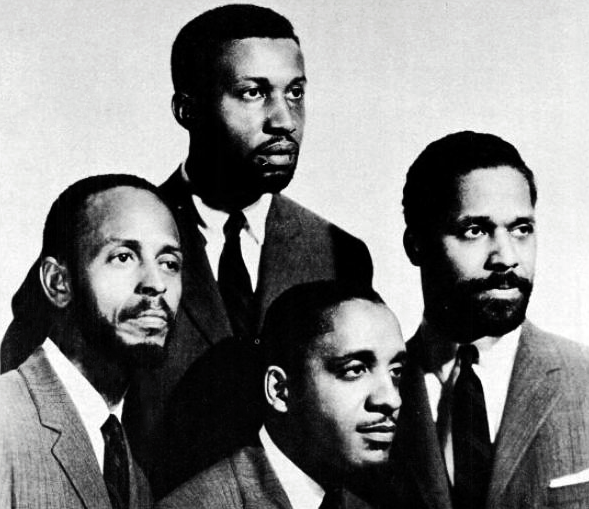
Even the look of the Modern Jazz Quartet was part of its argument, and worth a moment's attention in an age — ours and theirs — saturated with images. On their album covers and concert posters, in the photographs that fixed their public face, the four men appear exactly as they wished to be seen: composed, elegant, serious, dressed in immaculate evening clothes, carrying themselves with the gravity of classical artists rather than the forced geniality long demanded of Black entertainers. This visual self-presentation was continuous with everything else about the band. At a time when popular imagery of Black musicians still trafficked in caricature and condescension, the MJQ's calm, dignified, modernist self-portraiture was a quiet act of resistance, a claim staked in pictures as much as in sound. Atlantic Records, with its sophisticated design sense, framed the band as the serious art it was. To look at an image of the Modern Jazz Quartet is to see four men insisting, without a word, on their own full humanity and artistry — the same insistence that runs through the music. Sound and image spoke as one: this is serious art, made by serious men, who ask to be regarded as such. In 1960, that was no small thing to assert, and the band asserted it in every frame.
1959: the miraculous year
Pyramid was made at an extraordinary moment — for the years 1959 and 1960, when most of this record was recorded, are widely regarded as the single greatest flowering in the history of jazz, a concentration of masterpieces unmatched before or since. In 1959 alone the music produced Miles Davis's Kind of Blue, the serene modal masterpiece that would become the best-selling jazz album ever made; John Coltrane's Giant Steps, with its forbidding harmonic labyrinth; Dave Brubeck's Time Out, which taught jazz to swing in odd metres and gave the world 'Take Five'; Charles Mingus's turbulent, gospel-soaked Mingus Ah Um; and the New York arrival of Ornette Coleman with The Shape of Jazz to Come, the record that detonated the free-jazz revolution. Every one of these pushed in a different direction — modal, harmonic, metric, expressionist, free — and together they make 1959 a kind of big bang of modern jazz, a year in which a dozen possible futures for the music opened at once. The Modern Jazz Quartet made Pyramid in the thick of this ferment, and the album is its own distinct answer to the same question all these records were asking: where can jazz go now? The MJQ's reply — deeper into composition, counterpoint, and chamber-music refinement — was only one path among the many that opened that miraculous year. To hear Pyramid in the context of its astonishing moment is to hear one carefully chosen road taken at the greatest crossroads the music ever reached.
Composition and improvisation: the deepest question
At the heart of the Modern Jazz Quartet, and of Pyramid, lies the deepest aesthetic question jazz has to offer — the relationship between the written and the spontaneous, between composition and improvisation. This is jazz's unique and almost miraculous achievement: it is the one Western art in which composition happens in real time, in which the performer is also, in the moment of performance, the composer, inventing structured, coherent music on the spot. Most music traditions place composition and performance far apart — the composer writes, the performer realises. Jazz collapses the distance, asking the musician to create and execute at once, under the pressure of the passing second. The MJQ foregrounds this dialectic more consciously than almost any group in the music's history. In their work the two poles are held in deliberate, audible tension: Lewis's careful compositions and arrangements set the frame, and within that frame the players — above all Jackson — improvise freely, so that you are always hearing both the architect's plan and the spontaneous life that fills and tests it. The genius lies in the balance: enough structure to give the improvisation shape and meaning, enough freedom to keep the structure alive and unpredictable. Too much composition and jazz hardens into mere classical music; too much freedom and it dissolves into formlessness. The MJQ walks the wire between, and Pyramid is a sustained meditation on the question every bar of jazz quietly poses: how much should be planned, and how much should be discovered in the act? Their answer, poised and complete, is one of the most satisfying the music has given.
The standard, and the American songbook
Two of the six pieces on Pyramid — Ellington's It Don't Mean a Thing and How High the Moon — are what jazz musicians call standards, and the practice they represent is central to the art. A standard is a popular song, drawn from Broadway, Tin Pan Alley, Hollywood, or the great jazz composers, that has entered the common repertoire as a vehicle for improvisation: a familiar melody and, more importantly, a familiar harmonic structure that any group of musicians can take up and transform. The jazz tradition is built on this practice of creative re-imagining — of taking a well-known song and, through reharmonisation, rhythmic transformation, and improvisation, making it new, turning a three-minute popular tune into a vehicle for serious art. How High the Moon is a perfect example: a 1940 show tune whose chord changes became one of the favourite proving grounds of the bebop generation, the harmonic skeleton on which Charlie Parker built his 'Ornithology'. When the MJQ plays these standards, it participates in a great conversation stretching across the whole of jazz history — every musician who has ever played 'How High the Moon' is in dialogue with every other — and it demonstrates the alchemy at the music's core: the transformation of the commercial and the ephemeral into the lasting and the profound. The American popular song, in the hands of jazz, becomes raw material for an art its writers never imagined. Pyramid shows the MJQ taking the songbook and, with characteristic refinement, lifting it into the realm of chamber music.
Why a pyramid?
The album takes its name from a blues by the bassist Ray Brown, but the title resonates far beyond its source, and it is hard not to hear in it an emblem of the whole band's aesthetic. A pyramid is the most ancient and enduring of human structures — geometric, monumental, built of individual stones cut and fitted with absolute precision, rising through pure proportion to a single point, designed to stand for eternity. It is architecture in its most elemental and lasting form, and there could scarcely be a more fitting image for the music John Lewis built. For the MJQ's art is precisely an architecture of sound: pieces constructed from precisely fitted parts, raised through proportion and balance, aspiring to permanence rather than fashion, monumental in ambition while remaining clean and spare in line. The pyramid's union of the mathematical and the sublime — cold geometry producing overwhelming grandeur — mirrors exactly the union Lewis sought between strict form and deep feeling, between the calculated and the moving. And the pyramid's endurance speaks to what the band achieved: a body of work built to last, and lasting. Whether or not Ray Brown intended the metaphor when he named his blues, the title crowns the album perfectly — for Pyramid is, in sound, exactly what its name describes: a structure of fitted stones, raised with patience and precision, built to outlast its makers. More than sixty years on, it still stands.
How the critics heard them
The Modern Jazz Quartet has always divided opinion, and the argument it provoked is itself revealing. To many critics and listeners the band represented jazz at its most refined and dignified — proof that the music could achieve the seriousness and sophistication of the concert tradition, masters of taste and restraint whose every record rewarded close attention. To others, the same qualities looked like coldness: too cool, too composed, too academic, lacking the heat and abandon and risk that were, in their view, the soul of jazz; the tuxedos and the concert-hall manners struck these critics as a betrayal of the music's earthy, rebellious spirit, a domestication of something that should stay wild. This debate ran through the band's whole career and still echoes whenever the MJQ is discussed, and it is worth recognising that both sides are responding to something real. The MJQ genuinely did prize control, form, and refinement; whether you hear that as the music's elevation or its taming depends on what you believe jazz is fundamentally for. But the deepest listeners have always understood that the MJQ's restraint was not the absence of fire but its mastery — that the heat is everywhere in the music, banked and controlled, in Jackson's blue cry and the tension of every poised phrase. The band's coolness was a discipline imposed on a profound underlying heat, and to mistake the discipline for coldness is to miss the drama entirely. The argument over the MJQ is, in the end, an argument about the nature of jazz itself, and that the band could provoke it for half a century is a measure of how seriously it must be taken.
John Lewis, after
When the Modern Jazz Quartet finally wound down, John Lewis did not fade but continued, for four more decades, as one of the most dignified elder statesmen American music has known. He taught — passing his knowledge to younger musicians, holding academic posts, treating jazz with the scholarly seriousness he had always believed it deserved. He kept composing, pursuing the third-stream ideal and the fusion of jazz with the European tradition; in the 1980s he helped found and direct the American Jazz Orchestra, devoted to performing the great repertoire of jazz composition as a living concert tradition, much as a symphony orchestra performs the classical canon. And he returned, again and again, to the master who had shaped his whole vision, recording his own meditations on the preludes and fugues of Bach — closing the circle of a lifetime spent proving that jazz and the European tradition could be one music. He died in New York in 2001, in his eighties, having lived to see the jazz he loved finally and universally acknowledged as a great American art, in no small part through his own life's work. Lewis's career was a single sustained argument, pursued with quiet, unwavering conviction across sixty years: that this music was serious, that it deserved the concert hall and the conservatory and the respect of the world, and that a Black American art form could stand, without apology, beside Bach. Pyramid is one chapter of that argument, and the whole of his dignified life stands behind it.
The long shadow
The influence of the Modern Jazz Quartet runs wider and deeper than its modest, restrained surface might suggest, and it reaches places one might not expect. By proving that jazz could be genuine chamber music — composed, refined, intimate, built for the concert hall and the attentive ear — the MJQ opened a path that countless later musicians would follow. The whole subsequent tradition of 'chamber jazz', of jazz that prizes space, texture, careful composition and a cool, luminous restraint, descends in spirit from what Lewis and his colleagues built; the aesthetic of intimacy and refinement that would later define the celebrated European jazz of labels such as ECM — that distinctive sound of space, silence, and chamber-music poise so beloved by listeners of serious taste — has its clear ancestor in the example the MJQ set a generation earlier. The band also offered a model of artistic seriousness and professional dignity that helped change how jazz musicians saw themselves and how the world saw them, and a rare proof that a cooperative of equals could sustain great work across decades. Most of all, the MJQ enlarged the possible: it demonstrated, beyond argument, that jazz could carry the highest formal ambitions without losing its blues and its swing, that the cathedral and the church could share one roof. Every musician who has since tried to unite composition and improvisation, form and feeling, the European and the African-American, works in ground the Modern Jazz Quartet helped clear. Pyramid is a foundational document of that enduring achievement — quiet, immaculate, and far more influential than its gentle voice would ever claim.
Ray Brown, and the title blues
The album's title track is the work of a man who belongs to the band's deepest origins: the bassist Ray Brown, one of the greatest in the history of the instrument and a comrade of the MJQ men from the founding days. Brown had played alongside Lewis, Jackson and Clarke in Dizzy Gillespie's epochal 1946 big band — he was, in fact, the bassist in that very rhythm section from which the MJQ grew, before Percy Heath took the chair — and he went on to a towering career: for years the anchor of the Oscar Peterson Trio, a model of impeccable time, enormous woody tone, and unfailing taste, the bassist other bassists studied. For a time he was married to Ella Fitzgerald. That it should be Ray Brown's blues, 'Pyramid' (also known as 'Blues for Junior'), which gives this album its name and its bluesy ballast is fitting on every level: it ties the record back to the Gillespie crucible where it all began, and it ensures that the twelve-bar blues — the bedrock under all the band's sophistication — sits at the album's very centre, composed by one of the supreme blues bassists of the age. The architecture rises, but it rises from the blues, and Ray Brown laid that particular cornerstone.
Connie Kay's other life
The drummer Connie Kay's exquisite restraint within the MJQ can make one forget what a versatile and widely-employed musician he was outside it, and one connection in particular will startle listeners who think of him only in evening dress. Kay was a much-in-demand session drummer who played on countless rhythm-and-blues dates, including for Atlantic's great singers, lending his impeccable time and taste to music far removed from chamber jazz. And in 1968 he sat behind the drums for one of the most revered albums in all of popular music: Van Morrison's Astral Weeks, that hushed, jazz-inflected, improvisatory masterpiece, whose sublime, floating rhythmic feel owes much to Kay's sensitive, breathing, jazz-trained touch. There is something wonderful in the thought that the same drummer whose finger-cymbals shimmer through Pyramid also laid down the supple pulse beneath Van Morrison's visions — that the discipline and subtlety he perfected in the MJQ could serve so completely different a music. It is a reminder that these were complete, adaptable musicians, masters of their instruments in any setting, and that the restraint Kay practised in the quartet was a deliberate artistic choice by a player who could do anything. The lightest touch in jazz was also, when the music called for it, one of the most quietly influential in rock.
The meaning of cool
The word that hovers over this band and its era — cool — deserves to be understood not merely as a musical style but as a cultural philosophy with deep roots in African-American experience. Long before it named a kind of jazz, 'cool' described a way of being: emotional control, detachment, grace under pressure, the maintenance of dignity and composure in a world designed to provoke and humiliate. Some scholars trace the aesthetic to West African ideals of character and composure; in the American context it became a survival philosophy and a form of resistance — the refusal to give one's oppressor the satisfaction of seeing one rattled, the assertion of an inner mastery that no external indignity could touch. Cool was dignity weaponised as style. When this sensibility flowed into jazz at mid-century — in the feathery detachment of Lester Young, in Birth of the Cool, in the whole movement the word named — it brought that cultural depth with it. The Modern Jazz Quartet is perhaps the purest musical embodiment of cool in this fuller sense: not merely a relaxed or understated style, but an aesthetic of self-possession, of dignity through restraint, of profound feeling held under perfect control. The band's composure was cool as a Black American philosophy made audible — grace under pressure rendered in sound. To hear Pyramid as merely 'laid-back' is to miss this entirely; its coolness is the coolness of mastery and dignity, a cultural inheritance as much as a musical one.
The working life
For all its concert-hall dignity, the Modern Jazz Quartet was a working band in a hard profession, and it is worth remembering the labour behind the elegance. The life of the jazz musician in this era was one of relentless touring — endless nights on the road, long drives between cities, the grind of clubs and concert halls, modest pay for music of the highest art. The MJQ's particular status gave its members more security and dignity than most: their concert-hall bookings, their European tours, their steady recording for Atlantic, and the cooperative's shared structure made theirs a more stable and respected working life than that of musicians scrambling from gig to gig. But it remained a demanding existence, sustained by discipline and professionalism — the punctuality, the rehearsal, the immaculate presentation that were themselves a kind of labour. And for Black American musicians, the road carried its own burdens, the indignities of segregation shadowing even the most celebrated artists as they travelled. That the MJQ maintained its standard of refinement and consistency across more than two decades of this life is a testament not only to its art but to the sheer professional dedication of its four members. The serenity of the music conceals the discipline and the grind that produced it. Pyramid sounds effortless; it was not. Behind every poised phrase lies the working life of four master craftsmen, on the road, holding their art to an exacting standard night after night.
Pyramid in the discography
To place Pyramid rightly, it helps to see it within the Modern Jazz Quartet's remarkable body of recordings, for the band left a deep and consistent catalogue across its long life. The story begins on the Prestige label in the early 1950s — where the original quartet first recorded 'Django' — and reaches its great maturity in the Atlantic years, the period of this album. There the band made a series of distinguished records: Fontessa (1956), with its commedia-dell'arte-inspired suite; the film music of No Sun in Venice (1957); the live European Concert (1960), capturing the band's electricity before an audience; and Lonely Woman (1962), whose title track — a tender reading of an Ornette Coleman composition — shows once again Lewis's openness to the avant-garde. Within this rich discography, Pyramid (1960) holds a particular place as one of the most balanced and representative statements of the band's mature art: it gathers the fugue, the blues, the elegy, and the transformed standard into a single satisfying programme, a kind of compact summation of everything the MJQ did. It is not the band's only masterpiece, but it is among its most perfectly proportioned — an ideal entry point to the MJQ's world and a record that rewards a lifetime of return. Set among its companions, Pyramid reveals itself as a keystone in one of the most consistent and dignified catalogues in all of jazz.
Percy Heath, and a family of music
The bassist Percy Heath came from one of the most remarkable musical families in American history, and the fact deepens the human texture behind this record. He was the eldest of three brothers from Philadelphia who would each become significant figures in jazz: Percy on bass; Jimmy Heath, the distinguished saxophonist, composer and arranger, one of the most respected musical minds of his generation; and Albert 'Tootie' Heath, a fine drummer who played with many of the music's greats. Three brothers, three jazz masters — a concentration of talent in a single family that has few parallels. In later years, after the MJQ, Percy would join Jimmy and Tootie in the Heath Brothers band, bringing the family's music full circle. That the MJQ's deep, dependable bassist was a member of such a dynasty reminds us that jazz, for all its individual genius, was also a profoundly communal and familial art, transmitted through families and neighbourhoods and communities, the Black cultural institutions that nurtured generation after generation of musicians. Percy Heath's rock-solid foundation under the MJQ's elaborate architecture was the work of a man raised in music, surrounded by it, carrying a family tradition. Behind the four men in tuxedos lie whole communities, whole families, whole histories of music passed from hand to hand — and the Heaths are among the most distinguished of them all.
What to listen for
For the listener returning to Pyramid with fresh ears, it is worth knowing where the deepest pleasures lie. In Vendome, follow the single theme as it passes from piano to vibraphone and back, each voice entering in imitation of the last, and marvel that a genuine baroque fugue can swing — listen for the moment the strict counterpoint and the jazz pulse become one. In the title blues, attend to Milt Jackson: the way he bends and delays his notes, leaning behind the beat, wringing a vocal, gospel cry from the cold metal bars, the blues made audible in the most unlikely voice. In Django, surrender to the slow descending dirge of the opening, one of the most dignified expressions of grief in all of jazz, and notice how its shadow lingers over everything that follows, the recurring bass figure tolling beneath the solos like a distant bell. Throughout, listen to what the rhythm section does not do — to Connie Kay's barely-there shimmer of cymbal and bell, the orchestral delicacy of his colours, and to the open space around Percy Heath's deep, perfectly placed bass notes, the silence the band trusts. And above all, listen to the dynamics: how often the music drops to a hush that pulls you in, how rarely it shouts, how much it achieves by withholding. Pyramid rewards exactly the kind of attention it was built to receive — close, quiet, and patient. Give it that, and a record that can seem merely pleasant on a first pass opens into something inexhaustible.
Holding the line in the 1960s
As the 1960s unfolded and the jazz world convulsed — Coltrane reaching toward ecstatic free expression, Ornette Coleman and the avant-garde dismantling harmony and form, and the decade's end bringing the electric storm of fusion — the Modern Jazz Quartet did something quietly remarkable: it held its line. While much of the music raced toward ever greater freedom, volume, and abstraction, the MJQ continued to make its composed, refined, acoustic chamber jazz, neither chasing the avant-garde nor calcifying into nostalgia. This was not mere conservatism; it was a principled persistence, a faith that the band's particular synthesis of form and feeling remained worth pursuing whatever the fashion. And the MJQ was never closed to the new — its recording of Ornette Coleman's 'Lonely Woman' shows a band engaging thoughtfully with the very revolution it declined to join, and Lewis's championing of Coleman proves how seriously these supposedly conservative musicians took the music's radical edge. By keeping faith with its chamber ideal through a decade of upheaval, the MJQ preserved a strand of the music that might otherwise have been swept away — a reminder that restraint, refinement, and composed beauty had a permanent place in jazz, whatever else was happening. In an age of revolution, the band's steadiness was its own kind of integrity. Pyramid, made just before the storm, captures the ideal the MJQ would go on to defend through all the years of change.
America's classical music
Behind the whole project of the Modern Jazz Quartet lies a claim that has grown only more widely accepted in the decades since: that jazz is America's classical music — the indigenous art music of the United States, the nation's most original and significant contribution to the world's musical culture, an achievement to stand beside the symphonies of Europe. In the 1950s this claim was still radical; jazz was widely regarded, even by the cultured, as entertainment, dance music, or worse, and the idea that it belonged in the concert hall and the conservatory was contested ground. The MJQ was among the most persuasive arguments for the higher view. By bringing to jazz the disciplines of composition and counterpoint, by demanding the concert hall and the listening silence, by carrying themselves as the serious artists they were, Lewis and his colleagues made the case not through manifesto but through the sheer quality and seriousness of the music itself. Here, plainly, was art of the highest order, as worthy of study and reverence as any. That jazz is now taught in universities, performed in the great halls, and honoured as a classical tradition — that it has won, in short, the recognition the MJQ insisted it deserved — is in part the legacy of bands like this one, which simply refused to be anything less than serious. Pyramid is a small monument in that long campaign for recognition: a record that asks, quietly and confidently, to be heard as the classical music of its nation, because that is what it is.
The sound of the record
Part of why Pyramid remains such a pleasure to hear, more than sixty years on, is simply how good it sounds — and that is the achievement of Atlantic Records' approach to recording and of the engineer Tom Dowd in particular. These were the early years of stereo and high fidelity, when the technology of capturing sound was advancing rapidly, and Atlantic was at the forefront. Dowd, with his scientist's precision and his pioneering command of multitrack tape and the mixing console, made Atlantic's recordings cleaner, warmer, and more spacious than almost anything else in the industry — and the MJQ's transparent chamber textures were the perfect music to reward such care. Listen to Pyramid on a good system and you hear the result: the shimmering bloom and slow decay of the vibraphone hanging in the air, the deep woody resonance of Percy Heath's bass, the delicate metallic colours of Connie Kay's cymbals and bells caught in all their subtlety, the clean separation that lets every strand of Lewis's counterpoint be followed. The recording has air and depth and warmth; it places the four musicians before you in a believable space. For a band whose art depended on transparency, intimacy, and the smallest dynamic shadings, this quality of recording was not a luxury but a necessity — and Atlantic provided it. A great deal of the record's enduring sensual pleasure is the gift of engineers and a label who believed that jazz deserved to be captured with the same loving precision as any masterpiece, and who had the skill to do it.
The church in the music
For all the talk of Bach and the cathedral, there is another house of worship sounding through this music, and it is the Black American church. Beneath the blues that forms the bedrock of jazz lies the gospel shout and the spiritual, the sacred song of a people, and that sacred undertow runs deep in the MJQ's art — most of all through Milt Jackson, raised in the Detroit church, who carried its rhythms and its fervour in his hands all his life. When Jackson bends a blue note on the vibraphone, when his phrases lean and cry, you are hearing the inflection of the gospel singer, the sanctified rhythm of the storefront congregation, the deep well of sacred feeling from which so much of African-American music springs. The blues and the spiritual are two branches of one root, the secular and the sacred forever intertwined in this tradition, and the MJQ, for all its concert-hall composure, never lost touch with that source. There is a sense in which the band's whole achievement can be heard as the meeting of two sacred traditions — the European sacred music that culminated in Bach, and the African-American sacred music of the spiritual and the gospel shout — brought together in a single art. The cathedral and the church, once more: but both, in the end, are houses of the spirit, and the music that joins them carries a reverence that is unmistakable. Pyramid is poised and cool, but it is not without soul; the church is always there, in the cry of the blues at its heart.
The voice of two keyboards
The signature sound of the Modern Jazz Quartet — the thing that makes it instantly recognisable and unlike any other group in jazz — is the intimate interweaving of its two melodic voices: Milt Jackson's vibraphone and John Lewis's piano. Here are two instruments of strangely kindred nature, both struck rather than bowed or blown, both ringing in a similar register, both capable of both melody and harmony, and the MJQ built its whole texture on their dialogue. The two keyboards chase and answer each other, trade phrases, weave independent lines into shimmering counterpoint, lock into delicate unisons and part again — a conversation between equals that is the very heart of the band's chamber-music conception. The vibraphone brings its cool, sustained, bell-like glow; the piano brings its precise, percussive clarity and its harmonic command; and where they meet, in the open, transparent space the rhythm section leaves them, the MJQ's unmistakable sound is born. It is a texture no other instrumentation could produce, and it embodies the band's deepest principle — the equality of voices, the democracy of the conversation, the refusal of the usual hierarchy of soloist and accompanist. On Pyramid this dialogue of two keyboards is everywhere, from the fugal chase of Vendome to the tender exchanges that thread through every piece. Learn to hear it — the constant, intricate, civilised conversation between vibraphone and piano — and you have found the soul of the Modern Jazz Quartet, the sound that four men spent a lifetime perfecting.
Why the quiet lasts
There is a particular kind of recording that gives itself up all at once, dazzles on first hearing, and then has little left to offer; and there is another, rarer kind that seems modest at first and then deepens with every return, revealing more the longer you live with it. Pyramid is emphatically of the second kind. Its pleasures are not the obvious ones of virtuoso display or emotional spectacle; they are the quiet pleasures of balance, proportion, conversation, and the perfectly chosen note, and these are pleasures that do not exhaust themselves. Play the record once and it is lovely, civilised, a little cool. Play it for years and it becomes inexhaustible — you begin to hear the subtlety of Connie Kay's shadings, the rightness of every one of Percy Heath's notes, the intricacy of the dialogue between Jackson and Lewis, the way the tension between order and feeling is held in such perfect suspension that it never resolves and never tires. This is the reward of an art built on restraint and depth rather than surface: it gives back in proportion to the attention you bring, and it never runs dry. For the listener who returns to it across a lifetime, Pyramid becomes not a record one has heard but a record one is always still hearing — a companion that deepens as you deepen, a small, perfect structure of sound that, like the monument it is named for, only seems to grow more impressive the longer it stands. The quiet lasts because there is no end to what patient listening finds in it. That is the mark of the greatest art, and this unassuming masterpiece quietly possesses it.
A portrait of a partnership
At the centre of the Modern Jazz Quartet's long life stood a partnership between two very different men — John Lewis and Milt Jackson — and the human story of that relationship is, in miniature, the story of the band itself. They had come up together through Gillespie's band; they shared a quartet, a livelihood, and a stage for the better part of forty years; and they were, in temperament and musical instinct, almost opposites. Lewis was reserved, cerebral, drawn to form and the long composed line, an intellectual who loved Bach and prized control. Jackson was warm, spontaneous, a creature of the blues and the moment, a player whose deepest impulse was to blow free and hot. Within the band, Lewis's vision largely prevailed — it was he who imposed the tuxedos, the concert-hall discipline, the chamber-music restraint — and there is no doubt that Jackson sometimes chafed under a frame that channelled and contained his natural fire; his eventual departure in 1974, driven partly by money and partly, surely, by the long restraint, speaks to a real tension that ran beneath the band's serene surface. And yet the partnership held for decades, and produced some of the most enduring music in jazz, because each man needed exactly what the other supplied: Jackson's blues gave Lewis's structures their soul, and Lewis's structures gave Jackson's genius a shape and a setting it could never have built alone. Theirs was the productive friction of two great talents who completed each other precisely by differing — a marriage of opposites that, like the best such marriages, was sometimes strained and never dull and ultimately irreplaceable. When you listen to Pyramid, you are hearing that partnership at its height: two men who saw music differently, bound together in a single art, each making the other greater than he could have been alone. The whole band is the sound of that improbable, fruitful, lifelong union — order and ecstasy, cathedral and church, Lewis and Jackson, needing each other to the end.
The cathedral and the church
In the end, everything about Pyramid returns to the single creative tension that gave the Modern Jazz Quartet its life: the meeting of the cathedral and the church — of John Lewis's cool, architectural, Bach-haunted formalism and Milt Jackson's hot, blues-drenched, gospel-rooted soul. These were two visions of what jazz could be, two halves of the African-American musical inheritance, the European-trained ambition and the deep folk feeling, and a lesser band would have had to choose between them. The genius of the MJQ was to refuse the choice and instead make the tension its very subject, holding order and ecstasy, structure and freedom, the fugue and the blues in a perfect, unresolved, endlessly fruitful balance. The cathedral gives the church its form; the church gives the cathedral its soul. Neither wins, and in that suspended equilibrium lies the music's inexhaustible life. This is why Pyramid never tires and never dates: it is not a style but a balance, a civilised argument between the two deepest impulses in the music, conducted at the highest level by four masters who needed each other completely. Listen to it once and it is lovely; listen to it for years and it becomes a meditation on how the calculated and the felt, the planned and the discovered, the mind and the heart, can be reconciled without either surrendering. Four men, in evening dress, building a cathedral that never forgets the church — that is the Modern Jazz Quartet, and Pyramid is one of its most perfect and enduring testaments.
Reception, legacy — and a night in Slovenia
By 1960 the Modern Jazz Quartet was, as Scott Yanow later wrote for AllMusic, 'a jazz institution' — and yet, he added, 'they never lost their creative edge,' and the Pyramid performances remain 'stimulating, enthusiastic, and fresh.' Critics have long counted it among the Quartet's finest single albums, and its "Django" is frequently named the definitive recording of the group's signature piece. The record sold, the band toured the world's concert halls, and the MJQ went on — through Jackson's departure in 1974, a reunion in 1981, and a final disbanding in 1997 — to become one of the most enduring and beloved ensembles in jazz history. Jackson died in 1999, Lewis in 2001, Heath in 2005; Connie Kay had gone in 1994.
There is a detail in that history that I cannot resist, because it brings this cosmopolitan American music startlingly close to home. In the very year of Pyramid, on their 1960 European tour, the Modern Jazz Quartet played in Slovenia — a concert later issued, in Connie Kay's memory, as Dedicated to Connie (1995). Picture it: these four impeccably dressed Americans, carrying their fugues and their blues across the Iron Curtain, walking out before a Yugoslav audience to play "Django" in a hall not far from where I am writing this. The MJQ's whole project was the claim that this music belonged in the world's concert halls, equal to any. That it reached ours, in 1960, is proof that the claim was true.
Twenty-two years, Europe, and a night in Yugoslavia
What the Modern Jazz Quartet achieved after Pyramid is, in its own way, as remarkable as the music itself: an almost unheard-of constancy. From the settling of its membership in 1955 until its disbanding in 1974, the same four men — Lewis, Jackson, Heath, Kay — played together for nearly two decades, a stability all but unknown in jazz, a music notorious for its restless reshuffling of personnel. They rehearsed meticulously, dressed immaculately, arrived on time, and conducted themselves with a professionalism that was itself part of their argument. They became, by a wide margin, the most commercially successful and enduring small group in the history of the music, and they did it without ever compromising the chamber ideal or raising their voices.
Europe embraced them with particular warmth. On a continent that had long been readier than America to treat jazz as a serious art — to seat it in concert halls and write about it as one writes about composers — the MJQ found audiences perfectly attuned to their decorum and their refinement, and they toured the continent again and again. And here the story touches home. In 1960, the very period of this record, the Modern Jazz Quartet travelled behind what was then called the Iron Curtain to play in socialist Yugoslavia — including in Slovenia — part of the extraordinary postwar opening through which American jazz reached Eastern Europe. In those years jazz was a kind of cultural diplomacy and a quiet emblem of freedom; Willis Conover's Jazz Hour on the Voice of America was devoured by listeners across the socialist world, and a visit by a band of the MJQ's stature was a genuine event. That four impeccably dressed Black Americans, playing fugues and blues in evening dress, should have appeared on a Slovenian stage in 1960 is a small marvel of the period — a thread connecting this music directly to the soil where you sit listening to it now.
The band finally broke up in 1974, when Milt Jackson, feeling the cooperative had capped what he could earn, struck out on his own; but the pull of what they made together proved too strong, and they reunited in 1981 and played on into the 1990s, until age and death at last dissolved them — Jackson in 1999, Lewis in 2001, Heath in 2005. What they leave behind is a proof of concept that has never been bettered: that jazz could be chamber music; that improvisation and composition, the blues and the fugue, ecstasy and order, could be held in perfect, civilised balance by four men in tuxedos; and that to do so, in their time and place, was not merely beautiful but quietly, permanently brave. Pyramid is one of the most perfect surviving photographs of that achievement — forty minutes in which a great American argument is conducted entirely in music, and resolved, for the length of the record, into grace.
| Year | Album | Label | Note |
|---|---|---|---|
| 1953–55 | Django | Prestige | Early sides; the first "Django" and "Vendome". |
| 1956 | Fontessa | Atlantic | First Atlantic album; Lewis's chamber-jazz manifesto. |
| 1957 | One Never Knows (No Sun in Venice) | Atlantic | Lewis's film score for Roger Vadim. |
| 1959 | The Modern Jazz Quartet at Music Inn, Vol. 2 | Atlantic | With guest Sonny Rollins. |
| 1960 | Pyramid | Atlantic 1325 | The present album: fugue, blues and balance. |
| 1960 | European Concert | Atlantic | Landmark live double from the 1960 tour. |
| 1960 | Third Stream Music | Atlantic | Jazz meets the classical, with Gunther Schuller. |
| 1962 | Lonely Woman | Atlantic | Includes their reading of Ornette Coleman. |
| 1995 | Dedicated to Connie | Atlantic | A 1960 concert in Slovenia, issued in Kay's memory. |
Why it still matters
We are taught to think of jazz history as a series of revolutions — bebop overthrowing swing, free jazz overthrowing bebop — a music forever breaking its own forms. The Modern Jazz Quartet offers a quieter, almost contrary lesson, and Pyramid is its clearest text: that discipline can be its own kind of freedom, that restraint can be a vessel for the deepest feeling, that the blues loses nothing by learning to wear a fugue.
What I keep returning to is the integrity of the thing. Four men decided, against the grain of their art and their era, that jazz deserved the concert hall, the silent attention, the formal seriousness of the European tradition — and then they earned it, night after night, without ever letting the seriousness kill the swing. Pyramid is thirty-six minutes of that earned dignity. Put on "Django" and listen to how Milt Jackson's vibraphone sings the melody as if it might break, and how John Lewis's frame holds it so that it doesn't. That is the whole secret of this band: not coolness, not politeness, but a faith that form and feeling, intellect and the blues, the temple and the fire, are finally the same thing. Sixty years later it still sounds like the truth.
Pyramid remains one of the clearest proofs that jazz could speak the syntax of chamber music without losing its pulse — three-quarters of an hour in which discipline and the blues turn out to be the same thing.
A note when a new essay or travelogue appears. No noise, unsubscribe in one click.