Raphael Pichon and Pygmalion read Monteverdi's 1610 Vespers as sacred theatre: a mosaic of psalm, motet and Magnificat caught between the old polyphony and the new dramatic style.
For me, the Vespers are the first cinematographic work in the history of music. Monteverdi's dramatic genius is such that each psalm presents itself as a true scene of theatrical action. He sets a stage, and lets us feel, sense, visualise, even touch.Raphaël Pichon, in conversation with Jean-Clément Guez, liner notes to this recording (harmonia mundi, 2023)
A threshold, sung
There is a particular kind of recording that makes me put down whatever I am holding and simply sit. Raphaël Pichon's account of Monteverdi's Vespro della Beata Vergine — taped in January 2022 in the warm, candle-coloured acoustic of the Temple du Saint-Esprit in Paris and released by harmonia mundi in the late summer of 2023 — is one of them. I have lived with the Vespers of 1610 for most of my adult life, in versions stern and scholarly and versions plush and choral, and I came to this one expecting to admire it from a polite distance. Instead it took me by the collar.
What Pichon and his ensemble Pygmalion understand, and what they make audible from the very first bar, is that this music stands on a threshold — between the old world and the new, between the polyphonic cathedral of the Renaissance and the lit, gesturing stage of the Baroque, between liturgy and theatre. The opening Deus in adjutorium does not begin so much as detonate: a single, unchanging chord of D major, held and re-struck while the choir intones the call to prayer over a fanfare lifted, note for note, from the toccata that opens his own opera Orfeo of three years before. One critic put it exactly right — that blaze of unchanging harmony announces, just as clearly as anything in Orfeo, that the musical world had changed. You are not eased into the seventeenth century. You are thrown across its threshold.
This essay is an attempt to stand on that threshold for a while: to understand what Monteverdi actually published in 1610, why a court composer in provincial Mantua should have assembled so strange and so dazzling a book, what the music is about beyond its astonishing notes — and why, four centuries later, a French conductor and his young singers can make it feel less like a museum piece than like a letter addressed, somehow, to us.
The fanfare from the opera house
Consider, before going further, the single most audacious gesture in the whole collection — the way it begins. Vespers opens, by rite, with the versicle Deus in adjutorium meum intende ('O God, come to my assistance') and its response Domine ad adiuvandum me festina ('O Lord, make haste to help me'). A composer of the old school would have set this as a modest chant intonation. Monteverdi sets it as a blaze of sound — the full choir chanting the words in solemn falsobordone while beneath and around them the instruments erupt in a brilliant, festive fanfare.
And here is the detail that says everything about this music and its moment. That fanfare is not new. It is, note for note, the Toccata that opens L'Orfeo — the same brass-bright flourish that Monteverdi had written to summon the audience to his opera three years before, the curtain-raiser of the secular theatre, now transplanted whole onto the threshold of the sacred Office. The most worldly music imaginable — a fanfare to begin a night at the opera — becomes the call to evening prayer. Nothing could announce more nakedly what the Vespers are about: the collapse of the wall between sacred and secular, the new theatrical magnificence carried bodily into the church, the opera house and the basilica revealed as one continuous architecture of wonder. With its very first sound the collection declares that the language of Orfeo and the language of worship are the same language, and that the God of these Vespers is to be approached not with timid plainsong but with the full, blazing apparatus of the new music. It is, in the most literal sense, a curtain rising — and four centuries later it still lifts the hair on the neck.
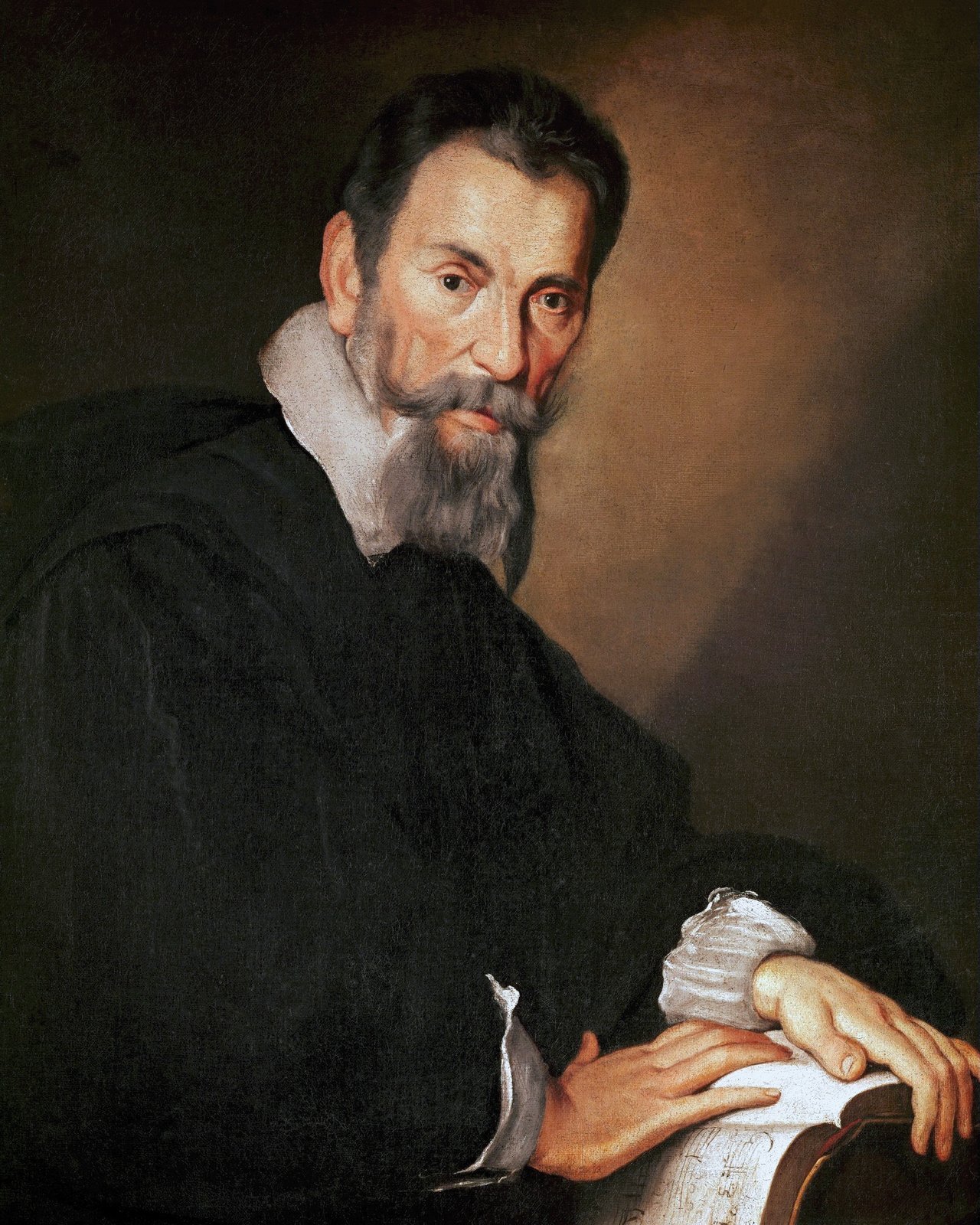
The composer made flesh
It is easy to let the word Monteverdi harden into a monument. Better to recover the man who actually wrote this book: a Cremonese barber-surgeon's son, baptised in May 1567, who arrived at the court of Mantua around 1590 as a junior string player — a suonatore di vivuola — and clawed his way up to maestro della musica by 1602. By the time the Vespers went to press he was in his early forties, famous, exhausted and bitterly underpaid.
The years around 1610 were the cruellest and most fertile of his life. In February 1607 his L'Orfeo had been staged in the ducal palace — the first opera that anyone still performs, a work that proved the new dramatic recitative could carry a whole evening. A year later, at the Gonzaga–Savoy wedding festivities of 1608, he produced L'Arianna, whose lament reduced the court to tears and of which almost nothing else survives. And between these triumphs, in the spring of 1607, his young wife Claudia Cattaneo died, leaving him with small children and a grief he never fully described. He had buried a wife and written the most celebrated theatrical music in Italy within a single year, and still the Gonzaga treasury paid him late, or not at all. His letters from this period are a master-class in wounded professional dignity — the complaints of a genius forced to beg for his salary.
He was also, by 1610, a marked man. Five years earlier the Bolognese theorist Giovanni Maria Artusi had publicly flayed Monteverdi's madrigals for their 'crudities' — unprepared dissonances, rule-breaking part-writing — and Monteverdi had answered, through the mouth of his brother Giulio Cesare, with the famous manifesto of the seconda prattica: the claim that in the new music the words are the mistress of the harmony, not its servant. To set sacred Latin in 1610, in a book dedicated to the Pope, was among other things a way of proving that the scandalous modernist could also command the most learned, most orthodox styles of the Church. The Vespers are, in part, a calling card written by a man who needed one.
Cremona: a barber-surgeon's son and the old polyphony
To grasp why the 1610 Vespers matter we must first follow the man who made them out of the obscure beginnings he never quite escaped. Claudio Monteverdi was baptised in Cremona on 15 May 1567 — the birth date itself is lost — the eldest son of Baldassare Monteverdi, a barber-surgeon and apothecary, a healer of modest standing in a Lombard cathedral town then under Spanish Habsburg rule. It was not a musical household, and there was no court behind him; everything Monteverdi became he built from a provincial choirboy's training and a ferocious, restless intelligence.
That training came from Marc'Antonio Ingegneri, maestro di cappella at Cremona Cathedral, a serious composer of madrigals and sacred music in the high Franco-Flemish tradition descended from Josquin, Willaert and Cipriano de Rore. Under Ingegneri the boy absorbed the prima prattica — the strict, learned art of Renaissance counterpoint in which every dissonance is prepared and resolved, in which the music is a perfect, impersonal architecture of interlocking voices and the words are, frankly, a pretext. Monteverdi mastered it utterly, and he would defend it to the end of his life even as he spent that life dismantling it. The point cannot be overstated: the man who would be accused of barbarism, of breaking the rules, knew the rules better than his accusers. He was no naïf storming the citadel from outside. He was the citadel's most gifted son, and he turned on it from within.
The prodigy published early and relentlessly. His Sacrae cantiunculae, little three-voice motets, appeared in 1582, when he was fifteen; a book of Madrigali spirituali followed in 1583, canzonette in 1584. Then came the work that would carry his name into history: the books of madrigals, secular songs for unaccompanied voices on poems of love and longing, in which Monteverdi conducted his slow, deliberate revolution. The First Book appeared in 1587, the Second in 1590, the Third in 1592 — each more daring than the last in its willingness to bend the old counterpoint toward the meaning of the words, to let a harsh syllable sound a harsh chord.
Mantua: the string player at the gilded court
Around 1590 or 1591, his Third Book under his arm, Monteverdi left Cremona for the one place a Lombard musician might rise: the court of the Gonzaga dukes at Mantua, one of the most brilliant and spendthrift small states in Italy. He was hired not as a singer or composer but as a humble suonatore di vivuola — a player of the viol and the violin, a hired instrumentalist near the bottom of the ducal music establishment, which was then directed by the formidable Fleming Giaches de Wert and, after him, Benedetto Pallavicino. For years Monteverdi played in the band, composed when he could, and chafed at his subordinate place.
His duke, Vincenzo I Gonzaga, was a Renaissance prince of the most extravagant kind — a patron of Tasso and, soon, of Rubens; a lover of music, theatre, alchemy and war; a spender on a heroic scale who left his duchy magnificent and broke. Vincenzo dragged his household across Europe in pursuit of glory, and Monteverdi went with him: in 1595 on the Duke's military campaign against the Ottoman Turks in Hungary, a brutal expedition into the Balkan war; and in 1599 to Flanders and the spa town of Spa, where the composer is thought to have encountered the new French musique mesurée and other foreign currents that fed his art. A court musician in this age was a servant who went where his master went, and Monteverdi saw more of war and the world than most composers ever would.
In 1599 he married Claudia Cattaneo, a singer at the court and the daughter of a court instrumentalist — a love match within the small, intense world of ducal musicians. They would have three children. And in 1601, on the death of Pallavicino, Monteverdi at last achieved the post he had wanted for a decade: maestro di cappella to the Duke of Mantua, master of all the court's music, sacred and secular. He was thirty-four, and the great storm of his career was about to break — not over the throne, but over a single chord.
The war over a chord: Artusi, and the second practice
In the year 1600 — the conventional dawn of the Baroque — a learned and conservative Bolognese theorist named Giovanni Maria Artusi published a dialogue with the damning title L'Artusi, overo Delle imperfettioni della moderna musica: 'Artusi, or, On the imperfections of modern music.' In it he quoted, to hold them up for ridicule, passages from madrigals he had heard but could not name — madrigals, it turned out, by Monteverdi, not yet published. Artusi was appalled. The young composer broke the sacred rules: he let dissonances enter unprepared, sounded clashing intervals without the careful approach and resolution that a thousand years of counterpoint demanded, treated the listener's ear to harshness where the law required sweetness. It was, to Artusi, simply error — ignorance dressed as novelty, the decay of a perfect art.
The most notorious exhibit was a madrigal called "Cruda Amarilli" — 'Cruel Amaryllis' — on a text of Guarini, in which the cruelty of the beloved is painted by a dissonance that stabs in without preparation, exactly as cruelty stabs. To Artusi it was a blunder. To Monteverdi it was the entire point. The clash was not a mistake to be corrected but an expressive necessity, a wound made audible, the word made flesh in sound. Two whole conceptions of what music is for stood face to face: music as autonomous, perfect, rule-governed beauty, versus music as the servant of human meaning, licensed to break any rule if the breaking tells the truth of the words.
"The text shall be the mistress, not the servant"
Monteverdi let the attack sit for years, then answered it not with a treatise but with a brief, electric note printed in the foreword to his Fifth Book of Madrigals in 1605. He had not erred, he said; he had composed according to a seconda prattica — a 'second practice' — distinct from the prima prattica of the old masters, and he promised a full treatise to explain it. (The treatise, to be called Seconda pratica, overo Perfettione della moderna musica, he tinkered with for the rest of his life and never finished — one of the great unwritten books of music.) Two years later his brother Giulio Cesare Monteverdi elaborated the doctrine in a 'Declaration' appended to the Scherzi musicali of 1607, and there the manifesto received its imperishable formula. In the first practice, the music is the master and the words its servant; in the second practice, the relation is reversed — l'oratione sia padrona del armonia e non serva, 'let the text be the mistress of the harmony and not its servant.'
That single sentence is one of the hinges of Western music. It announces, in plain words, the shift from the Renaissance to the Baroque: from a polyphony of interwoven equal voices serving an abstract perfection, to a music bent wholly toward expression, toward rhetoric, toward moving the affections of the listener — the music of monody and recitative and the solo aria, of opera and the dramatic motet, of everything that would follow for the next two centuries. Monteverdi did not abolish the old practice; he was emphatic that he honoured and could still write it. He simply claimed the freedom to set it aside when the words demanded, and to be judged by a different law when he did.
This is the indispensable key to the Vespers of 1610, and the reason this quarrel belongs in their story. For the 1610 print is, deliberately and provocatively, a demonstration of both practices at once: alongside the Vespers, Monteverdi published a strict, archaic, flawless six-voice Mass in the stile antico, built by the old contrapuntal rules on themes borrowed from a Gombert motet — the prima prattica in its purest form — and set it beside the wildly modern, virtuosic, dissonance-rich Vespers, the seconda prattica in full flight. The message to any patron who opened the book was unmistakable: I am master of the old and the new; I can out-Palestrina the conservatives and out-modernise the moderns, and here is the proof, bound together. The 1610 collection is not merely a setting of Vespers. It is a job application from the most versatile musician alive, written in the language of the great aesthetic war of the age.
Let the text be the mistress of the harmony, and not its servant.
Orfeo: the invention of an art form
The seconda prattica was not only a theory of dissonance; it was the seed of an entire new art, and in the same Mantuan years Monteverdi brought that art to its first full flower. During the Carnival of 1607, in a room of the Gonzaga palace, before the gentlemen of the Accademia degli Invaghiti, he presented L'Orfeo, favola in musica — a 'fable in music' on a libretto by Alessandro Striggio the younger, telling the myth of Orpheus, who sang so beautifully that he charmed death itself. It was not the first attempt at the new form the Florentines had been calling dramma per musica — Peri and Caccini had made experiments in Florence a few years before — but it was the first undeniable masterpiece, the work in which the infant genre of opera suddenly stood up and walked.
What Monteverdi grasped, as his predecessors had not, was that the new style of solo declamation — the stile recitativo, a single voice singing speech-like over a sustained bass — could carry not just words but drama: character, change, the whole arc of a human soul under pressure. When Orpheus learns of Eurydice's death, the music does what no madrigal could; it enacts a mind breaking. And Monteverdi surrounded that voice with an orchestra of unprecedented variety and meaning — strings, cornetts, sackbuts, recorders, harps, regals, a continuo of harpsichords and chitarroni — deploying particular instruments for particular dramatic colours, the underworld scored in dark brass and reeds, the pastoral world in bright strings. The instrumental imagination, the spatial and coloristic thinking, the marriage of voice and ensemble in the service of feeling — all of this Monteverdi was perfecting in exactly the years before 1610, and all of it pours directly into the Vespers, whose concertato motets are essentially sacred opera scenes and whose Sonata sopra Sancta Maria is a piece of pure instrumental theatre.
Arianna's lament, and a death in Cremona
Triumph and catastrophe arrived together. In the summer of 1607, while Monteverdi was at the height of his powers, his wife Claudia fell gravely ill; he brought her home to Cremona, and there, on 10 September 1607, she died, leaving him with two small children and a grief from which, by his own account, he never fully recovered. He was not granted time to mourn. The Gonzaga court was preparing lavish festivities for the wedding of the heir, Francesco, to Margherita of Savoy, and the bereaved maestro was ordered back to work to compose its centrepiece: L'Arianna, a second opera, on a libretto by Ottavio Rinuccini telling of Ariadne abandoned by Theseus on Naxos.
Then grief compounded grief. The young singer Caterina Martinelli — 'La Romanina', a girl Monteverdi had trained and who was to create the title role — died of smallpox in March 1608, before the premiere. Monteverdi, half-broken, finished the work; L'Arianna was performed in May 1608 to overwhelming acclaim and reportedly left its audience in tears. Almost all of its music is lost — but the one surviving fragment, the Lamento d'Arianna, Ariadne's great aria of abandonment, became the most famous piece of music in Italy, copied, imitated and reprinted for decades, the supreme demonstration of what the seconda prattica could do: a woman's heart laid open in pure singing speech. (Monteverdi loved it enough to arrange it twice more, once as a cycle of madrigals and once as a sacred Pianto della Madonna, the Virgin weeping over the dead Christ — the same melody of grief turned from a pagan princess to the Mother of God, a transformation that tells us much about how easily, in this composer's hands, the secular and the sacred flowed into each other.)
The 1608 festivities — two operas, a ballet, endless music, all under crushing deadlines and on his own slender salary — left Monteverdi exhausted, ill and bitter. He retreated again to Cremona and wrote a series of extraordinary, aggrieved letters to the ducal secretary, complaining of overwork, of poverty, of his ruined health, of a court that demanded everything and gave back too little. It was in this state — grieving, depleted, resentful, and determined to escape Mantua for a better post — that Claudio Monteverdi sat down to assemble the great printed monument of his sacred art. The Vespers of 1610 are, among everything else they are, the work of a man trying to buy his way out of a place that was killing him. The radiance of the music and the desperation of its circumstances are inseparable; the one was wrung out of the other.
Vincenzo's Mantua: genius, alchemy, and the engine of debt
The court that made Monteverdi and nearly destroyed him deserves to be seen in full, for it was one of the strangest and most brilliant places in Europe. Mantua under Vincenzo I Gonzaga — Duke from 1587, married to Eleonora de' Medici of Florence — was a small state of immense cultural ambition and ruinous appetite, a hothouse of art financed by borrowing against the future. Vincenzo was the very type of the late-Renaissance prince: a connoisseur of painting, music and theatre; a gambler and womaniser; an alchemist's patron forever chasing the philosopher's stone; and a would-be warrior who three times led expensive expeditions against the Ottoman Turks in Hungary. He spent on a scale that left the duchy magnificent and bankrupt, and the bill would come due, catastrophically, within a generation, when an imperial army sacked Mantua in 1630.
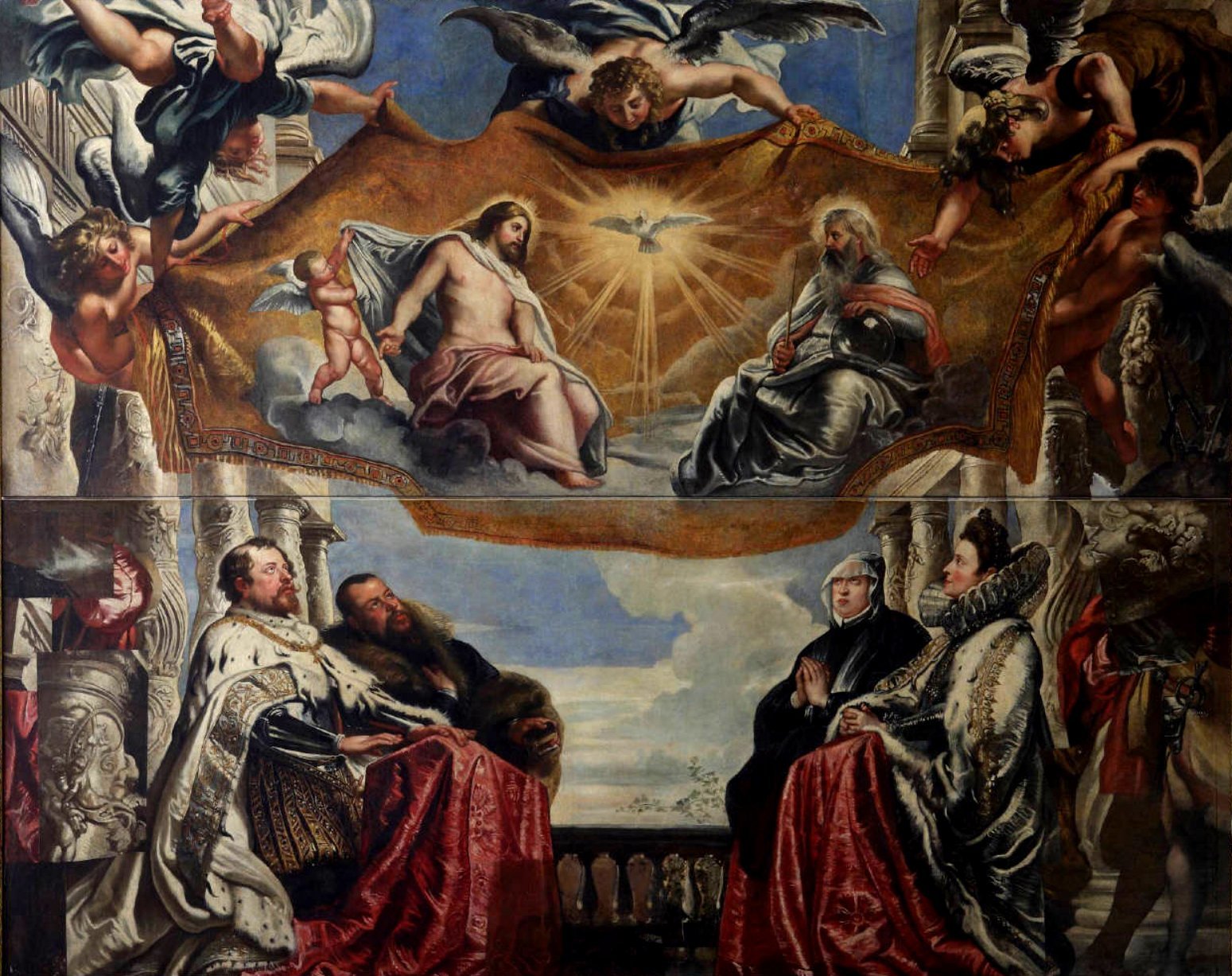
His patronage was extraordinary. He sheltered the half-mad poet Torquato Tasso, greatest of the age. He employed, from 1600 to 1608, a young Flemish painter named Peter Paul Rubens as court artist, who copied masterworks for the ducal collection, painted the Gonzaga family kneeling in adoration of the Holy Trinity, and was sent on diplomatic missions as far as Spain — the same Rubens whose vast group portrait of Vincenzo's family still lets us look the duke in the face. There were famous court dwarves with their own miniature apartments in the palace; there were alchemical laboratories; there was a theatre and an academy and a chapel and a band, all consuming money. And there was the music: a ducal cappella that under Wert, Pallavicino and finally Monteverdi was among the finest in Italy, the instrument on which our composer learned his trade and over which he eventually presided.
One dimension of Gonzaga Mantua is too often passed over, and it matters. The city held one of the largest and most culturally vibrant Jewish communities in Italy, with its own theatre troupe that performed at court and its own remarkable musicians. Chief among them was Salomone Rossi (c. 1570 – c. 1630), a Jewish violinist and composer in Vincenzo's service alongside Monteverdi, a pioneer of the early instrumental sonata and the author of Hashirim asher li-Shlomo — 'The Songs of Solomon' — a unique 1623 collection of polyphonic settings of Hebrew psalms and prayers for the synagogue, the first art-music of its kind in the Jewish liturgical tradition. That a Jewish master of the new style worked side by side with Monteverdi at the same court, in the same years, writing sacred polyphony in Hebrew while Monteverdi wrote it in Latin, is one of the quietly astonishing facts of this musical world — a reminder that the culture which produced the Vespers was more various, more porous, and more surprising than the textbook image of Counter-Reformation Italy suggests.
The chapel of Santa Barbara, and a duke's private rite
There is one more Mantuan institution without which the Vespers cannot be fully understood, and it is the source of one of the deepest scholarly puzzles about them. Vincenzo's father, Duke Guglielmo Gonzaga — himself a serious amateur composer — had built, between 1562 and 1565, a magnificent palatine basilica within the ducal palace dedicated to Santa Barbara, and had secured from the Pope an extraordinary privilege: the right to a unique liturgy, the rito di Santa Barbara, with its own calendar, its own observances, and above all its own body of plainchant, distinct from the standard Roman rite practised everywhere else in Catholic Europe. The chapel had its own maestri — Giaches de Wert among them — and its own repertoire built on this proprietary chant.
This matters because of a hypothesis that has shadowed the Vespers since the musicologist Graham Dixon advanced it in Early Music in 1987. Dixon argued that the 1610 collection, far from being the generic 'Vespers of the Blessed Virgin' its later nickname implies, was conceived with the specific liturgical use of Mantua — and quite possibly the Santa Barbara rite — in mind: that its psalms, its chant cantus firmi, and its overall shape point toward a particular Mantuan occasion rather than a universal Marian feast. The argument is contested; others note that the five psalms Monteverdi set are simply the standard psalms for Vespers of any feast of the Virgin, sung across all of Christendom, and that the 'Marian' framing may be partly a publisher's convenience to widen the music's market. The debate cannot be settled here, and may never be settled at all. But it teaches the essential lesson: that this music was born not in the abstract but inside a specific, peculiar, intensely local religious world — a duke's private chapel with a liturgy unlike any other — and that to hear it as a free-floating 'sacred concert' is to lose the very ground it grew from. Whatever Monteverdi intended, he built the Vespers out of the chant and the ceremony of a particular place, and that rootedness is part of their strange power.

What Monteverdi actually published
We speak of 'the Vespers' as though Monteverdi had written a symphony. What he in fact issued in 1610 was a printed book with a mouthful of a title: Sanctissimae Virgini Missa senis vocibus ac Vesperae pluribus decantandae, cum nonnullis sacris concentibus, ad Sacella sive Principum Cubicula accommodata — 'For the Most Holy Virgin, a Mass for six voices and Vespers to be sung by several voices, with some sacred motets, suitable for chapels or the chambers of princes.' The publisher was the Venetian Ricciardo Amadino, who had printed the score of Orfeo the year before; the music came out not as a score but as a set of seven separate partbooks, the normal commercial format of the day.
Two things in that title repay attention. First, the book is really two works bound together: a severe, antique, Palestrina-style parody Mass — the Missa in illo tempore — and the great, modern, multi-coloured Vespro. The pairing is deliberate: the old mastery and the new audacity, side by side, signed by one hand. Second, the title page carries two dedicatees. The music is offered to the Virgin, whose name stands in the dative at its head; but the living dedicatee, named and crowned with his coat of arms, is Pope Paul V Borghese, in a dedication dated 1 September 1610. The earliest trace of the enterprise is a letter of July 1610 from Monteverdi's assistant Bassano Casola to Cardinal Ferdinando Gonzaga; that autumn Monteverdi himself travelled to Rome, partbooks in hand, hoping to place his son Francesco in a seminary and — everyone agrees — to be noticed by the Curia. A partbook survives in the Vatican Library to this day. The audience with the Pope happened; the Roman post did not.
So the most sublime sacred music of its century was, at the level of biography, a job application: a provincial maestro, undervalued and overworked, betting his learning and his daring on a single luxurious print, and aiming it straight at Rome.
The other half of the book: a Mass in the old style
We speak of the Vespers, but it is worth remembering — and most modern listeners forget — that they were only half of what Monteverdi printed in 1610, and not even the half the title names first. The full title of the volume begins not with the Vespers at all but with a Mass: Sanctissimae Virgini Missa senis vocibus … ac Vespere … — 'A Mass for six voices … and Vespers …'. Bound at the front of the same collection, before a note of the radiant modern Vespers is heard, stands the Missa In illo tempore, a complete setting of the Ordinary of the Mass in the strictest, most archaic stile antico — the prima prattica in its purest and most learned form.
And it is no token gesture. The Mass is a parody Mass — an 'imitation' Mass, in the technical sense — built with rigorous craft on no fewer than ten melodic motives drawn from a motet, In illo tempore, by Nicolas Gombert, a Franco-Flemish master of the previous generation. To compose such a work is to submit oneself, deliberately, to the most demanding discipline of the old polyphony: to weave a whole Mass out of borrowed fragments in flawless, dense, dissonance-controlled counterpoint, exactly as Palestrina or Gombert himself would have done. Monteverdi, the supposed wrecker of the rules, sat down and out-conservatived the conservatives — and then bound the result, the perfect stile antico Mass, in the same covers as the wildly modern Vespers.
Now the full strategy of the 1610 print comes clear. This is a single object that says, in two facing languages: here is the old practice, mastered to the last suspension; and here is the new practice, carried to a height no one has reached. I am not a barbarian who breaks the rules because he cannot keep them — here is my proof that I keep them better than my accusers. And I am not a mere academic — here is my proof that I can shatter them into glory when the words demand. Judge me, Holy Father, as the complete master of the entire art of music, ancient and modern, sacred and theatrical, all of it, bound in one book. The Mass is the foundation that makes the audacity of the Vespers legitimate; the Vespers are the flight the foundation makes possible. To know the collection only by its famous half is to miss the argument that gives the whole its meaning — the most comprehensive demonstration of musical mastery any composer of the age ever set before a patron.

How a 1610 print was actually made
We should pause on the physical object itself, because the way music existed on paper in 1610 was nothing like what we imagine, and the difference shapes what the Vespers are. Venice had been the capital of European music printing for a century — ever since Ottaviano Petrucci there printed the first polyphony from movable type in 1501 — and through the great firms of Gardano, Scotto, and the partners Ricciardo Amadino and Giacomo Vincenti, the city poured out part-books to choirs and households across the continent. It was Amadino who printed Monteverdi's 1610 collection.
And 'part-books' is the crucial term. Polyphonic music in this age was almost never printed in score — that is, with all the voices aligned vertically on a single page, the way we read music today. Instead each voice and each instrument received its own separate little book: a Cantus book, an Altus book, a Tenor, a Bassus, a Quintus, a Sextus, and so on, plus a Bassus Generalis book carrying the new basso continuo. To perform, you did not gather around a conductor reading a master score — no such score existed, and the conductor-with-baton is an invention of two centuries later. You handed each singer or player their own book and they fitted their single line to the others by listening, led at most from the continuo. Monteverdi's 1610 print famously comprised eight such part-books — the seven vocal parts and the basso continuo — with the elaborate instrumental writing of the Sonata and the concertato movements cued within them. The whole towering edifice of the Vespers existed, materially, as a set of slim oblong booklets that had to be reassembled, in the mind and the ear, every time the music was sung.
The economics of such a print explain the dedication on its first page. Printing was costly and a composer rarely bore the cost merely to share his art; he sought a dedicatee whose name lent the volume prestige and who might reward the honour with money, employment, or favour. Monteverdi aimed as high as a Catholic musician could: he dedicated the collection to Pope Paul V — Camillo Borghese — with a dedication dated 1 September 1610, and that autumn he travelled to Rome to present it in person, plainly hoping the gesture might win him a Roman church appointment, or at least a coveted seminary place for his son. He came away with neither post nor preferment; Rome did not want him. The most ambitious sacred publication of the age failed, in the narrow sense, at the very thing it was designed to do. And yet some fifty to sixty copies of it survive in libraries around the world today — a substantial number for the period, evidence that the print circulated widely and was valued — even though not one documented performance of the complete Vespers in Monteverdi's own lifetime has ever come to light. The music we now revere as a cornerstone of Western art was, in its own day, a job application that did not work, scattered across Europe as eight little books and, so far as the record shows, perhaps never once heard whole.
Is it one work, or an anthology?
The romantic assumption — that, like Orfeo three years earlier, the Vespers is a single conceived whole — runs into hard facts. The collection is wildly heterogeneous in style, scoring and mode; no document records a complete performance in Monteverdi's lifetime; and the very title advertises music 'suitable for chapels or the chambers of princes', as if inviting buyers to take what they need. Many scholars now read the print as a brilliant portfolio: vesper pieces composed piecemeal over years for various occasions, gathered and published to show off the full range of a composer in search of a job. Pichon, like most performers, takes the opposite view — that the architecture coheres, that the final Gloria of the Magnificat is built to close not a canticle but a whole evening. Both are defensible. The work is perhaps best understood as something genuinely new: a book that becomes a single work in the act of being performed as one.Mary — or Santa Barbara?
In a celebrated 1987 article in Early Music, Graham Dixon argued that the music fits the feast of Santa Barbara — patron of the Gonzaga family, to whom the palace basilica was dedicated — better than any Marian feast. His evidence: the erotic Song of Songs texts (Nigra sum, Pulchra es) apply to any female saint; only two items, Audi coelum and Ave maris stella, are inescapably Marian; and the Sonata sopra Sancta Maria could be re-fitted to another saint's name, as such pieces routinely were. On this reading the Marian dedication was partly a marketing decision — a Virgin Mary sold more copies across Catholic Europe than a local Mantuan saint. The hypothesis has never been proved, and the Roman form of the Ave maris stella chant points away from Santa Barbara; but it permanently unsettled the pious assumption that the book was simply 'a Marian Vespers'.Should the high parts be transposed?
In Lauda Jerusalem and the larger Magnificat Monteverdi writes punishingly high tessituras. A well-attested convention of the time — the chiavette, or 'little high clefs' — signalled that such movements should be transposed down, often by a fourth, to a comfortable range. Andrew Parrott and others have argued forcefully that historically informed performance requires the downward transposition. Pichon disagrees, and says so in the booklet: keeping the original pitch at the high Italian diapason of the day (he reckons it around 440–465 Hz) 'multiplies tenfold' the emotional and spiritual charge. You can hear the stakes of a four-century-old technical dispute in the sheer altitude of his sopranos.The first 'modern' musical work?
Finally, the largest claim. Because the 1610 print is so unusually careful — figured bass, specified instruments, registration, an apparent architecture — some scholars (the debate runs through the Journal of the Royal Musical Association) treat it as a watershed in the very idea of a musical work: a fixed, authored, self-contained object, closer to how we think of a 'piece' than to the fluid, occasion-bound music that came before. Others find that anachronistic. But the question itself tells you what the Vespers are: a hinge on which an entire conception of music turns.The riddle of pitch: how high is too high
Of the debates that surround the Vespers, none is more technical, more bitterly contested, or more decisive for what the listener actually hears than the question of pitch — and it turns on a small notational detail called the chiavette, the 'little clefs'. Several of the grandest movements, including the racing Lauda Jerusalem and the great Magnificat, are written not in the ordinary clefs but in a combination of high clefs. By a widespread convention of the period, such high-clef notation may have functioned as a coded instruction: not 'sing these dizzying written pitches' but 'transpose this music downward', typically by a fourth or a fifth, into a comfortable singing range. The notation, on this reading, is a kind of shorthand that every trained musician of 1610 would have known to decode.
The consequences could hardly be greater. Take the high-clef movements at face value, at written pitch, and the sopranos and tenors are flung into a stratospheric, brilliant, almost painfully radiant tessitura — a blaze of high sound. Transpose them down, as scholars such as Andrew Parrott have forcefully argued the convention demands, and the very same music settles into a darker, richer, more sombre and sonorous register, an entirely different colour and weight. It is not a small adjustment of comfort; it transforms the character of the music, and with it the whole emotional architecture of the evening. And the uncertainty is compounded by a second unknown: there was no standard pitch in 1610. Venetian, Roman and Mantuan establishments tuned to different references — mezzo punto, tutto punto, corista and the rest — so that even the question of what frequency actually sounded when a singer read a given note is, four centuries later, irrecoverable. Every conductor who performs the Vespers must therefore make a wager about pitch that scholarship cannot settle for them, and the brilliance or the gravity of the result hangs on that single, unresolvable decision. The work does not come with the answer; it comes with the question, and the question is part of what keeps it alive.
The 1610 print is most likely an anthology rather than a symphony — vesper music gathered piecemeal over years — and yet this most Mantuan of books became the calling-card that won Monteverdi the greatest church post in Italy.
A walk through the book (I): the call and the psalms
Listen to how Pichon opens. The Invitatorium — Deus in adjutorium, Domine ad adjuvandum me festina, 'God, come to my aid; Lord, make haste to help me' — is, in the score, almost nothing: the choir chants the call on a single repeated chord while the instruments blaze the Orfeo toccata around them. It should not work. It is overwhelming. In two minutes Monteverdi has told you that the evening prayer of the Church and the new dramatic music of the theatre are, from now on, the same art.
Then come the great psalms, and here the listener meets the method that holds the whole book together: the cantus firmus. Beneath the brilliant surface of Dixit Dominus, Laudate pueri, Laetatus sum, Nisi Dominus and Lauda Jerusalem, Monteverdi lays the ancient Gregorian psalm-tone — the plainsong recitation formula — like a steel spine, and over it builds everything from sober falsobordone chanting to dizzying vocal fireworks. It is the oldest practice in Western church music, the chant, made to carry the newest. Pichon's basses and the continuo make that buried chant audible as a kind of gravity; you feel the modern decoration straining upward against an immovable older weight.
The psalms are also, in his hands, scenes. Laetatus sum — 'I was glad' — becomes a procession: the whole company moving together toward the house of the Lord, the music halting at the gates of Jerusalem while the carillons ring and the crowd's joy gathers at the threshold. As Pichon and his interlocutor Jean-Clément Guez put it in the booklet, these are not symbolic images but a literal transcription of human emotion. The Vespers think pictorially. They are, four hundred years early, a kind of cinema for the ear.
The old chant inside the new music: how the psalms are built
It is worth slowing down to see how Monteverdi actually constructs the five great psalms, because the method is the whole secret of the Vespers and a marvel of compositional daring. Each psalm is built upon its proper Gregorian psalm-tone — the ancient, anonymous plainchant formula to which that psalm had been sung in the Church for a thousand years — held as a cantus firmus, a fixed melodic scaffold, usually intoned in long, slow notes by one voice while every other voice and instrument weaves freely, brilliantly, modernly around it. This is the structural embodiment of everything we have said: the oldest material in Christendom, the chant, planted at the centre, and the newest music ever written, the concertato style, swirling about it. The medieval and the modern are not merely juxtaposed; they are locked together, bone and flesh, in a single living body.
Within that frame Monteverdi rings every possible change. In Dixit Dominus, the opening psalm, he alternates passages of falsobordone — a grand, rapid, chordal recitation in which the full choir declaims the text on block harmonies, a way of hurling many words at the listener with monumental simplicity — against florid solo flourishes and returning instrumental ritornelli, the refrains of the new theatre music. Laudate pueri hands the chant scaffold to solo voices and spins virtuoso divisions above it. Laetatus sum sets the psalm over striding, quasi-ostinato bass patterns that give it an almost dance-like propulsion. Nisi Dominus is the monument: ten voices in two facing five-part choirs, the chant migrating between them, a wall of antiphonal sound. And Lauda Jerusalem is the showpiece of sheer velocity — the chant intoned in long notes by the tenors in the middle of the texture while two three-voice choirs hurl rapid, interlocking figures around it at breathtaking speed, so that the still ancient melody and the racing modern voices sound at once, in the same instant, the past holding firm while the present flies. To analyse these psalms is to watch a composer solve, again and again, with inexhaustible invention, the single problem he set himself: how to honour the chant and shatter it in the same breath.
A walk through the book (II): the scandal of the motets
Between the psalms Monteverdi does the unexpected and inserts four free sacri concentus — motets that belong to no fixed point in the liturgy, and whose presence scholars still argue about (do they replace the antiphons, or merely ornament the psalms?). Musically they are the book's most modern pages: solo songs in the brand-new monodic style that Giulio Caccini had codified around 1600, a single voice declaiming over continuo, all rhetoric and ornament and breath.
And their texts are extraordinary. Nigra sum, sed formosa — 'I am black, but beautiful' — and Pulchra es, amica mea — 'You are beautiful, my love' — are drawn not from any prayer but from the Song of Songs, the most frankly erotic book in the Bible, a lovers' dialogue of desire and pursuit. To hear a tenor sing 'the time of pruning has come, the voice of the turtledove is heard in our land' with all the caressing ornament of an opera seduction, inside a service to the Virgin, is to feel the strangeness at the heart of this music: the sensual pressed into the service of the sacred, the language of human love made to speak of divine love. The Counter-Reformation Church had decided that the senses were not the enemy of devotion but its road, and Monteverdi drives straight down that road. (It is also, as Graham Dixon noticed, exactly the kind of text that fits any beautiful female saint — which is why these motets feed the Santa Barbara debate.)
Sacred opera: the motets, scene by scene
Between the psalms stand the four sacri concentus — the concertato motets — and these are the most openly astonishing music in the entire collection, because they are, quite simply, opera scenes in church. Composed in the very years of Orfeo and Arianna, in the same monodic and few-voiced concertato style, they bring the solo singing voice, with all its operatic power to enact a human soul, into the sacred Vespers, and they remain the place where a first-time listener's jaw most reliably drops.
Nigra sum — 'I am black but beautiful' — sets words from the Song of Songs as a solo tenor monody of frank, sensuous lyricism, the voice rising and turning on the line 'the time of pruning has come, and the voice of the turtle-dove is heard in our land' with an erotic tenderness that would not be out of place in a love scene. Pulchra es — 'Thou art beautiful, O my love' — draws two sopranos into an intertwining duet of such intimate, suspension-laden sweetness that on the words 'turn away thine eyes from me, for they have made me flee' the music seems almost to blush. Duo Seraphim is a miracle of theological word-painting: two tenors, painting the two seraphim of Isaiah's vision, sing a ravishing, dissonance-rich duet — 'Holy, holy, holy' — until the text turns to the Trinity, 'there are three who bear witness in heaven', and on the word tres, 'three', a third tenor steals in to make a trio; and then, on the words et hi tres unum sunt, 'and these three are one', the three separate voices fold together into a single unison line, three becoming one before the ear, the doctrine of the Trinity made not argued but audible. And Audi coelum deploys the beloved Baroque conceit of the echo: a solo tenor sings, and a second, hidden tenor answers the ends of his phrases as an echo that transforms the words — the final syllables returning changed, gaudio answering audio — a virtuoso play of sound and meaning that opens at last into the full choir. These four motets are the seconda prattica triumphant inside the sanctuary: the secular revolution's most powerful weapon, the expressive solo voice, turned to the praise of God and the Virgin, and losing none of its dangerous, human warmth in the turning.
Where the words come from
A word about the texts themselves, since they are not chosen at random but follow, and then magnificently bend, the shape of an ancient rite. Vespers — evening prayer, the great sung Office of the dying day — has a fixed liturgical form: an opening versicle (Deus in adjutorium meum intende, 'O God, come to my assistance'), then a sequence of five psalms, each preceded and followed by an antiphon; then a hymn; then, as the crown, the Magnificat, the Virgin's own song of praise. Monteverdi's collection follows this skeleton exactly — the opening call, the five psalms in their canonical order, the Marian hymn, the Magnificat — which is precisely why it functions as a true liturgical Vespers and not merely a loose anthology.
But where the rite calls for plainchant antiphons to frame the psalms, Monteverdi inserts his concertato motets — and this single substitution is the source of one of the work's enduring debates and much of its strangeness. The psalm texts are the standard Vulgate psalms appointed for the Virgin's feasts (Psalms 109, 112, 121, 126 and 147 in the old numbering), the common property of all Christendom. The motet texts, by contrast, come mostly from the Song of Songs, the Canticle of Canticles — those frankly erotic ancient Hebrew love poems ('I am black but beautiful'; 'thou art fair, my love') that the Church had long read allegorically, as figures of the love between Christ and his Church, or God and the soul, or — in a Marian setting such as this — the Bridegroom and the Virgin Bride. The theology sanctifies the sensuousness: the lover's body becomes the mystical body, the kiss becomes grace. And yet Monteverdi's music does not explain the eroticism away; it transfigures it, letting the sacred and the sensual burn with a single flame, which is perhaps the most Counter-Reformation thing about the entire enterprise. The hymn is the ancient Ave maris stella, 'Hail, star of the sea, kindly Mother of God', set strophe by strophe with alternating choral and solo verses over a recurring instrumental ritornello, a slow procession of praise. And the Magnificat sets Mary's words from the Gospel of Luke — 'My soul magnifies the Lord' — the song the Virgin sang when she learned she would bear God, here made the summit toward which the whole vast evening has been climbing.
A walk through the book (III): the Trinity in three notes
Two further marvels. In Duo Seraphim — 'Two seraphim cried one to another, Holy, holy, holy' — two, then three tenors entwine in ornament so dense it sounds improvised, a kind of ecstatic vocal calligraphy. Then the text turns to the mystery of the Trinity — Tres sunt qui testimonium dant in caelo: Pater, Verbum, et Spiritus Sanctus — and Monteverdi does something no theorist could have predicted: at 'Tres sunt' ('there are three') he sounds a chord of three distinct notes, and at 'et hi tres unum sunt' ('and these three are one') he collapses the three voices onto a single pitch over one bass note. The doctrine is not described; it is performed. Three become one before your ears.
In Audi coelum the device is the echo: a solo tenor sings, and a second, hidden voice answers from a distance, catching the last syllable of each phrase and turning it into a new word — gaudio answered by audio, the echo becoming a second speaker, a theological pun made audible. This is the basso continuo working as what Pichon beautifully calls a 'narrator' — the bass line capable, by a single chord, of turning the meaning of a word inside out. The whole book is an exegesis of sacred texts carried out in pure sound; here you can watch it happening, syllable by syllable.
The orchestra of the Vespers, and the bass that changed everything
The sound-world of the Vespers is itself a historical document, for it captures the early-Baroque sacred orchestra at the moment of its formation. Where Monteverdi specifies instruments, they are the characteristic colours of the age: the cornetto — a bright, agile, wooden lip-reed treble that blends with voices like no other instrument and was the soprano of the Venetian church; the viole da braccio, the violin family; the trombone or sackbut, the solemn, vocal bass-and-tenor brass; with recorders and flutes for gentler moments. The brilliant, ceremonial sonority of cornetts and sackbuts answering violins is the very signature of grand sacred music around 1610, the sound of San Marco and the Gabrielis, and Monteverdi wields it with theatrical command in the Sonata and the great psalms.
But the deepest instrumental innovation of the Vespers is not a melody instrument at all; it is the basso continuo, the foundation on which the whole new style rests. Beneath everything runs a single bass line, figured with numerals, over which chordal instruments — organ, harpsichord, the deep plucked chitarrone or theorbo — improvise the harmony in real time, supporting and propelling the voices above. This continuous, harmony-generating bass is one of the defining inventions that separate the Baroque from everything before it: it is what makes monody, recitative, the solo aria and the concertato texture possible at all, because it frees a single voice to sing expressively while the bass holds the harmonic ground beneath. The Vespers are among the towering early monuments of this new principle. To hear them is to hear, quite literally, the floor of modern music being laid — the continuo bass under Monteverdi's soaring voices is the same foundation on which Bach, Handel, and the entire edifice of tonal music would be built for the next two centuries.

A walk through the book (IV): architecture in stone and sound
The grandest psalms are buildings. In Nisi Dominus Monteverdi splits his forces into two five-part choirs that hurl phrases back and forth across the imagined space — the cori spezzati, 'broken choirs', the antiphonal style that Adrian Willaert and the Gabrielis had made the signature sound of Venice. Here is the deepest clue to the music's birthplace: the separate partbooks are laid out to imply exactly this spatial, double-choir disposition around a single organ — which is precisely the symmetrical architecture of the Santa Barbara basilica, organ-tribune facing singers' balcony. The print is, in a sense, a recording of a room.
Lauda Jerusalem and the great Magnificat push the high voices to the punishing altitudes that ignite the chiavette debate; Pichon keeps them where they are written, at the bright high pitch of the Italian seventeenth century, and the strain becomes a kind of incandescence. This is one of the recording's defining choices — and, for some listeners, its most divisive. The BBC critic for classical-music.com wanted Nisi Dominus to carry a more 'monumental' weight, in the manner of Gabrieli, where Pichon gives it a quicker, lighter step. You can hear the argument both ways. What is not in doubt is that Monteverdi has built, out of plainchant and split choirs, sound-architecture as ambitious as anything in the stone of the age.
Music for the happy few
One last thing must be said about the Vespers, and it is a practical thing with profound implications: this is music of ferocious, almost cruel difficulty, written for the very highest rank of professional musicians and, in all likelihood, for almost no one else. The solo writing bristles with gorgia and passaggi — rapid, elaborate ornamental divisions that demand a flawless, agile virtuosity; the tenor and soprano parts climb to a punishing tessitura and hold it; the duets require two singers matched in breath and intonation to a hair's breadth; and the Sonata sopra 'Sancta Maria' asks of its cornetts and violins a brilliance that would tax a virtuoso in any age. This is not music a parish choir could read on a Sunday. It is music for the kind of singers who created Monteverdi's operas — the elite of the elite, professionals at the summit of an exacting art.
Which raises a question that haunts the work and deepens its mystery. Could even the Gonzaga chapel, fine as it was, actually have mustered the forces and the skill to perform the complete Vespers as printed? We do not know — and, as we have seen, there is no record that anyone did, in Monteverdi's lifetime or for centuries after. It is entirely possible that this towering monument of sacred art was conceived less as a score to be performed entire on a given evening than as a printed demonstration — a compendium of everything its composer could do, in every style and every difficulty, bound together to dazzle a pope and win a post. The most ambitious church music of the age may have been, in its own day, more an argument than an event: a paper cathedral, built to be marvelled at, that the world would not learn to actually inhabit until our own time. There is something almost unbearably poignant in that — that Monteverdi poured this much genius into music he may never have heard sung whole, and that we, four centuries on, are in a sense the audience he wrote for and never had.
The Sonata, the Litany, and a motet from elsewhere
At the book's centre stands its most purely instrumental wonder: the Sonata sopra Sancta Maria, ora pro nobis. Over a glittering, fully written-out fantasia for two violins, three cornetti and three sackbuts — virtuoso instrumental writing of a brilliance new to sacred music — a single soprano line intones, eleven times, the simplest of prayers: Sancta Maria, ora pro nobis, 'Holy Mary, pray for us'. The Marian litany, plain as a heartbeat, floats unchanged above an ever-shifting instrumental jewel-box. It is the whole aesthetic of the Vespers in miniature: the immovable chant and the dazzling new art, locked together. (It is also Exhibit A in the Santa Barbara case: such pieces routinely had the saint's name swapped out, the slot marked merely 'N.' for nomen.)
Pichon makes one telling editorial choice here. Just before the Sonata he inserts a piece not from the 1610 print at all: the antiphon Sancta Maria, succurre miseris, SV 328, a later Monteverdi motet (published in the Promptuarium musicum of 1627) for three high voices. It is a small, deliberate act of interpretation — a way of framing the Sonata, of letting Mary be invoked in living polyphony before the instruments take up her name. The recording, notably, otherwise presents only Monteverdi's own music: unlike many performances, Pichon adds no Gregorian antiphons between the movements (those, he explains, he reserves for the concert hall). What you hear on these two discs is the 1610 book, plus this one curated guest, and nothing else.
The Venetian sound: split choirs and the stones of San Marco
Mantua made Monteverdi, but the Vespers are forever turning their face toward another city — toward Venice, where the grandest sacred music in Italy was being made, and where Monteverdi himself would arrive, transformed in fortune, only three years after the print appeared. To hear what the polychoral splendours of the 1610 collection are reaching for, one must know the Venetian tradition of the cori spezzati — the 'broken choirs'.
The great Basilica of San Marco, with its two facing galleries and its cavernous, resonant Byzantine spaces, had bred over the sixteenth century a music built on antiphony: two, three, or more separated choirs of voices and instruments answering one another across the architecture, sound thrown from gallery to gallery, the building itself made an instrument. The Flemish master Adrian Willaert, maestro at San Marco from 1527, was an early architect of the style; it reached its zenith under Andrea Gabrieli and above all his nephew Giovanni Gabrieli, organist of San Marco until 1612, whose Sacrae symphoniae of 1597 — including the famous Sonata pian' e forte, among the first works ever to specify both its instruments and its dynamics — deployed massed choirs of singers, cornetts and sackbuts in sonorities of overwhelming grandeur. Brass and the bright, voice-like cornett were the soul of this Venetian sound, and its spatial, ceremonial magnificence was the envy of Catholic Europe. (Giovanni Gabrieli's pupil Heinrich Schütz would carry it back to Germany and, in time, toward Bach.)
Monteverdi's Vespers, for all their Mantuan origin, are saturated with this Venetian dream. The great double-choir psalms — the granite Nisi Dominus for two five-voice choirs, the antiphonal Lauda Jerusalem — are cori spezzati in everything but their birthplace, sound flung between answering ensembles in the Gabrieli manner. And the Sonata sopra 'Sancta Maria' is the purest homage of all: a brilliant, athletic instrumental fantasia for cornetts, violins and sackbuts, over which a soprano (or a choir of them) chants the single litany petition Sancta Maria, ora pro nobis — 'Holy Mary, pray for us' — eleven times, the unchanging prayer riding the ever-changing instrumental tumult beneath it. It is a piece of pure ceremonial theatre, Venetian instrumental writing transplanted into a Marian devotion. When, in 1613, the bereaved, dismissed Mantuan servant walked into San Marco as its new maestro di cappella, he was in a sense coming home to a sound he had already mastered from afar. The Vespers are a Mantuan work dreaming of the lagoon — an audition, written three years early, for the greatest church-music post in Italy.
The Council of Trent and the policing of sacred sound
The Vespers were written inside a Church that had spent the previous half-century at war for its soul, and that war reached directly into the question of how music might sound in a holy place. The Council of Trent (1545–1563), the great deliberative engine of the Catholic response to the Protestant Reformation, had taken up, among a thousand graver matters, the problem of sacred music. The reformers' anxiety was twofold: that the elaborate polyphony of the age had grown so dense that the holy words were lost in a thicket of interweaving voices, and that composers routinely built their Masses on the tunes of bawdy secular songs, smuggling the tavern into the sanctuary. The Council's twenty-second session, in 1562, issued a decree demanding that music in church be purged of everything 'lascivious or impure', that the secular be banished, and that the words be made intelligible to the faithful.
It is worth being precise, because a beautiful legend has grown over the facts. Trent did not ban polyphony, did not prescribe a style, did not lay down rules of counterpoint; it stated principles and left their enforcement to local bishops and synods. The famous story that Palestrina single-handedly 'saved polyphony' by composing his Missa Papae Marcelli to prove that elaborate music could still be clear is a later embroidery — but it encodes a real and lasting pressure. For two generations after Trent, the watchwords of Catholic sacred music were clarity, gravity, dignity, and the supremacy of the text. And here is the irony that makes Monteverdi's achievement so vivid: the Counter-Reformation demanded that the words govern the music — and the seconda prattica, that scandalous secular revolution, demanded exactly the same thing, by a different road. Monteverdi could bring the most modern, dramatic, dissonant, theatrical music ever written into the church and claim, with a straight face, that he was only doing what Trent commanded: making the sacred words sovereign over the sound. The reform meant to discipline music; in his hands its central principle became the licence for an explosion of expressive freedom.
The cult of the Virgin, and an age of images
And why the Virgin? Why should the supreme sacred statement of the age take the form of a Marian Vespers? The answer lies at the heart of the confessional struggle. The Protestant reformers had stripped away the veneration of Mary and the saints as unscriptural idolatry; in fierce response, the Catholic world made devotion to the Virgin a banner of its identity, an emblem of everything Rome affirmed and Geneva denied. The rosary spread through the Dominican confraternities; Marian feasts multiplied across the calendar. When the Holy League's fleet shattered the Ottoman navy at Lepanto on 7 October 1571 — the decisive check to Turkish sea-power, and a victory the rosary confraternities had prayed for — Pius V attributed the triumph to the Virgin's intercession and instituted the feast of Our Lady of Victory, later Our Lady of the Rosary. Mary became the militant Catholic world's protectress, the Queen of Heaven who crushed the heretic and the infidel alike. To set her Vespers in the most magnificent music available was a profoundly contemporary act, a statement of confessional allegiance as much as of personal piety.
And it belonged to an age that had decided, against the whitewashed walls of Protestant churches, that the sacred should overwhelm the senses. Trent had affirmed the power and legitimacy of sacred images precisely where the reformers smashed them, and Catholic Europe answered with the most sensuous, dramatic, emotionally direct religious art ever made. These were the years of Caravaggio, painting saints with the dirty feet of peasants under raking, theatrical light; of the Carracci, reinventing the grand altarpiece in Bologna; of the young Rubens, then at the Gonzaga court itself. It was an aesthetic of overwhelming — of drama, flesh, light, tears and ecstasy, designed to seize the worshipper by the heart and not merely instruct the mind. Monteverdi's Vespers are the perfect sonic counterpart to that visual revolution: the echoing virtuosity of Audi coelum, the sensuous duetting of Pulchra es, the great spatial machinery of the psalms are Caravaggio's chiaroscuro and Bernini's coming ecstasies translated into sound — a Catholicism that does not argue but transports. To understand why the music is so theatrical, so unembarrassed by sensuous beauty in the service of devotion, one must see it standing in that gallery of dark, glowing, passionate sacred images, doing in time what they do in paint.
Ave maris stella, or music that goes underwater
If I had to send one movement to a stranger to explain why this book matters, it might be the hymn Ave maris stella, 'Hail, star of the sea'. Monteverdi takes the plain Marian hymn-tune and spins it through a sequence of strophic variations — now full choir, now a duet, now a ritornello for instruments turning between the verses like a slow tide. Pichon, in the booklet, reaches for an image I cannot improve: this is proprement sous-marine, properly submarine music — through rhythmic play, through the spacing of chords, through a hundred microscopic choices, Monteverdi sinks us into a space of infinite depth that we could almost touch with a finger. Time dilates; the usual coordinates blur. And then, at the very end, he strips everything away and lets the last verse stand a cappella — voices alone, unsupported, hanging in the cleared air. After so much colour, the sudden nakedness of unaccompanied singing is like surfacing into light. It is one of the most moving gestures in early Baroque music, and Pygmalion give it with a tact that made me hold my breath.
Concert or liturgy? The missing antiphons
There is a deeper question lurking beneath the hymn and the psalms, one that decides not how the Vespers sound but what kind of thing they are. In a true liturgical Vespers, every psalm is framed by a proper antiphon — a short plainchant verse, specific to the feast being celebrated, sung before and after the psalm to set its mode and announce its theme. These antiphons are the connective tissue of the rite, the threads that bind the psalms to a particular day and a particular meaning. And Monteverdi's print does not supply them. Where the antiphons should stand, he gives us his concertato motets instead — or rather, the motets occupy that liturgical space without being antiphons at all.
This leaves every performer facing a fork in the road. One path treats the collection as a self-contained concert work: present Monteverdi's polyphony and his motets as a continuous musical sequence, a unified composition to be heard for its own sake, and let the missing antiphons stay missing. The other path attempts to reconstruct a living liturgy: choose a specific Marian feast, find the proper Gregorian antiphons appointed for it, and insert them as plainchant before each psalm, so that Monteverdi's polyphony is heard the way it would have been heard in church — embedded in the ancient chant, one jewelled panel in a longer devotional whole. This second path makes the work substantially longer, roots it in a particular liturgical occasion, and changes its entire feel from concert to rite; the first keeps it as a free musical monument. Recordings divide sharply between the two, and neither can claim to be simply 'correct', because the print itself is silent on the matter. Once again the Vespers refuse to tell us what they are. They hand us a magnificent, incomplete set of materials and force us to decide whether we are building a concert or rebuilding a church — and the music sounds profoundly different depending on which we believe we are doing.
Two Magnificats, and how to end an evening
The book closes with not one but two settings of the Magnificat, Mary's own song of praise — Magnificat anima mea Dominum, 'My soul magnifies the Lord'. The larger is scored for seven voices and a full instrumental complement, the smaller for six voices and organ alone, and Monteverdi prints both, as if to say: take the forces you can muster. In the great Magnificat the cantus firmus of the chant runs through each verse while the texture above it is endlessly re-coloured — a flute duet here, a trio of trombones there, the Gloria Patri lifting the high tenors into the stratosphere over a vast, slow-breathing 'great officiant and his echo', as the booklet has it, a moment of immense lyricism. The Magnificat is the architectural keystone: everything the book has shown — chant and ornament, choir and soloist, the old and the new — gathered into a single culminating arch.
And then there is the question of the last word, which Pichon turns into one of his recording's quiet revelations.
The Magnificat as summa
The greater of the two Magnificats — the seven-voice setting with full instruments — deserves to be understood as the summa of the entire collection, the movement in which every technique Monteverdi has deployed across the evening returns and is gathered into one culminating arch. Like the psalms, it is built on a cantus firmus: the ancient Magnificat tone runs through it as a slow, fixed thread. But around that thread Monteverdi lays out the verses of Mary's song as a sequence of sharply contrasted miniatures, each a different world — here a solo voice spinning rapid divisions, there a duet of intertwining sopranos, here the full choir in grand falsobordone, there two cornetts or two violins in obbligato dialogue, here an echo effect thrown across the texture, there a sudden hush. It is a deliberate review of the collection's whole vocabulary, verse by verse, as though the composer were displaying his instrument-case one compartment at a time before closing it.
The long approach builds toward the doxology — the Gloria Patri, 'Glory be to the Father' — where Monteverdi lifts the high voices into the stratosphere over the slowly turning chant, a moment of almost vertiginous radiance, the evening's accumulated splendour discharged into pure light. And then, with characteristic practicality, he printed a second, smaller Magnificat for six voices and organ alone — the same structure, the same shape, but scaled for forces that could not command the cornetts and sackbuts of the great one. The gesture is touching and revealing: even at his most extravagant, Monteverdi was a working maestro who knew that not every chapel had a virtuoso band, and who provided, bound into the same volume, both the impossible dream and the achievable reality. You may end the evening, he says, with all the glory you can summon — or with all the glory you can afford.
The man who turned a corner in time
It is worth standing back, finally, to see the whole arc of the figure who made this music, because no composer sits more exactly on the hinge between two worlds. Monteverdi's nine books of madrigals, composed across more than fifty years, are themselves a map of the journey from the Renaissance to the Baroque: the first four books are sublime Renaissance polyphony; from the fifth onward the basso continuo enters, the voices break free, and by the Madrigali guerrieri et amorosi of 1638 he has invented even the stile concitato, the 'agitated style' of rapid repeated notes for depicting warfare and passion that would echo down to Beethoven and beyond. The Vespers of 1610 stand at the very pivot of that lifelong transformation, the sacred counterpart to the secular revolution his madrigals were enacting.
And the Venetian decades that followed were a long late flowering. As maestro di cappella at San Marco from 1613, Monteverdi reigned for thirty years as the most powerful church musician in Italy, rebuilt the basilica's music, and in 1640–41 gathered his sacred achievement into the vast retrospective Selva morale e spirituale. He took holy orders as a priest in 1632; he survived the catastrophic plague of 1630–31 that emptied Venice and killed his colleague Grandi. And then, astonishingly, in his seventies, when the world's first public opera houses opened in Venice, the old man returned to the stage that had made him and wrote two of the supreme masterpieces of all opera — Il ritorno d'Ulisse in patria (1640) and, at the age of seventy-six, L'incoronazione di Poppea (1643), that coolly amoral, psychologically fathomless drama of Nero and his mistress that remains one of the greatest things ever composed for the theatre. He died in Venice on 29 November 1643, mourned as a giant, and was buried in the great Frari church. From a barber-surgeon's son in Cremona to the inventor of modern opera and the bridge across which Western music walked out of the Renaissance and into everything that followed — and the Vespers of 1610, this desperate, dazzling, unperformed job application, glittering near the centre of the journey, one of the first and greatest monuments of the age he did more than any other man to begin.

The recording: Pygmalion in a Paris temple
All of this — the threshold, the mosaic, the submarine hymn — reaches us through a particular performance, made by particular people in a particular room, and the choices are everything.
Pygmalion is the choir-and-orchestra that Raphaël Pichon founded in 2006, fresh out of his own training as a singer and Baroque specialist; over the years it has become one of the most admired period ensembles in Europe, equally at home in Bach, Rameau and the early Italian Baroque (their previous Italian foray, Stravaganza d'amore, mapped the late-sixteenth-century Florentine intermedi). For the Vespers they assembled a large choir, a colour-rich band of cornetts, sackbuts, violins, viols, recorders, dulcian, harps, theorbos and organ, and a front line of soloists — Céline Scheen and Perrine Devillers, the searching mezzo Lucile Richardot, the tenors Emiliano Gonzalez Toro, Zachary Wilder and Antonin Rondepierre, the basses Étienne Bazola, Nicolas Brooymans and Renaud Brès — who carry the operatic weight of the concertato motets.
The sessions took place in January 2022 in the Temple du Saint-Esprit in Paris, a warm Protestant church whose acoustic — caught by the harmonia mundi engineers — wraps the sound in glow without drowning its detail; one reviewer felt it 'evokes the splendour of the ducal chapel in Mantua for which the Vespers were written'. Two decisions define the result. First, the high pitch: Pichon keeps the brilliant Italian diapason of around 440–465 Hz and refuses the downward chiavette transposition, so the sopranos blaze at the top and the whole sound tilts toward light. Second, the textual purity: this is the Vespers as Monteverdi printed them, with no inserted Gregorian antiphons (Pichon saves those for staged concerts) — only the single, curated addition of Sancta Maria, succurre miseris. The booklet itself is unusual: not an essay but a long, searching conversation between Pichon and Jean-Clément Guez, rector of Bordeaux cathedral, gathered by Eddy Garaudel — the interpreter thinking aloud about the work he is about to fix in sound. It is, frankly, one of the best liner texts I have read in years.
Even those who think they know the Vespers well will rethink that position after hearing this remarkable recording.James Manheim, TiVo / Qobuz review, 2023
Reception: rapture, and a dissenting voice
The record landed, in the late summer of 2023, with unusual force — it climbed the classical best-seller charts, an odd fate for a four-hundred-year-old liturgy, and the praise was widespread. Gramophone welcomed it warmly; the Early Music Review admired the chorus's energy, the 'perfect phrasing and unanimity', and the engineers' vivid sound, and made a generous historical point: that Pichon manages to 'embrace the scholarly and the epic dimensions' of the work, recovering some of the sweep that the earliest pioneers (Jochum, even Stokowski) had and that later, more correct versions sometimes lost. Writing for VAN, Olivia Giovetti caught the mood exactly — Pichon, she wrote, 'is exactly the sort of conductor you'd willingly follow down a rabbit hole.'
But a serious recording earns serious dissent, and it would flatter no one to hide it. The critic for BBC Music Magazine pressed on the very choices that thrill elsewhere. If the Vespers are taken as a unified whole, he argued, the performance risks becoming 'a little too homogenous': the early, granite double-choir Nisi Dominus arguably wants the 'monumental' grandeur of a Gabrieli, where Pichon gives it a quicker, lighter tread better suited to the later psalms; and in Nigra sum, that exquisite Caccini-style monody, Emiliano Gonzalez Toro adds almost no improvised ornament, leaving a connoisseur hungry for the decoration the style invites. These are not small points — they go to the heart of how this music should sound — and an honest listener will weigh them. My own ear comes down, most nights, with the rapture rather than the reservation; but the reservation is real, and it is part of why this recording is worth arguing about at all. (It is instructive to hear it beside Simon-Pierre Bestion's wilder, more 'spatialised' Vespro with La Tempête, released on Alpha the same year — two utterly different convictions about what the 1610 book is for.)
Four centuries of silence and resurrection
The strangest chapter in the story of the Vespers is the one that comes after Monteverdi: the long silence, and the astonishing modern resurrection. We have no record that the complete collection was ever performed in his lifetime; after 1610 it slipped, with almost all of his music, beneath the surface of taste. The Baroque he helped to launch swept past him; the high Baroque of Bach and Handel, then the Classical age, then the Romantic, had no use for a 'primitive' early-seventeenth-century master, and for the better part of three hundred years the Vespers existed only as eight rare little part-books in a handful of libraries, a curiosity for antiquarians. The man whom we now place among the supreme figures of Western music was, for three centuries, very nearly forgotten.
The slow return began in the nineteenth century, with historians and a dawning scholarly curiosity, but the decisive recovery belongs to the twentieth. Between 1926 and 1942 the composer Gian Francesco Malipiero edited Monteverdi's complete works, putting the scores back into the world; performing editions of the Vespers multiplied, each editor confronting the work's famous open questions and answering them differently. Then came the early-music revival, and with it a succession of landmark recordings that carried the Vespers from the seminar room into the concert hall and the record collection — the pioneering accounts of the 1950s and '60s, Jürgens's influential 1966 recording, and above all John Eliot Gardiner's electrifying 1974 version, which more than any other performance fixed the Vespers in the modern repertoire. The historically-informed-performance movement adopted the work as a touchstone, and today it is among the most recorded, most performed, and most beloved compositions of the entire age before Bach — a complete reversal of its first three and a half centuries of obscurity.
Part of what keeps the Vespers so alive is precisely that they can never be performed 'as written', because what was written leaves so much unsaid. There is no autograph manuscript; the 1610 print is all we have, and it is gloriously incomplete as a set of instructions. Should the performers insert the proper Gregorian antiphons before each psalm, framing the music in its liturgical setting, or present the polyphony alone as a concert? Should the high-clef movements be transposed downward, as the chiavette convention may imply, or sung at the dizzying written pitch? What instruments should double the voices, and where? Every performance is therefore an act of interpretation, a wager about an unrecoverable original — which is why no two recordings are alike, why the scholarly arguments never end, and why a four-hundred-year-old setting of Vespers remains, paradoxically, one of the most open and living scores in all of music. The silence of three centuries has been answered by an inexhaustible modern conversation, and the work seems only to grow richer the more we argue over what it is.
| Year | Conductor · Ensemble | Label | Character |
|---|---|---|---|
| 1966 | Jürgens · Monteverdi-Chor Hamburg | Teldec / DHM | A pioneering complete account; old-school epic sweep. |
| 1974 | Gardiner · Monteverdi Choir | Decca | The young Gardiner: bright, athletic, urgent. |
| 1984 | Parrott · Taverner Consort | EMI | Scholarly one-voice-per-part; the 'liturgical reconstruction' benchmark. |
| 1986 | Herreweghe · Collegium Vocale Gent | harmonia mundi | Lucid, devotional, exquisitely blended. |
| 1989 | Gardiner · Monteverdi Choir & EBS | DG Archiv | Recorded in San Marco, Venice; grand and theatrical — long a reference. |
| 1989 | Savall · La Capella Reial | Astrée / Alia Vox | Warm, instrumentally opulent, Mediterranean colour. |
| 1998 | Alessandrini · Concerto Italiano | Naïve / Opus 111 | Italianate, rhetorical, vivid word-painting. |
| 2005 | McCreesh · Gabrieli Consort | DG Archiv | Ambitious liturgical reconstruction with proper chant. |
| 2006 | Christophers · The Sixteen | CORO | Polished English choral refinement. |
| 2010s | Garrido · Ensemble Elyma | K617 | Colourful, theatrical, southern warmth. |
| 2023 | Bestion · La Tempête | Alpha | Wild, spatialised, radically re-imagined. |
| 2023 | Pichon · Pygmalion | harmonia mundi | The present recording: high-pitched, theatrical, 'cinematic'. |
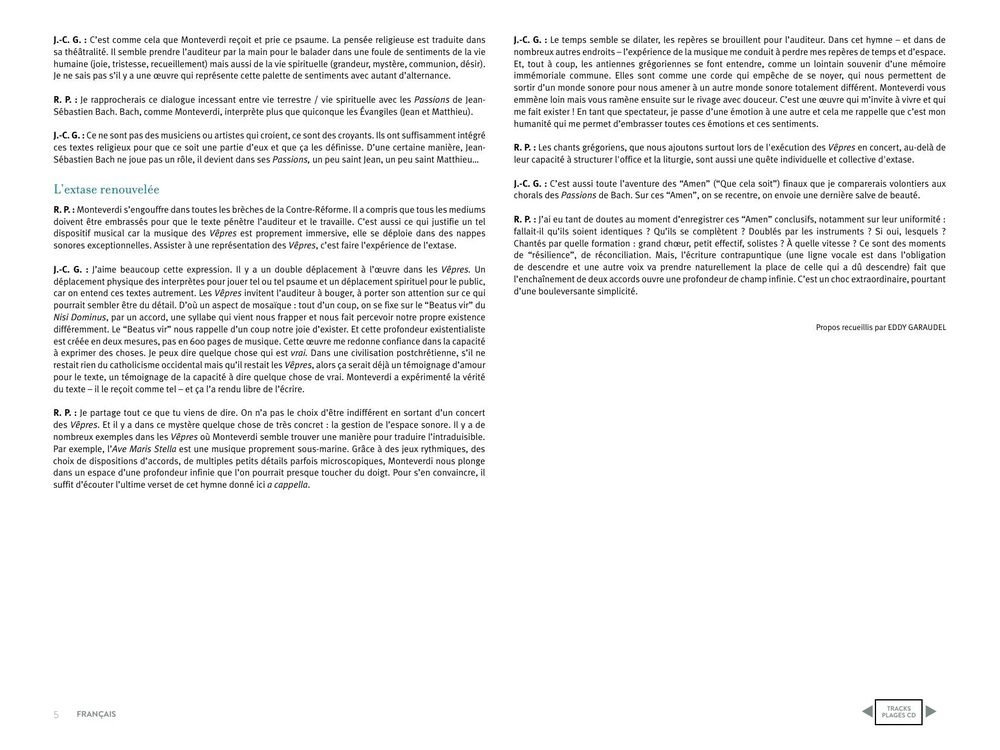


Vespro della Beata Vergine · HMM 902710.11
25 pages · French, English & German · an interview-style booklet in which Raphaël Pichon thinks aloud about the work.
- Conversation: Raphaël Pichon × Jean-Clément Guez
- Essay on the 1610 Mantuan collection
- Complete sung texts · Latin / FR / EN / DE
Why it still matters
I began by saying this recording took me by the collar, and I want to end by trying to say why — why a four-hundred-year-old evening service, assembled half by accident by an underpaid servant in a swampy duchy, should still be able to do that.
Part of it is purely musical: the Vespers stand at the precise hinge where Western music turns from the impersonal perfection of Renaissance polyphony toward the individual, speaking, feeling voice of everything that came after — Bach's Passions, opera, the whole expressive project of the next four centuries. Monteverdi puts the oldest thing in church music, the chant, underneath the newest, the solo aria, and from that collision strikes a music that is at once ancient and shockingly direct. To hear it is to stand at a fault-line in the history of the human ear.
But part of it is something Pichon's booklet says better than I can. In a civilisation that has largely forgotten the faith this music was written to serve, the Vespers survive as a witness — not primarily to a doctrine, but to the sheer human capacity to mean something completely, to say a true thing and stake everything on it. Monteverdi believed the words he set, and that belief made him free to set them as no one had dared. We do not need to share his creed to be undone by that freedom. The Vespers begin with a cry for help and end, in Pichon's reading, with a blessing for the dead, and in between they move through every register of being alive — joy, grief, terror, longing, ecstasy, peace. Pygmalion give them to us not as a relic under glass but as something still burning. Deus in adjutorium: God, come to my aid. Four hundred years later, the cry still carries, and these young musicians answer it as if everything — the next chord, the next breath — depended on getting it right. It does. That is what it still matters.
Four centuries on, the Vespro still asks its first question — Deus in adjutorium, God come to my aid — and Pygmalion answer it as if everything depended on the next chord.
A note when a new essay or travelogue appears. No noise, unsubscribe in one click.