Hildegard of Bingen — the Sibyl of the Rhine, her music, her visions, her century
Medieval sacred music · monophony, vision, and the greening of the world
By Primož Zevnik
Hildegard of Bingen (1098–1179) — Benedictine abbess, visionary, healer, and one of the most original composers of the Middle Ages — met where she lives most vividly: in her own soaring music, here carried by young Slovenian voices in a new cinematic production. An essay on her life, her century, her visions, her medicine, and the long road that ended, eight centuries late, in sainthood.
◆
O human, who are but dust of the earth and ashes of ashes: cry out and speak of the way of pure salvation, until those people are instructed who, though they see the inmost meaning of Scripture, do not wish to tell it or preach it.
The voice from the Living Light, commanding Hildegard to write · Scivias, Declaration (c. 1141)
◆
There is a moment, near the start of the film, when the camera holds on a single candle and a single girl's voice, and the great dark church seems to lean in to listen. The voice climbs — not the careful, level chant most of us imagine when we hear the word medieval, but something restless and vaulting, a melody that keeps reaching past the note you expect, opening upward as if the ceiling were not there. It is a line written nine hundred years ago by a Benedictine abbess on the Rhine, and it is being sung tonight in Ljubljana by a teenager who learned it, by heart, from a notation older than the bar-line. I have spent a great deal of my life recording music, and I am not easily surprised by sound. This surprised me. I had to film it.
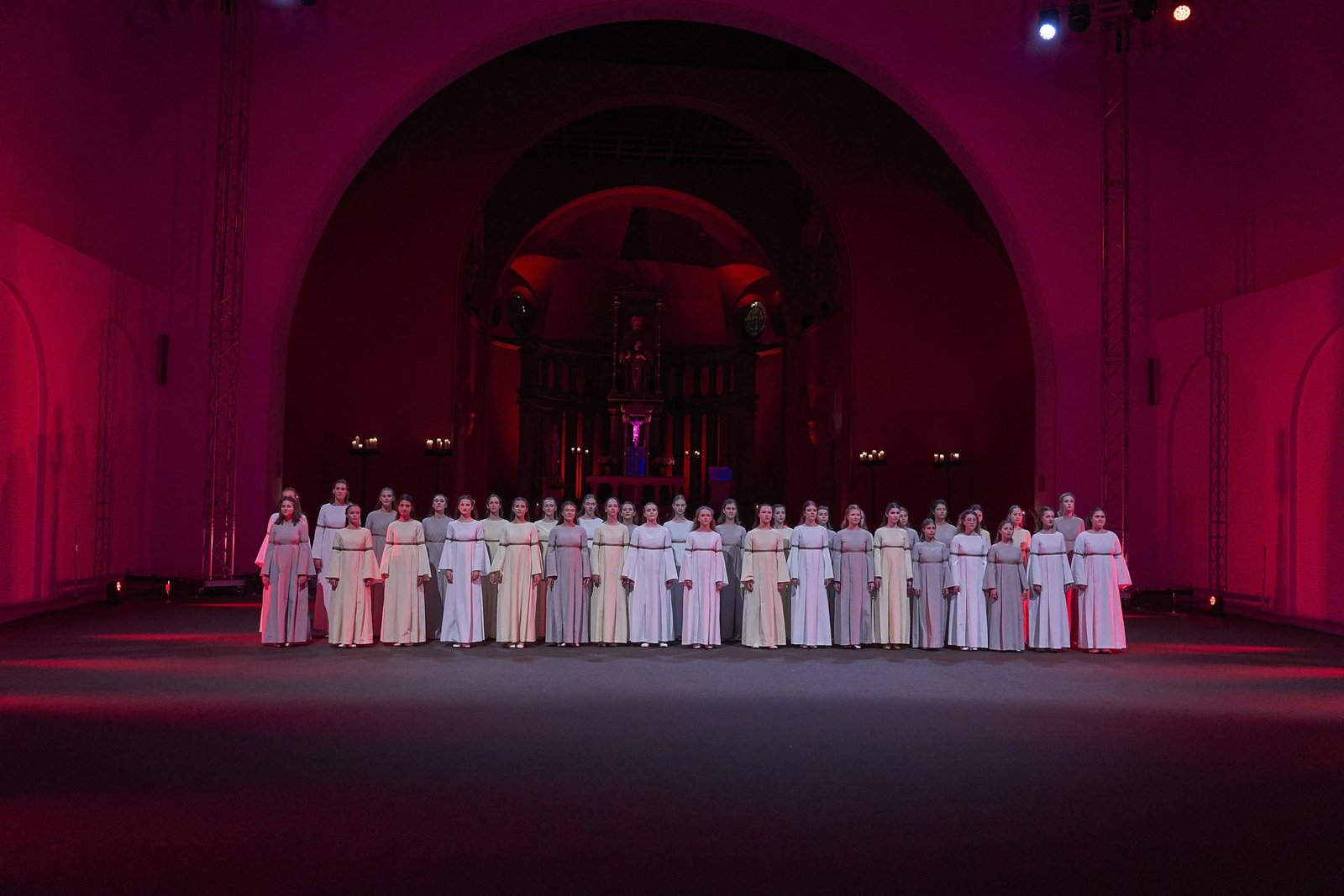
The work was called, in its first Slovenian life, Ljubezen preplavlja vse — Caritas abundat in omnia, “Love overflows into all things” — a singing-and-dancing vision of the music of Hildegard of Bingen, conceived by the conductor Helena Fojkar Zupančič for the St. Stanislav Girls' Choir of the Diocesan Classical Gymnasium. It was first performed in May 2022 in the Church of St. Joseph in Ljubljana, then in the cathedrals of Gornji Grad and Koper; at the end of that year it became something else again — a film. What you are reading is the essay I wanted beside it: not a programme note, but the whole world the music opens onto, the life and the century and the long afterlife of the woman whose voice those young singers were carrying. It is, I admit at once, a love letter to one of the strangest and most luminous figures in the history of European art.
The project had been years in the making before a single frame was shot. It began as a live performance — Ljubezen preplavlja vse — conceived by Helena Fojkar Zupančič as something far more ambitious than a concert of medieval song: a complete pevsko-plesna predstava, a sung-and-danced theatre piece in which Hildegard's chant was woven together with newly composed responses, with choreography drawn from medieval and Renaissance dance, with the colours of period instruments and the architecture of carefully designed light. To realise it, she gathered a remarkable company of collaborators — the musicologist who would teach the girls to read medieval notation, the award-winning composer who would build the contemporary bridge, the choreographer who would put the music into bodies, an ensemble of early-instrument players — and shaped the whole into a single evening that moved an audience to its feet. It was performed first in Ljubljana and then in two great cathedrals, and it might have ended there, as fine live performances do, living on only in the memory of those who were present. That it did not — that it became a film, and that the film became the occasion for this essay — is a small piece of luck for which I am the grateful and slightly disbelieving cause. What follows is everything I wish I could have folded into the film itself: the life behind the voice, the century behind the life, and the long, improbable journey by which a twelfth-century abbess came to be sung, in the twenty-first, by a choir of Slovenian girls in a candle-lit church.
The complete 43-minute cinematic production, recorded in the National Shrine of St. Joseph, Ljubljana — Hildegard's chant interwoven with three contemporary responses by Damijan Močnik. St. Stanislav Girls' Choir, dir. Helena Fojkar Zupančič. (Watch first, then read — or let it play beneath the essay.)St. Stanislav Girls' Choir in the candle-lit nave of the Church of St. Joseph, Ljubljana — a frame from the production. (Production still · replace.)
Who was she, this Hildegard? The short answer is almost absurd: a Benedictine nun who became, in turn, one of the most original composers of the Middle Ages, the author of three vast books of visionary theology, a writer on medicine and the natural world, an inventor of her own language, a correspondent of popes and emperors, a preacher who toured the Rhineland at an age when most of her contemporaries were long dead — and who, after eight centuries of being honoured as a saint without ever being formally made one, was finally canonised and named a Doctor of the Church in 2012. The longer answer is this essay. Let us begin where she began: in a small stone room, in a hard century, with a child who saw light.
─────I · chapter
The world into which she was born
Hildegard was born in 1098, most likely at Bermersheim in the Rheinhessen, the tenth child of a family of the lower nobility. To be the tenth child was, in the arithmetic of the age, to be a child who could be given away; and so she was promised to God as a tithe, an offering of one in ten. It is easy to read that fact with modern horror and miss what it also was — a door. The Church was, for a clever girl in the twelfth century, almost the only room in which a mind like hers could grow. The world outside that room was loud, violent, and tense with change. The First Crusade reached Jerusalem the year after her birth; the long quarrel between popes and emperors over who could appoint bishops — the Investiture Controversy — had only just been patched, uneasily, and would tear open again. The Rhine valley, her whole life's geography, was the spine of the Holy Roman Empire, thick with monasteries, vineyards, river-tolls and ambition.
We know less about her childhood than we would like, and what we know comes refracted through the later, sanctifying accounts — but the outline is poignant enough. She was born into a family with land and a name but not great wealth; her father, Hildebert, held his position in the service of the local nobility, the counts of Sponheim. As the youngest of so many children she was, in the cold logic of inheritance, surplus — and her parents, perhaps in gratitude for a sickly child's survival, perhaps simply following the custom of their class, resolved to render her to God. There is something almost unbearable in the picture of a small girl, eight years old, carried away from everything she knew to be sealed into a stone cell with a young woman barely out of girlhood herself; and there is something equally striking in how little self-pity Hildegard ever shows about it. She did not experience the enclosure as a wound to be nursed. She experienced it, in the end, as the soil she was planted in. The modern instinct is to read child oblation as a small cruelty, and by our lights it was; but to Hildegard it was simply the shape of a life given over, from its beginning, to a purpose larger than itself — and everything she became grew from that early, total transplanting.
A child given as a tithe
Child oblation — the dedication of a young child to monastic life by their parents — was a normal medieval practice, governed by the Rule of St. Benedict. Hildegard entered religious life at eight; she would remain inside its walls, in one form or another, for the next seventy-three years. The enclosure that might have been a cage became, for her, the one place spacious enough to hold what she saw.
To make sense of that choice — and of everything Hildegard would later be permitted to do — we have to step back from the cell and look at the whole landscape of her century. It was a far stranger, more turbulent and more intellectually alive moment than the word “medieval” usually conjures, and Hildegard stands at the precise crossing-point of its energies: the new learning and the old power, the river of commerce and the river of faith, all of it running, quite literally, past her door.
⌖ Historical context — the long twelfth century on the Rhine
To understand Hildegard you have to feel the strange double pressure of her century. On one side, the twelfth century was an age of astonishing intellectual ferment — historians have long called it the Twelfth-Century Renaissance. Cathedral schools were turning into universities; Latin learning, and through Arabic and Greek intermediaries the recovered science of antiquity, was flooding back into the West; Abelard was scandalising Paris with logic and love; the Cistercians, led by the incandescent Bernard of Clairvaux, were reforming monasticism toward a fierce, stripped-down ardour. Gothic was about to be born in stone at Saint-Denis. It was a moment when Europe began, again, to think on a large scale.
On the other side, it was an age of hard power. Hildegard's lifetime spans the reigns of emperors who treated the Church as a political instrument; the Second Crusade (1147–1149), which Bernard himself preached and which ended in humiliating failure; the papal schisms; the rise of the Hohenstaufen and the formidable Frederick Barbarossa, with whom Hildegard would one day correspond and, eventually, clash. The Rhineland sat at the crossing-point of all of it. Mainz, an hour from her later home, was one of the great archiepiscopal sees of the Empire; the river carried wine and pilgrims and armies alike.
Women, in this world, had almost no public voice. They did not preach; they did not teach men; they did not, as a rule, publish books under their own names and expect popes to read them. That a woman from a minor noble family could do all of these things — and be believed — is the first astonishment of Hildegard's life. She did it not by claiming authority for herself, which would have been fatal, but by claiming none: she was, she insisted, merely paupercula feminea forma, “a poor little figure of a woman,” an unlearned vessel through whom a higher voice spoke. It was the one rhetorical key that could open every locked door of her age, and she turned it with absolute conviction — and, one suspects, with a strategist's intelligence.
Consider, first, the political settlement into which she was born. The great wound of the previous generation — the Investiture Controversy, the savage quarrel over whether the Pope or the Emperor held the right to invest bishops with the symbols of their office — had been bound up, just six years before Hildegard's birth, by the Concordat of Worms in 1122. It was a compromise, and like all compromises it left both sides watching each other. The Emperor surrendered the ring and staff, the spiritual symbols; the Church conceded the Emperor a role in the temporal side of a bishop's appointment. But the deeper question — who, in the end, ruled Christendom, the sword or the keys — was not settled at all, only deferred, and it would shadow the whole of Hildegard's century. To grow up in the Rhineland in 1100 was to grow up in a world where the two greatest powers on earth, papacy and empire, were locked in a wary, unfinished embrace, and where a bishop was at once a prince and a pastor, a landholder and a successor of the apostles. Hildegard would spend her life inside that tension, and her ferocious letters to corrupt prelates draw their force from it: she held the clergy to the spiritual standard precisely because she watched them grasp at the temporal one.
Over that settlement rose a new dynasty. The Hohenstaufen came to the imperial throne in 1138, and in 1152 the most formidable of them, Frederick I — Barbarossa, “red-beard” — was crowned. He was a ruler of immense ambition who dreamed of restoring the grandeur of ancient Rome to the German crown, and his reign collided, again and again, with the papacy. From 1159 a contested papal election split the Church into a line of popes and a line of imperial antipopes, a schism that dragged on for nearly two decades. Hildegard corresponded with Barbarossa; she had met him, and he had granted her monastery imperial protection. But when he backed the antipopes against the legitimate Alexander III, she wrote to him with a bluntness that still startles — warning the most powerful man in Europe, in the voice of her visions, that he was behaving like a child and courting divine anger. That a cloistered abbess could rebuke an emperor to his face, and survive it, is the political miracle her papal endorsement had made possible.
Over everything, in 1147, fell the shadow of the Second Crusade. Bernard of Clairvaux — the same Bernard who had vouched for Hildegard at Trier — preached it across Europe with overwhelming eloquence; tens of thousands took the cross; and within two years it had collapsed in disaster outside Damascus, a humiliation that shook the confidence of the age and left Bernard himself struggling to explain how a holy war blessed by the Church could end in such ruin. Hildegard lived through that disillusionment, and it sharpened the apocalyptic strain that runs through her later work — the sense that the Church had grown lukewarm, that judgment was near, that the green vigour of true faith was drying into the ariditas of corruption and worldliness. When she went on the road to preach in the 1160s, this was her text: not comfort, but warning. The same restless century that produced soaring cathedrals and recovered Aristotle also produced a deep undercurrent of anxiety, and Hildegard gave that anxiety a voice.
The anxiety had a darker edge, too, in the rise of dissent. The twelfth century saw the first great flowering of organised heresy in the West — above all the Cathars, the dualist movement spreading through southern France and the Rhineland, who held that the material world was the work of an evil power and the spirit alone was good. To Hildegard, whose entire vision rested on viriditas, on the goodness and greenness of a creation saturated with God, this was not merely an error but an inversion of reality, and she preached against the Cathars directly. It is one of the quiet ironies of her thought that the woman so beloved today by seekers of “alternative” spirituality was, in her own time, a fierce defender of orthodoxy against the most successful alternative spirituality of her age.
And beneath the high politics lay the texture of the land itself — the Rhine, her whole world's artery. The river carried the wine of its terraced slopes, the pilgrims bound for shrines, the merchants and the armies. Along it stood the great cathedral cities, and among them the so-called ShUM cities — Speyer, Worms and Mainz — which were also, in this period, the beating heart of Ashkenazi Jewish life and learning in Europe. That coexistence had already turned to horror once: in 1096, as the First Crusade gathered, mobs had fallen upon the Jewish communities of the Rhineland in a wave of massacres, a catastrophe still fresh in living memory when Hildegard was a child. The world outside the cloister wall, in other words, was not the serene “Age of Faith” of later nostalgia. It was a place of pilgrimage and pogrom, of scholarship and slaughter, of cathedrals rising over cities that had run with blood — a world of tremendous spiritual energy and tremendous violence, held in the same trembling hand. To understand the serenity of Hildegard's music, you must hear it against that noise. It is not the sound of a calm age. It is a window opened, deliberately, onto a peace the age did not possess.
At eight she was entrusted not to a school but to a person: Jutta von Sponheim, the daughter of a count, who had chosen to live as an anchoress — a recluse sealed into a small dwelling attached to the men's monastery of Disibodenberg. The image is severe and worth holding onto. Two females, then more, walled into a stone cell beside a community of monks, their lives reduced to prayer, fasting, the chanting of the psalms at the eight hours of the Divine Office, and the slow turning of the liturgical year. There was a rite, in some places, that read the enclosure of an anchoress as a kind of funeral: she was dead to the world. And yet it was here, in this architecture of withdrawal, that Hildegard learned Latin, learned the psalter, learned to sing — and went on seeing what she had seen since she was a small child.
The figure of Jutta is worth holding in the mind, because she set the pattern Hildegard would both inherit and outgrow. Jutta was an aristocrat who had refused the world for a life of extreme austerity — the hair shirt, the barefoot prayer through cold nights, the deliberate narrowing of existence to its spiritual essentials — and her reputation for holiness drew other women to be enclosed alongside her, so that the single anchoress's cell slowly grew into a small community of nuns attached to the men's house. Into this world the child Hildegard was absorbed, and from Jutta she received the rudiments of everything: the Latin of the psalms she would chant for the rest of her life, the daily music of the Office, the discipline of a life lived entirely within walls. We should not sentimentalise it. The enclosure was real, the austerity was real, the renunciation of family and freedom and the ordinary future of a woman was real and permanent. And yet, within that severe and narrow frame, a mind of staggering range was quietly forming — absorbing the chant that would become the raw material of her own music, steeping in the scripture that would feed her visions, learning the rhythms of a life she would one day reshape into art. The cell that looked like an ending was, for Hildegard, a beginning so slow that it took nearly forty years to show itself.
🔍 Klikni za fullscreen · premakni za lupo
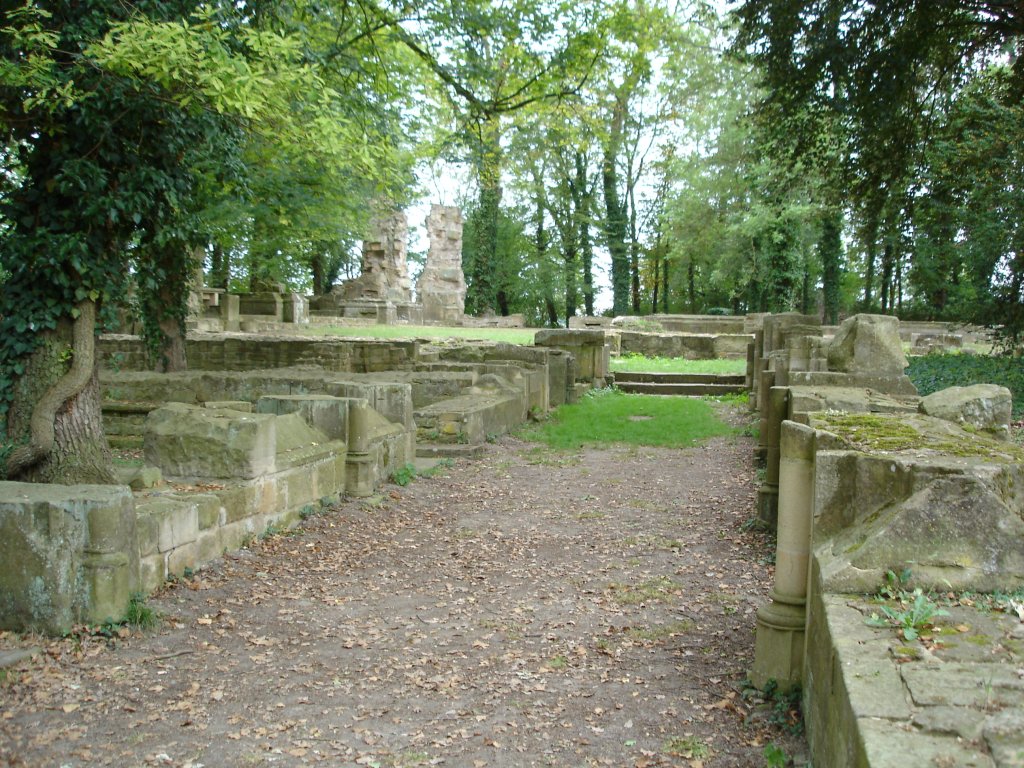
The ruins of Disibodenberg, the monastery where Hildegard was enclosed with Jutta von Sponheim and spent the first four decades of her life. (Wikimedia · verify.)
Jutta von Sponheim
Hildegard's teacher and the magnet of the little community, Jutta (c. 1091–1136) was venerated for her ascetic holiness — she wore a hair shirt and is said to have prayed barefoot through the cold. When she died in 1136, the women around her elected the thirty-eight-year-old Hildegard as their magistra, their leader. Only then, with Jutta gone and herself in charge, did Hildegard's own voice begin to be heard.
The visions had been with her, she said, almost from the beginning. She was careful — always — to describe them in a way that fenced off the obvious suspicions of madness or fraud. They came, she insisted, not in dreams or trance or bodily ecstasy, but in full waking consciousness, with her eyes open and her mind clear: an inner seeing and an inner hearing, a light she called the umbra viventis lucis, the reflection of the Living Light. For most of her life she told almost no one. She was afraid — of pride, of disbelief, of the Church's long suspicion of women who claimed to hear God directly. Then, in her early forties, the pressure broke. A voice from the light commanded her to write down what she saw; she fell ill, as she often did at the great turning points of her life, until she obeyed. She turned to her teacher and confessor, the monk Volmar, who would become her secretary and lifelong collaborator, and she began to dictate.
The nature of these visions has fascinated and divided readers for centuries, and Hildegard's own descriptions are precise enough to fuel the debate. She insisted, repeatedly and emphatically, that what she experienced was not the rapture of the ecstatic mystic — not a soul caught up out of the body, not dream or trance or swoon. She saw, she said, with the eyes of the inner self while fully awake, her bodily eyes open, her mind clear; the images appeared before her not in sleep but in the ordinary light of day, accompanied by a voice that interpreted them. She called the steady background radiance the “reflection of the Living Light,” and within it, at rarer moments, a more dazzling brilliance she named the Living Light itself. Modern readers have brought their own frameworks: some neurologists, struck by her accounts of shimmering points, fortified lines and showers of falling stars, have suggested that the visual auras of migraine may have been woven into her experience — a hypothesis that explains the form of certain images without touching their meaning. Hildegard would not have recognised the diagnosis, and it settles nothing about the content of what she saw. What matters for the music and the books is simpler and stranger than any explanation: that she experienced the invisible world as continuously present, pressing at the edge of the visible, and that she spent a lifetime finding words and images and melodies adequate to report it. The visions were not episodes punctuating an ordinary life. They were the medium she lived in.
🔍 Klikni za fullscreen · premakni za lupo
Hildegard receives the vision: the five tongues of flame descend upon her as she writes on wax tablets, with the monk Volmar recording at the side. Opening illumination of the Rupertsberg Scivias codex. (Wikimedia · verify.)
It came to pass… that the heavens were opened and a fiery light of exceeding brilliance came and permeated my whole brain, and inflamed my whole heart and my whole breast, not like a burning but like a warming flame, as the sun warms anything its rays touch.
Hildegard, describing the vision of 1141 · Preface to Scivias
─────II · chapter
The book called Know the Ways
The book that resulted was Scivias — a contraction of Sci vias Domini, “Know the ways of the Lord.” She worked on it for roughly ten years, finishing around 1151. It records twenty-six visions, grouped into three parts — creation, redemption, salvation history — and it is unlike anything else of its time: a cosmology, a theology, and a sustained act of imagination all at once, in which the unseen is made violently visible. Pillars, towers, a cosmic egg, a woman the size of a city who is the Church, fountains of living fire. Crucially, in its most magnificent surviving copy — the Rupertsberg Codex, produced under Hildegard's own direction — each vision was accompanied by an illumination, a painted image of startling, diagrammatic strangeness. These pictures are not decoration. They are the vision rendered as a structure you can stand inside, and they have become, if anything, more famous than the prose they accompany.
The making of the book is itself a drama worth pausing on. Hildegard was already in her forties when the command came — no longer young by medieval reckoning — and the writing did not come easily or quickly. She worked at it for roughly a decade, dictating to Volmar, who took down her Latin and helped to smooth it; her own grasp of formal grammar was uncertain, and she leaned on his learning as she leaned on his loyalty. The collaboration is a reminder that her authorship was never quite solitary: a woman's visionary voice, a monk's literate hand, the two of them bent over wax and parchment in the margins of a men's monastery, slowly turning fire into text. And the labour was physical. Again and again Hildegard tells us that resisting the call to write made her ill, that the visions pressed on her until she gave them out, that the act of disclosure was as much a release of bodily pressure as a spiritual duty. The serene authority of the finished book conceals the cost of producing it — the years, the sickness, the sheer audacity of a woman setting down, for the Church to read, a theology she claimed to have received directly from God. When at last it was done, copies were made and carried; the book travelled; and the strange, diagrammatic pictures that accompanied it travelled with it, fixing Hildegard's visions in the eye of everyone who saw them long before most could read a word of her Latin.
The Synod of Trier, 1147–1148
Hildegard's gamble — a woman publishing visions — could have ended in condemnation. Instead it was legitimised at the highest level. At the Synod of Trier, Pope Eugenius III is said to have read aloud from the unfinished Scivias, with the towering Bernard of Clairvaux present and supportive. The Pope sent Hildegard a letter of approval and encouragement. Overnight, she went from a local curiosity to a figure with papal endorsement — a sanction that protected her for the rest of her life.
It is worth pausing on how extraordinary that endorsement was. The Church of the twelfth century did not, as a habit, invite women to speak in its own voice. But Hildegard had arrived at exactly the moment when her particular gift — a claim to direct, unmediated divine vision — answered a hunger in the reforming Church for renewed, charismatic authority. Bernard, the most powerful churchman in Europe, recognised something genuine in her. With Eugenius's blessing she became, in effect, a licensed prophet, and she used that license for the next three decades with a boldness that still startles — rebuking clergy, advising emperors, scolding the lax and the corrupt, and, not incidentally, writing music.
It is worth being precise about the mechanism of her authority, because it is the key to everything that followed. Hildegard never once claimed to speak in her own name. Her formula, repeated like a refrain across the books and letters, was that she was an uneducated woman, a frail vessel, a paupercula feminea forma through whom the Living Light chose, for its own reasons, to speak — and the very weakness of the instrument was offered as proof of the strength of the source. This was not false modesty, though it was certainly strategy as well as conviction. In a Church that would have crushed a woman presuming to teach on her own account, it was the one posture that could not be attacked, because to attack it was to attack not Hildegard but the God she claimed merely to transmit. And once that claim had been ratified at the highest level — by a pope reading her words aloud, with the greatest churchman of the age looking on — it became a kind of armour. From behind it she could do what no woman of her century could otherwise have dared: correct bishops, instruct popes, warn an emperor, tour the Rhineland preaching to crowds of clergy, and pour out, year after year, a body of theology, music, science and verse under her own name. She had found the single key that fit every lock in her world — and, having found it, she turned it again and again, with a confidence that reads, at this distance, very much like genius wearing the mask of obedience.
⌖ Theological context — viriditas, and the greening of the world
If there is a single word that unlocks Hildegard — her theology, her medicine, and above all her music — it is viriditas. The word is usually translated “greenness” or “greening power,” but no translation quite holds it. Viriditas is the moist, vital, fertile force of life itself: the sap rising in a vine, the freshness of a meadow after rain, the vigour of a healthy body, the fruitfulness of a soul in grace. It is, for Hildegard, a divine energy that runs through all created things, binding the visible and invisible worlds into one living fabric. When the world is green, it is alive with God; when it dries out — ariditas, the opposite term — it withers toward sin and death. Few medieval thinkers held so vivid, so almost ecological a sense of creation as a single breathing organism.
This is not soft nature-mysticism, though our own age has sometimes flattened it into that. It is rigorously theological. Viriditas flows from the Holy Spirit — the ignis (fire) and the Paraclete (comforter) who, in Hildegard's vision, kindles and moistens and quickens the cosmos. Her favourite images for God are not the stern judge of so much medieval art but the gardener, the green branch, the living light, the fountain. And, strikingly, the divine often wears a feminine face in her work: Caritas (Love), Sapientia (Wisdom), and Ecclesia (the Church) appear as great women, radiant and maternal. Caritas abundat in omnia — “Love overflows into all things, from the depths most excellent to beyond the stars” — is not a sentimental line. It is a precise statement of her entire cosmology: a universe saturated, top to bottom, with an overflowing, greening, divine love.
This is why her music sounds the way it does. When a melody refuses to settle, when it keeps climbing, when a single syllable blossoms into a long garland of notes, that is viriditas made audible — the surplus, the overflow, the life that cannot be contained in a tidy phrase. To sing Hildegard is to enact her theology with the breath. The young women in Ljubljana, whether they could have named it or not, were singing the greening of the world.
To see how completely viriditas organises her thought, look at the architecture of Scivias itself. Its twenty-six visions fall into three parts that trace the whole arc of the divine drama: the first on creation and the fall, the second on redemption through Christ and the Church, the third on the history of salvation unfolding toward the end of time. It is, in effect, a cathedral built of images rather than stone, and at its threshold stands one of the strangest pictures the Middle Ages produced — the cosmic egg. Hildegard saw the universe as a vast oval, an egg of fire and shadow and bright air, with the earth suspended at its yolk and the winds and stars and elemental layers wrapped around it like the shell and white. It is not a map a modern astronomer would recognise, but it is doing something a map cannot: it is showing the cosmos as a single living organism, gestating, held in being by the warmth of God exactly as an egg is held by the warmth of the hen. The whole of creation, in that image, is alive and unborn and tended. That is viriditas drawn as a diagram.
Then there is the colour of her God. Where so much medieval theology reaches for the language of law, judgment and hierarchy, Hildegard reaches for the language of fertility and light. Her Trinity, in the famous vision, is a figure of sapphire blue — the Son — set within two concentric circles of living fire and gentle radiance, the whole image pulsing with the heat she calls love. Her Holy Spirit is ignis, fire, and the Paraclete, the Comforter, and above all the greening power, the divine moisture that quickens seed and soul alike. When, at the end of her life, she fought to keep her nuns singing, the theology underneath the fight was this: that the Spirit who greens the world is the same Spirit who breathes in music, and to silence the song is to dam the very current of life.
Most striking of all, to a modern reader, is how often the divine in Hildegard wears a woman's face. This was not feminism — the category did not exist, and Hildegard upheld the gender order of her age, insisting that women should not be priests and accepting their subordination in the visible Church. But in the invisible order, in the great allegorical visions, the powers that mediate between God and the world appear as towering female figures: Caritas, Love, the energy of the Godhead overflowing into creation; Sapientia, Wisdom, who was with God at the founding of the world; and above all Ecclesia, the Church herself, a crowned woman vast as a city, with the redeemed gathered in her arms and at her breast. Beside her, in the harsher visions, stands Synagoga, the figure of the old covenant, blindfolded and sorrowing. To populate the cosmos with these maternal, generative, female presences — to imagine Wisdom and Love and the Church as women of immense power and beauty — was, in a Church governed entirely by men, a quietly radical act of imagination, and it is much of why Hildegard speaks so directly to readers today who go looking for the feminine in the Christian tradition and are told there is none.
Her theology was also, deliberately, a road not taken. In the same decades that Hildegard was dictating her visions, the schoolmen of Paris — Abelard, the Victorines, soon Peter Lombard — were building the great machine of scholastic theology: rational, dialectical, argued proposition by proposition, the faith subjected to the tools of logic. Hildegard's theology is the opposite kind of knowing. It does not argue; it shows. It proceeds not by syllogism but by vision, image, symbol, the slow accretion of meaning around a picture. Where the schoolmen asked “whether” and “what follows,” Hildegard simply opened her eyes onto the burning cosmos and described what she saw, then let the voice of the Living Light supply the commentary. Both were ways of reaching for God; but hers preserved something the schools were beginning to lose — the conviction that the deepest truths are not concluded but beheld, and that beauty is not the decoration of doctrine but one of its primary forms. Her belief that Christ was foreknown and willed from all eternity, not merely as a remedy for sin but as the very point of creation, belongs to this vision of a cosmos designed from the first for love.
And this is why, in Hildegard, the disciplines we keep in separate rooms are in fact a single thing. The vision generates the book; the book is illuminated into images; the same theology is poured into music; and even her invented language, the Lingua Ignota, with its thousand strange and beautiful coinages — her word for God, for the soul, for a cricket and a campfire and a cathedral — seems to reach for a speech green enough, fresh enough, to name a creation she experienced as drenched in divine life. Word, image, melody and tongue are not four activities for Hildegard. They are four faces of one act of praise. When the young women in Ljubljana sang her antiphons, they were not performing a medieval curiosity; they were stepping, for a few minutes, inside a complete and self-consistent universe — one in which to sing the rising line of super sidera, up beyond the stars, is to enact the very structure of a world made, from its first morning, to overflow.
─────III · chapter
A house of her own
Success made Hildegard restless. By around 1150 her community of women had outgrown its cramped quarters at Disibodenberg, and — prompted, she said, by a vision — she resolved to move them to a place of their own: a windswept, half-ruined site across the Rhine near Bingen, dedicated to St. Rupert, the Rupertsberg. The monks of Disibodenberg were not pleased. Hildegard's growing fame had been good for their house; her women brought dowries and pilgrims. The negotiation over the move — and over the dowries the departing nuns were owed — was hard-fought, and Hildegard won it, securing not only the new foundation but a measure of independence for her community. She would later found a second house across the river at Eibingen, around 1165, and serve as abbess of both. To build, to negotiate, to administer property and protect it in law — these were not the expected activities of a visionary. Hildegard was a mystic who could also read a contract.
The move itself she framed, characteristically, as obedience to a vision rather than as ambition — God, she said, had shown her the new place and commanded the migration — but the human friction it produced was entirely earthly. The abbot of Disibodenberg resisted; his monks resisted; the loss of Hildegard's celebrated women, and of the dowries and pilgrim traffic they brought, threatened the very prosperity her fame had created. Hildegard fell ill again at the crisis, taking to her bed in a paralysis that lifted, the chronicles report, only when the resistance gave way — a pattern that recurs so often in her life that one hardly knows where to draw the line between sickness, will and sign. She won; the women crossed the river; and at the bleak, half-ruined Rupertsberg she built, from almost nothing, a community that would house some fifty nuns. Tradition credits her foundation with a piped water system feeding its workrooms, a piece of practical engineering that sits oddly and wonderfully beside the cosmic visions. A decade and a half later she repeated the feat across the Rhine at Eibingen, taking on a second house and crossing the river by boat to govern it. The administrative grind of all this — the charters, the disputes, the protection of endowments against grasping neighbours and resentful churchmen — was the unglamorous underside of her prophetic career, and she met it with the same formidable competence she brought to everything. The woman who saw the cosmic egg also kept the accounts.
Richardis von Stade
The most human wound of Hildegard's life. Richardis was a beloved young nun, close to Hildegard during the writing of Scivias. When Richardis was offered an abbacy elsewhere — at Bassum — Hildegard fought ferociously to keep her, writing letters to archbishops and even the Pope. She lost; Richardis left. And then, in 1152, Richardis died, young. Hildegard's grief, preserved in her letters, is raw and unguarded — a reminder that behind the cosmic visions was a woman who loved particular people and mourned them.
Her community of women became, in itself, a quiet provocation. A visiting magistra named Tengswich (Tenxwind) of Andernach wrote to Hildegard with a barbed, courteous letter of complaint: she had heard that on feast days Hildegard's nuns let down their hair, wore white silk veils and gold circlets, even rings — unseemly finery for brides of Christ, and besides, Hildegard admitted only girls of noble birth. Hildegard's reply is one of the most revealing documents she left. She defended the adornment with a theology of virginity: a virgin, she argued, stands in the unfallen radiance of Eden, untouched by the curse laid on married Eve, and may therefore be clothed in beauty as a sign of that paradisal state. It is a startling, aristocratic, and entirely characteristic answer — and it tells us that Hildegard's sense of beauty, of vesture and light and ceremony, was not incidental to her faith. It was her faith, made visible.
That exchange is a keyhole; through it we can see the whole peculiar world these women inhabited — a world whose daily texture is so foreign to us that, without some feeling for it, Hildegard's achievement loses its scale. What did it actually mean to be a woman, and a singer, inside a twelfth-century cloister?
⌖ Social context — the world of monastic women, and the day shaped by song
Begin with the walls. A Benedictine community lived under enclosure: the nuns did not leave, and the world did not casually enter. Within that boundary, life was governed not by the clock — there were no clocks — but by the bell, and the bell was tuned to prayer. The whole twenty-four hours were carved into the Divine Office, the eight canonical hours, beginning with Matins and Lauds in the cold and dark long before dawn and running through Prime, Terce, Sext, None, Vespers and Compline to the day's close. At each, the community gathered in the church to chant. Across the span of a week they sang their way through the entire Book of Psalms — all hundred and fifty — framed by the antiphons, responsories, and hymns proper to the day and the season. A nun like Hildegard would have known the psalter not as a book but as a bodily habit, the way you know a road you have walked ten thousand times. Music was not an enrichment of this life. It was this life, its very pulse and structure. To grasp Hildegard the composer, you have to grasp that she wrote for women who already spent a third of their waking hours singing.
Now consider how rare her literacy was. The overwhelming majority of medieval women — and most men — could neither read nor write. A girl placed in a good monastery was among the tiny minority who learned Latin, who handled books, who were trained in the chant and, sometimes, in the rudiments of theology, scripture, and the natural sciences as they were then understood. The cloister, for all its constraints, was the single most important institution of female learning in the medieval West; for centuries it produced virtually every woman whose intellectual work survives. When we marvel that Hildegard could write, we should remember both halves of the marvel: that almost no woman could, and that the monastery was the one place that made it even thinkable.
And yet the constraints were real and gendered. Women religious lived under male authority — a provost, an abbot, a bishop — and depended on priests for the sacraments they could not themselves administer. They were not to teach men or preach in public. The economics mattered too: a convent ran on the dowries its sisters brought and the lands it held, which is exactly why Hildegard's departure from Disibodenberg, with her well-born nuns and their endowments, was fought so hard by the monks who stood to lose them. To found a house, to win its independence, to administer property and defend it in the courts of the Church — these were feats of practical statecraft that the visionary literature rarely prepares us for. Hildegard did them all. She negotiated with abbots over money, designed (it is thought) a convent with running water piped to its workrooms, and held her ground against the most powerful men of the region. The mystic who saw the cosmic egg could also read a property deed — and that combination, far from being a contradiction, is the whole secret of how a twelfth-century woman built a platform high enough to be heard across Europe.
It helps to slow down and feel the actual shape of the day, because the day is where a life is really lived. The Rule of St. Benedict, six centuries old by Hildegard's time and still the constitution of her world, balanced the hours on a single phrase — ora et labora, pray and work — and wove the two into an unhurried, unvarying round. The night was broken for the long vigil of Matins, sung in the dark; before dawn came Lauds, the praise of first light; then through the day the little hours of Prime, Terce, Sext and None marked the passage of the sun; Vespers gathered the evening; Compline sealed the night with its prayers of protection before the great silence began again. Between the hours came the work — in the kitchen and the garden and the infirmary, at the loom, and, for the literate few, in the scriptorium, copying and illuminating the manuscripts that were a monastery's most precious export. Reading aloud accompanied meals; the year turned through its fasts and feasts; and over a lifetime this rhythm did not so much fill the days as become them. To enter such a community was to exchange the chaos of secular time for a life shaped like a piece of music — measured, repetitive, cumulative, built toward a resolution it trusted but could not see. Hildegard's compositions did not interrupt this life; they were its flowering, the most concentrated form of the thing the whole day was already doing.
She did not invent the learned nun; she crowned a long tradition of them. The cloister had been the seedbed of female learning for centuries before her. In the Ottonian world of the tenth century, the canoness Hrotsvitha of Gandersheim had written Latin plays in imitation of Terence; great royal abbeys like Gandersheim and Quedlinburg were ruled by abbesses who answered to no one but the Emperor and the Pope, women who minted coins, sent knights to the imperial army, and sat among the princes of the realm. An abbess could be, in the structure of medieval power, something close to a sovereign. Hildegard inherited that possibility and pressed it to its limit. When we are tempted to imagine her as a lonely miracle, a single light in total darkness, the truth is both less romantic and more interesting: she was the supreme blossom of an institution that had quietly been making powerful, literate, governing women for generations, in the one corner of medieval society where such women could exist at all.
That institution had a particular social colour, and Hildegard's critics put their finger on it. Tengswich's letter, with its complaint that Hildegard admitted only the well-born, was not merely catty; it named a real fact. Houses like the Rupertsberg were, in practice, aristocratic institutions, places where noble families settled the daughters they would not or could not marry off, along with the lands and rents that came with them. A convent was woven into the dynastic strategy of the regional nobility; its sisters were nodes in a web of kinship and patronage that reached out across the whole Rhineland. This is not a cynical observation — it is simply how such communities were funded and sustained, and it is why Hildegard's struggle to take her nuns and their endowments away from Disibodenberg was fought so bitterly. Property, lineage and prayer were not separate spheres. The same noble networks that gave a house its wealth gave it its recruits, its protectors, and its enemies, and an abbess who could not navigate them would not last.
And then there was the body, which monastic idealism never quite escaped. These were lives lived close to the bone — the cold of an unheated church at the night office, the long fasts of Advent and Lent, the plain and repetitive food, the physical labour, the absence of the ordinary consolations of family and the world. Hildegard herself was often ill, frequently at the great hinges of her life, and modern readers have wondered whether some of her visions came wrapped in the auras of migraine; she described light, shimmering fortifications, fields of stars, in ways that have struck more than one neurologist. Whether or not that is part of the story, it returns us to her own deepest conviction: that body and soul are not enemies but one greening fabric, and that what happens in the flesh and what happens in the spirit are the same weather, read on two instruments. The enclosed life, with all its severity, was for Hildegard not a war against the body but a discipline of it, a way of keeping the whole person — flesh, mind and soul together — turned, like a plant, toward the light. That conviction is the hidden link between the abbess who fasted and the physician who wrote of remedies and the composer who wrote music that demands the singer's whole breath. They are one woman, and the cloister, for all that it walled her in, was the ground in which that wholeness could grow.
All of that — the enclosure, the unceasing song, the rare gift of letters, the hard practicality — is the ground from which her music grew. And it is time, now, to listen to the music itself.
─────IV · chapter
The sound itself
And now the music — for it is the music that brought those young Slovenian voices, and this essay, and very possibly you, to Hildegard at all. She composed, across her life, some seventy-seven liturgical songs, gathered under a title as grand as her cosmology: Symphonia armonie celestium revelationum, “the symphony of the harmony of celestial revelations.” They are antiphons, responsories, sequences, hymns — the building blocks of the Divine Office and the Mass — written for her own nuns to sing. And they sound like nothing else in the chant repertory. Where most plainchant moves in careful, stepwise arcs within a narrow range, Hildegard's melodies leap and soar, sometimes spanning more than two octaves, vaulting upward through wide intervals, then unfurling a single syllable into a long, ecstatic melisma of many notes. Her conductor in Ljubljana, Helena Fojkar Zupančič, put it exactly: the melodies are razgibane in žive — restless and alive — with a very large range, virtuosic. They are hard to sing. They are meant to be.
There is a particular sensation that Hildegard's music produces and almost no other chant does — the feeling of a line that will not close. Ordinary plainchant gives the ear a quiet satisfaction of return: the melody rises a little, wanders, and settles back to rest. Hildegard withholds that rest. Her phrases open upward and keep opening, reaching a high note and then, instead of falling home, climbing past it; the resolution is always one step further than you expect, so that the listener is held in a kind of sustained ascent, suspended, leaning. It can feel almost vertiginous, and it is entirely deliberate — the musical signature of a theology that conceived of the soul as forever drawn upward toward a God who is always higher, always more. Even her chosen genres bend under this pressure. An antiphon meant to frame a psalm becomes, in her hands, a small ecstatic flight; a sequence becomes a long unfurling ladder of praise. And because she wrote the words as well as the notes, text and tune are fused at a level the ordinary chant repertory never reaches: the melisma blossoms exactly where the word turns luminous, the leap arrives precisely on the syllable that names the height. To sing it well, as those young women discovered, is not merely to hit the notes but to shape the long ascents, to find the breath for lines that seem designed to outlast a single lungful — to enact, with the body, a music that was always about reaching past the body's limits.
🔍 Klikni za fullscreen · premakni za lupo
A page of Hildegard's notated music in early staff notation, from one of the two great surviving sources of the Symphonia (the Dendermonde and Wiesbaden / “Riesencodex” manuscripts). (Wikimedia · verify.)Hildegard's antiphon O Virtus Sapientiae — 'O strength of Wisdom' — sung by the St. Stanislav Girls' Choir: the soaring, restless monophony described above.
⌖ Liturgical and musical context — chant, and the breaking of its mould
To hear how radical Hildegard's music is, you have to know the world it grew from. The daily life of a Benedictine community was built around the Divine Office — eight services a day, from Matins in the dark of night to Compline at its close, at which the nuns sang their way through the entire Book of Psalms each week, framed by antiphons, responsories and hymns proper to the season. This was plainchant (or Gregorian chant): a single unaccompanied melodic line, sung in unison, in free, text-driven rhythm, organised by the system of the eight church modes. Its genius is restraint. The melody serves the word; it rarely calls attention to itself; it moves, for the most part, by step, within a comfortable compass. Centuries of monks and nuns had polished it into a vast, anonymous, collective art in which the individual composer all but disappeared.
Hildegard does something almost transgressive within that world: she writes chant that is unmistakably personal. Her melodies are signed, in effect, by their own excess — the soaring tessitura, the wide leaps of a fifth or an octave, the way a phrase will rise to a luminous peak and hang there, the long melismas that pour out over a single vowel like light through a window. She favours certain modes — the bright, slightly otherworldly sound of the Dorian and the Phrygian, and especially the Lydian, with its raised fourth degree that lends an ecstatic, weightless quality. And her texts, which she wrote herself, are not the standard liturgical Latin but her own dense, image-crowded, sometimes almost untranslatable poetry, so that word and melody are born together. “Her songs are not only melodies,” Helena Fojkar Zupančič observed; “they are melodies that arise out of the word.”
This is exactly what made the music so demanding for the young singers in Ljubljana — and why their achievement was real. The musicologist Dr. Katarina Šter, who guided the choir into Hildegard's world, had them learn to read the music from square notation, the medieval notation that preceded the modern stave, with far less rhythmic information than later scores; the singers had to shape the long melismas themselves, supplying the breath and the line that the bare notation only sketches. There were no bar-lines to lean on, no fixed beat to lock together — “and in such purified unison,” Šter noted, “every slip is heard.” They learned the modes through exercises, kept returning to the recitation of the texts so as not to drown in the melisma, and sang the whole exacting programme from memory. It was, in Šter's lovely phrase, a medieval musical marathon — and she was sure that each of those young women now carries, in some hidden pocket, a musical diamond.
To place Hildegard's achievement, it helps to know how chant was actually built and sung, because the system she inherited was itself one of the great intellectual constructions of the early Middle Ages. By the twelfth century, Western liturgical music had been organised into the eight church modes — scale-patterns, each with a characteristic final note and a characteristic range, that gave every chant its particular emotional weather. The theorists had names and numbers for them, paired them as “authentic” and “plagal,” and debated their ethos; a singer learned to feel the difference between the grave first mode and the bright, almost unstable fifth. Just a century before Hildegard, the monk Guido of Arezzo had revolutionised the teaching of this music, devising the lines of the musical staff and the system of solmisation — the syllables, ancestors of our do-re-mi, that let a singer read a melody from sight rather than learning every chant by rote from a master's voice. Guido even mapped the notes onto the joints of the hand, the famous “Guidonian hand,” so that a choirmaster could point to a knuckle and call up a pitch. This was the living technology of music in Hildegard's world — and it is worth remembering that the “square notation” the Ljubljana singers had to master was the direct descendant of Guido's invention, a notation precise about pitch but sparing about rhythm, which is exactly why so much of the shaping was left to them.
Within that system, what does Hildegard actually do? Her surviving music falls into the standard liturgical genres — antiphons and responsories for the Divine Office, sequences and hymns, and the through-composed drama of the Ordo Virtutum — but she treats each with a freedom that sets her apart from almost every named contemporary. The ordinary antiphon of the chant repertory is a modest thing, a short melodic frame for a psalm, moving by step within an octave. Hildegard's antiphons can erupt: a single one may leap upward through a fifth and then a fourth in quick succession, range across two octaves and more, and pause to spin a single syllable into a long, vaulting melisma of a dozen or twenty notes. She returns, again and again, to certain luminous melodic gestures — a soaring opening leap, a hovering high note, a fall and recovery — so that her music, though strictly monophonic and unmeasured, carries an unmistakable personal signature. It is monody that behaves like rhetoric: every rise and fall is keyed to the meaning of the word beneath it, so that the melody does not merely carry the text but enacts it, climbing at the mention of heaven, descending into the depths, opening wide at the name of the Spirit.
It is illuminating to set her beside what was happening at the very same moment a few hundred miles to the west. In Paris, in Hildegard's lifetime, the composers we call the Notre-Dame school — Léonin and, soon, Pérotin — were taking Western music in the opposite direction, building the first great monuments of measured polyphony, stacking voices in rhythmic patterns over a held chant. That was the road that led, eventually, to the entire edifice of Western harmony. Hildegard took the other road. She poured her originality not into the combination of voices but into the single line itself, pushing monophony to an expressive extreme it had never reached and would rarely reach again. Hers is the great might-have-been of medieval music — a vision of where the single sung line could go if it were treated not as a humble vehicle for words but as a soaring, personal, almost operatic art. And this is precisely the road Damijan Močnik reopened for the production: by responding to her melodies with the parallel fourths and fifths of organum and the gentle chords of fauxbourdon, he imagined, in sound, the bridge she herself never crossed — what might have happened if Hildegard's line had met the Paris polyphony, if the two roads of the twelfth century had converged.
There is also the matter of survival, which is never neutral. Almost everything we have of Hildegard's music comes down to us through two manuscripts: the Dendermonde codex, copied around 1175 during her lifetime and very possibly under her supervision, and the vast Wiesbaden manuscript known as the Riesencodex, the “Giant Codex,” which gathers her complete works and weighs as much as a small child. That these books exist at all is a piece of luck; that the music in them can be sung again is the achievement of modern scholars and performers who had to reconstruct, from a notation that records pitch but not rhythm, how the lines should actually move. Every modern performance of Hildegard is therefore also an interpretation — a set of choices about tempo, about whether to add a drone beneath the line, about whether and how to colour it with medieval instruments. The early-music pioneers who brought her back made those choices in different ways, some austere and voices-only, some warmly instrumental; and the Ljubljana production made its own, grounding the young voices in the soft drones of Gothic harp, fiddle, recorder and hurdy-gurdy. There is no single “authentic” Hildegard to recover, because the manuscripts do not specify one. What there is, instead, is an invitation — a melodic skeleton of extraordinary beauty, asking each generation of singers to supply the breath, the line and the life. That the latest to accept the invitation should be a choir of Slovenian schoolgirls, reading Guido's notation nine hundred years on, is exactly the kind of continuity that makes the history of this music feel less like a museum and more like a relay.
Into this nine-hundred-year-old sound the production folded a living voice. Between the two halves of Hildegard's own music, the Slovenian composer Damijan Močnik set three of her texts anew, with two instrumental interludes written for the occasion — a deliberate dialogue across the centuries rather than a pastiche of it. He did not try to imitate chant, which would have been a museum exercise. Instead he asked a more interesting question: what might Hildegard's music have become two hundred years later, had it kept growing — on the same melodic fragments, in the same modes, but admitting the first flowering of polyphony? His answer reached back to the earliest techniques of medieval part-writing.
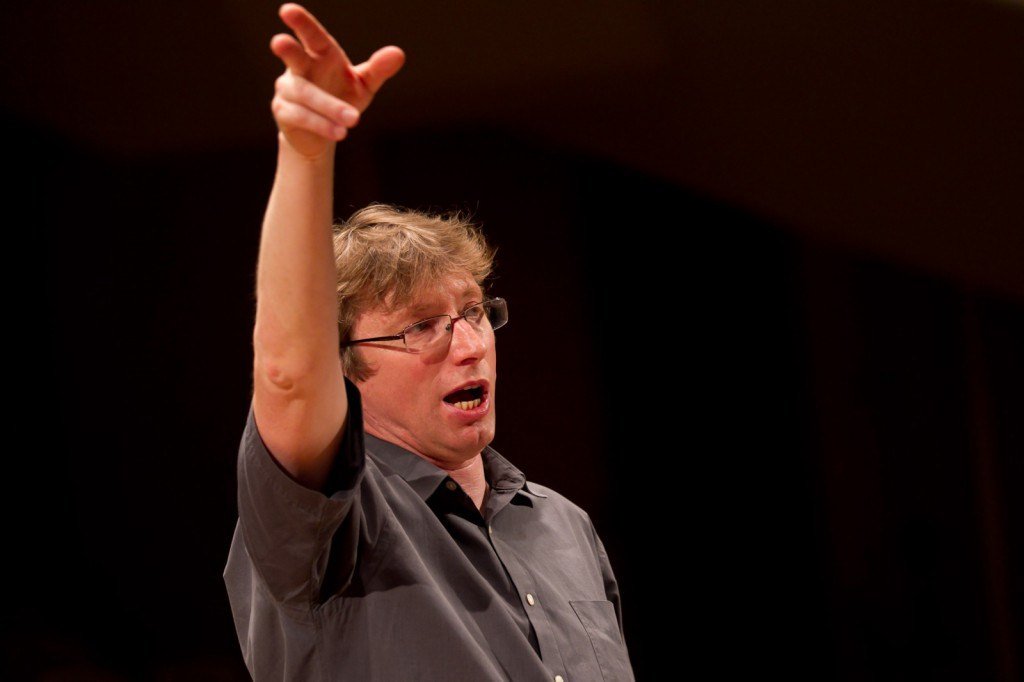
Damijan Močnik — the award-winning Slovenian composer whose three contemporary responses build the bridge across the centuries.Damijan Močnik, O Virtus Sapientiae — from his Caritas abundat in omnia: the contemporary response, in which the layered textures of early polyphony rise out of, and dissolve back into, Hildegard's melody.
Damijan Močnik's bridge across 200 years
Močnik — a laureate of the Kozina Prize and the Prešeren Fund Award, who had already written a Concerto for trumpet, harp and strings on Hildegardian themes — built his responses from the toolkit of early polyphony: organum (parallel fourths and fifths) and fauxbourdon (parallel six-three chords), with characteristic medieval cadences. In the central Caritas abundat these techniques stack in shifting layers; polychords gather; then an eight-voice polyphony blooms, each voice with its own character and pacing — and out of that dense, modern-sounding fabric, again and again, reminiscences of Hildegard's own line surface like a face in water.
And here is one of those texts — the antiphon that gave the whole project its name, four lines that compress Hildegard's entire vision of a love-saturated cosmos into a single breath.
Caritas abundat in omnia,
de imis excellentissima super sidera,
atque amantissima in omnia,
quia summo Regi osculum pacis dedit.
Love overflows into all things,
from the depths most excellent up beyond the stars,
and most loving toward all things,
for to the highest King she has given the kiss of peace.
Hildegard of Bingen · antiphon Caritas abundat in omnia · Latin, with English translation
Caritas abundat in omnia — 'Love overflows into all things,' the antiphon that gave the whole project its name, from the film.
Notice what the words do, and then imagine the melody doing it too: “from the depths” — de imis — sung low, and then “beyond the stars” — super sidera — carried up and up, the line itself climbing the cosmos it describes. This is Hildegard's method everywhere: the shape of the sound is the meaning. It is also why her music survives translation into a Slovenian gymnasium so gracefully. You do not need to construe the Latin to feel the ascent. The body understands it.
Glossary — a few words for Hildegard's world
viriditas — “greenness” or “greening power”
Hildegard's central idea, the moist, vital, fertile divine energy that animates all living things; the opposite of ariditas, dryness or withering.
Symphonia armonie celestium revelationum — “the symphony of the harmony of celestial revelations”
the collective title of Hildegard's roughly 77 liturgical songs.
Ordo Virtutum — “The Play of the Virtues”
Hildegard's sung morality play (c. 1151), in which the Virtues and the Soul contend for the human person; one of the earliest such dramas with music.
Lingua Ignota — “the unknown language”
a private vocabulary of around a thousand invented words, with its own alphabet, that Hildegard devised — perhaps for mystical, perhaps for playful or communal use.
─────V · chapter
The first opera, almost
Around the same years, Hildegard wrote something with no real precedent: the Ordo Virtutum, “The Play of the Virtues,” a fully sung sacred music-drama in which sixteen Virtues — Humility their queen, with Charity, Hope, Chastity, Discipline and the rest — contend with the Devil for a wavering human Soul. It is sometimes called the earliest surviving morality play, and one of the very earliest works of music-theatre in the West, predating what we would later call opera by centuries. There is a telling detail in its dramaturgy: every character sings except one. The Devil cannot sing. He only shouts, snarls, declaims in raw speech. In a work by a woman for whom melody was the very sound of grace and of the greening Spirit, the refusal of song is the mark of the diabolical. To be cut off from music is, quite precisely, to be cut off from God — a conviction that would return, near the end of her life, as the central drama of her final years.
The Ordo Virtutum deserves more than a footnote in the history of theatre, because it stages, in miniature, Hildegard's entire vision of the human condition. A Soul — Anima — begins in radiant eagerness to reach God, falters under the weight of worldly desire, is lured away by the Devil, and at last, battered and repentant, struggles back to the company of the Virtues who have been calling to her throughout. Around this single wavering soul gather the sixteen Virtues, led by Humility, each with her own voice and character, singing the soul home. It is a psychomachia, a battle for the self, set entirely to music — and its boldest stroke is the one already noted: the Devil alone is denied song. He can only bellow and rasp in raw, unpitched speech, a black hole in the texture of sung praise. In a work whose every other sound is melody, his speechlessness is theologically exact: evil, for Hildegard, is precisely the inability to join the harmony, the dissonance that has cut itself off from the music of creation. We do not know exactly how the play was first performed — most likely by Hildegard's own nuns, perhaps to mark the consecration of the Rupertsberg church, the women taking the parts of the Virtues and a priest or Volmar growling the Devil — but we can imagine it: a community of women enacting, in their own voices, the journey of every soul from radiance through ruin to return, with the one male voice in the cast reduced to the snarl of the damned. It is the Symphonia turned into drama, and it predates the secular musical theatre we call opera by the better part of half a millennium.
A movement sequence from the production — the choir's choreography, drawn by Barbara Kanc from medieval and Renaissance dance, turns Hildegard's sung theology into bodies in motion. (Production still · replace.)The choreography in motion — Hildegard's sung theology turned into bodies, drawn by Barbara Kanc from medieval and Renaissance dance.
─────VI · chapter
The abbess who wrote about medicine
Hildegard's mind did not stop at the edge of the altar. She also wrote two substantial works on the natural world and the healing of the body: the Physica (a catalogue of the properties of plants, stones, animals, metals and elements) and the Causae et Curae (“Causes and Cures,” on the origins of illness and its remedies). These are not mystical texts at all. They are practical, empirical, sometimes startlingly down-to-earth compendia of the medicine of her day — humoral theory, herbal lore, dietetics, the management of body and temperament — filtered through her own observation of the world around her monastery. The same word governs them as governs her music: a body in health is green, full of viriditas; illness is a drying-out, an imbalance, a loss of moisture and vital force. She is often, and not unreasonably, called a pioneer of natural science in Germany — someone who looked hard at the created world and wrote down what she found.
What is easy to miss, from a distance of nine centuries, is how unusual it was for these two strands of her work to come from the same pen. The visionary and the naturalist are not obviously the same person; one reports the burning cosmos of the inner eye, the other catalogues the cooling properties of a particular herb. Yet in Hildegard they are continuous, and the bridge between them is once again viriditas. The greening power that pulses through the cosmic visions is the same force she traces in the vigour of a healthy body and the virtue of a healing plant; sin and sickness are both, in her vocabulary, a drying-out, a failure of moisture and vital heat. So the woman who saw the Trinity as a sapphire figure ringed in fire could turn, without any sense of contradiction, to the question of which herb cools a fever or steadies a troubled mind, because for her these were not two subjects but one continuous reading of a single, living, God-soaked world. It is this seamlessness — cosmos and body, vision and recipe, the sublime and the practical held in one hand — that makes her, to a modern eye accustomed to keeping such things in separate rooms, so bracing and so strange.
How a conductor met a saint: through a biscuit
There is a charming truth at the root of the whole Ljubljana project. Helena Fojkar Zupančič first encountered Hildegard not through the music at all, but through her recipes — the “cookies for wellbeing” (the famous spiced Nervenkekse, biscuits of joy) that modern enthusiasts have revived from her medical writings. The biscuits made her curious: who was this woman, known since the Middle Ages, who left recipes for happiness? Pulling that thread, she found the composer, the visionary, the theologian — and a project was born. It is a perfectly Hildegardian way in: through the body, through viriditas, through the green and ordinary world, toward the stars.
It is easy to smile at the biscuits and miss the seriousness underneath them. Hildegard's medical writing is not folklore; it is one of the more remarkable bodies of natural observation to come out of the twelfth century, and it deserves to be read on its own terms before we either romanticise it as ancient wisdom or dismiss it as superstition. To do that, we have to enter a way of thinking about the body, the world and God that had not yet been broken into separate pieces.
That unbroken way of thinking is genuinely difficult for us to inhabit, because we are the heirs of the very divisions Hildegard never knew. For us, medicine is a science, religion a private faith, music an art, and natural history a department of biology, each with its own journals and its own experts who do not, as a rule, read one another. Hildegard would have found that fragmentation not so much wrong as unintelligible. To her, the herb and the psalm and the vision and the humour of the body were facets of one reality, studied with one attention and serving one end — the flourishing of a creature, and through the creature the whole of creation, in the life of God. When we try to sort her into our categories — was she a scientist, a composer, a mystic, a theologian? — we are asking a question that her own mind would have refused, because the answer is that she was all of them at once and could not have been any of them separately. This is why she rewards, and resists, the modern reader in equal measure: she offers us riches in half a dozen fields, and then quietly insists that we have misunderstood her if we take them one field at a time.
⌖ Medicine, the body, and the unity of all things
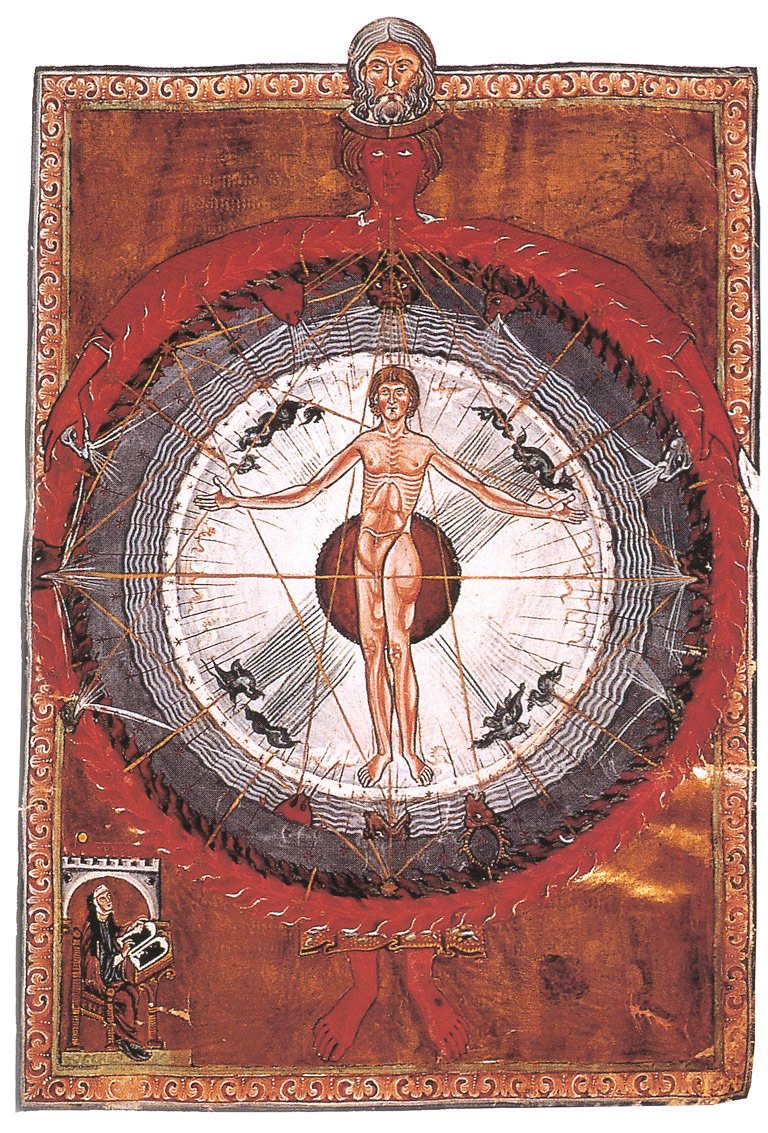
Hildegard's medical writing belongs to a world before the modern split between science and spirit, and that is exactly what makes it interesting — not as a source of cures (some of her remedies are sensible, some are of their age, and none should be taken as a prescription today) but as a way of seeing. For Hildegard, the human being is a microcosm: a small model of the whole universe, knit from the same four elements and four humours, subject to the same rhythms as the turning cosmos. What happens in the body echoes what happens in the heavens; soul and flesh are not at war but interwoven; to heal is to restore a balance, a moisture, a greenness that has been lost. The famous illumination of the Universal Man — a human figure held at the centre of concentric cosmic wheels, embraced by a vast winged divine figure — is the picture of this idea: humanity at the heart of creation, bound by love into the structure of everything.
This holism is the part of Hildegard our own century has seized on most eagerly, and it is worth being honest about. A great deal of what now circulates under her name — “Hildegard medicine,” wellness teas, spelt-based diets, crystal lore — is a modern construction, sometimes loosely tethered to her actual texts and sometimes floating free of them. The real Hildegard is at once less and more than the wellness brand: less, because she was a twelfth-century Benedictine working within the medical science of her day, not a prophet of holistic health; more, because the vision underneath — of a single, living, interdependent creation in which body, soul, world and God are continuous — is genuinely her own, genuinely radical, and genuinely ahead of its time. She did not anticipate modern biology. She anticipated something harder: the intuition that everything is connected, and that the connection is, at bottom, love.
The two medical works themselves repay a closer look, because they are stranger and more concrete than the modern “Hildegard wellness” industry would lead you to expect. The Physica is essentially a vast catalogue of the natural world arranged by kind — plants, elements, trees, stones, fish, birds, animals, metals — with, for each, an account of its qualities and its uses for the body. The Causae et Curae is more systematic and more speculative: it sets out a whole theory of why the human being falls ill and how health is restored, rooted in the medicine she had absorbed from the tradition. That tradition was humoral. The body, like the cosmos, was thought to be compounded of four elements — earth, water, air, fire — answering to four humours — black bile, phlegm, blood, yellow bile — and four qualities — cold, moist, hot, dry. Health was their balance; sickness was their disorder; and the physician's task was to read the imbalance and correct it through diet, herb, regimen and rest. None of this was original to Hildegard; it was the common inheritance of ancient and Arabic medicine, then flowing back into Europe through the medical school at Salerno. What was hers was the way she folded that inherited science into her own theology of greenness, so that an excess of dryness was at once a medical and a spiritual fact, and the restoration of viriditas was at once a cure and a sacrament.
What startles the modern reader most is her frankness about the body, and especially about women's bodies, which is remarkable for a celibate nun of the twelfth century. She writes plainly about menstruation, conception, pregnancy and sexual desire; her account of the experience of female pleasure is famously vivid and matter-of-fact, described as a kind of warmth that gathers and releases, and she treats it not as shameful but as part of the ordered working of creation. She has a theory of how the qualities of the parents at conception shape the temperament of the child; she writes about melancholy and its weather in the soul; she is interested in the whole human animal, sweat and seed and sorrow included. For a woman whose public authority rested on her purity and her visions, this unembarrassed attention to the flesh is itself a kind of theology — a refusal to treat the body as the enemy of the spirit, a conviction that the God who greens the meadow also greens the body, and that to understand the one is to honour the other.
Her remedies are a mixture, as any honest account must say, of the shrewd and the strange. Some of her dietary counsel — her praise of spelt, the hardy grain she calls Dinkel, as gentle and strengthening; her use of fennel, of herbs and simples whose properties were genuinely understood — reads as sensible folk medicine of a high order, the distilled observation of a community that grew and prepared its own food and tended its own sick. Other passages belong entirely to the symbolic world of her age, attributing powers to gems and stones, reading correspondences between a plant's appearance and its use. It would be a mistake to read her either as a proto-scientist who happened to be born too early or as a fount of suppressed ancient wisdom; she was a careful, curious twelfth-century observer working inside a twelfth-century framework, and both the carefulness and the framework are real. The Vatican, in naming her a Doctor of the Church, pointed to exactly this — that she looked hard at the created world and recorded what she found — and there is a genuine sense in which the discipline of close observation, repeated and written down, is the seed from which natural science would later grow.
This is the point at which honesty matters most, because Hildegard is now the patron saint of a flourishing industry. Walk into a health-food shop in Germany or Austria and you may find “Hildegard” teas, spelt biscuits, tinctures and regimens, a whole apparatus of Hildegard-Medizin marketed as her recovered system. Some of it is loosely tethered to her texts; much of it floats free, a modern wellness culture borrowing a medieval name for the authority of age. The cookies that first drew Helena Fojkar Zupančič to Hildegard — the spiced Nervenkekse, the “biscuits of joy,” compounded of spelt flour and warming spices like cinnamon, nutmeg and clove, and claimed to lift the spirits and steady the nerves — belong to exactly this borderland between genuine transmission and modern reinvention. And yet there is something fitting, even profound, in the fact that a recipe for happiness was the door through which a conductor walked toward a saint. For the deepest thing in Hildegard's medicine is not any particular remedy but the vision that holds them all: that the world is one green body, that to eat and to pray and to sing are continuous acts, that joy itself is a form of health and health a form of grace. The biscuits are a small and slightly comic emblem of a very large idea — and the idea, unlike the marketing, is unmistakably hers. To take her medicine seriously is not to brew her teas; it is to recover, for a moment, a world in which the cure of the body and the care of the soul were never imagined to be two different things.
Then there are the pictures. The illuminations of the Rupertsberg Scivias — the cosmic egg, the great blue figure of the Trinity in concentric rings of gold, the pillars and towers of the City of God — are among the most arresting images the Middle Ages produced, and they were made under Hildegard's direction, almost certainly to her descriptions, to render her visions as structures the eye could enter. They are diagrammatic rather than narrative, emblematic rather than pretty: maps of meaning, designed to be contemplated and memorised. To turn the pages of that book — even in reproduction — is to feel a mind thinking in colour and geometry, building cathedrals out of vision.
Scholars still argue about how much of the actual painting Hildegard directed, but the consensus tilts toward something remarkable: that the images of the Rupertsberg codex follow her descriptions so closely, and depart so tellingly from convention, that she must have overseen their design even if other hands held the brush. They are not illustrations in the modern sense — decorations added to brighten a text. They are the visions themselves, translated into a second language. Where the prose unfolds a vision in time, sentence by sentence, the image gives it all at once, as a structure the eye can enter and the memory can hold: the concentric rings, the towering allegorical women, the cosmic egg, the pillars of the City of God, rendered in lapis blue and burnished gold and a green that recurs with almost doctrinal insistence. They were made for contemplation, to be gazed at and memorised by a community trained in exactly that discipline, and they work on the modern viewer in much the same way — drawing the eye inward and downward through layer after layer of meaning. The later Lucca manuscript of the Liber Divinorum Operum, designed by the next generation of her nuns, carries this visual theology to its summit in the image of the Universal Man, the human figure outstretched at the centre of the wheeling cosmos and enfolded by the vast red-winged figure of divine Love. No words Hildegard wrote say more plainly what she believed: that the human person stands at the heart of creation, bound into the structure of everything by a love that holds the whole turning universe in its arms.
🔍 Klikni za fullscreen · premakni za lupo
The Universal Man: humanity at the centre of the cosmos, embraced by the divine, from the Lucca manuscript of the Liber Divinorum Operum. The clearest single image of Hildegard's microcosm–macrocosm vision. (Wikimedia · verify.)
─────VII · chapter
The preacher on the road
In her sixties — an age at which most of her contemporaries were dead — Hildegard did the most improbable thing of all. She left her enclosure and went on preaching tours, travelling the rivers and roads of Germany to address clergy and laypeople in Mainz, Trèves, Cologne, Metz, Würzburg and beyond. A woman, preaching, in public, to mixed audiences including priests, sometimes by their own invitation: there is essentially no precedent for it. She used the unimpeachable authority of her visions to say things no one else could safely say — lashing the corruption and laxity of the clergy, calling the Church back to viriditas and away from the dryness of sin. At the same time she kept up an enormous correspondence: nearly four hundred of her letters survive, exchanged with popes and the Emperor Frederick Barbarossa, with abbots and archbishops, with the visionary Elisabeth of Schönau and with ordinary people who wrote to her for counsel, prophecy, or healing. She had become, from inside a convent on the Rhine, one of the most consulted figures in Europe.
The preaching tours are perhaps the single most astonishing fact of her career, and it is worth dwelling on just how transgressive they were. Saint Paul's injunction that women keep silent in the churches was the bedrock of the medieval gender order; women did not preach, full stop. Yet here was Hildegard, in her sixties and seventies, boarding boats and riding the roads to stand before assembled clergy and laity in city after city — four separate journeys took her along the Main, the Rhine, the Moselle, into Mainz and Cologne and Trèves and Würzburg and Bamberg and beyond — and to address them, by their own invitation, in the voice of prophecy. In Cologne she is said to have stood before the cathedral clergy and denounced their worldliness to their faces, warning them of the disasters their negligence would invite; the canons were so struck that they asked her for a copy of the sermon. The only authority that could license such a thing was the one she always claimed — not her own, never her own, but the Living Light speaking through her — and it is a measure of how completely that claim had been accepted that bishops sat and took correction from an old nun. Around the journeys ran the vast web of her correspondence: nearly four hundred surviving letters to popes and the Emperor, to abbots and archbishops, to fellow visionaries like the younger Elisabeth of Schönau, and to ordinary men and women who wrote to Bingen as one might write to an oracle, seeking a prophecy, a cure, a word of guidance, a verdict on a troubled conscience. She answered them all in the same voice, stern and tender by turns, and the letters carried her authority into corners of Christendom her body never reached. From a single room above the Rhine, a woman the Church forbade to preach had made herself heard across a continent.
Soloist and ensemble in the restored nave — the medieval instruments (Gothic harp, fiddle, recorder, hurdy-gurdy) ground Hildegard's monophony in the colours of her own century. (Production still · replace.)
─────VIII · chapter
The last battle: a war over music
Hildegard's final year delivered the most fitting crisis of her life. A nobleman who had once been excommunicated, but — Hildegard insisted — had been reconciled to the Church before he died, was buried in the consecrated cemetery of the Rupertsberg. The ecclesiastical authorities of Mainz demanded that the body be dug up and removed. Hildegard, then in her eighties, refused; she would not, she said, disturb a man who had died in good standing. In punishment, the prelates laid an interdict on her convent — and an interdict meant, among other things, silence: no Mass, no sacraments, and no singing of the Divine Office. They had found the one penalty that could wound her most precisely. They had forbidden her nuns to sing.
The dispute had the shape of a small thing that opens onto a vast one. The facts were almost trivial — a single grave, a single corpse, a question of whether one man had died inside or outside the communion of the Church. The prelates of Mainz, acting while their archbishop was away in Rome, insisted the body be exhumed and cast out of consecrated ground. Hildegard, certain that the man had been reconciled and received the sacraments before he died, refused to deliver his bones to dishonour; she is even said to have gone out herself and blurred the traces of the grave so that it could not be found. For this defiance her whole community was placed under interdict — cut off from the sacraments, and, hardest of all, silenced. For perhaps a year the women of the Rupertsberg could not lift their voices in the Office that had structured every day of their lives. One can scarcely imagine a deprivation more exactly aimed at Hildegard, for whom song was not ornament but the very breath of the soul's life with God. And so the last great act of her life was not a vision but a fight — an eighty-year-old woman, gravely ill, marshalling her arguments to win back, for her nuns, the right to sing.
Her response was a letter that is, in its way, the manifesto of everything she believed. To silence music in the praise of God, she argued, is to side with the Devil — for music is not a decoration of worship but a memory of paradise itself, an echo of the harmony Adam knew before the Fall, when the human voice was still in tune with the song of the angels. When we sing, we are briefly restored to that lost concord; to take song away is to push the soul back toward the dryness and discord of the Fall. She warned the prelates, in effect, that those who silence praise on earth without good cause will themselves lose their place in the choir of heaven. It is an astonishing thing to write to one's superiors at the age of eighty, and it worked: the interdict was lifted not long before she died. Her music had defended itself in her own words.
The letter is worth lingering over, because it is the clearest statement Hildegard ever made of why music mattered to her — and it turns out to matter for reasons that go to the root of her whole theology. Song, she argued, is not a human invention bolted onto worship for pleasure's sake; it is a memory of paradise. Before the Fall, Adam's voice was attuned to the praise of the angels, and the music of the liturgy is the broken echo of that lost concord, the nearest the fallen creature can come to the harmony it was made for. When a community sings the Office, it is briefly restored to that original music, drawn back toward the greenness of its first estate; and the breath that carries the sung line is, quite literally, the breath of the Spirit moving through the body. To silence that song without grave cause, then, is not a minor disciplinary act but a kind of violence against the order of salvation itself — it pushes the soul back from the remembered concord toward the discord of the Fall, and those who do it, she warned, side unwittingly with the one voice in all creation that cannot sing. There is, in that argument, the whole of Hildegard: the conviction that beauty is not decoration but doctrine, that the body and the spirit sing with one breath, and that to take away a community's music is to take away a foretaste of heaven. She was defending her nuns' right to chant the psalms. She was also, in the same breath, explaining why eight hundred years later we cannot stop listening.
Those who, without weighty reason, impose silence on a church and forbid the singing of God's praises… will lose their place among the chorus of angels, unless they amend their fault through true penitence and humble restitution.
Hildegard of Bingen, to the prelates of Mainz, on the interdict laid upon her convent (1178–1179) — paraphrase of her letter defending sung praise
Hildegard died on 17 September 1179, in her eighty-first year. Her nuns reported that two streams of brilliant light crossed in the sky above her cell at the hour of her death, meeting in the shape of a cross — a last vision, this time seen by others, for the woman who had spent a lifetime describing light. Almost at once she was venerated as a saint. And then, for the better part of eight centuries, the formal recognition never quite came.
The accounts of her last days have the quality of her whole life — luminous, a little uncanny, witnessed. She had outlived nearly everyone: Volmar, her secretary of decades, had died years before, and she had felt the loss as the severing of a right hand. She herself was worn down by the recurring illness that had shadowed her since childhood. When the end came, on the seventeenth of September 1179, her nuns reported that two arcs of radiant light appeared in the night sky above her cell and crossed in the form of a cross at the moment she died — a final vision, this time granted not to Hildegard but to those who loved her, as if the light she had spent a lifetime describing had come, at the last, to sign its own work. She was buried at the Rupertsberg, and her tomb at once became a place of pilgrimage and reported miracle. Her bones would have a long history of their own — moved for safety down the centuries, eventually coming to rest at the abbey church in Eibingen, where they remain the heart of a living shrine. But the woman herself had finished. What she left behind — the books, the songs, the letters, the language, the medicine, the images — was already, in 1179, one of the most extraordinary bodies of work any single mind had produced in the medieval West. It would take the world a very long time to notice.
─────9 · chapter
The eight-century wait
Veneration came at once; canonisation did not. Local cult was confirmed as early as 1326 by Pope John XXII, and Hildegard's name appeared in martyrologies; pilgrims came to her shrine at Eibingen. But the formal machinery of canonisation, attempted more than once, stalled — partly on the medieval difficulty of documenting miracles to the required standard, partly, one suspects, on the sheer strangeness of the candidate. For eight centuries she was, in practice, a saint without the paperwork. Then, in 1979, on the eight-hundredth anniversary of her death, Pope John Paul II called her “a light for her people and her time.” And in 2012 Pope Benedict XVI — a German theologian with a particular love for her — completed what history had left undone: on 10 May he extended her veneration to the universal Church by equivalent canonisation, and on 7 October he proclaimed her a Doctor of the Church, only the fourth woman ever so honoured, after Teresa of Ávila, Catherine of Siena and Thérèse of Lisieux. Her writings, he declared, had brought about “an incisive renewal of theology, liturgy, natural sciences and music.” Theology, liturgy, science, music: it is, remarkably, an accurate four-word summary of a single life.
The long delay between her death and her doctorate is, in its own way, as telling as the honour that finally came. Within decades of 1179 the machinery of canonisation was set in motion; a formal inquiry into her life and miracles was opened in the early thirteenth century at papal request. But the process stalled — the records were judged incomplete, the documentation of miracles insufficient to the exacting standard Rome had by then developed, and the cause simply lapsed, was revived, and lapsed again across the centuries. In practice it hardly mattered to those who loved her: her name was entered in the Roman Martyrology, her feast was kept, pilgrims came to her relics at Eibingen, and she was honoured as a saint in everything but the final legal formality. She became one of those curious figures the Church carried for centuries as a saint de facto while the de jure recognition hung perpetually unfinished. It took the convergence of two things to complete it at last: the modern rediscovery that made her, for the first time, a figure of worldwide importance rather than a German local cult; and a German pope with a scholar's love of her work. When John Paul II marked the eight-hundredth anniversary of her death in 1979 with that luminous phrase — a light for her people and her time — he set the seal of the highest authority on her renewed fame. And when Benedict XVI finished the work in 2012, first extending her cult to the universal Church and then raising her to the rank of Doctor, he was not inventing her sanctity but ratifying, after eight hundred years, what the faithful had never doubted.
1098–1179
her life on the Rhine
~77
surviving songs (the Symphonia)
4th
woman ever named Doctor of the Church (2012)
Between her death and her doctorate lies the strangest part of the story: for most of those eight hundred years, almost nobody outside Germany heard her music at all. The notation sat in two great manuscripts; the songs were sung, if ever, by specialists. What follows is the timeline of a life that kept happening long after it ended.
Year
Event
1098
Born at Bermersheim, tenth child of a family of the lower nobility
c. 1112
Enclosed at Disibodenberg under the anchoress Jutta von Sponheim
1136
Jutta dies; Hildegard elected magistra of the women
1141
The vision that commands her to write; she begins Scivias
1147–1148
Synod of Trier: Pope Eugenius III endorses her work
c. 1150
Founds her own monastery at Rupertsberg
c. 1151
Completes Scivias; writes the Ordo Virtutum
1158–1163
Liber Vitae Meritorum; the preaching tours begin
1163–1173
Liber Divinorum Operum, her last great visionary book
c. 1165
Founds the daughter house across the Rhine at Eibingen
1178–1179
The interdict over the buried nobleman; her letter defending music
17 Sept 1179
Dies at Rupertsberg, in her 81st year
1326
Cultus confirmed by Pope John XXII
1979
John Paul II: “a light for her people and her time”
10 May 2012
Equivalent canonisation by Benedict XVI
7 Oct 2012
Proclaimed Doctor of the Church — the fourth woman so named
Hildegard of Bingen — a life, and its long afterlife
─────10 · chapter
The voice returns
The Hildegard the world now loves is, in large part, a creation of the last fifty years. The turning point came in 1982, when the British ensemble Gothic Voices, with the soprano Emma Kirkby, released a record of her songs under a title borrowed from Hildegard's own description of herself: A Feather on the Breath of God. It was a quiet sensation, and it opened the door. The ensemble Sequentia, founded by Barbara Thornton and Benjamin Bagby, devoted years to recording the complete music, including a landmark Ordo Virtutum; the American quartet Anonymous 4 carried her sound to vast new audiences. At the same time, scholars — Barbara Newman above all, with her critical edition of the Symphonia and her study Sister of Wisdom, alongside Peter Dronke and Sabina Flanagan — rebuilt the historical Hildegard from the manuscripts up, rescuing her both from neglect and from the looser myths that had begun to gather around her name. A voice that had been silent for eight centuries was suddenly everywhere: in concert halls, on film soundtracks, in the headphones of people who had never set foot in a church.
It is worth asking why it happened then — why the early 1980s, of all moments, should have been the hour of Hildegard's return. Part of the answer is simply technical: the early-music movement had by then developed both the scholarship and the performing skill to bring medieval monophony convincingly back to life, and the recording industry had the reach to carry it to a mass audience. But part of the answer is cultural. Hildegard arrived precisely as a generation was beginning to look outside the worn grooves of the standard concert repertory for something older, stranger, more contemplative — and as a parallel current of feeling was reaching for the feminine, the ecological, the mystical, the holistic. She answered both hungers at once, and the two recordings that opened the door — Gothic Voices' luminous, voices-only A Feather on the Breath of God, and the long, devoted labour of Sequentia, who set out to record the whole of her music — between them defined the two poles of how she would be heard ever after: pure austerity on the one hand, warm instrumental colour on the other. The scholars came with them, or just ahead of them. Barbara Newman's critical edition gave the songs a reliable text and her Sister of Wisdom gave the theology a serious modern reading; Peter Dronke set her among the great medieval Latin poets; Sabina Flanagan wrote the visionary life. Between the performers and the professors, a figure who had been a footnote became, within a decade or two, the most recorded composer of the entire Middle Ages — and the strangeness never wore off. That is the curious thing about the revival: familiarity has not domesticated her. Eight hundred years and a thousand recordings later, the first leap of one of her antiphons still lands on a modern ear as something almost shockingly alive.
The Abbey of St. Hildegard at Eibingen, above the Rhine near Rüdesheim — the living Benedictine community that bears her name and guards her memory. (Wikimedia · verify.)De Spiritu Sancto — Hildegard's hymn to the Holy Spirit, grounded by the hurdy-gurdy and the medieval ensemble; one of the movements watched millions of times worldwide.O ignis Spiritus Paracliti — 'O fire of the Spirit, the Comforter': the Spirit as fire and greening life, viriditas made audible.
So why now? Why has a twelfth-century abbess become one of the most listened-to medieval composers in the world, sung by a girls' choir in Ljubljana eight hundred and forty years after her death? The answer says as much about us as about her.
⌖ Why Hildegard speaks to our century
Several of our deepest preoccupations seem to find, in Hildegard, an ancestor — and it is worth being clear about which of these are truly hers and which are our projections onto her.
The first is the voice of women. Hildegard is the earliest composer in the Western tradition, of either sex, whose large body of work survives with a name attached — and she is a woman, who wrote, taught, preached, founded institutions, and held her ground against bishops, in a world built to prevent all of it. For an age intent on recovering the silenced voices of the past, she is almost too good to be true: not a footnote or a muse, but a maker of the first rank. That part is simply, gloriously real.
The second is ecology. Her viriditas — the vision of a single, green, interdependent creation, in which the health of the body, the soul, and the living world are one fabric — reads now like an intuition of everything we are slowly, painfully relearning about our place in nature. She did not, of course, have our science or our crisis; to call her a “medieval environmentalist” is an anachronism. But the underlying picture — that everything is bound to everything, and that to dry out the world is to sin against it — is genuinely hers, and genuinely consoling.
The third is the hunger for wholeness. We have inherited a world neatly divided into disciplines — music here, medicine there, theology and science in separate buildings that no longer speak. Hildegard belonged to a world before those walls went up, and her work moves between them as if they did not exist, because for her they did not. Part of the longing she answers is a longing for that unbroken vision: a single mind holding the cosmos, the body, the soul, and the song together.
And then there is the simplest reason of all, the one that needs no theory. The music is ravishing. Strip away the scholarship and the mysticism and the canonisation, and what remains is a melodic imagination of rare beauty — lines that lift the heart, that sound at once utterly strange and immediately moving, that do to a listener now exactly what they did to her nuns on the Rhine. That is why the young women in Ljubljana fell into it; that is why audiences wept at the premieres; that is why I had to point a camera at it. Beauty, in the end, is its own argument.
But the story of her return is worth telling more fully, because it is also a cautionary tale about how an age remakes the figures it rediscovers. For most of eight centuries Hildegard was, outside a few German monasteries, almost forgotten — a name in martyrologies, a local saint, a footnote. Her modern resurrection came in two waves, and they did not always agree. The first was scholarly and musical: the patient reconstruction of her songs from the manuscripts, and the recordings of the early 1980s — above all Gothic Voices' A Feather on the Breath of God — that suddenly let the world hear what had been silent. The second wave was something larger and looser: a popular Hildegard who became, in the 1980s and 1990s, an icon of the New Age, a patroness of holistic healing and crystal lore and feminine spirituality, her image reproduced on candles and calendars, her name attached to products and philosophies she would not have recognised. The two Hildegards — the rigorously reconstructed historical abbess and the soft-focus mystic of the wellness shelf — have coexisted uneasily ever since, and a good part of the work of scholars like Barbara Newman, Peter Dronke, Sabina Flanagan and Fiona Maddocks has been to rescue the first from the second: to give us back a Hildegard who is stranger, harder, more orthodox and more astonishing than the comfortable myth.
Take the feminist reclamation, which is real and deserved but easily flattened. It is simply true that Hildegard is the first composer in the Western canon, of either sex, to leave a large body of named work; true that she wrote, taught, preached and governed in a world built to keep women silent; true that she is one of the most powerful female voices to reach us from the entire Middle Ages. To recover her is genuinely to enlarge our sense of what women did and made. And yet the historical Hildegard was no rebel against the gender order of her Church. She accepted that women should not be priests; she could be scathing about her own sex even as she transcended every limit placed on it; her authority depended on presenting herself not as a strong woman but as a weak one, a mere channel for a higher voice. The honest reclamation is more interesting than the slogan: not a proto-feminist who broke the rules, but a woman who, by submitting absolutely to the one source of authority her age could not gainsay — direct divine vision — won a freedom of speech and action that no argument for her own rights could ever have secured. She did not storm the citadel. She found the one gate it could not close.
The ecological Hildegard needs the same care. Her viriditas really does read, to us, like an ancient intuition of interdependence, of a creation whose health is one fabric — and the consolation of that is not fraudulent. But she was not an environmentalist; she had neither our science nor our catastrophe in view, and to enlist her as a medieval prophet of sustainability is to make her, once again, a mirror for our own preoccupations. The deeper and truer thing is that her vision of a single, living, God-soaked world offers a frame in which our ecological grief and responsibility can be felt as something more than utility — a sense that to wound the world is not merely imprudent but a kind of sacrilege against the greening Spirit. That is a gift worth taking. It is just not the same as making her say what we already think.
What survives all the appropriations, and what finally explains her hold on us, is the music — and here the numbers tell their own quiet story: Hildegard is now the most recorded composer of the entire Middle Ages, more recorded than any of the anonymous masters of the great cathedrals, a twelfth-century nun outselling the whole male tradition that surrounded her. That is not the work of scholarship or ideology. It is the work of the sound itself, which does to a listener now exactly what it did eight hundred years ago: lifts the line past the expected note, opens the ceiling, makes the greening of the world briefly audible. When Benedict XVI — himself a careful theologian, no friend of fashion — named her a Doctor of the Church, he was not bowing to the New Age; he was recognising, in the official voice of the institution she served, that this strange woman had renewed theology, liturgy, science and music all at once, and that her renewal still has work to do. The deepest danger in loving Hildegard is the danger of using her — of turning her into whatever our moment most wants her to be. The remedy is the one those young singers stumbled onto without theory: to stop explaining her and simply let her sing, to meet her not as a symbol but as a maker, and to discover that the feather on the breath of God is lighter, and stranger, and far more alive than any of the meanings we keep trying to pin to it.
─────11 · chapter
A church that came back to life
There is one more thread, and it closes the circle in a way almost too neat to be invented. The film was recorded in the National Shrine of St. Joseph in Ljubljana — a church with its own story of silencing and return. Built by the gifts of ordinary people, it was confiscated by the authorities in 1949 and turned, of all things, into a film studio; for decades its altar was hidden and the sound that filled it was cinema, not prayer. Only later was it restored to what it had been. To bring Hildegard's music — the music of a woman who fought a bishop to keep her nuns singing — back into a space that had itself been stripped of song and then given it back, and to record it there on film, the very medium that had once displaced its worship, is the kind of rhyme that history occasionally permits. The Jesuit fathers handed the whole church over to the production. For four days and nights of preparation and filming, the crew barely slept; they hung blackout curtains from great lifts, raised ramps and clusters of intelligent lights, ran rails and a crane and a film dolly and a battery of cameras through a working shrine — to capture young voices carrying a nine-hundred-year-old vision of light.
The coincidence runs deeper the longer you look at it. The Church of St. Joseph was raised in the early twentieth century by the Jesuits, built with the gifts of ordinary Ljubljana faithful; then, in the hard years after 1949, the new authorities took it, stripped it of its sacred function, and turned it into a film studio — the very building where prayer had been silenced became a place for making images. For decades the altar stood hidden, the nave served the camera, and the church's own voice was, in the most literal sense, suppressed. Its later restoration gave it back to worship and to beauty. To choose that building for this music — to bring the songs of a woman who fought a bishop to keep her nuns singing into a church that had itself been silenced and then restored, and to do it with the very medium, film, that had once usurped its sanctuary — is a rhyme almost too perfect to plan. I did not fully grasp it until we were inside, rigging the lights. We hung blackout drapes from tall motorised lifts, raised the great support ramps, flew clusters of programmable lights, laid track for the dolly, swung the crane, set four and more cameras around a working shrine; we shot with the equipment of the most demanding film productions, Arri glass and intelligent lighting, every cue programmed in advance through long sleepless nights — four days and nights of preparation and filming in which we barely slept at all. The Jesuit fathers gave us the whole church, with a generosity I will not forget. And through all the technical machinery, the thing we were actually there to do never changed: to catch, on film, the sound of young Slovenian voices carrying a vision of light first sung on the Rhine eight and a half centuries ago, in a room that knew, in its own stone, exactly what it means to have your song taken away and then, against all odds, given back.
Wide shot of the full forces in the restored shrine — choir, instrumentalists, and the architecture of light designed for the film. (Production still · replace.)
WORTH KNOWING — THE PRODUCTION
This film is a Zevnikov · PPZ Produkcija and TAJUS production, conceived with a single, unembarrassed ambition: to make the finest sacred-music film in the world. By the measure that matters most — the one set by audiences rather than by the makers — it has come extraordinarily close. The movements drawn from it, above all De Spiritu Sancto and Caritas abundat, have together been watched millions of times across the globe, carried in dozens of languages to listeners who have never set foot in a Slovenian church, and met, time and again, with rapt silence and standing ovations. Behind the voices stands one of the finest youth choirs in Europe; behind the new music, a multi-award-winning composer; and behind the camera, a crew working at the very limit of the craft. It premiered on Ash Wednesday, 18 February 2026.
Helena Fojkar Zupančič — conductor and creator of the project, who over three decades built the St. Stanislav Girls' Choir into one of the finest youth ensembles in Europe.
⌖ ⌖ Helena Fojkar Zupančič & the St. Stanislav Girls' Choir
Helena Fojkar Zupančič founded the St. Stanislav Girls' Choir of the Diocesan Classical Gymnasium in Ljubljana in 1996 and has led it ever since — some forty singers, aged sixteen to nineteen, who rehearse twice a week and take individual vocal-technique lessons besides. Under her the choir became the first and only Slovenian choir invited to the World Symposium on Choral Music (Barcelona, 2017), the supreme global gathering of choral conductors; it has represented Slovenia at Europa Cantat in Tallinn (2018) and sung at the National Conference of the American Choral Directors Association in Kansas City (2019), and its excellence has been recognised in Oslo, Basel, Cork and Derry, Taiwan, Maasmechelen and far beyond. Fojkar Zupančič — a trained solo singer and music pedagogue who has also stood before the Choir of the Slovenian Philharmonic — is the absolute winner of the EBU «Let the Peoples Sing» competition (Oslo, 2009), and holds the Silver Gallus Plaque (2019) and the Republic of Slovenia Award for outstanding achievement in music education (2016). By common consent of the Slovenian and international choral world, she is among the most accomplished choral conductors of her generation.
Helena Fojkar Zupančič before the choir — a frame from the film.The ensemble in movement, bathed in the architecture of light designed for the film.
THE FILM — HOW IT WAS MADE
The film was captured over four sleepless days and nights in the National Shrine of St. Joseph in Ljubljana, the choir lit by clusters of programmable intelligent lighting, with a dolly, a crane and a battery of cameras moving through a working shrine. It was shot on the Blackmagic Cinema Camera in 6K BRAW through ARRI optics, stabilised with Gyroflow, and graded in DaVinci Resolve through a FilmBox film-emulation pipeline built on an Ektachrome / ECN-2 stock profile — the warm, grain-true colour of analogue motion-picture film carried into the digital frame. The medieval instruments — Gothic harp, fiddle, recorder and hurdy-gurdy — were played by an ensemble of early-music specialists, and the whole was mixed and mastered for the cinematic sound the church's acoustics made possible.
Specification
Detail
Camera
Blackmagic Cinema Camera · 6K BRAW
Optics
ARRI
Stabilisation
Gyroflow
Colour grade
DaVinci Resolve · FilmBox · Ektachrome / ECN-2
Sound
mixed & mastered by Iztok Zupan
Choir
St. Stanislav Girls' Choir · cond. Helena Fojkar Zupančič
Composer
Damijan Močnik
Location
National Shrine of St. Joseph, Ljubljana
Premiere
Ash Wednesday · 18 February 2026
Production
Zevnikov · PPZ Produkcija & TAJUS
The film — technical specifications
A soloist alone in a pool of light — Hildegard's monophony at its most intimate.
CREDITS
Director & producer: Primož Zevnik · Producers: Juš Hrastnik, Gal Nagode · Director of photography: Juš Hrastnik, Primož Zevnik · Editing & colour grading: Primož Zevnik
Composer & arrangements: Damijan Močnik · Music producer: Boris Rener · Sound & mastering: Iztok Zupan
Choreography & motion design: Barbara Kanc · Costume design: Irena Tomažin · Medieval-chant mentor: Dr. Katarina Šter · Translations: Tog Hoath (English), Neža Karlin
Instrumental ensemble: Janez Jocif (percussion, hurdy-gurdy, tanpura), Tilen Udovič (fiddle), Urška Rihteršič (Gothic harp), Una Košir (recorder)
St. Stanislav Girls' Choir — Soprano I: A. Pavlovič, A. Mavrič, J. Poredoš, L. Suhodolnik, J. Skobe, E. Otrin, P. Rakar, A. Strmčnik, A. Lebar, T. Novak · Soprano II: K. Briški, L. Kumar, J. Čarman, A. Zajec, P. Avsenik, N. Penko, Z. Vintar, D. Dominko, R. Martinjak, E. L. Škraba · Alto I: M. Banko, E. Škaler, L. Klavžar, E. Ivanc, J. Purnat, E. Lanišek, E. Pirnat, R. Brenčič, A. Šnajder · Alto II: J. J. Petrovič, A. Grum, L. Kavčič, K. Klobučar, A. M. Sojar, I. Movrin, Z. Demšar, M. Robnik
Crew: Andraž Žigart, Matej Zagorc, Tadej Pernuš, Jan Presker · Light design: Lušin, Tadej Pernuš, Sebastjan Zavrl · Set design: Gašper Polajžar, Domen Kovaček, Rok Zavrl (STRC) · Make-up & wardrobe: Petra Skubic, Zala Klavs, Lea Ložak · Stage tech: Goran Veselinović, Jan Novak, Borut Jalšovec, Nace Tomato, Darjan Vidmar · Equipment: Event Lighting, MB Grip, RIWAL
With thanks to the Jesuit Order of Ljubljana (Fr. Tomaž Mikuš), the Archdiocese of Ljubljana (Msgr. Dr. Franc Šuštar) and the Mayor of Ljubljana, Zoran Janković.
A TAJUS and PPZ Produkcija production.
The restored nave of the National Shrine of St. Joseph, flooded with light — the church that was silenced and then, against all odds, given its voice back.The full forces before the high altar — the closing image of the film.The finale — O ignis Spiritus Paracliti, the sequence on which this essay ends: medieval monophony and Močnik's contemporary polyphony resolving into a single resonance.
─────12 · chapter
Why we still listen
Hildegard called herself penna in dei spiramine — a feather on the breath of God: weightless, carried, sounding only because something larger moves through it. It was humility and it was also, I think, the truest description she ever gave of her art. Her music does not assert; it ascends. It takes the breath of a singer — a Benedictine nun in 1150, a Slovenian seventeen-year-old in 2022 — and lifts it past the note you expect, toward a height the notation only points at. Eight hundred years did not dim it, because what she made was never tied to her century; it was tied to the voice, and the voice is always present tense. We still listen because she found a way to make the greening of the world audible, and because, when those young women open their mouths in the dark of a church, the ceiling, briefly, is not there.
There is a deeper reason, too, and it has to do with time. Most of what we make is bound to its moment — it speaks the language of its age, and when the age passes the speech grows faint. Hildegard's music has proved unusually free of that gravity, and I think it is because she aimed it at something that does not change. The longing her melodies enact — the reaching upward, the refusal of the easy resolution, the sense of a self drawn always toward a height just past the one it has reached — is not a twelfth-century longing. It is simply the longing, the one that turns up in every century under different names, and she found a sound for it so direct that nine hundred years of changing fashion have slid off it without a mark. When a Slovenian seventeen-year-old, who has never read a line of medieval theology and may not share a word of Hildegard's faith, opens her mouth and lets one of those antiphons climb, something passes between the twelfth century and the twenty-first that needs no translation, because it was never really about either century. It was about the human voice reaching past itself. That is what survives. That is what we are still listening to. And that, in the end, is why a film made in a borrowed church in Ljubljana, with sleepless nights and too many cameras, felt less like a production than like joining a line of people — nuns, scholars, singers, strangers in headphones — who have been passing this sound from hand to hand for eight hundred years, and who will go on passing it long after the last of us has put down the camera.
O ignis Spiritus Paracliti, vita vite omnis creature — O fire of the Spirit, the Comforter, the life of the life of every creature.
Hildegard of Bingen · opening of the sequence O ignis Spiritus Paracliti
─────13 · chapter
For further reading and listening
On the life and thought: Barbara Newman, Sister of Wisdom: St. Hildegard's Theology of the Feminine (University of California Press, 1987), and her critical edition, Symphonia: A Critical Edition of the Symphonia armonie celestium revelationum (Cornell University Press, rev. 1998).
Sabina Flanagan, Hildegard of Bingen: A Visionary Life (Routledge, 2nd ed., 1998).
Fiona Maddocks, Hildegard of Bingen: The Woman of Her Age (Faber, 2001).
The Cambridge Companion to Hildegard of Bingen, ed. Jennifer Bain (Cambridge University Press, 2021).
On record: Gothic Voices with Emma Kirkby, A Feather on the Breath of God (Hyperion, 1982); Sequentia, the complete-edition recordings including Ordo Virtutum; Anonymous 4, 11,000 Virgins. These are offered as gateways into the sound, not as the subject of this essay — the subject is the work itself, and the woman who, against every expectation of her age, made it.
She called herself a feather on the breath of God — weightless, carried, sounding only because something larger moved through it. Her melodies still ascend past the note you expect; eight hundred years have not dimmed them, because what she made was tied not to her century but to the voice, and the voice is always present tense. We listen still because she made the greening of the world audible.
Letters from Zevnikov
A note when a new essay or travelogue appears. No noise, unsubscribe in one click.