
Volume 10 of Masaaki Suzuki's complete cantata cycle pairs Bach's most splendid civic cantata — Preise, Jerusalem, den Herrn BWV 119, written for the Leipzig council in 1723 — with the Easter Tuesday parody Ein Herz, das seinen Jesum lebend weiß BWV 134. Two faces of Bach: the public ceremonialist of trumpets and timpani, and the festal preacher of intimate dialogue.
The French overture, music of royal entrance, here crowns a free imperial city — Leipzig giving thanks for itself, in Bach's most regal voice.on BWV 119 — booklet essay, Klaus Hofmann
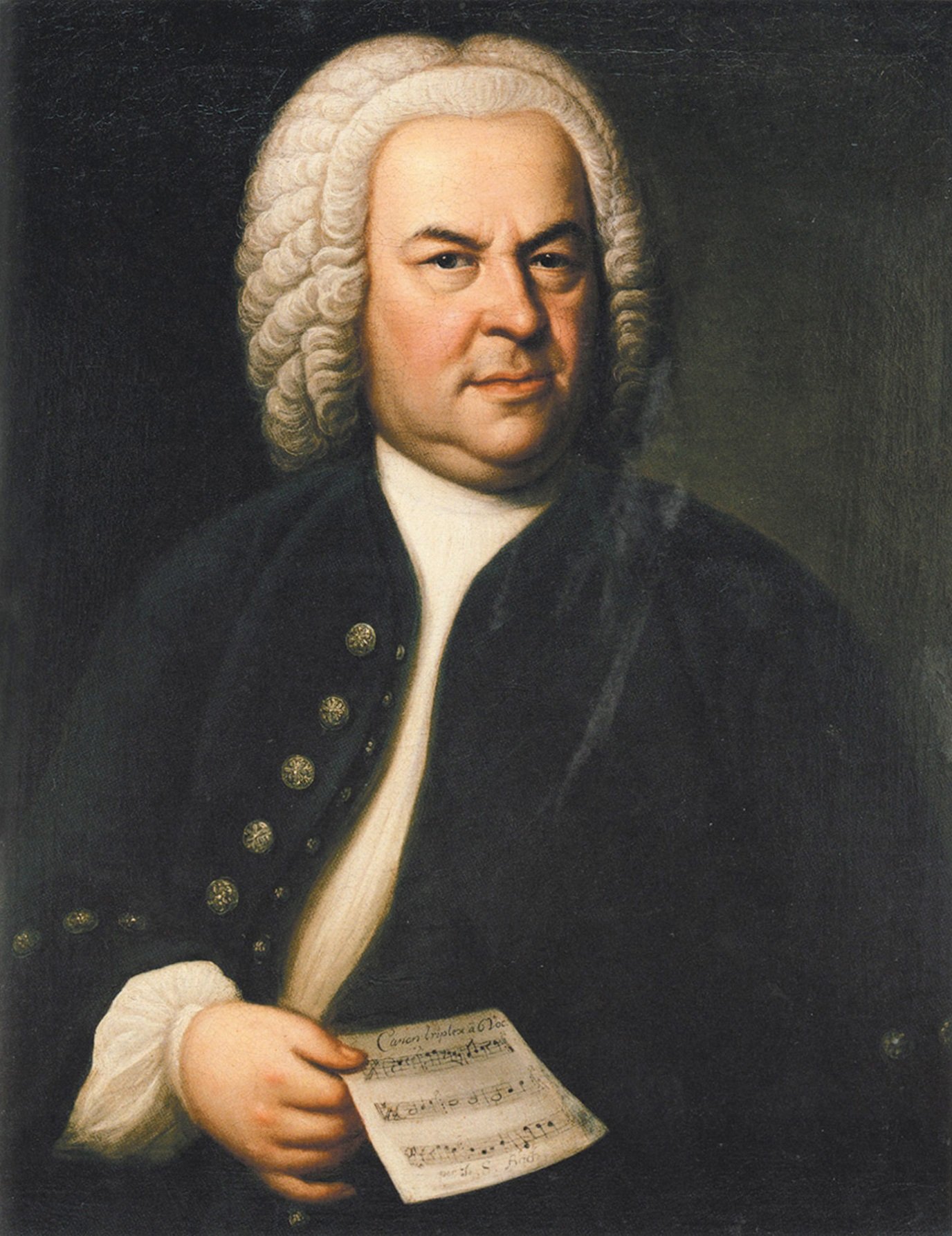
Bach in his first Leipzig August
The Thomaskantor's first August
By the summer of 1723, Johann Sebastian Bach had been in Leipzig for barely three months. He had taken up the post of Thomaskantor on 30 May, having lost the Hamburg competition to Telemann, having lost the Leipzig competition to Graupner, and having been chosen — in the famous dismissive phrase of council member Abraham Platz — "since the best could not be obtained, mediocre ones would have to be accepted." The mediocre one set about, in his first Leipzig year, composing one of the most ambitious cantata cycles in Western music: a new sacred cantata, on average, every week.
Into this prodigious schedule fell, on 30 August 1723, the annual Ratswechsel — the formal change of the Leipzig town council, marked by a service in the Nikolaikirche and a sermon delivered before the assembled magistrates, professors, and citizenry. The cantata for this occasion was both a musical obligation and a political opportunity. Bach, conscious of his new employers' scrutiny, responded with Preise, Jerusalem, den Herrn BWV 119 — the most lavishly scored cantata he would compose in Leipzig for years.
The composer as civic servant
It is easy to forget how thoroughly Bach's professional life was bound to municipal politics. The Thomaskantor was not simply a church musician but a city official, answerable to the council that elected itself each August. The composer who would write the St Matthew Passion four years later was also the man who taught Latin grammar to the boys of the Thomasschule and squabbled with the rector over disciplinary authority. BWV 119 is, among other things, a calculated gift to his employers — and a demonstration of the resources he could command when the occasion warranted.
From Cöthen to Leipzig
The companion work on this disc, BWV 134, reaches back to Bach's previous post. Between 1717 and 1723 he had served Prince Leopold of Anhalt-Cöthen as Kapellmeister, composing chiefly instrumental music — the Brandenburg Concertos, the unaccompanied violin and cello works, the first book of the Well-Tempered Clavier. The sacred parody BWV 134, derived from a Cöthen New Year's serenata, is one of several works through which Bach mined his courtly past for Leipzig liturgical use. The transformation is total: secular allegory becomes Easter proclamation, and Prince Leopold's congratulations become the risen Christ's victory.
A theology of craftsmanship
What unites the two cantatas, despite their different occasions, is Bach's characteristic conviction that music is an act of formal theology. The trumpets of BWV 119 are not merely pomp; they are an acoustic image of the heavenly Jerusalem invoked in the text. The contrapuntal duets of BWV 134 are not merely virtuosity; they are an enactment of the believer's dialogue with grace. Bach's surviving theological library — the Calov Bible commentary, with its marginal annotations in the composer's own hand — confirms what the music already declares: that for him, structure was meaning. The fugue and the doctrine of justification by faith were, in his understanding, complementary disciplines.
He would remain in Leipzig for twenty-seven more years, dying in 1750 with the Art of Fugue unfinished on his desk. The cantatas of 1723–24, of which these two are exemplars, represent the headlong productivity of a man newly arrived, newly responsible, and newly determined to leave no liturgical occasion unmusicked.
Two cantatas, two Leipzigs
Civic pomp and Easter consolation
The two cantatas at the heart of Volume 10 occupy opposite poles of Bach's Leipzig vocabulary. Preise, Jerusalem, den Herrn BWV 119 is a Ratswahlkantate — a cantata for the annual change of the town council, performed in the Nikolaikirche on 30 August 1723, only three months into Bach's tenure as Thomaskantor. Ein Herz, das seinen Jesum lebend weiß BWV 134, by contrast, is an Easter Tuesday work, a parody of the Cöthen secular serenata Die Zeit, die Tag und Jahre macht BWV 134a, whose sacred form Bach assembled in 1724 and revised in 1731.
BWV 119 — the architecture of a free imperial city
The text, drawing on Psalm 147 (Preise, Jerusalem, den Herrn), allowed Bach a rare opportunity to deploy the full plein-jeu of his Leipzig forces: three trumpets, timpani, two recorders, three oboes (two of them da caccia), strings and continuo. The opening chorus is cast as a French overture, that most regal of Baroque forms — the dotted grave unfolding into a fugal vite on the words Er macht Frieden in deinen Grenzen. The choice is not casual: the French overture was the music of royal entrance, and the Leipzig council, in its self-image as a kleines Reich, deserved no less.
What follows is a sequence of arias and recitatives whose imagery praises Leipzig itself — Wohl dir, du Volk der Linden (a touching reference to the city's lime-tree avenues), So herrlich stehst du, liebe Stadt. The tenor aria with two recorders and continuo is pastoral; the alto aria Die Obrigkeit ist Gottes Gabe — "authority is God's gift" — is scored with the dark, autumnal colour of two oboi da caccia, a sonority Bach reserved for moments of solemn ethical weight. The soprano recitative Nun! wir erkennen es erupts unexpectedly into a Halleluja chorus on Der Herr hat Guts an uns getan, before the work closes with a four-part chorale fortified by the entire instrumental apparatus. Nine movements; perhaps thirty-five minutes; the most magnificent civic cantata Bach ever wrote.
BWV 134 — parody and transformation
The Easter cantata BWV 134 is a different animal: a parody of a secular New Year's serenata composed at Cöthen for Prince Leopold. Bach retained five of the original six movements, transposing congratulatory rhetoric into Easter rejoicing. The opening dialogue between Furcht and Hoffnung (Fear and Hope) in the secular original becomes here a colloquy between two anonymous voices — tenor and alto — meditating on the risen Christ. The tenor aria Auf, Gläubige, singet die lieblichen Lieder dances in 3/8 with violin obbligato; the duet Wir danken und preisen dein brünstiges Lieben is a tour de force of contrapuntal exchange, the two voices passing the same melodic cell through every available permutation. The closing chorus Erschallet, ihr Himmel is one of Bach's most exuberant Easter perorations, a da capo structure of unbroken energy.
That such radiant music began life as courtly compliment says everything about Bach's pragmatic attitude to his own materials. Parody for him was never recycling but re-consecration: the same notes, differently directed. The 1731 revision, captured on this recording, restores certain recitatives that had been compressed in the 1724 first version, giving the work its definitive shape.
Two faces of one craftsman
Heard together, BWV 119 and BWV 134 illuminate Bach's range as a public composer — the ceremonial Lutheran on one hand, the introspective festal preacher on the other. Both works share the conviction that music's highest function is to articulate gratitude: civic, theological, personal.
Suzuki and the Bach Collegium Japan
Bach Collegium Japan — a quiet revolution
Founded in 1990 by Masaaki Suzuki, the Bach Collegium Japan emerged from an unlikely premise: that a country with no native Lutheran tradition might produce the most theologically attentive Bach performances of its generation. Suzuki, born in Kobe in 1954, the son of a Protestant family, studied organ and harpsichord with Ton Koopman and Piet Kee at the Sweelinck Conservatorium in Amsterdam. His return to Japan in 1983 to teach at Kobe Shoin Women's University led, seven years later, to the founding of the ensemble whose complete cantata cycle on BIS — begun in 1995, completed in 2013 — stands as one of the great recording projects of our age.
The choir numbers around twenty; the orchestra plays period instruments at Kammerton. The soloists, frequently drawn from the choir itself, are an international roster that has remained remarkably stable: the soprano Yukari Nonoshita, the countertenor Robin Blaze, the tenor Gerd Türk, the bass Peter Kooij. On Volume 10 these four are joined by the soprano Yoshie Hida.
What distinguishes Suzuki from his European colleagues — Koopman, Gardiner, Herreweghe — is less a matter of tempo or articulation than of register. There is no rhetorical insistence, no editorial italicising. The performances trust the music to make its theological case. Some critics have heard this as restraint to the point of reserve; others as the most authentic recovery of Lutheran Andacht — devotion — that the period-instrument movement has produced. Gramophone wrote of the cycle that it "sets a standard that may never be surpassed."
Concertmaster Ryo Terakado and continuo player Naoko Imai anchor the instrumental ensemble with the same long-breathed patience that defines Suzuki's direction.
Sessions at Kobe Shoin Chapel
Kobe Shoin Chapel — a Japanese Lutheran acoustic
The recording was made at the Kobe Shoin Women's University Chapel, the BCJ's home venue throughout the BIS cycle. The Chapel — a modest twentieth-century space attached to a Christian liberal arts college founded in 1892 — proved acoustically ideal: reverberation long enough to flatter the trumpets of BWV 119, short enough to preserve consonantal clarity in the dialogues of BWV 134. Sessions for Volume 10 took place between late 1998 and 1999, with producer Hans Kipfer and engineer Ingo Petry (Take5 Music Production, Berlin) responsible for the BIS house sound.
The booklet, with substantial commentary by Klaus Hofmann and Tadashi Isoyama, places both cantatas in their liturgical contexts and reproduces the libretti in German with English, French and Japanese translations — a quadrilingual courtesy that has characterised the cycle from its inception. Robert Suff served as BIS's executive producer.
The disc was released on the BIS label (BIS-CD-1031) and later reissued as part of the boxed complete edition. The cycle as a whole, begun in 1995, would not reach completion until 2013 — a span of eighteen years and some fifty-five volumes, the longest-gestating Bach cantata project ever undertaken on disc. That Volume 10, recorded mid-cycle, already displays the interpretive and engineering consistency of the whole speaks to the rare discipline of all parties involved.
Transparency as theology
Suzuki's BIS cycle has, by Volume 10, achieved a recognisable signature: a chamber-scaled choir of around twenty singers, period instruments at A=415, and a recorded perspective that places the listener in the third row of a Lutheran town church rather than at the back of a cathedral. In BWV 119 the engineering challenge is considerable — three trumpets, timpani, two recorders, three oboes (two da caccia), strings and continuo — yet nothing congeals. The trumpets of Toshio Shimada and colleagues ring with the bright, vocalised tone of natural instruments, never the metallic shriek that mars lesser period bands. The opening French overture is taken at a deliberate, ceremonial gait; the fugal Allegro dances rather than runs. In the alto aria Die Obrigkeit ist Gottes Gabe, Robin Blaze's countertenor floats above the two oboi da caccia with that particular nutty, reedy halo BIS captures so well — the microphones close enough to register the breath, distant enough to allow the church acoustic its share. The pastoral BWV 134, with its lighter scoring, benefits from the same restraint: Gerd Türk's tenor and Blaze's alto entwine in the duet Wir danken und preisen with a chamber-musical intimacy. Producer-engineer Hans Kipfer (Take5 Music Production) maintains the BIS house aesthetic — wide dynamic range, minimal compression, instrumental colours individuated without artificial spotlighting. The SACD layer (this volume issued as a hybrid disc) opens the soundstage vertically; the timpani in the closing chorale acquire genuine weight without bloom. If one wants Bach's cantatas as living liturgical objects rather than concert showpieces, the engineering here is exemplary.Further reading
- BIS Records — Bach Cantatas Series
- Bach Collegium Japan — official site
- BWV 119 — Bach Cantatas Website
- BWV 134 — Bach Cantatas Website
- Masaaki Suzuki — biography
Volume 10 stands among the most rewarding instalments of Suzuki's cycle: civic pomp and Easter consolation held in a single, lucid frame.
A note when a new essay or travelogue appears. No noise, unsubscribe in one click.