Bob Belden — A Hollywood Requiem in Fourteen Frames
✦
Black Dahlia — orchestral jazz suite for chamber ensemble, after the unsolved murder of Elizabeth Short
From Goose Creek to Blue Note: a composer's three-year meditation on a murder, a city, and the noir score that never was
By Primož Zevnik
Bob Belden's Black Dahlia (Blue Note, 2001) is a long-form orchestral jazz meditation on the brief life and unsolved murder of Elizabeth Short, the twenty-two-year-old woman whose body was found severed and posed in a vacant lot in Leimert Park, Los Angeles, on the morning of 15 January 1947. Rather than a true-crime soundtrack, Belden composed a fourteen-movement chamber suite — drawing on Gil Evans, Bernard Herrmann, Alban Berg's expressionist operas, and the sepia-toned LA of Polanski's Chinatown — in which the trumpet, tenor saxophone, and a small string contingent stand in for character, atmosphere, and fate. The work, three years in the making and assembled across more than sixty musicians, remains one of the most ambitious orchestral jazz statements of its decade.
❝
Every American century has its murder ballad; mid-century Los Angeles got Bob Belden's, fifty-four years late and scored for chamber orchestra.
Editorial
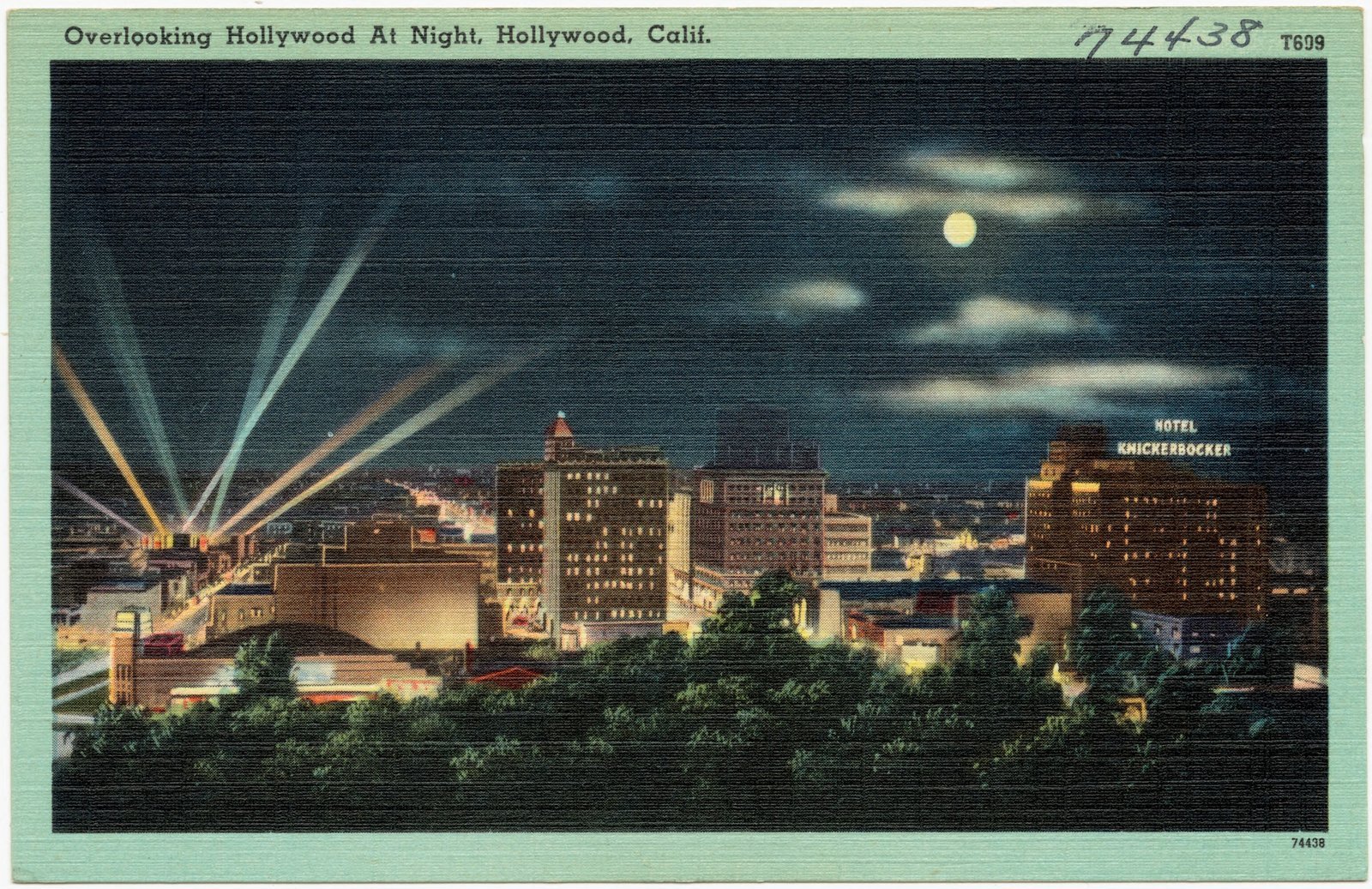
Hollywood looking south from the hills at night — the city of contracts, screen tests, and unsolved disappearances into which Elizabeth Short walked in the summer of 1946 (Wikimedia Commons).
─────I · chapter
Bob Belden — Arranger as Dramatist
Bob Belden (1956–2015) belonged to that rare American lineage of musician-thinkers for whom composition, arrangement, and production formed a single discipline. Born in Evanston, Illinois, raised in the Charleston-area suburb of Goose Creek, South Carolina, he passed briefly through the University of South Carolina — where the composer Jay Knowles introduced him to the music of Gil Evans — before transferring to the University of North Texas, that legendary incubator of large-ensemble craft. There he absorbed the orthodoxy of Thad Jones and Bob Brookmeyer while listening, with equal seriousness, to Evans's Sketches of Spain, Bernard Herrmann's Hitchcock scores, and the ambient experiments of Brian Eno.
Graduating in 1978, Belden spent eighteen months with Woody Herman's Thundering Herd — the apprenticeship through which most American arrangers of his generation passed — followed by intermittent work with Donald Byrd (1981–1985), a chair in the Mel Lewis Orchestra, and production credits on two Red Rodney records. By 1983 he had settled in New York as a session writer, gradually building the network of musicians who would become the Belden Ensemble.
He earned his first wide recognition in the early 1990s with a series of jazz reinterpretations of unlikely sources: Sting's songbook on Straight to My Heart (1991), Puccini's Turandot (a 1993 project ultimately blocked by the composer's estate), and Prince's catalogue on When Doves Cry (1994). These were not novelties. Belden's gift was to identify, within material the jazz world had dismissed, the harmonic and dramaturgical bones suitable for the orchestral imagination. The Sting record in particular — with its dense voicings, Marc Copland on piano, and the saxophone of a young Bob Berg — announced an arranger of unusual rigour.
By the late 1990s, Belden had moved into the executive corridors of Blue Note Records, where he served as head of A&R and supervised the label's reissue program. He won multiple Grammy Awards for his annotation and production of Miles Davis archives: The Complete Bitches Brew Sessions (1998), The Complete In a Silent Way Sessions (2001), The Cellar Door Sessions 1970 (2005), and The Complete On the Corner Sessions (2007). This deep, sustained immersion in Davis's electric period — the way Teo Macero had spliced and stretched tape, the way an orchestra could be assembled from overdubs and reverb, the way silence and density were equivalent compositional resources — left audible traces in Belden's own writing.
Black Dahlia, released by Blue Note in 2001 after a three-year gestation, is the culmination of these accumulated practices. It is at once a tone poem, a concept album in the Sergio Mendes-by-way-of-Gil-Evans tradition, and a personal essay on Los Angeles as palimpsest. Belden had relocated temporarily to California to research the project; the score draws on his reading of James Ellroy's 1987 noir novel The Black Dahlia, Otto Friedrich's 1986 cultural history City of Nets: A Hollywood Portrait of the 1940s, and the contemporary newspaper accounts of the January 1947 murder. He spoke, in interviews around the release, of having internalised the harmonic language of Alban Berg's Wozzeck and Lulu — the romantic-expressionist score of a young woman destroyed — alongside Jerry Goldsmith's music for Roman Polanski's Chinatown, which provided, in Belden's own description, the sepia-toned ambience of memory rather than period reconstruction.
What distinguishes Belden's compositional voice on this album is its refusal of two temptations common to large-ensemble jazz: the showcase concerto and the through-composed academic exercise. His movements move like film cues. They establish a mood, introduce a soloist as character rather than virtuoso, and dissolve into the next scene with the patience of a tracking shot. Tim Hagans, his lifelong trumpet collaborator from the Hagans-Belden Quintet, functions here almost as the unseen narrator; the saxophone of Lawrence Feldman and Belden himself takes on the role of interior monologue.
Belden continued to write large-scale works until his sudden death from a heart attack in May 2015 — including the Animation/Imagination projects, the Iran-themed concert music documented on Treasure Island and Asiento, and the Davis tributes Miles from India (2008, Grammy nomination) and Miles Español (2011). Black Dahlia remains, however, the work in which his ambitions as composer, historian, and producer arrived at their fullest synthesis.
THE NORTH TEXAS LINEAGE
The University of North Texas — formerly North Texas State, in Denton — has occupied an unusual place in American jazz pedagogy since the 1940s. Its One O'Clock Lab Band, founded in 1947, became the first college ensemble to function as a working professional jazz orchestra, and the school produced a remarkable lineage of large-ensemble arrangers: Lou Marini, Marvin Stamm, Bob Mintzer, Joe Lovano in passing, and — in the late 1970s — Belden. The pedagogy emphasised dense voicings, brass writing in the Thad Jones manner, and the discipline of writing without padding. The Sting record of 1991 already announced a Belden who had absorbed those lessons but pushed past them. Black Dahlia is North Texas grown into film score, then bent back toward chamber composition.
MILES DAVIS REISSUES — A COMPOSITIONAL EDUCATION
Between 1998 and 2007, working as Blue Note's A&R chief and as Columbia/Legacy's lead jazz reissue producer, Belden assembled the definitive multi-disc surveys of Miles Davis's electric period: The Complete Bitches Brew Sessions, The Complete In a Silent Way Sessions, The Cellar Door Sessions 1970, The Complete On the Corner Sessions. The work amounted to a slow, granular study of Teo Macero's tape editing — the way a thirty-minute jam could be reduced to a six-minute composition, the way reverb could function as an instrument, the way density and silence were equivalent compositional resources. By the time he sat down to write Black Dahlia, Belden had absorbed Macero's lessons at a level no other arranger of his generation had matched. The studio layering of the suite — strings overdubbed onto rhythm sections, woodwinds added in passes, the soundstage built rather than captured — is unimaginable without those Davis sessions in his ear.
ELIZABETH SHORT — A LIFE IN OUTLINE
Elizabeth Short was born on 29 July 1924 in Hyde Park, a southern neighbourhood of Boston, the third of five daughters in a family that fractured early — her father staged his own suicide during the Depression and resurfaced in California years later. She worked as a waitress, drifted between Florida and Massachusetts, became briefly engaged to Major Matt Gordon, an Army Air Corps pilot who died in a crash in the final weeks of the Pacific war, and arrived in Los Angeles in the summer of 1946 with the vague intention common to thousands of young women of her generation: to be photographed, to be noticed, to be in the movies. She was twenty-two. The newspapers, hungry for posthumous archetype, would later christen her the Black Dahlia — a name borrowed from George Marshall's 1946 film The Blue Dahlia and from her preference for black clothing.
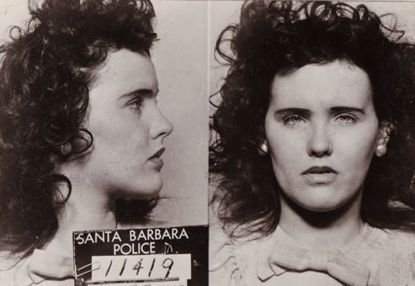
Elizabeth Short in a police bulletin photograph distributed in the days following the discovery of her body, January 1947 — the single image by which most of America came to know her (Wikimedia Commons).
15 JANUARY 1947 — LEIMERT PARK
Her body was discovered at approximately ten in the morning by a woman walking her child to school along South Norton Avenue in the Leimert Park district of Los Angeles. It had been severed at the waist, drained of blood, the face slashed at the corners of the mouth from ear to ear, and posed with arms above the head and legs apart in a kind of obscene formal composition. Almost sixty men subsequently confessed; twenty-five were considered viable suspects by the Los Angeles District Attorney's office; no charge has ever been laid. The case remains, after seventy-nine years, one of the most extensively investigated and least understood homicides in American history. Belden's suite does not attempt to solve it. It attempts to honour, in fourteen movements, the brevity of the life that preceded it.
Santa Barbara police mugshot, September 1943 — Short was nineteen, arrested for underage drinking at a roadhouse near the army camp where Matt Gordon was stationed (Santa Barbara Police, public domain).
THE WEREWOLF AND THE DAHLIA — A NAME IS BORN
The body had been first reported by Betty Bersinger, a young housewife pushing her three-year-old daughter in a stroller toward a cobbler shop on Norton Avenue. The girl never saw it — Bersinger ran to a neighbour's house to phone police. Within an hour, Will Fowler and Felix Paegel of the Los Angeles Examiner had arrived (according to Fowler's later autobiography; competing accounts place Aggie Underwood of the Herald-Express on the scene first). For the first day and a half, the case had a different name: Underwood, the Herald-Express city editor — and the first woman to hold that position at any major Los Angeles daily — christened it the Werewolf Murder, the noun the 1940s American press reached for whenever a homicide exceeded rational explanation. The name Black Dahlia came later, traced by historians to a Long Beach drugstore where Short had spent hours in 1946. A woman behind the counter, contemporary to her, had used the phrase casually — a play on Alan Ladd's 1946 film The Blue Dahlia, on Short's dyed-black hair, on the sheer black clothing she favoured. A patron police officer overheard. The Hearst reporter Bevo Means heard it from him. The headline ran on 18 January 1947. It has not been replaced since.
TWO LOS ANGELES, TWO FRONT PAGES
January 1947 was the high noon of the American daily paper. Los Angeles had four major dailies, organised by Hearst (the morning Examiner and afternoon Herald-Express), by the Los Angeles Times (Chandler family, conservative, anti-labour), and by the Daily News. On 16 January 1947, the morning after the discovery, the Examiner gave the case its entire front page; the Times placed it on page two, beneath stories about a forty-million-dollar municipal bond issue and a London labour strike. The Times would never run the Black Dahlia case on its front page during the entire investigation — a class signal as much as an editorial one. The Hearst papers, sold at newsstands to the working population by sound and headline, lived on stories like this; the Chandler Times, delivered to the lawns of business subscribers, did not. The case became a sustained event of mid-century American journalism almost entirely through the Hearst syndicate. James H. Richardson, the Examiner city editor, would later record that during the thirty-three days of intensive coverage, the paper's circulation reached its highest point since V-J Day.
THE BILTMORE — 9 JANUARY 1947
She was last seen on the evening of 9 January 1947, six days before her body was found. Robert M. "Red" Manley, a twenty-five-year-old married hardware salesman, had driven her into downtown Los Angeles from San Diego, where she had been staying with a family. He let her out at the lobby of the Biltmore Hotel on Olive Street — that vast Spanish-baroque pile across from Pershing Square, the largest hotel in the western United States at the time of its opening in 1923. She told him she was meeting her older sister, in town from Boston. Manley would later be cleared after extensive interrogation, but his account of the evening — corroborated by hotel staff who recalled her making and abandoning calls from a lobby telephone — remains the last verified sighting. She left the Biltmore at approximately ten in the evening. A cocktail lounge a few blocks west, the Crown Grill, later produced witnesses who thought they had seen her. After that, six days unaccounted for. Then the vacant lot.
THE AVENGER LETTERS
Between 21 January and 1 February 1947, the Examiner received a sequence of communications that the LAPD ultimately concluded — at least for the first — to have come from the killer. On 21 January, an unidentified caller congratulated city editor Richardson on the paper's coverage and promised souvenirs. On 24 January, a manila envelope, soaked in gasoline (a procedure that, mirroring the cleaning of the body itself, suggested forensic awareness), arrived at the Examiner offices. Inside, in a brown leather address book, lay seventy-five pages of names; Short's birth certificate; her social-security card; photographs; a series of business cards. A note, assembled from words clipped from newspapers, read: Here is Dahlia's belongings. Two days later, a handwritten letter promised the writer's surrender at a specific Wilshire address on the morning of 29 January. The address was watched. No one came. A subsequent note, postmarked the same day, read: Have changed my mind. You would not give me a square deal. Dahlia killing was justified. A signature followed — Black Dahlia Avenger — that subsequent letter writers, almost all of them later identified as cranks or sufferers from delusional disorders, would adopt. Steve Hodel, a retired LAPD homicide detective, has more recently published a sustained case for identifying the original author of the Avenger letters; the case remains contested.
─────II · chapter
A Cinematic Requiem in Fourteen Movements
Black Dahlia is best heard as a single forty-minute arc rather than a sequence of discrete tracks. The fourteen movements are organised into something resembling the four-part shape of a tone poem: invocation (movements 1–3), the city and its temptations (4–6), love and its derangement (7–9), and the unravelling (10–14). The tonal centre oscillates between a luminous D-flat major and a darker E-flat minor, with episodes of bitonal drift that recall Ravel's Daphnis et Chloé and Alban Berg's Lulu more than any post-bop orthodoxy.
Genesis opens with sustained string harmonics over a pedal — a Hollywood sunrise filtered through Debussy. The orchestration is unusual for a jazz date: a small string section (violins, violas, cellos), flute, oboe, bassoon, French horn, alongside the customary trumpet, saxophones, piano, bass, and drums. Belden writes for these forces as Gil Evans wrote for the Miles Ahead ensemble — voicings tightly clustered, with the trumpet hovering above as a single, exposed thread.
In Flight introduces the Elizabeth Short character through Tim Hagans's muted trumpet, an angular line over a 5/4 ostinato. The conceit is travel: the Massachusetts-to-California migration that defined so many Hollywood hopefuls. Dawn then arrives in California — string writing of remarkable transparency, a quiet reference to Herrmann's Vertigo prelude in its rocking minor triads and chromatic inner voices.
City of Angels, the longest movement at nearly seven minutes, is the suite's harmonic and dramatic pivot. A slow montuno emerges in the rhythm section; Belden's tenor saxophone takes the principal solo, with a tone closer to Wayne Shorter's circa Native Dancer (1974) than to any neo-bop voice. The two Dream / Dream World movements function as a single diptych — an alternate-take pairing that one suspects was the composer's deliberate doubling rather than a redundancy, since the second reading inverts the orchestration: string melody over woodwind ostinato, where the first had it reversed.
Prelude to Love and the Danza d'Amour / Danza d'Amore pair shift to a Latin idiom — a clear nod to the Afro-Cuban bands of postwar Los Angeles, the Lalo Guerrero ensembles and the Tito Puente orchestras that played the Hollywood Palladium and the Crescendo. Belden treats the dance forms as scaffolding for a slowly dissolving infatuation; the second Danza is markedly more chromatic, the harmony beginning to slip, the rhythm section dragging just behind the beat. Zanzibar — named for the Hollywood nightclub at Sunset and Western, where Billy Eckstine and Dizzy Gillespie's big band played in 1944 — is the suite's sole genuinely up-tempo movement, a 4/4 swing in which Hagans's open trumpet finally cuts loose. It is also the last moment of brightness.
The title movement, Black Dahlia, is structurally astonishing: a passacaglia of sorts, with a descending bass line of nine bars (not eight — Belden's quiet asymmetry, which forces every restatement to land in a different rhythmic position) over which the orchestra accumulates dissonance. There is no climax in the conventional sense; the texture thickens until it simply stops, like a sentence trailing off. The Edge of Forever (Last Night at the Hacienda Club) depicts, in slow swing, what Belden imagined as Short's final evening — saxophone and trumpet in close intervals, the rhythm section dropping nearly to silence.
101 North is the abduction sequence: the highway out of Los Angeles, scored as a relentless 7/8 figure that derails harmonically every two bars, the brass intruding in unpredictable accents. The closing Elegy (City Lights, Prayer, Procession and Ascension) is the most overtly Herrmann-esque movement of the suite — a four-section coda lasting nearly seven minutes, ending in string harmonics that mirror the opening Genesis and close the cycle in a deliberately unresolved suspended chord. The story does not end. The case was never solved.
What lifts Black Dahlia above its evident filmic affinities is Belden's restraint. He never reaches for the kettle drum, never quotes a period tune, never lets the soloists comment ironically on the material. The result is a jazz orchestral work of unusual moral seriousness — a memorial, not a melodrama, written by a composer who refused to aestheticise the violence at its centre.
THIRD STREAM AND ITS DESCENDANTS
The term third stream was coined by Gunther Schuller in a 1957 lecture at Brandeis to describe a music that drew from both the European classical tradition and jazz without subordinating one to the other. The early third-stream experiments — Schuller's own Transformation, the Modern Jazz Quartet's collaborations with the Beaux Arts Trio, John Lewis's writing for orchestra — were earnest but often laboured, the jazz language stiffening under the weight of classical form. By the time Belden wrote Black Dahlia, four decades later, the project had been transformed by Gil Evans, by Charles Mingus's Epitaph, by George Russell's Lydian Chromatic Concept, and by film scoring's quiet absorption of jazz vocabulary (Henry Mancini, Lalo Schifrin, Quincy Jones). Black Dahlia belongs to this late, mature third stream — a music in which the distinction between idioms has effectively dissolved, leaving the composer free to draw on whichever resource the dramatic moment requires.
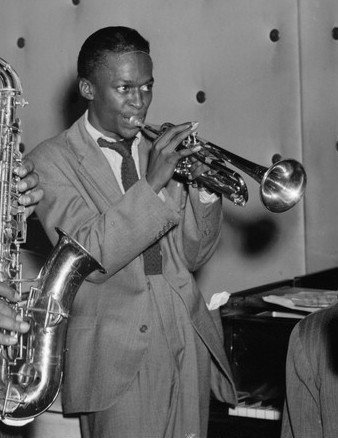
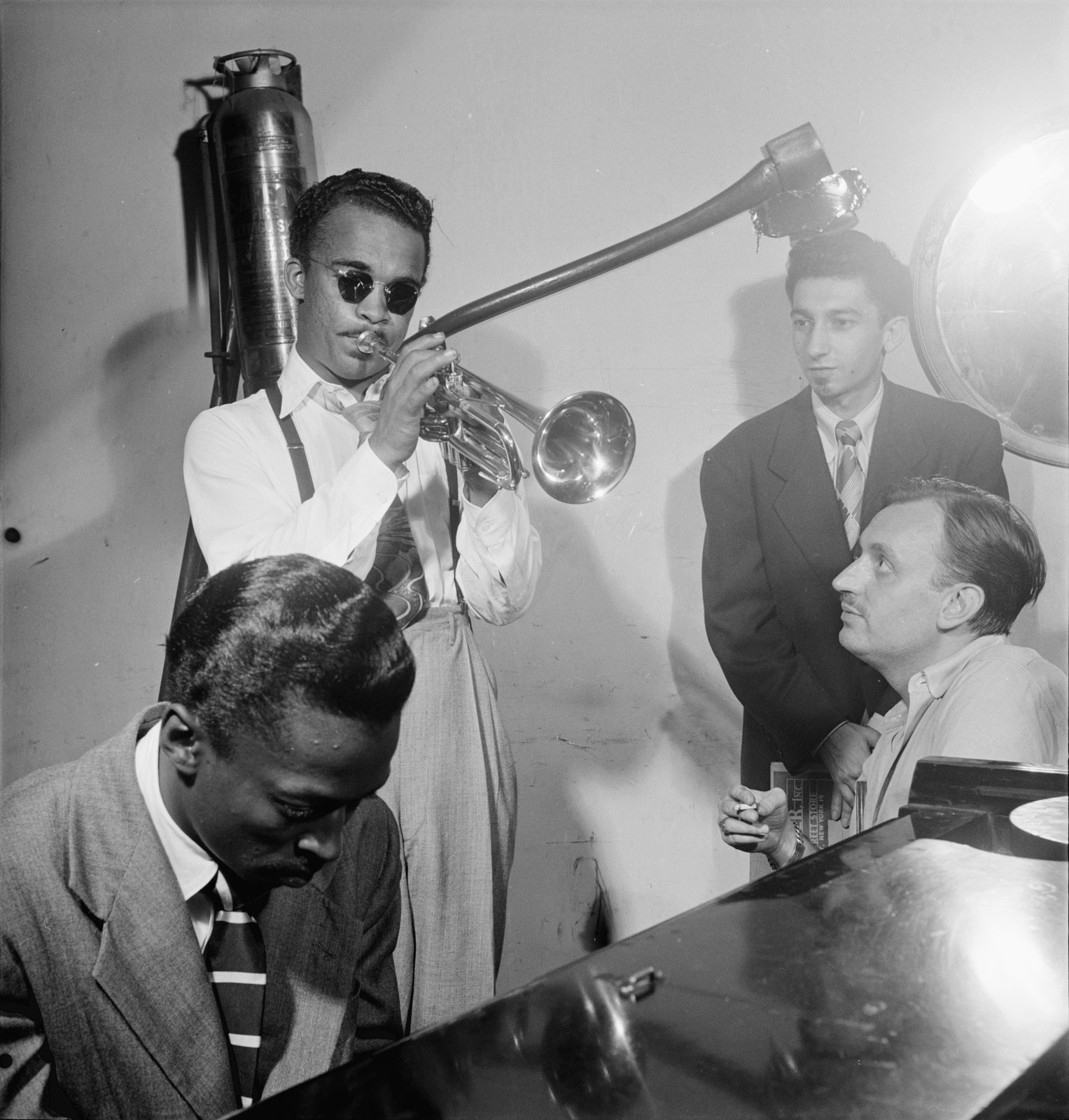
Miles Davis at the Three Deuces, Manhattan, 1947 — the year of Elizabeth Short's death, photographed by William P. Gottlieb during the bebop renaissance whose harmonic vocabulary Belden would later transmute into orchestral chamber writing (Library of Congress, Gottlieb Collection).
THE EVANS / DAVIS LINEAGE
Between 1957 and 1960, Gil Evans and Miles Davis recorded three of the most influential orchestral jazz albums in American music: Miles Ahead, Porgy and Bess, and Sketches of Spain. The instrumentation Evans devised — French horn, tuba, flutes, and flugelhorn replacing the conventional big-band brass — became the template for a chamber-jazz tradition that would extend through Bob Brookmeyer, Maria Schneider, and Belden himself. The voice-leading Evans pioneered, with tightly clustered four- and five-note chords leaving deliberate space between bass and inner harmony, is everywhere audible in Black Dahlia. Belden once described his composing process for the album as 'three years inside Gil Evans's head' — a flattering self-description, but accurate.
Howard McGhee, Brick Fleagle, and Miles Davis in conversation, September 1947 — the New York jazz milieu in the same months that the Los Angeles police were closing the active file on Elizabeth Short (Library of Congress, Gottlieb Collection).
BERNARD HERRMANN AND THE NOIR SOUND
If one figure haunts Black Dahlia more than any other, it is Bernard Herrmann (1911–1975) — the New York-born CBS Symphony Orchestra conductor, Welles collaborator, and Hitchcock composer whose scores for Vertigo (1958), North by Northwest (1959), Psycho (1960), and Taxi Driver (1976) defined the harmonic language of American screen anxiety. Herrmann favoured small repeated cells, modal harmonies suspended between major and minor, and an instrumental colour weighted toward strings, harp, low woodwinds, and muted brass — much of the palette Belden adopts for Black Dahlia. The opening of Vertigo's prelude, with its rocking habanera figure and chromatic descent, is audibly recalled in Dawn; the descending passacaglia of the title movement owes its harmonic mood to Herrmann's Psycho string writing. Belden never quotes. He inherits.
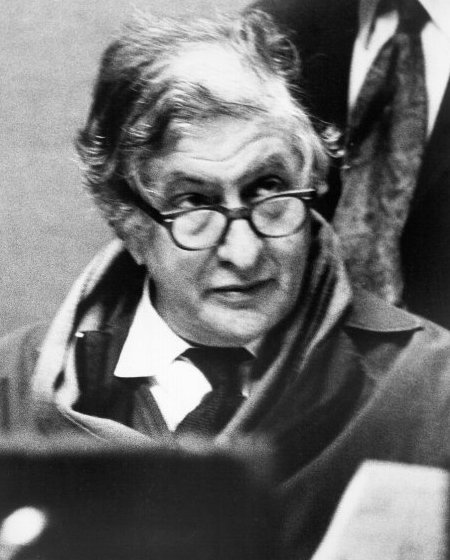
Bernard Herrmann in the early 1970s — the film composer whose modal language and string scoring define, more than any other influence, the harmonic atmosphere of Black Dahlia (Wikimedia Commons).
POSTWAR LOS ANGELES — THE LATIN UNDERCURRENT
The Los Angeles into which Elizabeth Short walked in 1946 was not yet the freeway-bound, suburban metropolis it would become in the 1950s. It was a city of streetcars, of recently demobilised servicemen, of women who had worked the wartime aircraft plants and now drifted between defence-industry layoffs and clerical jobs. Hollywood Boulevard was lined with radio broadcast studios, jazz clubs, and the Latin ballrooms — the Crescendo, the Palladium, the Mocambo on Sunset — where postwar Angelenos heard the Afro-Cuban bands of Machito, Lalo Guerrero, and (touring out of New York) Tito Puente. Belden's Latin movements — the Danza pair, the montuno underlying City of Angels — are not mere period colour. They register a real fact of the city's soundscape, a music Elizabeth Short almost certainly heard in her months on Hollywood Boulevard. The political moment behind that music was equally real: the zoot suit riots of 1943 had marked Mexican-American youth as targets of moral panic; by 1947, the LAPD had been substantially federalised under Chief C. B. Horrall, with Red Squad surveillance of leftists, Mexican-American activists, and African-American musicians a documented fact of the period.
─────III · chapter
Tim Hagans, Lawrence Feldman, and the Belden Ensemble
The musicians assembled for Black Dahlia form an ensemble carefully chosen from Belden's long-standing New York network. Tim Hagans, the principal trumpet voice, had by 2001 already co-led the Hagans-Belden Quintet for nearly a decade, including the acclaimed Animation/Imagination and Re-Animation Live! projects on Blue Note. A Dayton-born trumpeter with a tone equally indebted to Booker Little and Kenny Wheeler — that is, to two players who understood the long-form lyrical phrase as primary — Hagans is the closest thing the suite has to a protagonist. His playing throughout Black Dahlia is restrained, lyrical, and shaped by an unusually patient sense of long-form architecture. The muted trumpet line in In Flight is exemplary: an angular contour that nevertheless refuses to resolve into anything resembling a head, building instead toward the suite's first real harmonic statement in Dawn.
Lawrence Feldman, a New York reedsman whose career spans Broadway pits, the Saturday Night Live band, the Mingus Big Band, and countless film dates, contributes flute, alto flute, and soprano saxophone. His doublings allow Belden to write for shifting woodwind colours without expanding the personnel; the alto flute in Dream World and the soprano in Prelude to Love are particularly distinguished. Feldman is the kind of player who is heard most clearly when his name is not on the marquee — an ensemble musician of the highest order.
Belden himself plays tenor saxophone and conducts. His tenor tone on the album is unusual: lighter than the post-Coltrane Brecker-school norm, more closely related to the Stan Getz line of voicing — Belden was, after all, a Texan-trained arranger who had spent his youth listening to Getz's Focus arrangements by Eddie Sauter, another touchstone for Black Dahlia's string-and-saxophone writing.
The rhythm section draws on Belden's familiar collaborators: Marc Copland on piano, whose impressionist voicings (Copland had emerged from the New Jersey scene around Bill Evans's harmonic heirs, including a substantial period of study with the underrated pianist Don Friedman) align perfectly with the orchestral writing; Scott Lee on bass, whose double-bass work has the dark sustain typical of the New York chamber-jazz scene around John Patitucci; and Billy Kilson on drums, whose subtlety here is in striking contrast to his more muscular work with Dave Holland's quintet of the same period.
The string contingent is anchored by Joyce Hammann as concertmaster — a New York player familiar from Astor Piazzolla's American sessions and from contemporary chamber repertoire — alongside violist Lois Martin and cellist Dave Eggar, all musicians of cross-genre experience comfortable in both written and partly improvised contexts. French horn (Chris Komer) and bassoon round out the orchestral palette.
It is an ensemble of arrangers' musicians: players valued less for their solo signatures than for their ability to disappear into a composer's vision. This is precisely what Black Dahlia requires.
THE PIANO CHAIR — MARC COPLAND
Marc Copland is the unusual figure on the bandstand: an alto saxophonist who, in his mid-thirties, switched permanently to piano under the influence of Bill Evans's late voicings. By 2001 he had developed a harmonic palette of unusual independence — extended tertian chords used as colour rather than function, an avoidance of bebop comping clichés, a touch indebted to French repertoire as much as to American jazz piano. His role on Black Dahlia is supportive in the strictest sense: he comps almost nothing in the conventional manner. Instead, he sustains, voices, and occasionally takes over the harmonic argument from the orchestra. The piano writing in City of Angels — that suspended pedal underneath Belden's tenor solo — is unimaginable in another pianist's hands.
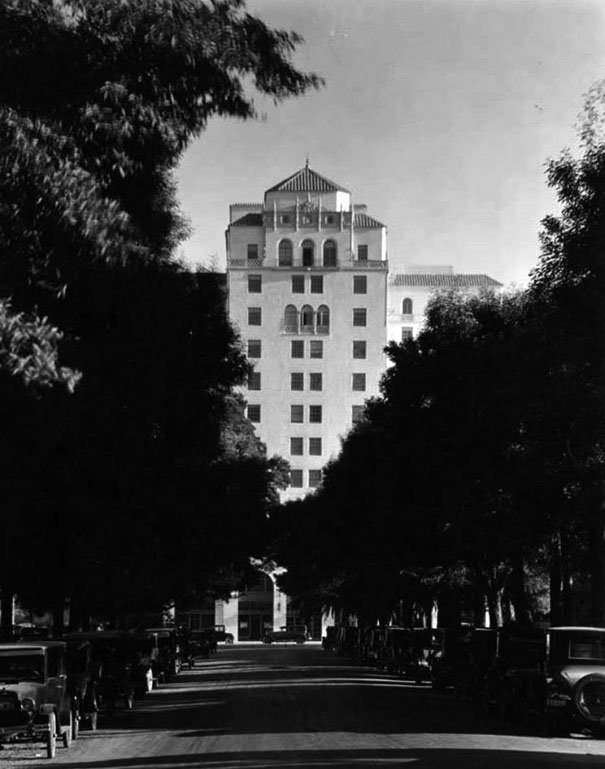
The Hollywood Roosevelt Hotel, photographed shortly after its 1927 opening — the Spanish Colonial landmark where the first Academy Awards were held in 1929 and where, in the late 1940s, a young Marilyn Monroe lived during her first studio contract (Wikimedia Commons).
─────IV · chapter
Sessions for a Hollywood Memorial
Black Dahlia was recorded in New York during 2000 and released by Blue Note Records in early 2001, as part of the brief but distinguished run of large-scale composer-driven projects Belden was able to realise during his tenure as head of A&R at the label. The sessions were tracked in stages: rhythm section and soloists first, then strings and woodwinds overdubbed — a procedure consistent with Belden's well-known admiration for the Teo Macero / Miles Davis studio methodology, and one that allowed for the careful spatial layering audible in the finished mix.
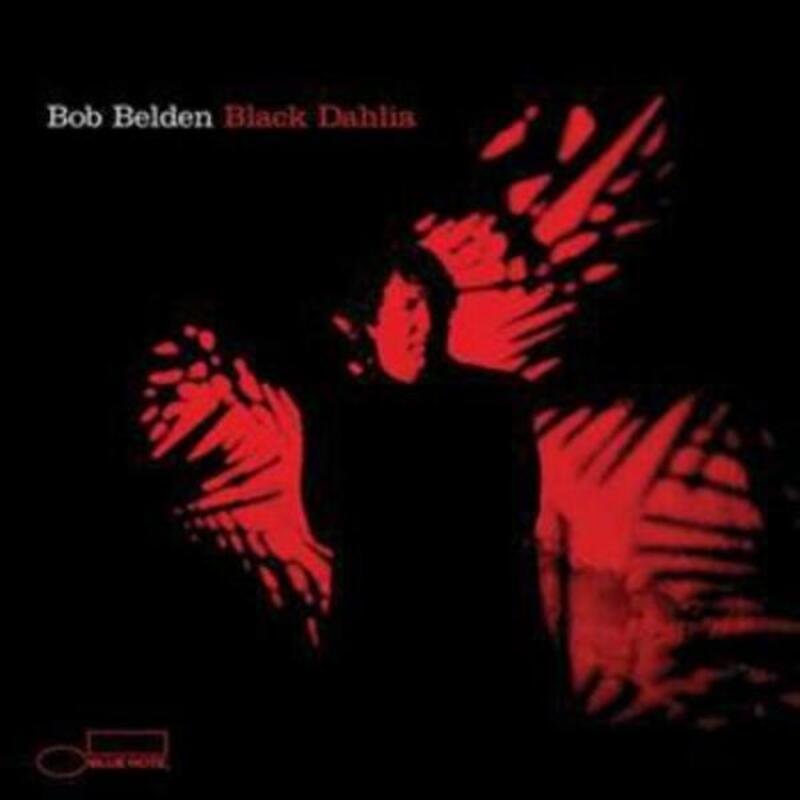
Belden produced the album himself, working with engineering personnel from the Blue Note roster of the period. The catalog number Blue Note 7243 5 27855 2 0 places it within the label's main contemporary series rather than its archival branches. The cover art — a stylised image evoking 1940s Hollywood typography over a noir-toned portrait — was designed to position the album as a concept work rather than a conventional jazz release.
The research substrate is unusual for a jazz date. Belden later spoke in some detail about his sources: James Ellroy's 1987 novel The Black Dahlia, the first volume of Ellroy's L.A. Quartet and a work that established the literary frame within which postwar Los Angeles is now almost always read; Otto Friedrich's 1986 cultural history City of Nets: A Hollywood Portrait of the 1940s, which charts the migration of European intellectuals to Los Angeles during the Nazi years (Brecht, Mann, Schoenberg, Adorno, Korngold) and the consequent cross-pollination of art-music and film score that produced figures like Herrmann himself; and the contemporary newspaper coverage of the case in the Los Angeles Examiner, the Herald-Express, and the Times. The harmonic and dramatic substrate is more eclectic still: Alban Berg's Wozzeck (1922) and Lulu (1937), Roman Polanski's Chinatown (1974) with Jerry Goldsmith's score, the orchestral writing of Eddie Sauter for Stan Getz's Focus (1962), and the Davis/Evans trilogy already mentioned.
Critical reception at the time was warm if puzzled: reviewers admired the writing but struggled to categorise the result, which sat uncomfortably between jazz, contemporary classical, and film-music traditions. The All About Jazz reviewer called it 'the most ambitious jazz recording of the year' and noted that the suite was 'three years in the making' and required over sixty musicians across the various sessions. The album received a Grammy nomination for Best Large Jazz Ensemble Album but did not win — the award went that year to Dave Holland's Not For Nothin'. In the years since Belden's death in 2015, Black Dahlia has been increasingly recognised as one of the most fully realised orchestral jazz statements of its decade, and as a key document of his compositional voice. The work has not been performed live since the original sessions — its scale and the specific colours Belden assembled make revival logistically formidable. It remains, in that sense, a studio composition in the strictest tradition: heard, if at all, in the form in which it was assembled.
A STUDIO BUILT LIKE A SOUNDSTAGE
The recorded sound of Black Dahlia is integral to its dramatic argument. Engineered with the attention to spatial layering that characterised Belden's Blue Note reissue work, the album presents its mixed ensemble in a wide, slightly forward stereo image with notable depth behind the strings. The soundstage feels constructed rather than captured — closer in philosophy to Teo Macero's Miles Davis productions than to a documentary chamber-jazz recording.
The string section, though small, is given remarkable presence: violins and violas occupy the upper plane with a silk-and-rosin texture suggesting close cardioid placement, while the cello sits warmly in the lower-middle distance. Woodwinds — particularly the oboe in Genesis and the flute in Dawn — are recorded with an almost art-song intimacy, key noise audible, breath shaping the phrase.
Tim Hagans's trumpet is placed slightly left of centre, with a long, organic reverb tail that recalls a film-scoring stage rather than a jazz club. When he plays muted (In Flight, The Edge of Forever), the microphone reveals the granular buzz of the Harmon stem; when open (Zanzibar), the air around the bell expands without any loss of focus. Belden's tenor and Feldman's reeds are similarly served — a present, almost confessional tone, never homogenised into ensemble blend.
The rhythm section deserves particular note: the bass is full but not bloated, the kick drum tight, the cymbals (especially in Zanzibar) sparkling without harshness. Piano voicings — those tightly clustered Belden chords — emerge with their internal voice-leading intelligible, which on lesser recordings would collapse into mud.
Interpretively, the ensemble plays with the patience of a chamber orchestra rather than the heat of a jazz date. There is virtually no improvisation that does not serve the dramatic situation; even Hagans's most extended solos remain within the formal arc Belden has drawn. The whole has the quality of a film score performed without the film — which is, in fact, the most accurate description of what Belden composed. On a capable system, the suite rewards single-sitting attention; on headphones, the spatial conceit reveals itself fully.
RECEPTION — THEN AND NOW
On release in early 2001, Black Dahlia divided the jazz press cleanly. DownBeat and JazzTimes praised the writing but registered visible discomfort at its film-music affinities — a discomfort still common in the American jazz academy of that period, which tended to read orchestral ambition as suspect. The European reception was warmer: Jazz Magazine (Paris), Jazzthing (Berlin), and Stuart Nicholson's writing in The Times (London) treated the album as a successor to Maria Schneider's Allégresse and to the late work of Carla Bley. The Grammy nomination in the Best Large Jazz Ensemble Album category confirmed the album's reach. Since Belden's death in 2015, critical reassessment has been steady: a 2017 Wire retrospective listed it among the essential orchestral jazz statements of the 2000s, and the 2020 Penguin Guide to Jazz (final edition) awarded it the crown — an unusually emphatic late endorsement.
Gil Evans / Miles Davis — Sketches of Spain (Columbia, 1960)
Bernard Herrmann — Vertigo (original soundtrack, 1958)
Stan Getz — Focus, arr. Eddie Sauter (Verve, 1962)
Maria Schneider Orchestra — Allégresse (Enja, 2000)
Bob Belden — Re-Animation Live! (Blue Note, 2000)
Bob Belden — Treasure Island (Sunnyside, 1990)
*Black Dahlia* is the work in which Belden's three vocations — arranger, historian, producer — arrived at full synthesis. A Hollywood requiem composed by a jazzman who understood that the most devastating noir is written in counterpoint, not blood, and that the only honest memorial to an unsolved murder is one that refuses to invent a solution.
Letters from Zevnikov
A note when a new essay or travelogue appears. No noise, unsubscribe in one click.