Beethoven's Mass in C major, dismissed at its 1807 Eisenstadt premiere by Prince Nikolaus II of Esterházy as »insupportablement ridicule et détestable«, has long suffered the shadow of its monumental successor, the Missa Solemnis. Mariss Jansons, in this Munich live recording from January 2018, restores to it the human warmth and the dramatic urgency that E. T. A. Hoffmann already discerned in 1813 — a Mass »composed from the depths of a profoundly religious feeling«. The recording is paired with the Leonore Overture No. 3, made some fourteen years earlier in the same hall, framing the two faces of Beethoven's middle-period ethical imagination: the prayer for peace and the cry for freedom.
Beethoven's Mass in C was the failure that taught him how to write the Missa Solemnis. The detour is not minor; it is the road.Editorial
Mariss Jansons in Munich — A Live Recording, Eleven Months Before His Death
Mariss Jansons (1943–2019) was, at the time of this Munich performance in January 2018, in the sixteenth year of his tenure as Chief Conductor of the Symphonieorchester des Bayerischen Rundfunks. He had taken up the post in 2003, succeeding Lorin Maazel, and would hold it until his sudden death in St. Petersburg on 1 December 2019 — eleven months after this recording was made. The Bavarian Radio Symphony was, at this point, the orchestra he led with greatest concentration and longest continuity: it was where, across a sixteen-year span, he made his deepest recorded statements on the central German repertoire — the Beethoven and Brahms symphonies, the Mahler cycle, the Strauss tone poems, the choral-orchestral evening recorded here.
Jansons's biography is one of the unusual histories of the late twentieth century. Born in Riga in 1943 — his father Arvīds Jansons was a celebrated conductor in his own right, his mother Iraida Jansone a Latvian-Jewish singer — he survived the Riga Ghetto and the dispersals of the war as an infant. (His mother gave birth to him in hiding, behind a stage curtain, on the day of an extermination action.) He studied first with his father, then at the Leningrad Conservatory under Yevgeny Mravinsky, the conductor most identified with the Shostakovich symphonies, and later in Vienna with Hans Swarowsky and in Salzburg with Herbert von Karajan. The Karajan connection is decisive: Jansons was Karajan's assistant at the Berlin Philharmonic in the late 1960s and inherited from him both the long-line phrasing and the conviction that orchestral playing must, before all else, sing.
He took up his first major post — Chief Conductor of the Oslo Philharmonic — in 1979, holding it until 2002 in a tenure that transformed an obscure Scandinavian orchestra into an internationally recorded ensemble. During the 1990s and 2000s he built a parallel career at the Pittsburgh Symphony (1997–2004) and the Royal Concertgebouw Orchestra (2004–2015). The Bavarian Radio Symphony post overlapped with the Concertgebouw years and was, in the end, the longer of the two. The BR Symphony became, by the late 2010s, his musical home — the ensemble in which he had developed the deepest understanding of woodwind colour, choral integration, and the spatial dynamics of a live concert recording.
The Mass in C major was recorded on three nights of live concerts at the Herkulessaal of the Munich Residenz — the long, gilded eighteenth-century banqueting hall converted to a concert venue in 1953 after the destruction of the Bavarian National Theatre during the war, and, since then, the principal concert space of the BR Symphony — on 11 and 12 January 2018. The four soloists were assembled from Jansons's preferred Bavarian-Austrian roster: the Salzburg-born Genia Kühmeier (soprano), one of the great Mozart sopranos of the early twenty-first century; the Vienna-trained Elisabeth Kulman (alto), a former operatic mezzo who had narrowed her career, after a vocal injury and recovery, to concert and recital work; the Cambridge-trained Mark Padmore (tenor), the English Evangelist of his generation and a Bach specialist of formidable reputation; and the German bass-baritone Hanno Müller-Brachmann, a long-time soloist with Daniel Barenboim's Berliner Staatsoper and a frequent collaborator with Jansons.
The Chor des Bayerischen Rundfunks — the Bavarian Radio Choir, in its current form one of the three or four leading professional radio choirs in Europe alongside the RIAS Kammerchor (Berlin), the WDR Rundfunkchor (Cologne), and the Latvian Radio Choir (Riga) — sang under the chorus master Howard Arman, whose preparation of the Mass in C was widely praised in the Munich reviews. The choral discipline of the BR Chor is one of the recording's most striking attributes: the long fugal passages of the Gloria and Credo are sung with extraordinary precision and tone-quality, and the great quiet choirs at the close of the Agnus Dei are placed with a delicacy that is the achievement of a specific institutional tradition. Arman, a British choral conductor who had spent the preceding decade building the BR Chor into one of the great instruments of European sacred-music performance, was at the height of his work with the ensemble when this recording was made.
The pairing with the Leonore Overture No. 3 — a separate concert recording from approximately fourteen years earlier in the same hall — is a programming decision rather than a musical accident. Beethoven himself would not have programmed the two works together: the Leonore Overture belongs to the Fidelio score, and the Mass to the Eisenstadt liturgical occasion. But side by side — a sacred work and a secular work, separated by fourteen years of Beethoven's central decade — they make a coherent statement of the moral universe of the composer's middle period. The prayer for peace and the cry for freedom: it was Jansons's pairing, and it is among the most carefully chosen of his late recordings.

The Mass in C major — Structure, Voices, the Inheritance of Haydn
Beethoven's Mass in C major, Op. 86, was composed between July and August 1807 in the modest hill town of Heiligenstadt outside Vienna — the same village in which, five years earlier, Beethoven had written the so-called Heiligenstadt Testament, the letter to his brothers in which he confronted his progressive deafness. The compositional process was rushed, conducted with the Prince's anxious correspondence pressing for completion; Beethoven's letter of 26 July reassured Esterházy that the work would be delivered by 20 August, leaving time for rehearsals before the 13 September performance.
The five movements — Kyrie, Gloria, Credo, Sanctus-Benedictus, Agnus Dei — follow the conventional Catholic Mass Ordinary, scored for four soloists (soprano, alto, tenor, bass), four-part chorus, and orchestra: woodwinds in pairs with the addition of contrabassoon; pairs of horns and trumpets; timpani; full strings; organ continuo. Notably absent are trombones — Beethoven omitted them, almost certainly because the Eisenstadt orchestra lacked the necessary players. The Kyrie further omits flutes, trumpets, and timpani, restricting itself to a chamber-orchestral palette that recalls a Haydn slow movement more than a Beethoven heroic statement. The work opens, not with a great orchestral exordium of the kind that begins the Haydn Nelsonmesse, but with a quiet choral entry — Kyrie eleison sung piano — in C major over a sustained string pedal. It is, from the first bar, a different conception of sacred music: not court-ceremonial but interior, contemplative, almost private.
The structural innovation of the Mass — what made it strange to Esterházy ears in 1807 — is the integration of soloists and chorus into a single continuous musical body, rather than the alternation of operatic solo aria and choral fugue that characterised Haydn's six late masses. In Haydn the chorus dominates the laudatory and credal sections, the soloists take the meditative and devotional sections (the Et incarnatus, the Benedictus), and the structural design is sectional and almost balletic. Beethoven instead treats soloists and chorus as alternating but interpenetrating voices throughout, with the soloists frequently emerging from the choral texture rather than entering separately. The result is a musical surface that is more symphonic than vocal-virtuosic: the four soloists are not given the grand aria opportunities that Haydn supplied; they are absorbed into the structural argument.
Beethoven himself drew attention to this peculiarity in the letter to his publisher Breitkopf & Härtel of 16 January 1811, when he was attempting to sell the work for publication: »I believe that I have treated the text as it has seldom been treated before. Apart from Kyrie eleison, cheerfulness pervades this Mass.« The phrase Heiterkeit waltet in dieser Messe — 'cheerfulness pervades this Mass' — has been quoted in every subsequent reception study; it is Beethoven's own description of what he had attempted, and it has remained the central interpretive crux of the work for two centuries.
The Heiterkeit is real and is the most striking feature of the Mass to anyone hearing it for the first time after the Missa Solemnis. The Gloria is exuberant, almost dance-like in its outer sections; the Credo opens with a great choral expansion — Credo, credo, the repeated affirmation in chorus before the tenor enters with the text proper — and proceeds through an Et incarnatus of remarkable warmth (the alto solo descending against the chorus in a passage Beethoven himself would later cite, in conversation with Karl Holz, as among his most successful writing). The Sanctus is luminous; the Benedictus develops as a chamber-music meditation for the four soloists with chorus; and the Agnus Dei moves through the conventional C-minor opening into a final, ecstatic Dona nobis pacem in C major that recalls — in mood if not in scale — the closing chorus of Handel's Messiah. The whole architecture is sunlit in a way that almost no subsequent sacred work of Beethoven would be: the Missa Solemnis, fifteen years later, is dark, conflicted, ecstatic at moments but never cheerful.
The Mass had a single substantial public hearing in Beethoven's lifetime apart from the Eisenstadt premiere: excerpts (the Gloria and Sanctus) were performed at the legendary Vienna concert of 22 December 1808 at the Theater an der Wien — the so-called 'Akademie' or 'monster concert' at which the premieres of the Fifth Symphony, the Sixth Symphony (the Pastoral), the Fourth Piano Concerto (with Beethoven himself as soloist), and the Choral Fantasy all took place over four hours in an under-heated theatre. The concert was a partial fiasco — under-rehearsed, the Choral Fantasy breaking down and having to be restarted — but the excerpts from the Mass were noted by E. T. A. Hoffmann in his subsequent essay in the Allgemeine musikalische Zeitung of 1813 with substantial praise: Hoffmann described the work as 'clearly composed from the depths of a profoundly religious feeling'. The Hoffmann review marked the beginning of the slow rehabilitation of the Mass: a positive reception in print, in the most authoritative musical journal of the period, by the writer who was simultaneously establishing the modern critical reception of Beethoven's instrumental music.
Beethoven and the Sacred — From Bonn Catholic Youth to Heiliger Dankgesang
Beethoven's relationship to sacred music is one of the most peculiar trajectories in the history of nineteenth-century composition. He was born in 1770 in Bonn, into a family of Court musicians attached to the Catholic Electoral Court of the Archbishop-Elector of Cologne. His grandfather Ludwig van Beethoven the elder (b. 1712) had been Kapellmeister of the Electoral chapel; his father Johann van Beethoven was a tenor in the chapel choir, with the irregular salary and intermittent drunkenness that the small Bonn court tolerated; and the young Ludwig grew up within walking distance of the chapel's daily liturgical schedule. He was baptised at the Bonn Münster — the great Romanesque cathedral that still anchors the old city — and his earliest music-making was the standard church-musician's apprenticeship: organ continuo in Mass services, occasional substitution for the cathedral organist, accompaniment of the boys' choir.
From approximately 1781 his primary teacher was Christian Gottlob Neefe (1748–1798), the Court Organist at Bonn, who introduced him to Bach's Well-Tempered Clavier and gave him his first systematic compositional instruction. Neefe was an Enlightenment Protestant; he held religious views considerably more sceptical than the official Catholic culture of the Bonn court, and these views influenced the young Beethoven decisively. By the time he left Bonn for Vienna in November 1792 — never to return — Beethoven was already a religious sceptic by Enlightenment standards. He rarely attended church through his subsequent Viennese career, kept no priest as confessor, and seems to have held the practical doctrine that genuine religious feeling was a matter of inner conscience rather than confessional observance. He read Christian Sturm's Betrachtungen über die Werke Gottes im Reich der Natur (Reflections on the Works of God in the Realm of Nature) — a Lutheran natural-theology text — and kept it on his desk through the Heiligenstadt years; he copied into his diary excerpts from Lessing, Kant, and the Indian Brahmin texts available in German translation through the work of Sir William Jones.
The sacred works are therefore not the products of orthodox confessional faith but of a sustained, idiosyncratic, intensely personal religious sensibility. Four works define the canon. The first major sacred work — the oratorio Christus am Ölberge, Op. 85, premiered at the Theater an der Wien on 5 April 1803 — is a setting of the Mount of Olives narrative in a curious mixture of Italianate operatic style and Lutheran Passion lineage. Christus am Ölberge was not a critical success at its premiere; Beethoven himself was dissatisfied with the libretto (by Franz Xaver Huber) and revised the work substantially in 1811. But it is the first attempt in his career at sustained sacred composition, and it established the territory the Mass in C major would occupy four years later.
The second is the Mass in C major of 1807. The third — and the masterpiece — is the Missa Solemnis in D major, Op. 123, composed between 1819 and 1823 for the installation of Beethoven's pupil and patron Archduke Rudolph as Archbishop of Olmütz (the installation took place in March 1820; Beethoven did not complete the Mass in time for it). The Missa Solemnis is the work Beethoven described, in the famous inscription on the title page, as »Von Herzen — möge es wieder zu Herzen gehen« — From the heart — may it return to the heart — and which he considered, in the last years of his life, his greatest achievement.
The fourth and last major sacred dimension is the late string quartet movement, the Heiliger Dankgesang eines Genesenen an die Gottheit ('Holy Song of Thanksgiving from a Convalescent to the Divine'), the slow movement of the String Quartet in A minor, Op. 132 (1825). The Heiliger Dankgesang was composed in the spring of 1825 in immediate response to Beethoven's recovery from a severe stomach illness during the previous winter; the score bears at its head Beethoven's explanation, »in der lydischen Tonart« — in the Lydian mode, the F-major scale with raised fourth — and is one of the most personal sacred utterances in his entire catalogue, more inward than any of the three other sacred works and, in its long-line cantus-firmus chorale and intercalated »Neue Kraft fühlend« (Feeling new strength) episodes, the closest Beethoven ever came to writing pure spiritual autobiography in music.
Beethoven's sacred output is thus small but intensely concentrated: one oratorio, two Masses, one quartet movement — four works that span twenty-two years and that define his most idiosyncratic compositional territory. The Mass in C major sits at the structural midpoint of this trajectory. It is the first attempt at a complete Mass setting, the laboratory for what would become the Missa Solemnis, the failure that taught Beethoven the lessons he needed for the success. Heiterkeit waltet in dieser Messe — cheerfulness pervades this Mass — was Beethoven's defence of the work in 1807 against Esterházy's bewilderment. By 1820, when the Missa Solemnis was taking shape, cheerfulness had been replaced by something far darker, more anguished, and more spiritually difficult. The detour through the Mass in C major is the means by which Beethoven discovered what sacred music could become. (For the complete chronicle of Beethoven's sacred path, including the Heiligenstadt Testament and the Heiliger Dankgesang in detail, see the appendix attached to this post.)
Leonore Overture No. 3 — The Opera Beethoven Refused to Lose
The Leonore Overture No. 3, Op. 72b, is the third of four overtures Beethoven wrote for the opera that, in its various revised forms, became Fidelio. The genesis of the opera is one of the longer compositional histories of the Beethoven catalogue, spanning more than ten years and four substantially different versions of both the score and the title.
The original 1805 production at the Theater an der Wien — under the title Leonore, with libretto by Joseph Sonnleithner after the Bouilly Léonore of 1798 — was an effective failure, performed three times to small audiences in November of that year, just days after Napoleon's army had occupied Vienna. (Most of the Viennese aristocracy had fled the city; the audience consisted largely of French officers, none of whom spoke German.) Beethoven withdrew the score, rewrote substantial portions of it for a March 1806 production (the second version), withdrew it again after similar lack of success, and finally produced the third and definitive version in May 1814 under the new title Fidelio, with a substantially revised libretto by Georg Friedrich Treitschke. The 1814 Fidelio was the version that established the work in the operatic repertoire; the 1805 and 1806 versions were forgotten, and recovered only in the twentieth century through scholarly editions.
The four overtures correspond to these versions: Leonore Overture No. 1 (Op. 138, the so-called Prague overture, possibly composed in 1806 but probably for a planned Prague production that never took place); Leonore Overture No. 2 (the 1805 original, the longest and most experimentally structured); Leonore Overture No. 3 (the 1806 revision, the most popular of the four); and the Fidelio Overture in E major (1814, the version actually used in modern productions of the opera). The Leonore Overture No. 3 — the one on this recording — is in C major and runs approximately fourteen minutes. It is the longest, most symphonic, and most dramatically extroverted of the four, and has had an independent concert life since the 1830s, when Mendelssohn and Schumann included it in their Leipzig Gewandhaus programmes. The conventional modern practice — initiated by Gustav Mahler in his Vienna State Opera production of Fidelio in 1904 — is to perform the Leonore Overture No. 3 between the two scenes of Act II of Fidelio, as a kind of symphonic commentary on the dramatic action just unfolded.
In purely musical terms the overture is in sonata form with a long slow introduction (Adagio), a Presto exposition characterised by the entry of the famous off-stage trumpet call (the Posthorn-Signal announcing the arrival of the Minister, who will release Florestan from prison), a development that elaborates the trumpet motif at length, and a recapitulation that builds to a great C major brass cataclysm in the closing minutes — Beethoven at his most heroic-extrovert, the apotheosis of the Heroic Period that the Mass in C major tried (and largely failed) to translate into sacred terms. The Jansons reading of the Leonore Overture No. 3 is taken from an earlier Munich Herkulessaal concert and was recorded approximately fourteen years before the Mass — placing it in the early Jansons-BR period, when the orchestra was still finding its sound under his direction. The interpretation is brisk, technically immaculate, and brings out the work's symphonic-structural rigour rather than its operatic-dramatic theatricality.
Reception — From Eisenstadt 1807 to the Twenty-First Century
The early reception history of the Mass in C major is a study in slow rehabilitation. Beethoven himself was conscious of having produced a difficult work and made several attempts to secure performances after the Esterházy disaster. The first major success came in 1808–1809, when Beethoven negotiated with the Stadtmagistrat (city council) of Vienna for a performance at the Lutheran Trinity Church for Holy Week 1809; the performance was prepared but ultimately cancelled, possibly because of the Napoleonic occupation of Vienna in May of that year. The publication of the score by Breitkopf & Härtel in 1812, with the new dedication to Prince Ferdinand von Kinsky (one of the three Viennese aristocrats — with Archduke Rudolph and Prince Lobkowitz — who jointly funded Beethoven's annual stipend after 1809), opened a wider circulation: by 1815 the Mass had been performed in Frankfurt, Karlsruhe, and Leipzig, with reception that was generally favourable but never enthusiastic.
The nineteenth century, in its larger sweep, was severe to the Mass in C major. The work was overshadowed by the Missa Solemnis (published 1827, performed widely from the 1830s onward), and the standard critical line — established by Adolf Bernhard Marx in his 1859 Beethoven biography and repeated by A. W. Thayer in his 1866–1879 Life of Beethoven — was that the Mass in C was a 'preparatory study' for the Missa Solemnis, a 'youthful' work (Beethoven was thirty-seven, not particularly youthful), and a 'transitional' piece. The work entered the choral repertory of the major German oratorio societies — the Berlin Singakademie, the Leipzig Gewandhaus, the Munich Bach-Verein — but never achieved the centrality of either the Haydn masses (still performed annually at Esterházy) or the Missa Solemnis (becoming the late-nineteenth-century summit of Beethoven sacred music). The Romantic generation found in it neither the heroic ambition of the symphonies nor the spiritual struggle of the Missa Solemnis; what they heard was, in Schumann's phrase, a 'beautiful, modest, but not great' work.
The twentieth-century reception was more sympathetic. Otto Klemperer's 1965 EMI recording with the Philharmonia Orchestra and Chorus was the first major modern reading to argue, by interpretive force, for the work's autonomy from the Missa Solemnis: Klemperer treated the Mass in C not as preparation but as its own integral statement, with the slow tempi and architectural gravity he brought to his great Beethoven cycle. Karl Richter's 1968 Munich performance with the Munich Bach Choir — the very ensemble Richter had built into one of Europe's leading sacred-choral institutions — established the Mass as a fixture of the Bavarian sacred repertory. John Eliot Gardiner's 1990 Archiv recording with the English Baroque Soloists and the Monteverdi Choir, the first major period-instrument reading, recovered the eighteenth-century Haydn-derived dimension of the work and made the case for it as a serious continuation of the Haydn tradition rather than a flawed anticipation of the Missa Solemnis.
The most influential late-twentieth-century recording is probably Nikolaus Harnoncourt's 1988 Teldec account with Concentus Musicus Wien and the Arnold Schoenberg Chor — a reading that is exceptionally precise in its handling of the chamber-orchestral textures of the Kyrie and the Benedictus, and that established the chamber-music dimension of the work that the Jansons reading also exploits. Harnoncourt's recording made the Mass in C central to his sacred-music project; he conducted it in concert programmes throughout the 1990s and into the 2000s, until his death in 2016.
Jansons's 2019 BR-Klassik release belongs to a small cluster of late-twentieth and early-twenty-first-century readings that have together rehabilitated the Mass beyond the 'preparatory study' description that dominated nineteenth-century discourse. The other major contributions are Bernard Haitink's 2016 LSO Live recording (with the London Symphony Chorus); Philippe Herreweghe's two readings (1996 and 2014, both Harmonia Mundi); and Daniel Barenboim's 2012 Decca account with the West-Eastern Divan Orchestra from Salzburg. Jansons is, within this group, the most architecturally serious — closer in temperament to Klemperer than to the period-instrument school — and the live Herkulessaal recording captures both the symphonic weight and the particular acoustic of one of the great German concert halls.
Jansons and the BR Forces — Reading the Cheerfulness
Jansons's reading of the Mass in C major is, in the larger field of modern recordings, a serious-architectural account in the tradition of Klemperer rather than a period-instrument reading in the tradition of Gardiner or Harnoncourt. The tempi are broadly moderate — the Kyrie opens at approximately Andante con moto, somewhat slower than Beethoven's metronome marking; the Gloria takes about ten minutes, comparable to Klemperer and slower than Gardiner; the Credo is fifteen minutes, again toward the slower end of the modern spectrum; the Sanctus-Benedictus and the Agnus Dei round out a total performance time of approximately fifty minutes. The interpretive emphasis is on weight, balance, and choral integration; the BR forces are large but exceptionally well-balanced, with the soloists placed slightly forward of the choir and the orchestra in classical-symphonic disposition.
The particular interpretive insight of the Jansons reading is in the Et incarnatus est of the Credo, which Beethoven scored for alto solo with chorus (rather than soprano solo, as Haydn had typically done). Elisabeth Kulman sings the passage with the warmth of a mezzo who has spent fifteen years in the operatic repertoire and now, in concert work, can deploy the lower part of her register with the kind of expressive amplitude that the music requires. The chorus enters underneath her at »Et homo factus est« with a hushed piano that is, in the live concert recording, one of the most striking moments of the reading: the choral integration is so complete that the listener can hardly tell where the solo ends and the choir begins. This is the Beethoven sacred ideal — the soloist absorbed into the choral body, the choral body emerging from the soloist — that the Esterházy Mass of 1807 was the first attempt to realise. Jansons hears it and stages it with extraordinary clarity.
The Agnus Dei is the other great achievement of the reading. Beethoven opens the movement in C minor — a colour the Mass has not previously deployed — with the bass solo (Müller-Brachmann) entering on a low repeated octave figure that Jansons paces with extreme deliberation. The chorus responds at »miserere nobis« in C minor, the alto solo emerges to the dominant, the soprano and tenor join, and the structural argument of the movement turns toward C major at »Dona nobis pacem« — the prayer for peace, which Beethoven sets as a great choral processional that recalls (consciously, certainly) the closing chorus of Handel's Messiah. The Jansons reading takes the Dona nobis pacem slowly, with the choral C major opening out as a long-line architectural arrival rather than a Hallelujah-style climax. The recording captures the choral piano singing with exceptional fidelity; the Herkulessaal's acoustic favours the kind of carefully balanced soft choral writing that Jansons brings out, and the BR Chor under Howard Arman is one of the few European choirs that can sustain pianissimo dynamics across an extended phrase without losing tone-quality. This is, by any standard, one of the major modern readings of the work.
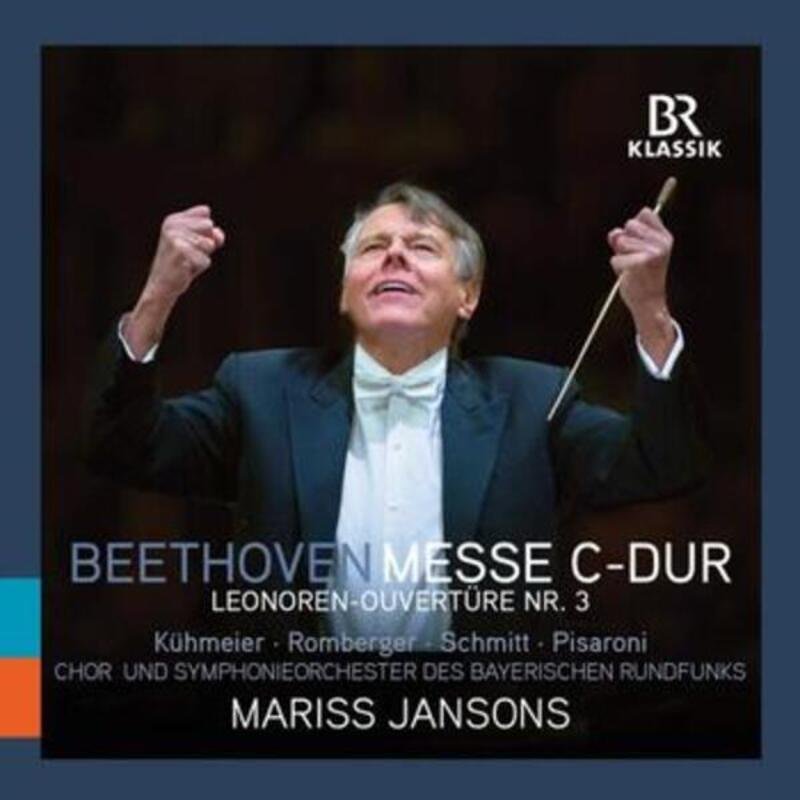


Mass in C major, Op. 86 · Leonore Overture No. 3, Op. 72b · BR 900184
13 pages · the original release booklet — complete programme notes and credits, exactly as issued.
- Ludwig van Beethoven (1770–1827)
- Mariss Jansons (1943–2019)
- Complete booklet · programme notes & credits
Further Reading and Listening
Institutional
- Symphonieorchester des Bayerischen Rundfunks
- BR-Klassik — the label
- Beethoven-Haus Bonn — archive, museum, scholarly centre
- Esterházy Palace, Eisenstadt — site of the 1807 premiere
- Mariss Jansons — Royal Concertgebouw Orchestra obituary
Scholarship
- Charles Rosen, The Classical Style: Haydn, Mozart, Beethoven (Norton, 1971, rev. 1997) — the indispensable English-language critical study
- Maynard Solomon, Beethoven (Schirmer, 1977, rev. 1998) — the standard modern biography
- Lewis Lockwood, Beethoven: The Music and the Life (Norton, 2003) — the major recent musical biography
- Jeremiah W. McGrann, Beethoven's Mass in C (Cambridge Studies in Music, 1991) — the only book-length English study
- William Drabkin, Beethoven: Missa Solemnis (Cambridge Music Handbooks, 1991) — companion to the later Mass
Recordings of the Mass in C major — a critical discography
- Otto Klemperer · Philharmonia (EMI, 1965) — the great architectural reading
- Karl Richter · Münchener Bach-Chor (Archiv, 1968) — the Bavarian sacred tradition
- Nikolaus Harnoncourt · Concentus Musicus Wien · Arnold Schoenberg Chor (Teldec, 1988) — the period-instrument turning point
- John Eliot Gardiner · English Baroque Soloists · Monteverdi Choir (Archiv, 1990)
- Philippe Herreweghe · La Chapelle Royale · Collegium Vocale Gent (Harmonia Mundi, 1996 and 2014)
- Bernard Haitink · London Symphony Chorus (LSO Live, 2016)
- Mariss Jansons · BR-Klassik (2019) — the recording under discussion
For the wider Beethoven sacred-music journey (see the appendix attached to this post for the complete chronicle)
- Christus am Ölberge, Op. 85 (1803) — the first sacred work
- Mass in C major, Op. 86 (1807) — the work discussed here
- Missa Solemnis, Op. 123 (1819–1823) — the masterpiece
- Heiliger Dankgesang from String Quartet Op. 132 (1825) — the last sacred utterance
Paired with the *Leonore Overture No. 3* recorded fourteen years earlier in the Herkulessaal, this album frames the two faces of Beethoven's ethical imagination: the prayer for peace and the cry for freedom. Eleven months after the Mass was recorded, Jansons died in St. Petersburg. The BR Symphony continues; the live concert recording remains as one of his last major statements on the central German sacred repertoire — a reading that takes seriously the cheerful dignity of Beethoven's failure, and that restores to a much-maligned work the warmth its first listeners could not hear.
A note when a new essay or travelogue appears. No noise, unsubscribe in one click.