
René Jacobs's 2013 Matthäus-Passion (Harmonia Mundi), recorded in Berlin's Teldex Studio with the Akademie für Alte Musik Berlin and the RIAS Kammerchor, is among the most theatrically argued readings of Bach's great Passion in recent memory — a recording that takes the double-choir, double-orchestra architecture as a dramaturgical premise rather than a logistical accident. It belongs to the line of mature period-instrument readings that begins with Harnoncourt in 1970 and extends through Gardiner, Herreweghe, Suzuki, and now Jacobs himself: a Matthäus that argues — quietly, persuasively — that drama and devotion were never separable, and that Bach knew it better than anyone since.
Bach wrote no Passion for the world; he wrote it for one Friday in Leipzig in 1727. The world, against all expectation, learned to listen.Editorial
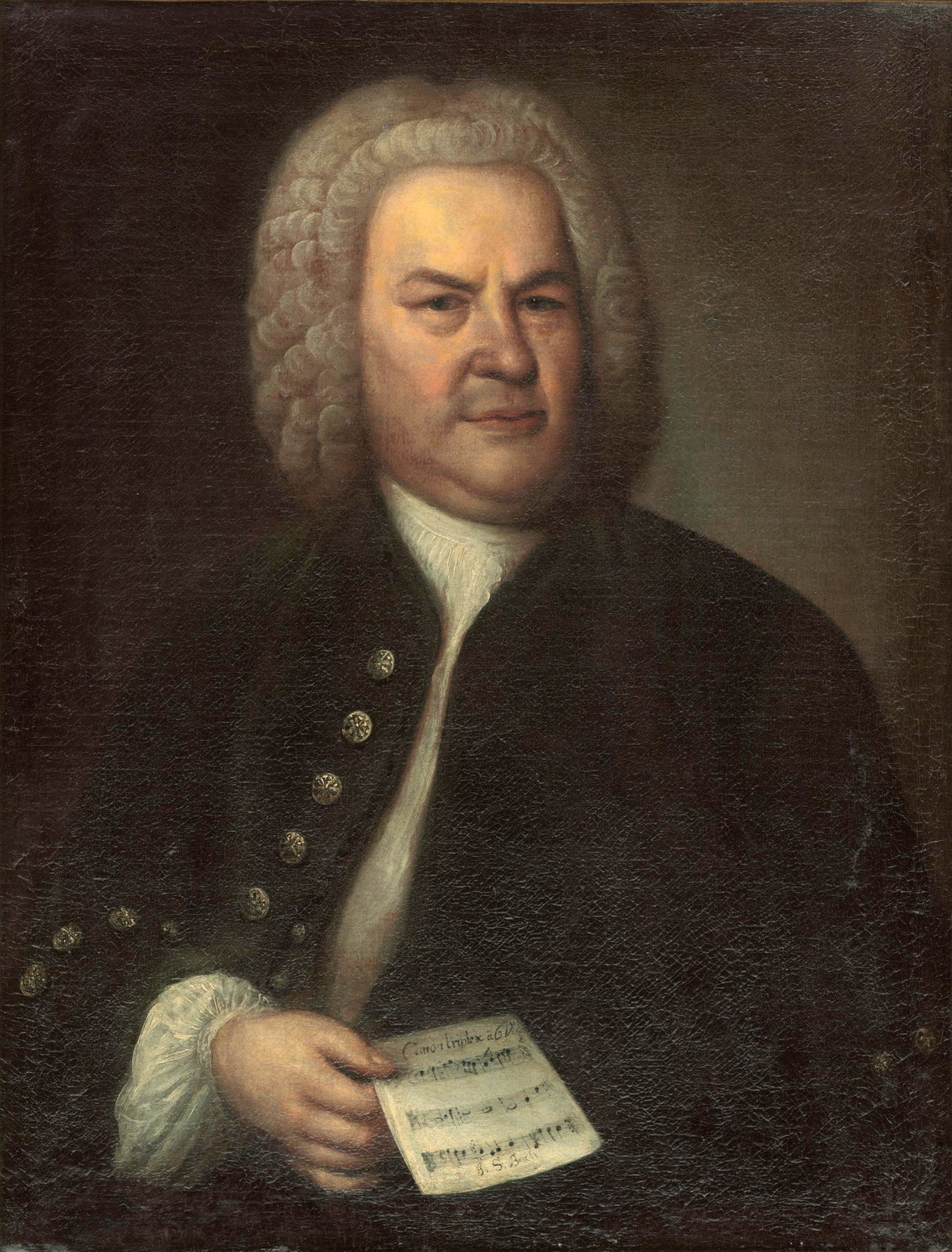
René Jacobs and the Drama Recovered
René Jacobs (b. 1946) belongs to that small fraternity of conductor-singers — the others would be John Eliot Gardiner, Philippe Herreweghe, Christophe Rousset — who came to early-music direction by way of the voice, and whose readings consequently carry a peculiar weight of vocal intelligence. A Belgian countertenor of formidable career (he sang Handel for Christopher Hogwood, Monteverdi for Nikolaus Harnoncourt, Cavalli on his own terms), Jacobs turned to conducting in the late 1970s and has, since the mid-1990s, been steadily reshaping the way the great Baroque vocal repertoires — the Monteverdi operas, the Handel oratorios, the Bach Passions, the Mozart operas — are read by the period-instrument community.
What Jacobs brings to the Matthäus-Passion is not novelty for its own sake but a particular dramaturgical seriousness: he hears the work as an opera in disguise — not in the sense of theatrical staging, but in the sense that every recitative, every aria, every chorus is the utterance of a specific person at a specific moment in a specific narrative. The Evangelist is not a neutral narrator but a witness whose voice darkens as the passion deepens; Christ's parlando is not stately recitative but the speech of a man whose authority comes from the certainty of his fate; the turba choruses (the crowd interjections — Sei gegrüsset, Wahrlich, dieser ist Gottes Sohn gewesen, Lass ihn kreuzigen) are not abstract polyphony but the voice of the human collective at its most contradictory.
This reading — patient where many are urgent, vocal-led where many are choral-massed, transparent where many are reverential — is what the recording's reception has correctly identified as its core argument. It is a Matthäus that argues for Bach as a dramatist of the highest order, not as a contemplative whose music happens to have narrative material attached. The argument is not new — Schweitzer made it in 1908, Harnoncourt in 1970, Gardiner in 1988 — but Jacobs makes it with a clarity of detail that places his recording among the four or five indispensable modern readings.

The Matthäus is not a passion oratorio in the Italian sense — it is a Lutheran Good Friday service that has, in passing, become one of the great pieces of music. Bach knew the difference. He never confused the two.
Leipzig 1723 — A Cantor's Burden
To understand what the Matthäus-Passion meant in the Leipzig of 1727, one must understand what kind of post Bach had taken on four years earlier. In May 1723, after a long deliberation that included his third-choice rejection by the Leipzig town council (the post had first been offered to Telemann, then to Christoph Graupner, both of whom declined), Bach was appointed Thomaskantor — Cantor of the Thomasschule and Music Director of the four principal churches of Leipzig. The position carried duties so extensive they could only be discharged by a man of preternatural industry: the composition and direction of music for two services every Sunday and on every feast day in the four churches; the teaching of Latin and music to the Thomasschule pupils; the rehearsing of the choir; the maintenance of the church instruments; the supervision of the city's musical institutions including the Stadtpfeifer. Bach was, in effect, the city's chief musician, and he was contractually required to produce a new cantata for nearly every Sunday of the liturgical year.
The Passion settings were a separate undertaking, performed only on Good Friday in the Vespers service, alternating between the Thomaskirche and the Nikolaikirche. The Good Friday Vespers ran several hours: the congregation arrived in the early afternoon, sat through Part I of the Passion, then heard a long sermon — typically by the Superintendent — and then returned for Part II. Communion followed; the service ended well past sunset on the longest, most penitential day of the Lutheran year. This was not a concert. It was a liturgy, framed by the architecture of the church and the rhythm of devotion, in which Bach's music was one element among several.
The libretto, supplied by the Leipzig postal official Christian Friedrich Henrici — pen name Picander — combines three distinct textual layers. The first is the Gospel narrative according to Matthew (chapters 26 and 27), in Luther's German translation, set as recitative for the Evangelist with the words of Christ and the other actors as recitative within recitative. The second is the Lutheran chorale repertoire — thirteen settings of well-known hymn melodies, harmonised in Bach's characteristic four-part style; congregations would have recognised these melodies, and the Matthäus-Passion thus has built into it a participatory dimension that the modern concert hall cannot reproduce. The third is the free poetic interpolation — fifteen arias and a number of arioso meditations — which Picander wrote specifically for Bach's setting and which provide the work's reflective, devotional voice.
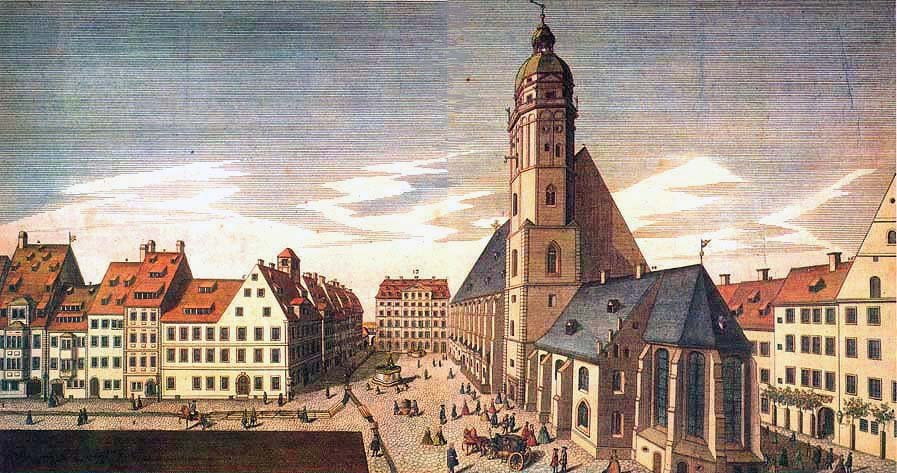
The Double Choir as Drama — Architecture and Theology
The first performance, on the Good Friday of 1727 (the dating, long disputed, is now accepted by most scholars after Joshua Rifkin's research in the 1970s), used the modest forces typical of Leipzig church music: probably eight to twelve singers per choir, an orchestra of fifteen to twenty, divided spatially between two galleries above the nave. Bach revised the work substantially around 1736; the score we now know is the revision. In any complete performance it runs roughly three hours; Bach's congregation heard it in two halves, with the sermon between, and would have left the church well past sunset on the longest day of the Lutheran liturgical year.
The dual-choir architecture is unique among Bach's surviving Passions. The Johannes-Passion (1724), the Markus-Passion (1731, music now lost), and the two further Passions catalogued in the 1754 Nekrolog all used a single choir and single orchestra. The Matthäus-Passion alone splits them in two, with the two choirs answering each other antiphonally in the great choruses and converging only in the central, soprano-led cantus firmus interpolations.
The theological argument behind this architecture is laid out in Picander's libretto: in the opening chorus, Kommt, ihr Töchter, helft mir klagen, Choir I (the Tochter Zion — the Daughters of Zion) addresses Choir II (the Gläubigen — the believers), with the two groups asking and answering across the question of who is going to the cross and why. The double-choir architecture is therefore not symphonic display but a theological device: the work stages, structurally, the relationship between the soul and the believer, between the witness and the participant, between the human and the divine. The two choirs converge only when they confess together (Kommt, ihr Töchter's central cantus firmus, O Lamm Gottes, unschuldig) and when they witness together (the final chorus, Wir setzen uns mit Tränen nieder). For the rest of the work, they answer each other — the architecture of dialogue, given musical form.
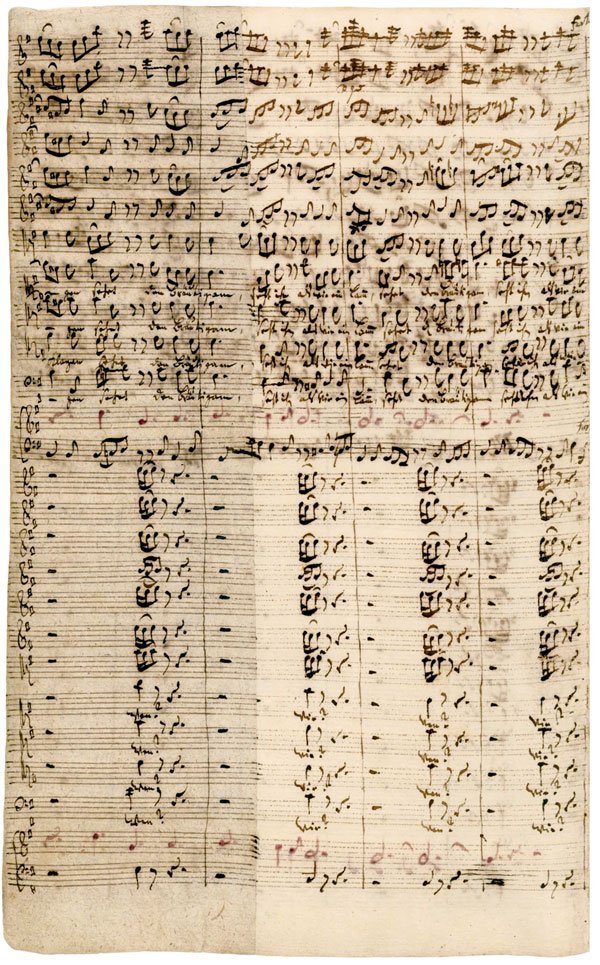
Five Passions, three vanished — Bach's lost vault
Four years after Bach's death, his son Carl Philipp Emanuel Bach and his pupil Johann Friedrich Agricola published a brief but authoritative obituary in Lorenz Christoph Mizler's Musikalische Bibliothek. Among the works they listed in Bach's catalogue, one line has haunted Bach scholarship ever since: Fünf Passionen, davon eine zwei-chörig. Five Passions, of which one is for double choir.
We possess two of them complete: the Johannes-Passion, BWV 245 (first performed 1724), and the double-choir Matthäus-Passion, BWV 244 (first performed 1727). A third — the Markus-Passion, BWV 247 (1731) — survives only as a libretto in Picander's published verse; the music has been partially reconstructed, by Simon Heighes in 1995 and by Malcolm Bruno in 2008, from parodies of other surviving Bach works. The fourth and fifth Passions are listed in the Nekrolog and are otherwise without trace. They were almost certainly performed at one of the four Leipzig churches in the gap years between the surviving settings — possibly Good Fridays 1725 and 1730 — and they have vanished beyond any recovery.
The Passion that does survive complete, in the form Bach intended for posterity, survives because of one of the longest chains of preservation in musical history. That chain is the subject of what follows.
The Nekrolog of 1754
On 28 July 1750 Johann Sebastian Bach died in Leipzig, four months after a botched eye operation by the English oculist John Taylor (the same Taylor who would, eight years later, equally botch Handel's eyes in London). He was buried that evening in the small Johanniskirche cemetery outside the city gates, in an unmarked grave. The Thomasschule, the Leipzig town council, and the wider German musical world did not particularly notice. Bach had been Thomaskantor for twenty-seven years and was regarded, at the time of his death, as the city's most reliable but rather old-fashioned music director — a figure of slightly diminishing relevance to the new Mannheim symphonic style and the Italianate galanterie beginning to dominate the German concert world. Four years later, in 1754, the Nekrolog appeared — the obituary written by Bach's son Carl Philipp Emanuel (1714–1788) and Bach's former pupil Johann Friedrich Agricola (1720–1774), published in Lorenz Mizler's Musikalische Bibliothek. The Nekrolog is one of the four or five primary sources for everything we now know about Bach's compositional life. Among its categories appears the brief, enigmatic notation that has haunted Bach scholarship since: Fünf Passionen, deren eine zweychörig. Five Passions, of which one for two choirs. We know the two-choir one (the Matthäus) and the Johannes; we know, by inference, the third (the Markus, of which not a single note of Bach's music has survived). The fourth and fifth are unknown.What was lost — and how
Bach died intestate. His widow Anna Magdalena and the four surviving children of his second marriage inherited the estate by informal agreement. The keyboard music went largely to Carl Philipp Emanuel — already well-established at the Berlin court of Frederick the Great, with the means and inclination to preserve them. The choral works went, in significant part, to Wilhelm Friedemann Bach, the eldest son, who at the time of his father's death was Music Director at the Halle Marienkirche. Wilhelm Friedemann would prove the most unreliable custodian in the history of musical estates. He left Halle in 1764 under circumstances that have never been fully clarified — possibly forced out, possibly resigning out of pique — and spent the rest of his life in increasingly straitened circumstances in Brunswick and Berlin, dying in 1784. During these twenty years he sold off, gave away, lost, or simply mislaid an unknown but substantial portion of his father's manuscripts. We have specific letters in which he writes of selling parts of the inheritance. The lost Passions — including, very probably, the Markus-Passion score from which Picander's libretto alone has survived — passed through Wilhelm Friedemann's hands during this period and were dispersed beyond recovery. The picture is not entirely bleak. Carl Philipp Emanuel was a different sort of custodian. From his Berlin years and especially during his Hamburg directorship (1768–1788), he carefully preserved the manuscripts he had inherited and made copies of works he knew to be elsewhere in family hands. The Matthäus-Passion score that survives is in Anna Magdalena Bach's copying hand, with Johann Sebastian's revisions; it passed first to Carl Philipp Emanuel, then through his estate to a Berlin musical antiquary, eventually finding its way to Carl Friedrich Zelter of the Berlin Singakademie — the conductor and pedagogue who would become Felix Mendelssohn's teacher and the indirect source of the 1829 revival. Had this chain been broken at any point — had Carl Philipp Emanuel been less careful, had Zelter not been the obsessive Bach collector he was — the Matthäus-Passion would in all probability have been lost too. The score that survives is the only complete autograph.The Markus-Passion, BWV 247
Of the three lost Bach Passions, the Markus-Passion is the one whose contours can be reconstructed in greatest detail. Picander published its libretto in his Ernst-, Schertzhaffte und Satyrische Gedichte of 1732, three years after publishing the Matthäus-Passion libretto in the same volume. From Picander's text we know that the Markus-Passion was a modest setting by comparison with the Matthäus: the Gospel narrative is from Mark, chapters 14 and 15, with only eight free arias to interrupt it (about half the number of the Matthäus) and sixteen chorale stanzas. The work was conceived for a single choir and orchestra; the double-choir architecture is not present. Critically, modern scholarship has recovered a substantial portion of the music. Bach's compositional habit in the late 1720s and early 1730s was to recycle his own material across genres — to take an aria written for a secular cantata and refit it for a sacred occasion, with new text and adjusted instrumentation. This parody practice (the term carries no comic connotation; it simply means re-use) is exceptionally well documented in Bach. The opening chorus of the Markus-Passion, Geh, Jesu, geh zu deiner Pein, has been identified with near-certainty as a parody of the opening chorus of the Trauer-Ode, BWV 198 — Laß, Fürstin, laß noch einen Strahl, a funeral cantata for Queen Christiane Eberhardine of Saxony composed in 1727. Several arias have been identified with parody sources in BWV 54 and in the Christmas Oratorio. For a substantial percentage of the lost Markus-Passion — possibly as much as half — the music has not been lost at all but exists in other surviving Bach works, simply with different words. Two major reconstructions have been performed: Simon Heighes (1995, recorded by Coro and Concerto Köln) and Malcolm Bruno (Breitkopf 2008, with different choices about the lost recitative material). Neither can claim to be Bach's Markus-Passion. What they can claim is to be Bach-substantive reconstructions of a work whose architecture is known and whose total shape can be approximated to within a definite tolerance.The phantom Lukas-Passion (BWV 246)
The Bach-Werke-Verzeichnis catalogues a Lukas-Passion as BWV 246. It is one of the most curious entries in the catalogue, because the work is almost certainly not by Bach. The score survives in a copy in Bach's hand, with some annotations — Bach evidently knew the work and may have performed it at one of the Leipzig Good Fridays when his own setting was not ready — but stylistic analysis, harmonic profile, treatment of the recitative, and use of the chorale tradition all suggest a different composer, possibly a North German contemporary or a member of the Bach circle, but not Johann Sebastian himself. The work was accepted as Bach's into the early twentieth century, included in the Bach-Gesellschaft complete edition of 1851, and eventually excluded by the New Bach Edition (NBA) launched in 1954. The fourth and fifth Passions of the Nekrolog are therefore still missing, with no surviving fragment that can be assigned to them.Anna Magdalena's hand
To say that the Matthäus-Passion survives is to make a particular claim. The autograph score Bach himself wrote — the original of 1727 — does not exist in undamaged form. What survives is the revised score of c. 1736, and the major part of that score, in the form used in subsequent Leipzig performances, is in the hand of Anna Magdalena Bach (1701–1760), Bach's second wife. Before her marriage in 1721, Anna Magdalena had been a court singer at Anhalt-Köthen — a professional soprano, paid more than her husband-to-be was paid as a court musician in the same establishment. After the marriage she gave up public singing but remained intensely musically active: she sang in domestic performances of Bach's vocal works and became the principal copyist of his late period. The copyist's hand we now identify as Anna Magdalena's is responsible for substantial portions of the Mass in B minor manuscript, the Goldberg Variations fair copy, and — critically — the working performance materials of the Matthäus-Passion in its 1736 form. The score that reached Mendelssohn through Zelter in 1824 was therefore not Bach's pure autograph but a working manuscript in two hands: Johann Sebastian's revisions of c. 1736 and Anna Magdalena's clean copy of the underlying score. Without Anna Magdalena's copying, the score Mendelssohn studied as a fifteen-year-old would have been substantially illegible. It is therefore not an exaggeration to say that the 1829 revival was made possible by Anna Magdalena Bach as decisively as by Mendelssohn or by Zelter. Her hand was the medium through which the work passed from her husband's lifetime into the next century.The cheese-shop legend
The story of how Zelter acquired his copy has been told in two distinct forms. The romantic version, sourced to the Berlin composer Adolf Bernhard Marx (1795–1866) and repeated in countless nineteenth-century music histories, runs: Zelter found the score in a Berlin cheese shop, where the proprietor had acquired waste paper from the dispersed estate of a Berlin collector and was using the manuscript pages to wrap his merchandise; Zelter rescued the score and through that rescue saved Bach's greatest work from oblivion. The legend is colourful and almost certainly false. Marx told the story in 1865, nearly forty years after the events, in his autobiographical Erinnerungen aus meinem Leben. There is no contemporary documentary support. The cheese-shop motif is a generic eighteenth-century literary device — the lost masterpiece rescued from wrapping fish or salami or cheese — that appears in numerous parallel stories about other lost works in roughly the same period. It tells us more about how the nineteenth century wanted to mythologise the recovery of its musical past than about how Zelter actually came by his manuscript. The more prosaic account is that Zelter inherited his copy through the documented channels of late-eighteenth-century Berlin Bach connoisseurship: from the Sara Levy salon network (Levy was the only public female keyboard pupil of Wilhelm Friedemann Bach and a sustaining patron of Carl Philipp Emanuel in his Berlin years), from the Itzig-Mendelssohn family circle, from C. P. E. Bach's Hamburg estate, or from one of the smaller Bach collectors who emerged in Berlin in the 1790s and early 1800s. What the cheese-shop legend captures, despite its falsehood, is something important. It records the nineteenth century's belated awareness of how nearly it had lost its inheritance. The legend is not factually accurate but it is emotionally accurate: the score did hang by a thread of accident and inheritance. Three of Bach's five Passions failed in some such chain. The Matthäus and the Johannes survived. That they are with us at all is one of the small but luminous facts of musical history.
The Resurrection — Berlin, 11 March 1829
It is one of the singular facts of the Matthäus-Passion's afterlife that for more than a century after Bach's death the work was virtually unheard. Bach had become, in the second half of the eighteenth century, an esteemed but specialist taste — the keyboard works circulated among connoisseurs, the cantatas and the great choral works did not. There were sporadic Leipzig Thomaskirche performances after 1750, but no public concert performance of the Matthäus-Passion is recorded between Bach's death in 1750 and Mendelssohn's reading in 1829.
The turning point came through one family, one teacher, and one twenty-year-old composer. In the winter of 1823, the fourteen-year-old Felix Mendelssohn received from his maternal grandmother Bella Salomon a Christmas present that would change the course of European musical history: a manuscript copy of the Matthäus-Passion, prepared at her request from the autograph held by the Berlin Singakademie, where her son-in-law's friend Carl Friedrich Zelter served as director. The score was technically the property of the Singakademie, but Zelter had quietly arranged for the copy to be made — by the institution's most reliable copyist, working evenings — as a gift to a precocious child whose talent he had been observing for several years. Mendelssohn studied the score with Zelter through 1824 and 1825. By 1827 he had begun assembling a small group of friends — most importantly the actor and amateur singer Eduard Devrient, who wanted to sing the part of Christus — to perform sections of the work in semi-private readings at the Mendelssohn family home in the Leipziger Straße in Berlin.
The first public performance took place at the Singakademie on Wednesday, 11 March 1829 — exactly one hundred and two years after the Leipzig premiere. The performance was conducted by the twenty-year-old Mendelssohn from a small podium centrally in front of the choir, with the orchestra divided into two groups on either side and the two choirs in elevated risers behind. The forces were sizeable by the standards of the period: a choir of approximately one hundred and fifty (about double Bach's likely Leipzig forces); an orchestra of about forty. Mendelssohn had cut approximately a third of the work — ten arias, seven of the choruses, six of the chorales — to bring the running time down to something manageable for a concert audience: just under three and a half hours of music.
The performance began at 6.10 p.m. and ran, with a short interval after Part I, until approximately 9.30 p.m. The reception was a sensation. The Berlin musical newspapers reviewed the performance in extensive detail over the following weeks; the Allgemeine Musikalische Zeitung, edited by Adolf Bernhard Marx, devoted six consecutive issues to coverage. The second performance, on 21 March, was equally successful; the third, on 18 April, was conducted not by Mendelssohn but by Zelter himself in symbolic affirmation of the work as the inheritance of the Singakademie.
The Singakademie hall
The performance took place at the Singakademie hall on Unter den Linden — the long, low building completed in 1827 by Carl Theodor Ottmer to replace the previous wooden structure on the same site. The hall has not survived; it was destroyed in the Allied bombing of Berlin in 1945. (The site is now occupied by the Maxim Gorki Theater, a small experimental house that has preserved the early-nineteenth-century neoclassical façade.) Its dimensions were modest by modern symphonic standards: capacity for approximately four hundred and fifty seated, with standing room behind. The acoustic was clear, slightly dry, and well-suited to choral and chamber forces.The audience
The performance was scheduled for 6.00 p.m. on Wednesday, 11 March 1829. Mendelssohn had chosen Wednesday rather than Friday (the liturgically appropriate day) because the Friday performances of the Singakademie were generally less well-attended; the Wednesday slot was, paradoxically, the more prestigious. Tickets had been on sale for ten days and had sold out within hours. The price was 1 thaler — substantial but not prohibitive; a working artisan's daily wage was approximately 0.5 thaler. The audience that gathered included virtually every figure of musical and intellectual significance then resident in Berlin. King Friedrich Wilhelm III of Prussia attended with his court, occupying the central reserved boxes; Princess Charlotte and several other members of the royal family were present. Georg Wilhelm Friedrich Hegel, in his last years as Rector of the University of Berlin, attended with several of his graduate students and was overheard during the interval praising the work's truly Protestant erudite genius. Friedrich Schleiermacher, the leading Protestant theologian of his generation, was present; so was the historian Friedrich Carl von Savigny, the philosopher Friedrich Heinrich Jacobi, and Heinrich Heine (then twenty-two, recently arrived in Berlin from Hamburg). It is one of the rare moments in nineteenth-century musical history when a single concert hall held, simultaneously, the philosopher, the theologian, the historian, the legal scholar, the poet, and the king of a Protestant nation — all attending the same music.The cuts and the running time
Mendelssohn had cut approximately a third of Bach's score. The cuts were made for two reasons. First, to reduce the running time to something manageable for a concert audience — Bach's Leipzig liturgical performance had run with a sermon between the two halves and could absorb longer durations; without the sermon, three hours and twenty minutes was already at the upper limit. Second, to remove the longer reflective movements that Mendelssohn judged would lose the audience's attention in a non-liturgical context. Modern performance has restored most of these cuts; we now hear, in any complete reading, what the audience of 1829 did not.The cascade outward
By autumn 1829 plans were laid for performances in Frankfurt, Breslau, Stettin; the Vienna performance followed in 1830, the Paris performance in 1840 (under Habeneck, in a French translation by Maurice Bourges), and the London performance in 1854 (the first English-language complete performance, conducted by William Sterndale Bennett at the Hanover Square Rooms). By the 1860s the work was no longer a recovered curiosity but a standard fixture of Good Friday concert programming throughout Protestant Germany. By the 1880s the Bach-Gesellschaft had completed publication of the Matthäus-Passion score in its complete-edition project (volume 4, edited by Wilhelm Rust), and the work had entered the choral repertory of every German musical society and most major British and American oratorio societies. Bach was no longer obscure. He had become, almost overnight by the standards of musical history, foundational.Bach's grand, truly Protestant, robust and erudite genius — which we have only recently learned again to appreciate at its full value.Georg Wilhelm Friedrich Hegel, overheard during the interval of the 11 March 1829 performance

The voices — five singers, one conductor who heard them whole
A Matthäus-Passion on disc is the sum of its voices: the Evangelist who carries the narrative across three hours, the Christus whose every utterance is haloed in strings until the cry from the cross, the alto whose Erbarme dich is the work's emotional pivot. Jacobs's 2013 cast was assembled with the care of a man who has himself sung Bach and who knows, from inside the voice, what each role needs from the singer chosen for it.
Werner Güra — the Evangelist
Werner Güra (b. 1964, Munich) carries the Evangelist's recitative across the whole arc of the work. Trained at the Salzburg Mozarteum and refined with the Swiss baritone Kurt Widmer in Basel and the Dutch soprano Margreet Honig in Amsterdam, Güra entered the Semperoper Dresden in 1995 — five seasons of principal Mozart and Rossini roles. From the late 1990s he turned increasingly to Bach: a long collaboration with Philippe Herreweghe (the 1998 Collegium Vocale St Matthew with Bostridge as Evangelist, Güra in the arias), a 1997 Christmas Oratorio with Jacobs, the 2006 Harnoncourt Christmas Oratorio at the Vienna Musikverein, the 2013 Matthäus under review here, the 2015 Johannes-Passion with the same Jacobs–AKAMUS forces. By the time of this recording he had become — with Mark Padmore, Ian Bostridge, and the younger Julian Prégardien — one of the four reference Evangelists of the period-instrument era.
His voice has been compared with Fritz Wunderlich's for its high-lyric clarity and ease in the upper passaggio. What Güra brings to the Evangelist is not vocal display but narrative authority: he is the witness whose voice darkens as the Passion deepens, who can move from the genteel recitative of the early Gospel scenes to the broken intensity of Und siehe da, der Vorhang im Tempel zerriss in zwei Stück without ever forcing the tone. The recitative Und er kam und fand sie aber schlafend — Christ returning twice from prayer to find the disciples asleep — is among the unforgettable moments of this recording: Güra's voice carries the sorrow of repetition, the third return, with a calm that is harder to achieve than any operatic outburst.
Johannes Weisser — the Christus
Johannes Weisser (b. 1980, Oslo) is the Norwegian baritone Jacobs has chosen for his major bass-baritone roles since the late 2000s — Don Giovanni on the celebrated 2007 Jacobs–Freiburger recording and on a subsequent world tour; Adam in Haydn's Schöpfung; Lucio in Mozart's Lucio Silla; Christus here. Trained in Copenhagen, with an Oslo Masetto at twenty-three and a Komische Oper Berlin debut shortly after, Weisser describes himself in interviews as a baritone with a low extension — a voice whose bass tessitura is real but not native, which gives his Christus a lyric inflection different from the cathedral-bass Christ of Dietrich Fischer-Dieskau or the operatic darkness of the Russian school.
Weisser's Christus is the version of the role that suits Jacobs's reading: a Christ whose authority comes from inwardness, not from monumentality. The arioso passages where Christ institutes the Eucharist (Trinket alle daraus) — what one perceptive critic called the musical and dramatic climax of Christ's participation in the work — are sung by Weisser with what the same critic described as audible surrender to the spirit of the music. The cry from the cross (Eli, Eli, lama asabthani?), where the string halo finally drops away, is in Weisser's voice the cry of a man, not of an icon. This is precisely Jacobs's argument: the Matthäus dramatises a human Passion, not a stained-glass one.
Bernarda Fink — the alto
Bernarda Fink (b. 29 August 1955, Buenos Aires) is the soul of this recording, and her name on the back cover is one of the reasons Slovenian audiences have a particular claim on it. Born in Buenos Aires to Slovenian political refugees who had fled the country in the wake of the 1945 communist takeover, Fink grew up in a household where Slovenian was spoken at the dinner table and Slovenian sacred music — the late-nineteenth-century Cerkvene pesmi, Mahnič choral arrangements, the Gallus motets — was sung at family gatherings. Her parents had married in a refugee camp; her younger brother Marko (Marcos) Fink, also a singer, was born there. Together the siblings have made several recordings of Slovenian and Argentinian art-song — the 2011 Slovenija! album on Harmonia Mundi is the best-known — and in February 2013 (the same year as this Matthäus) the two of them were jointly awarded the Prešeren Fund Prize, the most prestigious Slovenian cultural award after the Prešeren Prize itself.
She studied at the Instituto Superior de Arte del Teatro Colón in Buenos Aires, won First Prize at the Nuevas Voces Líricas competition in 1985, moved to Europe shortly after, and was discovered, in a way that has now become near-legendary among Jacobs's collaborators, by Jacobs himself for his 1988 Flavio — Handel, her first early-music project, in a tradition for which she had never had formal training. He helped me make friends with this music, she has said in interviews. He taught me, he modelled me. With the exception of Bach, I no longer sing baroque.
The exception matters. Fink has remained, for thirty-five years, one of the great Bach altos of her generation — with Harnoncourt, with Gardiner, with Herreweghe, with Suzuki, with Jacobs. She has been awarded the Austrian Honorary Medal for Art and Science (2006), a Grammy for the Jacobs Giulio Cesare, a Diapason d'Or for Dvořák songs, and the Prešeren Fund Prize already mentioned. She lives in southern Austrian Carinthia with her husband, the Austrian-Slovenian diplomat Valentin Inzko (former High Representative for Bosnia and Herzegovina) — a Carinthian-Slovenian household just over the border from where her parents' world used to be.
Sunhae Im — the soprano
Sunhae Im (b. 1976, South Korea) emerged in the 2000s as one of Jacobs's preferred sopranos for the Mozart and Bach repertoires. Trained in Seoul and at the Hochschule für Musik Karlsruhe with Roland Hermann, she made her European debut at the Komische Oper Berlin and has since recorded extensively with the period-instrument community — Jacobs's Magic Flute, Don Giovanni, Cosí fan tutte, both Bach Passions, the Christmas Oratorio. Her voice is light, agile, almost crystalline in the upper register, with the clean intonation that Bach's contrapuntal writing demands; the aria Aus Liebe will mein Heiland sterben — Bach's Sinfonia of pity, scored for flute and oboes da caccia without the supporting strings, the only major number in the work without continuo — is in Im's voice a single sustained breath of innocence. It is one of the great moments of this recording.
Marie-Claude Chappuis, Topi Lehtipuu, Konstantin Wolff — the smaller arias
Three further soloists complete the principal cast. The Swiss mezzo Marie-Claude Chappuis divides the alto arias with Fink and brings a darker, more dramatic timbre to Können Tränen meiner Wangen and Sehet, Jesus hat die Hand. The Finnish-French lyric tenor Topi Lehtipuu sings the tenor arias Ich will bei meinem Jesu wachen and Geduld, Geduld! with the honeyed brilliance of a fully refined Mozartean — Lehtipuu has been a long-time Jacobs Don Ottavio and Ferrando. The German bass-baritone Konstantin Wolff sings Komm, süßes Kreuz in both the lute and the gamba versions Bach left for that aria — an alluring stream of dark-sapphire tone, in one early review — and Mache dich, mein Herze, rein, the great penultimate aria, with the steadiness that the aria's quasi-pastoral character requires.
Two voices from a single Slovenian household in Buenos Aires — Marcos the baritone, Bernarda the alto — who across half a century have each, in their separate ways and now together, become proud members of the artistic family of Professor Zevnik. Bernarda's last professional recording — the aria Erbarme dich, recorded in September 2025 with the accordionist Marko Hatlak for the PPZ production — closes that long musical journey at home: at the same hearth where it began.Editorial · Poslušalnica profesorja Zevnika
The Modern Recording Tradition — From Mengelberg to Jacobs
The first complete commercial recording of the Matthäus-Passion was made under Willem Mengelberg with the Concertgebouw Orchestra in Amsterdam in 1939 — a Palm Sunday performance captured for the Dutch radio archive, released subsequently on Telefunken and reissued by Naxos in 2000. Mengelberg's reading, with its slow tempi, its enormous chorus, and its now-startling solo cadenzas, belongs unambiguously to the late-Romantic German tradition: Bach as Beethoven's grandfather, the Passion as oratorio in the post-Wagnerian sense.
Otto Klemperer's 1962 EMI recording with the Philharmonia Orchestra and Choir was for a generation the canonical reading. Klemperer treats the work with what one might call cathedral gravity: slow tempi, enormous forces, a sense of every phrase as a public liturgical pronouncement. The recording remains in active circulation in the EMI/Warner remasterings; for many listeners it remains, after sixty years, the Matthäus against which all others are measured.
The period-instrument revolution began, for the Matthäus, with Nikolaus Harnoncourt's 1970 Concentus Musicus Wien recording on Teldec — a recording that introduced to the Matthäus a generation of practices (gut strings, lower pitch, smaller forces, faster tempi, less vibrato) that have shaped every subsequent reading. John Eliot Gardiner's 1988 Archiv recording with the English Baroque Soloists and the Monteverdi Choir was the first to bring the dramatic intensity of Harnoncourt's reading together with a fully refined Anglican-choir tradition; it remains one of the strongest readings ever made. Philippe Herreweghe's 1999 Harmonia Mundi recording with Collegium Vocale Gent introduced a quieter, more devotional reading — a Matthäus drawn closer to chamber music than to opera. Masaaki Suzuki's 1999 BIS recording with the Bach Collegium Japan, the first from Asia, preserved the period-instrument idiom while emphasising the work's chorale tradition more strongly than any of his Western contemporaries.
Jacobs's 2013 reading belongs in this line — the line of mature period-instrument readings that begins with Harnoncourt in 1970 and extends through Gardiner, Herreweghe, Suzuki, and now Jacobs himself. What Jacobs adds to the tradition is the operatic sensibility brought across from his Monteverdi and Handel recordings: the recitatives are dramatised rather than merely declaimed, the arias are sung with the kind of textual attention that opera demands, and the choruses are voiced with the contrapuntal clarity that contemporary period choirs have developed to a level Bach himself would have recognised. He continues, in the tradition's natural arc, the work that began in Vienna in 1970 — and from a Berlin studio in 2012, two centuries and three years after the Singakademie revival, he completes what Mendelssohn started.
Jacobs's reading — what is gained, what is risked
What is gained in the Jacobs reading is the recovery of the work's dramatic spatial argument. The two choirs are recorded with sufficient separation that the antiphonal architecture is audible at every moment; the turba choruses are voiced with operatic attack rather than chorale-style devotion; the recitatives carry the kind of forward narrative urgency one associates with the Monteverdi operas where Jacobs spent so many of his early years. The double-orchestra dialogue — Choir I's strings answering Choir II's woodwinds, the two continuo groups in subtle counterpoint with each other — is captured with a stereo-image clarity that Bach's Leipzig Thomaskirche could not have offered.
What is risked, of course, is the loss of the inward, contemplative gravity that the Klemperer, Karajan, and even Gardiner readings have taught us to associate with the work. Jacobs's reading is articulate, theatrical, ardent — and some listeners will find it less devotionally weighted than they expect. The opening chorus Kommt, ihr Töchter takes a tempo that is, by the standard of the post-war tradition, brisk; the great alto aria Erbarme dich (under Jacobs and with Fink) is faster than the Klemperer or Karajan readings of the same piece. The recording does not, in this sense, replace its predecessors — it adds a dimension to the conversation.
It is, finally, a reading that hears the work as Bach wrote it: with two distinct musical bodies in sustained dialogue, with the Evangelist as a specific witness rather than an abstract narrator, with Christ's parlando as the speech of a person facing death rather than the stately recitative of a liturgical archetype. The argument Jacobs makes is the argument the score itself makes when it is heard with sufficient clarity. The Matthäus-Passion is, among many other things, the greatest musical dramatisation of the Christian Passion narrative ever composed — and it has taken until 2013, two hundred and eighty-six years after its composition, for a recording to argue that case with the spatial and dramatic clarity Bach himself would have wanted.
Jacobs has restored to the Matthäus its spatial drama and its theological clarity in equal measure — a reading that hears the work as it was written, with two distinct musical bodies in sustained dialogue, and that loses none of the inward gravity that the great post-war recordings taught us to expect.
After the Revival — A Hundred and Fifty Years of Influence
The 1829 Berlin revival did not merely return the Matthäus-Passion to active circulation; it altered the course of nineteenth-century German musical thought. Robert Schumann, twenty years old at the time of Mendelssohn's first reading, kept a copy of the score on his Leipzig writing desk through the 1830s and 1840s and wrote in his Hausbuch that the Matthäus-Passion is the deepest music we possess. Schumann's late oratorios — Das Paradies und die Peri (1843), Szenen aus Goethes Faust (1844–1853) — are unimaginable without the Matthäus's example of choral-orchestral architecture in service of a continuous narrative.
Johannes Brahms, born in 1833 and trained in the wake of the Bach revival, became one of the great Bach editors of his generation; the Bach-Gesellschaft (founded in 1850, partly at Brahms's instigation) would build on his work. Brahms's Deutsches Requiem (1868) is a direct response to the Matthäus and to the Bach tradition more broadly — a work that takes the Lutheran liturgical setting of death and remakes it as a Protestant musical philosophy. The Requiem's opening, Selig sind, die da Leid tragen, would not exist in its specific gravity without the Matthäus's example.
Felix Mendelssohn himself returned to the work repeatedly. He conducted it again in 1841 in Leipzig (the first Leipzig revival since Bach's death), in 1843 in Birmingham, and in 1846 in Berlin; his last conducted performance was in March 1847, eight months before his death. Each of these performances refined Mendelssohn's editorial choices and contributed to the gradual stabilisation of the work's text in the second half of the nineteenth century. The Bach-Gesellschaft's complete edition (1851–1899), in which the Matthäus appears as volume 4 (edited by Wilhelm Rust, published 1854), is the work's first scholarly text; modern performance practice still consults it as a documentary baseline. By 1900 the Matthäus-Passion had been recorded for the gramophone, performed in every major European capital and in many American cities, and incorporated into the repertoire of every German choral society. It had ceased to be a discovery and had become — what it remains today — a touchstone.

For further reading
- John Eliot Gardiner, Music in the Castle of Heaven: A Portrait of Johann Sebastian Bach (Allen Lane, 2013) — magisterial late synthesis from one of the Passion's great modern conductors
- Christoph Wolff, Johann Sebastian Bach: The Learned Musician (Norton, 2000) — the standard modern Bach biography
- Daniel R. Melamed, Hearing Bach's Passions (Oxford University Press, 2005) — the best single guide to the Passion settings as a corpus
- Albert Schweitzer, J. S. Bach (1908, English transl. Ernest Newman 1911) — the foundational modern study; Schweitzer's argument that Bach's music is programmatic shaped the entire twentieth-century reception
The work was first heard in Leipzig on Good Friday 1727 and remained largely unheard for over a century, until Mendelssohn's revival in Berlin on 11 March 1829. Jacobs's 2012 reading is the latest stop on a road that runs from a Leipzig church through a Berlin Singakademie hall and into a Kreuzberg recording studio, and it reminds us — through the spatial drama Bach wrote into the score and that Jacobs restores — that the *Matthäus-Passion* has been, since the moment of its composition, a piece about how the divine and the human speak to each other across a distance.
A note when a new essay or travelogue appears. No noise, unsubscribe in one click.