
On 24 March 1721 a Lutheran Kapellmeister in a small Calvinist town wrapped six concertos in faultless French courtesy and sent them to Berlin. The parcel became the most mythologised gift in the history of music — supposedly never opened, never played, sold for small change at its owner's death. The documents tell a stranger story, with a prison cell at one end and a burning railway line at the other. And in March 2005, in a Roman palace hall built for a Farnese Hercules, Rinaldo Alessandrini and Concerto Italiano recorded the six as what he insists they have always been: Italian music, written by the one German who understood the Italians better than they understood themselves. This essay follows both journeys — the manuscript's and the recording's — until they meet.
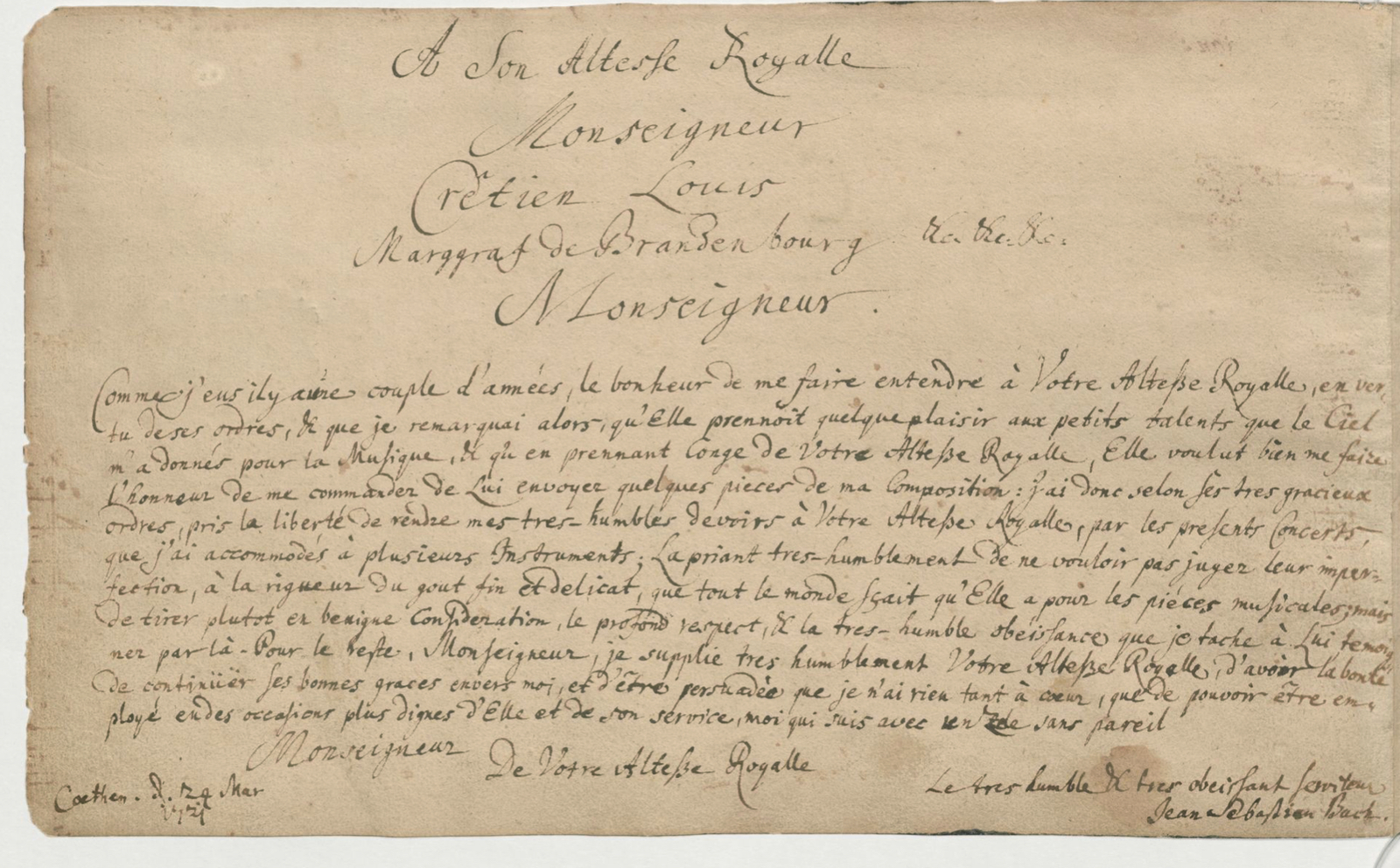
Son très-humble & très obéissant Serviteur, Jean Sébastien Bach, Maître de Chapelle de S.A.S. le Prince régnant d'Anhalt-Cöthen.Signature of the dedication manuscript · Cöthen, 24 March 1721
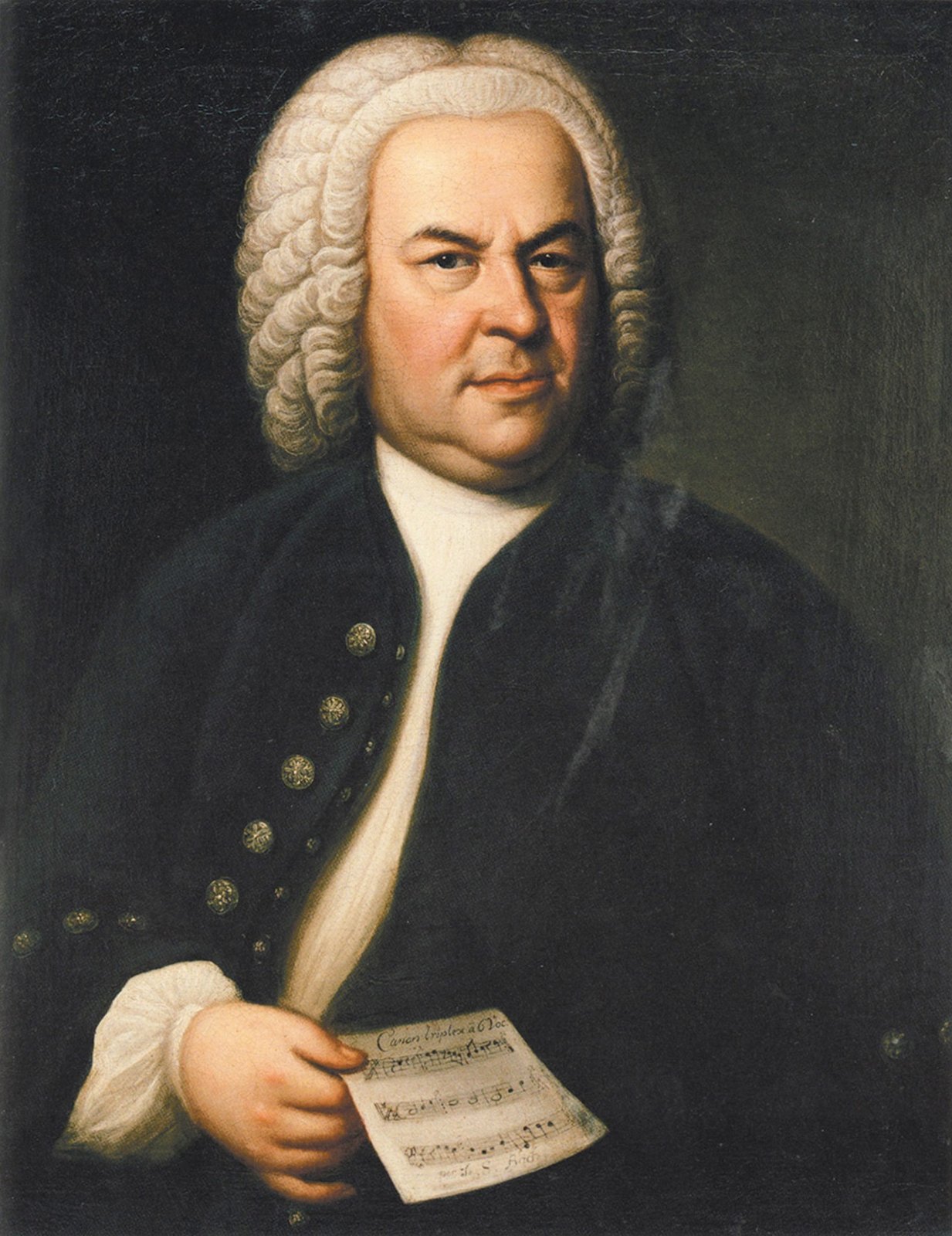
The most famous unopened gift in music
Every masterpiece eventually grows a legend, and the legend of the Brandenburg Concertos is among the most seductive ever told. It runs like this: in 1721 Johann Sebastian Bach, hunting for a better position, sent six dazzling concertos to a Berlin prince who could not play them, did not thank him, never had them performed, and shelved the manuscript unopened; at the prince's death the score was lumped into a job-lot of music and valued at a few groschen — small silver change for the greatest set of orchestral works the Baroque ever produced; a century later someone stumbled on it in a dusty archive, and only then did the world receive its gift. Indifference, oblivion, resurrection: the parable writes itself, and for a hundred and fifty years programme notes have rarely resisted it. It flatters everyone it touches — the genius too far ahead of his time, the philistine aristocrat, and above all us, the posterity perceptive enough to recognise what a margrave allegedly could not.
The documents, as we shall see, tell a quieter and stranger story — one with a real prison cell at the beginning, a real train under aerial bombardment near the end, and a long middle in which the score was never actually lost at all, merely unread. What is true in the legend is the essential paradox: that a collection now regarded as a summit of Western instrumental music — six concerts avec plusieurs instruments, as Bach's own French title modestly puts it — spent its first century and a quarter in almost complete silence, and entered the repertoire not through concert halls but, as we shall also see, through the gramophone. The Brandenburgs are that rarest of things, a cornerstone of the canon younger, as a living repertoire, than recorded sound itself.
The work needs little introduction and infinite re-introduction. Six concertos, no two alike; six different orchestras drawn from one pool of players; horns against oboes, a trumpet against a recorder, nine solo strings against nobody, a harpsichord staging history's first keyboard coup d'état, and a final concerto that bans the violins altogether. Nothing in the concerto literature before 1721 attempts such a systematic survey of the orchestra's possibilities, and — this is the astonishing part — nothing after it does either: the set founded no school, spawned no imitations, and sits in history like an erratic boulder, deposited by a glacier that passed only once. Composers raided its lessons — the keyboard concerto, the mixed-wind sinfonia — but nobody again attempted the survey itself; the experiment was complete. Christoph Wolff called the scoring a spectrum without parallel; performers have called it, less reverently, a trap — because each concerto exposes a different section of the ensemble to merciless daylight, and a band that survives the First's horns must still face the Second's clarino trumpet, the Third's nine-way transparency and the Sixth's velvet darkness.
Which is precisely why the recording under discussion matters. In March 2005 the Roman ensemble Concerto Italiano under Rinaldo Alessandrini — harpsichordist, Monteverdi specialist, a man who had spent twenty years arguing that Italian music breathes differently when Italians play it — set down the six concertos in the Salone d'Ercole of the Palazzo Farnese, one instrument to a part. Their wager was simple and slightly heretical: that the Brandenburgs are not German monuments to be approached with awe, but Italian conversation pieces — Venetian and Roman blood transfused through a Saxon hand — and that they spring back to life when treated as such. The wager paid off spectacularly; the disc gathered honours on release, scandalised the slower-pulsed, and has kept its place in the catalogue ever since. This essay tells both stories at once: the long, strange life of Bach's parcel, and the spring days in Rome when it was unwrapped as if for the first time.

Köthen: a court without a liturgy
The town in which these concertos took their final shape had perhaps three thousand inhabitants and a castle with a moat. Anhalt-Köthen was one of the smallest sovereign splinters of the Holy Roman Empire — a principality you could walk across in an afternoon — and its young ruler, Prince Leopold, born in 1694 and master of his own Schloss from 1716, was that rarest of employers: a prince who did not merely keep music but understood it. His education had been seriously musical and seriously cosmopolitan; he had made the grand tour, heard what Italy and the imperial cities had to offer, and returned home determined that his miniature court would sound like a major one. He played several instruments — among them, crucially for our story, the viola da gamba, a detail that will matter enormously when we reach the Sixth Concerto. When Bach later looked back on these years, in a famous letter of 28 October 1730 to his school friend Georg Erdmann, the words he chose for Leopold were not courtier's varnish but something close to affection — and the same letter's bitter coda, written from Leipzig, makes clear how much he felt the loss: he had meant, he says, to spend the rest of his life in that prince's service.
The court's confession shaped its music more than its budget did. Köthen was Calvinist, and the Reformed service wanted no cantatas, no concerted church music, no organ splendour — only psalms, plainly sung. For a composer of Bach's appetite this was either a famine or a liberation, and Bach, characteristically, treated it as the latter. Freed for the only sustained period of his life from the weekly treadmill of liturgical production, he turned the full pressure of his invention onto instruments: the violin concertos, the sonatas and partitas for violin alone, the cello suites, the first book of the Well-Tempered Clavier, the French Suites begun for his new wife's notebook — and the six concertos that concern us here all belong, wholly or in great part, to this Köthen workshop. It is one of history's neater ironies that the most theologically saturated of composers wrote his great secular monuments because a Calvinist prince's church had no use for him on Sundays. The catalogue of these years reads like a manifesto of that liberation: where Weimar's ledger is cantatas, Köthen's is concertos, suites and sonatas — music whose only liturgy is attention.
The workshop was superbly staffed. When the new Prussian king Friedrich Wilhelm I — the Soldier King, who measured culture in grenadiers — dissolved the Berlin court capelle in 1713, Leopold caught several of its finest players for his little Residenz, and by the standard account Bach had around seventeen or eighteen professionals at his disposal: virtuosi like the gambist Christian Ferdinand Abel, whose family name would echo through English concert life for two generations, and a roster of winds and strings good enough that Bach could write, in these very concertos, some of the most exposed and merciless parts of the century. It was a chamber orchestra of soloists avant la lettre — a fact that, as we shall see, modern scholarship and modern performers alike have made much of. Bach arrived in December 1717, with the title of Kapellmeister, a salary near the top of the court list, lodgings, and the bruises of his Weimar exit still fresh. For five years the arrangement was as close to ideal as his life would offer; the shadow that ended it — a princely wedding in December 1721, and a bride Bach later remembered, half in jest, as an amusa, a stranger to the muses, arriving just as the court's finances tightened — was still below the horizon when he ruled the staves of the dedication score.
There is a melancholy postscript to the Erdmann letter worth knowing: Bach wrote it from Leipzig in 1730 not as memoir but as a discreet job inquiry — things had soured at the Thomasschule, and he was asking his old schoolfellow, by then a diplomat in Danzig, to keep an eye open for a post. The warmest surviving words about Köthen, in other words, were written by a man wishing he could go back. Paradise is usually a retrospective genre.
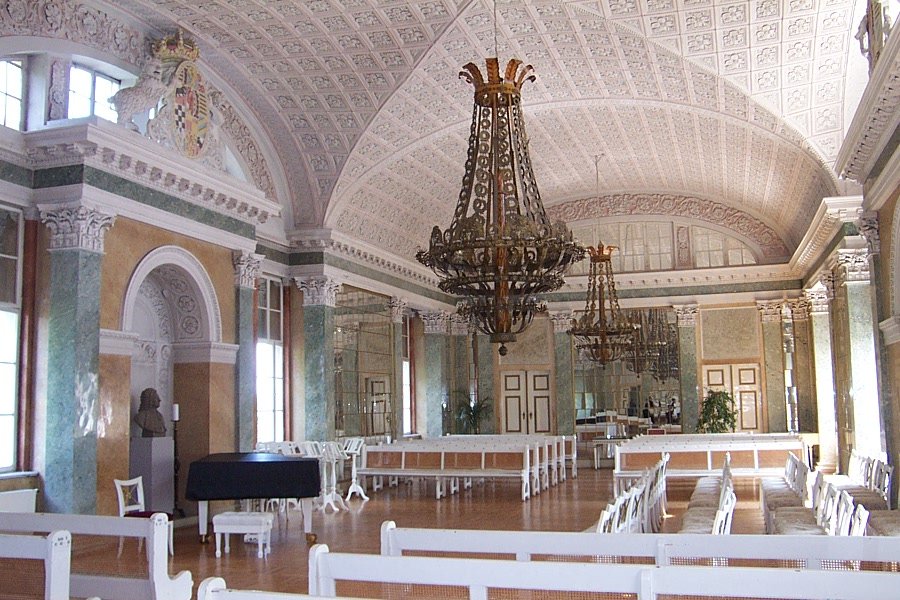
… einen gnädigen und Music so wohl liebenden als kennenden Fürsten …

From a Weimar cell to a Berlin harpsichord
The arrest was the endgame of a long humiliation. At Weimar Bach had served nine years, risen in 1714 to the specially created post of Konzertmeister — with the duty, which he relished, of composing a cantata every month — and filled the court church with the first great harvest of his vocal music; when the old Kapellmeister Johann Samuel Drese died in 1716, Bach had every professional reason to expect the succession. The duke gave it instead to Drese's unremarkable son. Bach's response was characteristic of the man whose employment files, across four decades, form a small anthology of friction with authority: he stopped composing cantatas almost on the spot, sought an exit, and accepted Leopold's offer of the Köthen Kapellmeistership in the summer of 1717 — and when Duke Wilhelm Ernst refused to release him, he pressed the point with what the protocol calls stubbornness until the duke jailed him for it. Four weeks in the county judge's chambers, then release with a notice of unfavourable discharge: it is the only documented imprisonment of a major composer for the crime of resigning. Tradition adds a glittering interlude: in the autumn of 1717, before the arrest, Bach is said to have travelled to Dresden for a keyboard duel with the famous French virtuoso Louis Marchand, who, having heard Bach practise, quietly left town before the appointed hour. The story comes to us polished by generations of admirers, and is best enjoyed with that label attached; we will meet Marchand's ghost once more, hiding in the slow movement of the Fifth Concerto.
Köthen healed all of it. For the first and only time in his life Bach worked for a ruler he genuinely admired, at a salary that placed him among the senior officers of the court, with lodgings, respect, and virtuosi waiting for whatever he wrote. The six years that followed were the happiest and, instrumentally, the most fertile he would know — shadowed once, terribly, in July 1720, when he returned from attending Leopold at the Carlsbad spa (the prince took his Kapellmeister and a travelling consort to the fashionable waters more than once) to find his wife Maria Barbara dead and already buried, with no one able to tell him more than that. The man who compiled the Brandenburg score the following spring was a recent widower with four children; by December 1721 he would marry again — the young court soprano Anna Magdalena Wilcke, a professional musician in her own right — in a season of weddings that also gave Leopold a bride, of whom more later, because that particular marriage may have cost music history its Köthen golden age.
The thread that leads directly to our manuscript runs through Berlin. In March 1719 Bach travelled to the Prussian capital on court business: to collect and pay for a great two-manual harpsichord that Leopold had ordered from the celebrated builder Michael Mietke. Somewhere on that errand — the dedication itself says so, recalling that he had the good fortune to play before His Royal Highness a couple of years earlier — Bach performed for Christian Ludwig, Margrave of Brandenburg, and the Margrave asked him to send some pieces of his composition. Two years passed before the request was honoured, which tells us mainly that Bach honoured it on his own schedule and to his own standard: not a hasty bundle of existing parts, but a curated, recopied, rebalanced anthology — the work, scholars suspect, of many winter evenings. When the parcel finally went north it contained not an apology for the delay but the most extravagant sampler of orchestral possibility ever assembled — and, sitting last in the score though newest in conception, a concerto written around the very Mietke harpsichord that had occasioned the Berlin journey in the first place. The errand had become the masterpiece.
It is worth picturing the texture of those Köthen years, because the concertos are soaked in it. The Kapellmeister's calendar ran on chamber evenings and occasional splendour — serenatas for princely birthdays and the New Year, music for the court's guests and journeys, the prince himself sometimes taking a part — and the working unit was always the same handful of known virtuosi, gathered close enough to read one another's bowing arms. Music written inside such a household is written for persons, not for sections: when Bach gives the gamba an easy part or the trumpet an impossible one, he is looking at a particular face. The Brandenburgs' famous individuality of scoring is, among other things, simply a portrait gallery of a payroll.
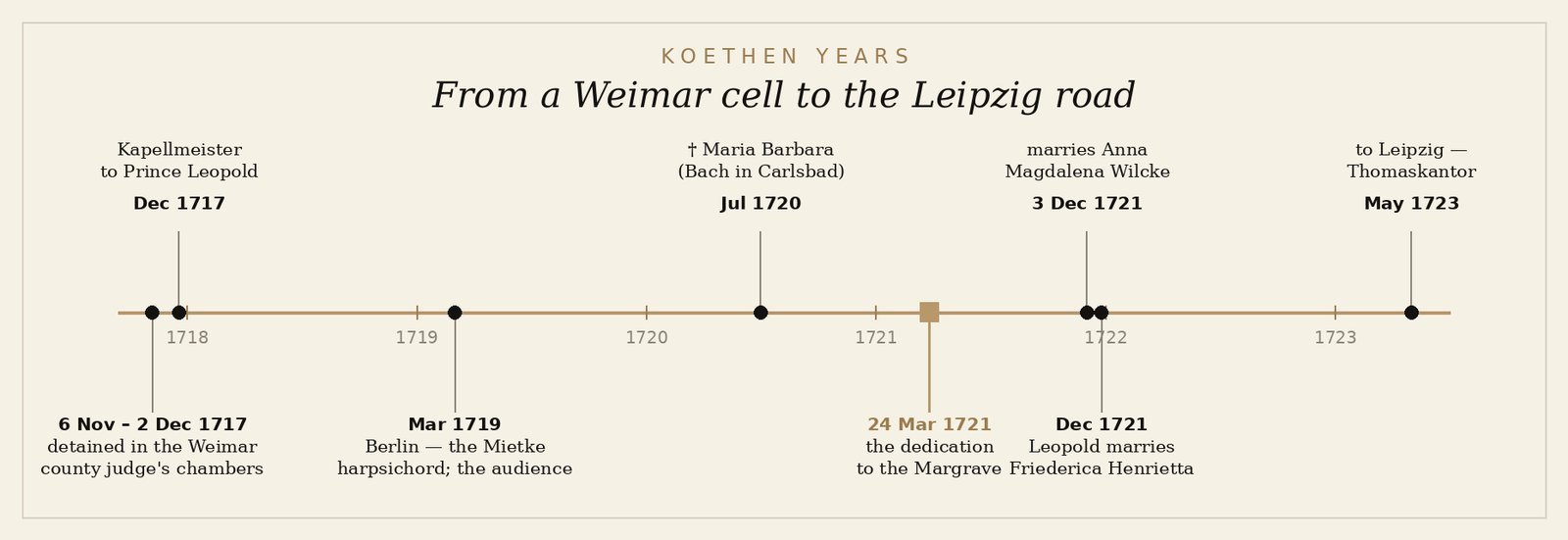
24 March 1721: a parcel and its orchestra
The object itself deserves a moment's attention, because the object is half the story. The dedication score — today shelf-mark Am.B 78 in the Berlin State Library — is a fair copy in Bach's own hand, almost entirely autograph: no copyist, no shortcuts, the work of a man who understood that for this recipient the calligraphy was part of the music. The title leaf gives him his full French dress — Maître de Chapelle de S.A.S. le Prince régnant d'Anhalt-Cöthen — and the dedication that follows performs every step of the courtly minuet: he recalls the Berlin audience of a couple of years before, offers the concertos as the Margrave had commanded, and begs the prince, in the idiom of the age, not to measure their imperfection by the rigour of his fine and delicate taste but to read in them the profound respect of the giver. It is rhetoric, and it is also a precise self-advertisement: the closing lines pointedly mention his readiness for service. Generations of scholars have argued whether the manuscript is best read as a gift or as a job application; the honest answer is that in 1721 the two genres were one. Nor should the word 'copy' mislead: a fair copy in the composer's own hand is a performance in ink — tempo of the pen, spacing of the systems, an engraver's eye Bach never needed to hire.
Malcolm Boyd, whose Cambridge handbook remains the best single companion to these works, stresses what the manuscript's revisions reveal: Bach was not composing six new concertos in the winter of 1720–21 but selecting, revising and re-scoring the best of what his Weimar and Köthen years had produced — tightening a ritornello here, adding a part there, recopying everything into fair order. The First Concerto's opening movement had already served, as early as 1713, as the sinfonia to the Hunt Cantata BWV 208; the Fifth was the newborn of the set, built for the Mietke instrument of 1719. The collection, in other words, is an anthology posing as a bouquet — a retrospective of a decade, bound in French. And the French title is the driest understatement in the history of title pages: Six Concerts avec plusieurs Instruments, six concertos with several instruments, for what Wolff's famous verdict, quoted below, identifies as the most original scoring project of the century.
One question hangs over the dedication: whose orchestra did Bach imagine playing it? The musicologist Heinrich Besseler noticed long ago that the forces required by the collection — setting aside the First Concerto, rebuilt for special occasions — tally almost exactly with the seventeen players Leopold kept at Köthen, down to individual specialisms, and concluded that the set is a portrait of Bach's own band. Wolff, examining the same evidence, concludes the opposite: the collection reflects no specific ensemble at all, neither the Margrave's nor the Prince's, and is better read as a survey of the possible — six ideal orchestras that existed complete only in Bach's head. The two views are less contradictory than they sound. Bach abstracted from the players he knew; abstraction is what he did to everything he touched, dance rhythms and Vivaldi concertos included.
The companion question — could the Margrave's own musicians have played it? — has hardened into the legend we began with: that Christian Ludwig's modest Berlin establishment was simply unequal to the music, and the score therefore went straight to the shelf. Boyd's dry objection deserves to be heard, and we will give it the floor among the scholarly quarrels below; for now it is enough to say that the famous image of the unopened parcel rests on remarkably little evidence, and that the one hard fact — the concertos are not named in the inventory drawn up at the Margrave's death in 1734 — proves only that nobody itemised them, not that nobody played them. What the dedication's florid first sentence actually documents is touching enough without embroidery: a composer remembering that a great prince once took some pleasure, as he puts it, in the little talents Heaven had given him for music, and paying for that moment of attention with a decade of his best work.
For the reader who wants the dating map in one breath, here is the scholars' rough consensus, argued more fully among the quarrels below: the First's core is oldest, demonstrably pre-1713; the Third and Sixth carry the flavour of earlier consort thinking, whatever their final dates; the Second and Fourth sit most comfortably in the Köthen years themselves; and the Fifth, child of the Mietke harpsichord, is the newborn — its early draft from the late 1710s, its final form possibly the last thing finished before the ink of the dedication dried. Six concertos, then, spanning perhaps a decade of invention: less a single work than a retrospective exhibition, hung by the artist himself.
Every one of the six concertos set a precedent in its scoring, and every one was to remain without parallel.Christoph Wolff, Johann Sebastian Bach: The Learned Musician (2000)

The machine of conversation — and six experiments upon it
Before walking through the six rooms of this collection, it is worth pausing at the doorway to admire the machine Bach inherited — because everything he does in the Brandenburgs is done to that machine. The concerto of 1720 was an Italian invention barely a generation old in its mature form. Arcangelo Corelli in Rome had crystallised the concerto grosso: a small group of soloists, the concertino — in his case two violins and cello — set against the full body of strings, the ripieno, the two forces alternating like speakers in a dialogue. Giuseppe Torelli in Bologna sharpened the format toward the solo concerto; and then Antonio Vivaldi in Venice, in the epoch-making L'estro armonico of 1711, gave it the engine that would drive instrumental music for a century: the ritornello. A memorable opening statement for the full ensemble returns — ritorna — again and again, whole or in fragments, in changing keys, like the refrain of a ballad; between its returns, the soloists fly their episodes of figuration and modulation, each episode a journey outward, each ritornello a homecoming. The form is a map of keys as much as of themes: tonic at the start and finish, the near relations visited in between, the listener always knowing — by the refrain's return — exactly where on the map the music stands. Tension and homecoming, the few against the many, the room answering the individual voice: it is less a form than a dramaturgy, and the eighteenth century recognised it instantly as a portrait of its own social order.
Bach met this machine in Weimar, mostly on paper. The musical young duke Johann Ernst brought Vivaldi's Amsterdam prints home from his studies, and Bach devoured them the way he devoured everything — by transcription, arranging Venetian concertos for solo organ and harpsichord (a whole shelf of them survives) until their mechanism lay disassembled on his workbench: how a ritornello is built from detachable limbs, how an episode spins sequence from a motif, how a return can be disguised, delayed, abbreviated to a single gesture. What he learned there he never abandoned: every fast movement in the Brandenburg set is a ritornello structure, and several slow ones too. What he added was his own pathology — an inability to leave any voice unemployed. Where Vivaldi's ripieno accompanies, Bach's argues; where the Italian concerto delights in the clear opposition of few and many, Bach delights in smudging the line, promoting accompanists to soloists mid-phrase and demoting soloists to bass-players, until the social order of the orchestra itself becomes the subject of the music. The Brandenburgs are six studies in exactly this: what happens to the Italian conversation machine when every participant insists on having opinions.
Underneath it all, in every concerto and every bar, runs the floor of the Baroque world: the basso continuo — harpsichord with cello and violone realising the harmonic ground over a figured bass line, the keyboard player reading shorthand numerals and improvising the filling in real time. It is the one element Bach never experiments with — until, in the Fifth, he detonates it — because it is the one element that makes all the other experiments legible. The continuo is gravity; the concertos are six ways of flying.
Lay the six title pages side by side — Bach headed each concerto with a meticulous inventory of its instruments, and we will quote each in his own Italian as we come to it — and the design of the collection leaps out. No two concertos share a scoring. The First fields the largest and most aristocratic band: hunting horns, a wind choir of three oboes and bassoon, and a violino piccolo. The Second compresses four utterly unlike soloists — trumpet, recorder, oboe, violin — into a single concertino. The Third abolishes the distinction between soloist and accompanist: nine string players, all principals. The Fourth crowns a virtuoso violin with a pair of mysterious 'echo flutes'. The Fifth smuggles the continuo harpsichord across the social frontier into the concertino, with consequences felt for two centuries. And the Sixth banishes the violins entirely, building its sound from the dark middle of the string family downward. Even the keys trace a deliberate arc — F and F, G and G, then D, then a settling third downward to B-flat: two matched pairs and a tailpiece, bright hunting-field flat keys framing the set, the one sharp-key concerto (the Fifth, the harpsichord's) glittering at the climax. The matrix below shows the whole scheme at a glance; it looks less like a set of six pieces than like a periodic table of the early eighteenth-century orchestra.
Is there a programme behind the pattern? In the 1990s an allegorical reading made the rounds: the early-music director Philip Pickett, in the essays accompanying his 1994 Decca recording, proposed that the six concertos honour the Margrave in six mythological guises — the hunter like Diana in the horn-calls of the First, the hero like Hercules facing the choice of virtue in the Second (where Pickett hears the trumpet as Hercules and the gentler concertino voices as the gods contending for his soul), then patron of Apollo and the Muses in the nine-voiced Third, shepherd like Pan in the Fourth's piping flutes, lover in the Fifth, scholar like Athena's protégé in the learned canons of the Sixth — the whole collection a Vanitas gallery in sound, designed, as he put it, as an object for study and contemplation as much as for performance. He even gave the First a title, The Triumph of Caesar. Scholarship has treated the theory with raised eyebrows and visible enjoyment; it is unprovable, occasionally strained, and yet it catches something real about the age, which decorated its palaces with exactly such allegorical programmes — painted Hercules cycles, Diana fountains, Muses on the ceilings — and expected its princes to read them at sight. A presentation manuscript was a courtly object before it was a musical one, and Bach, the supreme musical cryptographer, would at minimum have understood the game. We will let the theory shadow us lightly through the six concertos — and it will hand us, at the end, one almost absurdly perfect coincidence concerning a certain Roman hall named after Hercules.


Concerto I in F major — the hunt comes indoors
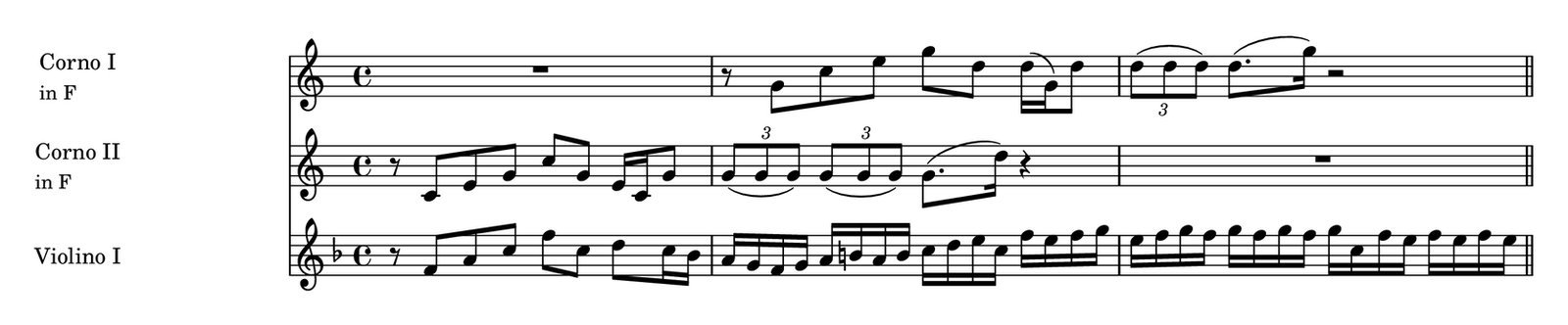
Concerto 1mo à 2 Corni di Caccia, 3 Hautb: è Bassono, Violino Piccolo concertato, 2 Violini, una Viola è Violoncello, col Basso Continuo — so reads Bach's heading, and the first two words of the inventory are the loudest: corni da caccia, horns of the hunt. In 1721 the horn was barely domesticated; it belonged to the stable-yard and the forest, to signals and kills, and its players ranked with huntsmen as much as with musicians. To seat two of them inside a courtly concerto was a deliberate collision of worlds — and Bach composes the collision instead of smoothing it. From the second bar the horns ride their triadic hunting-calls in jaunty triplets across the band's running semiquavers, two rhythmic universes occupying the same downbeats, the outdoors crashing the salon (Ex. 1); listen closely and you can hear the rest of the orchestra pointedly declining to notice, like courtiers ignoring muddy boots. If Pickett's allegory holds anywhere, it holds here: the Margrave greeted as lord of the chase. The movement, incidentally, is the oldest music in the set — it had opened the 'Hunt' Cantata BWV 208 back in 1713, in a Weimar version (BWV 1046.1) without the violino piccolo and without the third movement — and Bach would recycle its substance twice more in Leipzig, once as the sinfonia of Cantata BWV 52, so evidently he knew what he had.
This is also the only concerto in four movements, and the most orchestrally luxurious — so luxurious that Heinrich Besseler, as we saw, had to set it aside as a 'special occasion' piece when matching the set to Köthen's seventeen players. The violino piccolo, a small violin tuned high, leads the solo work with a faintly silvered, toy-soldier brilliance, and its duets with the principal oboe in the Adagio are the collection's first great shadow: a lament in the relative minor, the oboe's sighing line (Ex. 2) suspended over a tolling pedal, the two voices winding through chromatic inflections — that aching c sharp against the D minor field — that would not embarrass a Passion. Listen for the way the two soloists hand the dying phrase back and forth, candle-passing at a vigil — courtly mourning, perfectly composed. The whole movement is marked to be played sempre piano; grief at court keeps its voice down. The third movement restores daylight with athletic high spirits and a central episode where the piccolo violin finally gets its full virtuoso say — music Bach later rebuilt, horns swapped for trumpets, as the opening chorus of the congratulatory cantata BWV 207, which tells you how festive he considered it. In its lilting compound metre the horns take their revenge too, riding in bright parallel thirds above the band — forest professionals and the toy aristocrat finally negotiating as equals.
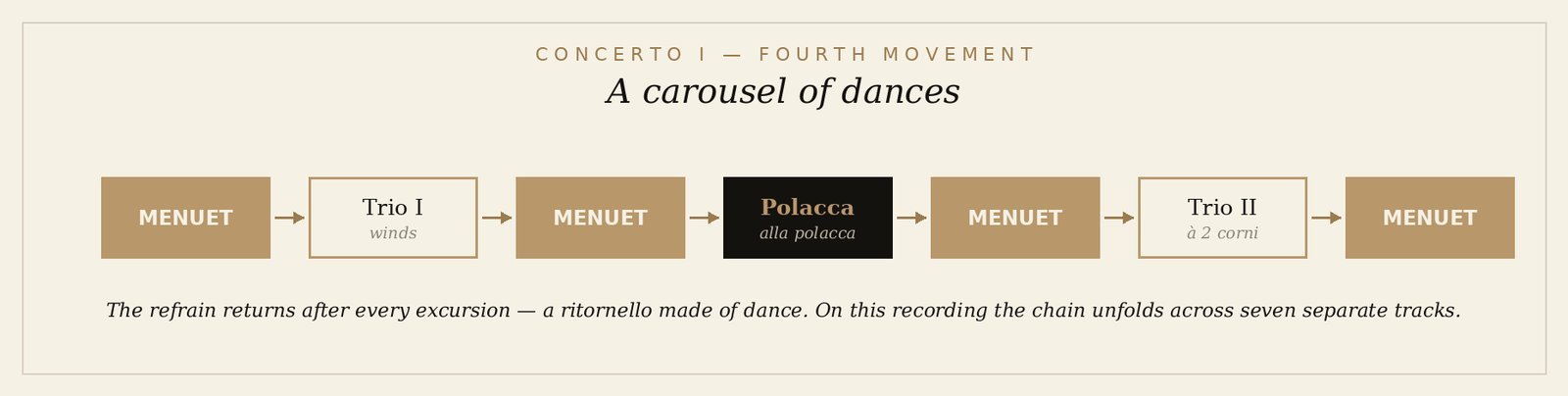
Then Bach does something structurally sly. Instead of ending, the concerto appends a carousel: Menuet, Trio for the wind band, Menuet again, a Polacca for the strings (the one explicitly Polish gesture in the set, a nod to fashion in an age when Saxony's elector wore the Polish crown), Menuet again, a second Trio for the two horns over unison oboes — the hunters given the last private word — and the Menuet one final time. The refrain principle of the ritornello, in other words, transplanted onto the dance floor: a rondo of bows and curtseys. On this recording the chain unfolds across seven separate tracks, and Alessandrini's single players give each return of the Menuet a slightly different bow, as dancers rather than monuments. His horn players, it must be said plainly, have the hardest job on the album — the corno da caccia parts are notorious, and even the disc's warmest reviewers noted moments where the Roman horns hunt fractionally wide of the quarry. It is the price of valveless honesty, and the swagger is worth it. Elsewhere the Romans' wind choir is a continuous pleasure — the oboes phrasing like singers in their Trio, the bassoon a dry wit underneath — and the violino piccolo keeps its faintly unearthly edge instead of being polished into an ordinary violin. Concerto Italiano's traversal runs 20:49.

Concerto II in F major — four soloists and one immortal trumpet
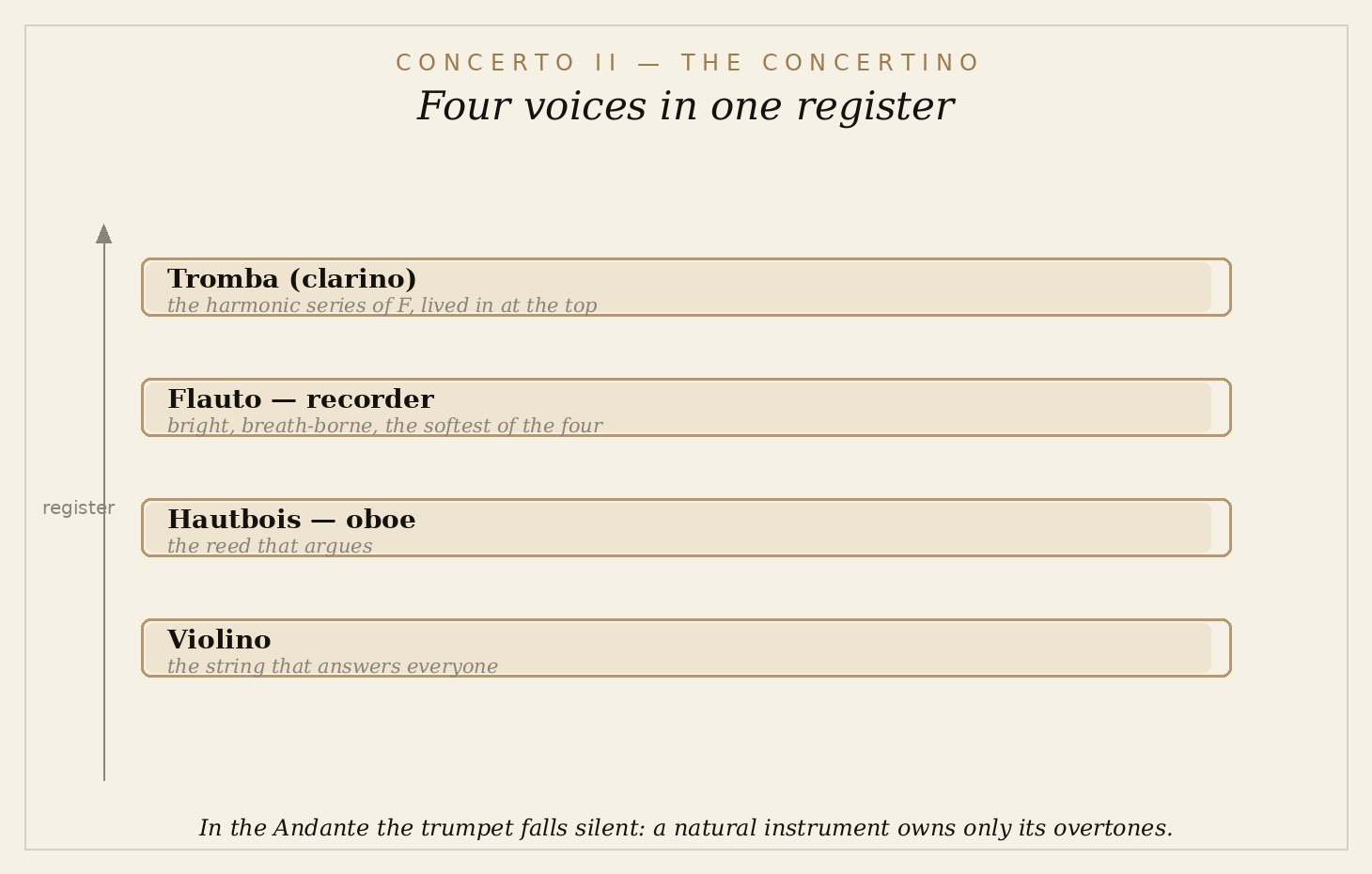
Concerto 2do à 1 Tromba, 1 Fiauto, 1 Hautbois, 1 Violino, concertati, è 2 Violini, 1 Viola è Violone in Ripieno col Violoncello è Basso per il Cembalo. Four soloists, then — and a stranger foursome was never assembled. A natural trumpet in F, the most brilliant and least flexible instrument of the age; a recorder, the gentlest; an oboe; a violin. The experiment is acoustic democracy under maximally unequal conditions: can a trumpet converse, rather than proclaim, with a flute of soft wood? Bach's answer is to write the four parts as genuine equals — the violin opens the solo exchanges, and the same garlanded subject then passes oboe, recorder, trumpet, each entrance a rung higher in brilliance, the four tessituras interlocking like the diagram below — and to trust balance to the players and to God. The first movement's ritornello is one of his most compact and detachable, a two-bar cell the whole movement keeps re-deriving; the form is Vivaldi's, the traffic density pure Bach. The democratic round is audible within the first minute: violin proposes the garland alone, oboe takes it up, recorder third, trumpet last and highest — four evenly spaced entrances, four speakers agreeing to differ. It is the concerto that profits most obviously from this recording's one-per-part economy: with a single violin and viola in the ripieno, Concerto Italiano's trumpeter can play at conversational volume, and the recorder, for once in this piece's discography, is a participant rather than a casualty. The Roman trumpeter, for his part, shapes the line with conversational dynamics rare on record — clarino playing as speech rather than fanfare — which is the concerto's whole experiment vindicated in sound.
The trumpet part itself is the Everest of the Baroque repertoire. It lives in the clarino register — the instrument's highest octave, where the natural harmonics finally lie close enough together for stepwise melody — and it was almost certainly written for a specific pair of lungs: Johann Ludwig Schreiber, Leopold's court trumpeter at Köthen, a guild professional whose entire art consisted of exactly this stratosphere. When the clarino art died with its guild in the later eighteenth century, this concerto became literally unplayable as written; the nineteenth century faked it on cornets, clarinets and horns, the twentieth invented the piccolo trumpet for it, and the recovery of the valveless original — lips and air alone selecting among the overtones — is one of the quiet triumphs of the historical-performance movement. Physics also explains the trumpet's famous absence from the Andante: a natural instrument owns only the overtones of its single fundamental, and in the minor-key slow movement Bach simply has nothing safe to offer it. So the remaining three soloists conduct a grave conversation over a walking quaver bass — a chain of overlapping entries on a single drooping subject, chamber music hiding inside a concerto — until the finale, where the trumpet returns to fling open the door with the fugue subject itself (Ex. 3), the most exuberant I'm back in the orchestral literature, and the movement runs its course as a fugue whose academic rigour nobody notices because everyone is grinning. Even the Andante's economy rewards close attention: one drooping figure passed among flute, oboe and violin in overlapping imitation above the walking cello — a whole movement built from a single sigh and a staircase. Alessandrini paces it as pure chamber music, three friends above a cello, with no conducting audible anywhere.
This concerto carries a cultural payload no other ten minutes of Bach can match, and a modern scholarly footnote besides: recent research has reconstructed a lost chamber version of the whole work — Concerto da camera in Fa maggiore, catalogued BWV 1047R, the four solo parts intact over a continuo reduction, published by Bärenreiter in Klaus Hofmann's edition — a reminder that beneath this most public of concertos may lie Köthen chamber music, written for a tableful of friends before it was scaled for a margrave. Concerto Italiano despatch it in a lean 11:10, with an ending so abrupt it makes you laugh — the reviewers noticed it too — which, one suspects, is the intended effect: the trumpet simply declines to let the party run a bar past its best moment.


Concerto III in G major — nine voices and an open door
Concerto 3zo à tre Violini, tre Viole, è tre Violoncelli col Basso per il Cembalo. Three, three and three: the most radical scoring in the set hides behind the most modest. There is no concertino here because there is no ripieno — every one of the nine string players is a soloist, and the music is a perpetual redistribution of authority among them. A figure ignites in the violins, leaps to the violas, is seized by the cellos; trios form and dissolve; the nine regroup by family, by register, by pairs across families; for a few bars the second viola is the most important musician in Europe. The first movement's ritornello — that instantly recognisable striding unison, with its three-note knocking cell — supplies the raw material for everything, and the movement's middle stretch undertakes a genuine harmonic expedition: out of radiant G major through its neighbours, dipping into the first minor shadows of the piece, the violas at one unforgettable moment chasing each other in canon before the home key reasserts itself. On the continuo part Bach wrote, in his own hand, Violone & Cembalo — the tenth and eleventh participants, holding the floor while the nine argue above. The unison ritornello is itself the thesis: nine players speaking as one instrument before dispersing into nine opinions, and every return of it re-assembles the parliament. He clearly loved the result: in Leipzig in 1729 he promoted this movement, with a wind ensemble of oboes (a taille among them) and a pair of horns grafted onto the nine strings, to open the Whitsun cantata Ich liebe den Höchsten von ganzem Gemüte, BWV 174. Keep that fact in your pocket: this album does something delicious with it.
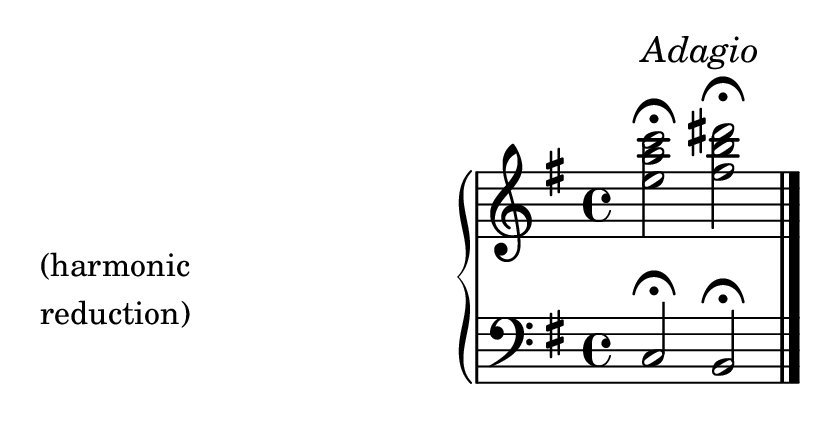
And the middle movement? Bach wrote one bar. Two chords, marked Adagio, crowned with fermatas: a Phrygian half-cadence in E minor — the iv⁶ sinking by semitone onto the dominant (Ex. 4) — and nothing else. It is the most discussed empty space in eighteenth-century music. The cadence formula itself was a standard Baroque hinge between movements, a comma before the finale; but a comma is not a movement, and there is no direct evidence of what, if anything, Bach expected to happen around those chords. Improvisation was the daily bread of his players, and the dominant-of-E-minor destination — a key the outer movements never visit — seems to beg for at least a moment's exploration; yet the autograph is serenely silent. The performing tradition has answered with everything from nothing at all — play the two chords as written, a stark 'musical semicolon' — through improvised flourishes for violin or harpsichord, to wholesale transplants: the Largo of the G major violin sonata BWV 1021 or the corresponding movement of BWV 1019 are sometimes borrowed, since each happens to close with the identical Phrygian formula; Wendy Carlos, electrifying Bach on the Moog, famously composed a different second movement for each of her three recordings. Every performance of this concerto is therefore also a small confession of belief about what a musical text is — instruction, framework, or invitation.
Alessandrini's confession is elegantly Italian: a brief harpsichord elaboration, growing directly out of the final chord of the first movement and delivered by the director himself from the continuo bench — the cadence treated not as a void to be filled but as a doorway already ajar, the Gramophone reviewer singling out precisely this seamless join. On this album the Adagio and the finale share a single track, which is honest bookkeeping: the one exists only to release the other. And the finale — a stamping binary dance in racing semiquavers, each half repeated, a perpetuum mobile that pours through the three choirs like water through locks — is where this recording first bares its teeth: a tempo at the outer edge of articulacy, nine Italians playing as if the building were on fire, every line nonetheless audible because every line is one person. The passage where the three cellos briefly take the lead — so often a murk on orchestral recordings — lands here with the distinct grain of three separate bows. Total timing, 9:56; we will hear from the tempo police in due course.
Concerto IV in G major — a violin among the echoes
Concerto 4to à Violino Principale, due Fiauti d'Echo, due Violini, una Viola è Violone in Ripieno, Violoncello è Continuo. The puzzle is right there in the heading: what on earth is a fiauto d'echo? No instrument of that name survives under that label, and the question has entertained organology for a century. The mainstream answer — and the one heard on this recording — is a pair of alto recorders, whose dialogues of soft answering phrases create the 'echo' effect the title promises, especially in the slow movement, where Bach writes the pair's repetitions at a dynamic remove, forte phrases shadowed piano, a built-in acoustic of distance. But rival theories refuse to die: Thurston Dart championed the flageolet, which would lift the sound a silvery octave; some scholars, David Lasocki among them, point to surviving double recorders — twinned instruments capable of echoing themselves; and Nikolaus Harnoncourt, with characteristic theatrical literalism, simply placed his two recorder players offstage, turning the echo from a timbre into an architecture. The debate gets its own hearing among the scholarly quarrels below; what matters here is that Bach built uncertainty of distance into the very scoring — the only concerto of the six whose title names an acoustic effect rather than just an instrument.
Whatever the flutes are, the concerto belongs to the violin. The violino principale part is the most openly virtuosic writing in the whole collection — and in the first movement the brilliance is structural, not decorative: the long central episode hands the violin cascading bariolage, the bow rocking across strings in unbroken semiquaver triplets while the flutes hold the thematic fort, display and substance trading places. The finale ups the stakes: a fully worked fugue whose subject the ripieno states with academic gravity before the soloist explodes it into moto-perpetuo passagework — the movement the Neue Bach-Ausgabe marks Presto, a single word over which, as we shall see, modern performers have nearly come to blows. And yet Bach cannot resist subverting his own star system: in the central Andante, an E minor sarabande of grave courtesies, whenever the concertino plays unaccompanied the solo violin is demoted to playing the bass line beneath the two recorders. The virtuoso as footman; remember this inversion, because in the next concerto it becomes the entire plot, and one modern scholar has built a whole theology on it.
Bach himself evidently prized the piece: he rebuilt it in Leipzig as the harpsichord concerto BWV 1057, transposed to F, the keyboard swallowing the violin part whole, annexing stretches of the recorders' lines, and occasionally adding a fourth contrapuntal voice of its own — less a transcription than a hostile takeover, and proof that the composer regarded the work as bone-deep keyboard music waiting to happen. The work thus leads a triple life in the catalogue — violin concerto in all but name from one angle, concerto grosso for flutes from another, keyboard concerto in embryo from a third — and which face you meet depends entirely on who is performing. On this album the answer is unambiguous: a violin concerto among friends, the flutes confidants rather than decoration. Posterity has given it a curious literary afterlife too: Aldous Huxley reached for it in his final novel, Island (1962), where its slow movement sounds through the book's closing pages — the music of lucidity itself, chosen by a writer who had spent a lifetime looking for exactly that. Concerto Italiano play the concerto in 14:31, the recorders forward and conversational, their echo dialogues genuinely dynamic rather than merely polite, the violinist — in OPPP conditions, gloriously exposed, with no section to hide a single semiquaver in — treating the Presto as a high-wire act without a net, which is precisely what the marking invites and precisely what scandalised the slower-pulsed among the disc's first critics.
Concerto V in D major — the servant seizes the harpsichord
Concerto 5to à une Traversiere, une Violino principale, une Violino è una Viola in ripieno, Violoncello, Violone è Cembalo concertato. The last word of the heading is the revolution: cembalo concertato. For the first time in the history of the genre, the keyboard — until this moment the hired help of the ensemble, the continuo's anonymous engine — is named a soloist. Notice, too, the first word: traversiere, the fashionable French transverse flute, its only appearance in the set, where the Second and Fourth had used recorders; even in his choice of flutes Bach is cataloguing the present and the future side by side. The Fifth is by general agreement the newest music in the collection, written around the great two-manual Mietke harpsichord Bach fetched from Berlin in 1719, and it seems almost certain that the composer himself sat at it — the concerto is, among other things, a self-portrait with instrument. Scholars have long read it as the ancestor of every keyboard concerto since, which means the entire piano-concerto tradition — Mozart to Rachmaninov, every soloist who ever strode past an orchestra to the bench — descends from a Köthen Kapellmeister showing off the court's new furniture. The opening ritornello is itself a flourish of new-instrument pride: a brilliant unison kick of a theme, all rhythm and daylight, built to make a two-manual instrument's answering figuration glitter.
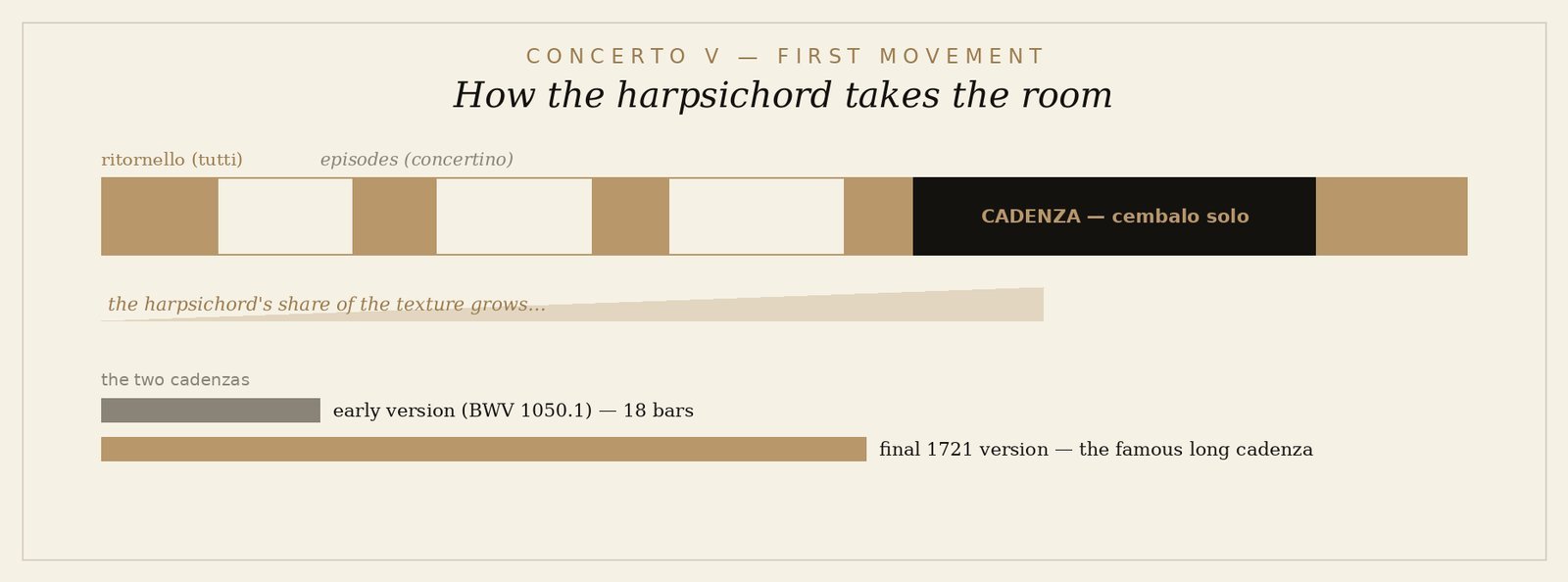
Bach plots the coup with a dramatist's patience. The harpsichord begins respectably, double-booked as soloist and book-keeper: obbligato brilliance in the concertino episodes, dutiful figured bass whenever the ripieno plays. But its share of the texture keeps growing — runs lengthen into unbroken demisemiquavers, the flute and violin's material thins to interjections — until, near the end of the first movement, the ensemble simply falls away and the servant is left alone in the hall for the most famous cadenza of the entire Baroque: a vast solo flight, figuration tightening turn by turn over a long dominant preparation, hands crossing and recrossing, before the ritornello returns to restore a constitution that everyone present knows has just been rewritten. Even here there is a philological story. The earlier version of the concerto, BWV 1050.1, survives with a cadenza of just eighteen bars — terse, functional, a sketch of the eruption to come — which Bach then expanded for the dedication score into the long final form, several times its size (the diagram below sets the two side by side). This album does something connoisseurs adore: it includes the early short cadenza as a separate bonus track, a hundred-second alternate ending, so the listener can hear the revolution in two drafts — reform, then storming of the palace.
The middle movement withdraws into the most intimate scoring in the set: an Affettuoso in B minor for flute, violin and harpsichord alone, the ripieno dismissed entirely — a trio sonata smuggled into a concerto, the harpsichord's right hand now a fully melodic partner rather than a chordal servant, three voices exchanging a single tender subject in the textures Bach would later perfect in the sonatas for flute and obbligato keyboard. And here lives the ghost: tradition holds that the movement weaves in a theme of Louis Marchand, the Dresden duellist who fled. The claim is old and unverifiable, and is best filed beside the duel itself; but if true, Bach buried his rival inside the gentlest music he ever wrote, which would be the most elegant revenge on record. On this recording the Affettuoso moves at a true walking pace, the harpsichord's melodic right hand given equal billing with flute and violin — three voices, one breath — and the movement emerges as what it is, the secret centre of the whole set. The finale releases everything as a dance — a gigue that behaves like a fugue, the violin stating the subject, the flute answering in kind (Ex. 5), the harpsichord third in, the concertino fending entirely for itself for long stretches before the ripieno consents to join, the whole movement rounded by a full return of its opening paragraph, refrain logic to the last. Concerto Italiano's 20:19 traversal makes the social drama audible as few performances do, because with one player per part the harpsichord is not balancing against an orchestra; it is outnumbering individuals. Alessandrini directs the insurrection from the bench, and his cadenza has the one quality the passage cannot live without — the sense of a performer deciding, in real time, how far to push his luck.

challenge (as opposed to reflect) existing musical and social hierarchiesMichael Marissen, The Social and Religious Designs of J. S. Bach's Brandenburg Concertos (Princeton, 1995)
Concerto VI in B-flat major — viols in the dark
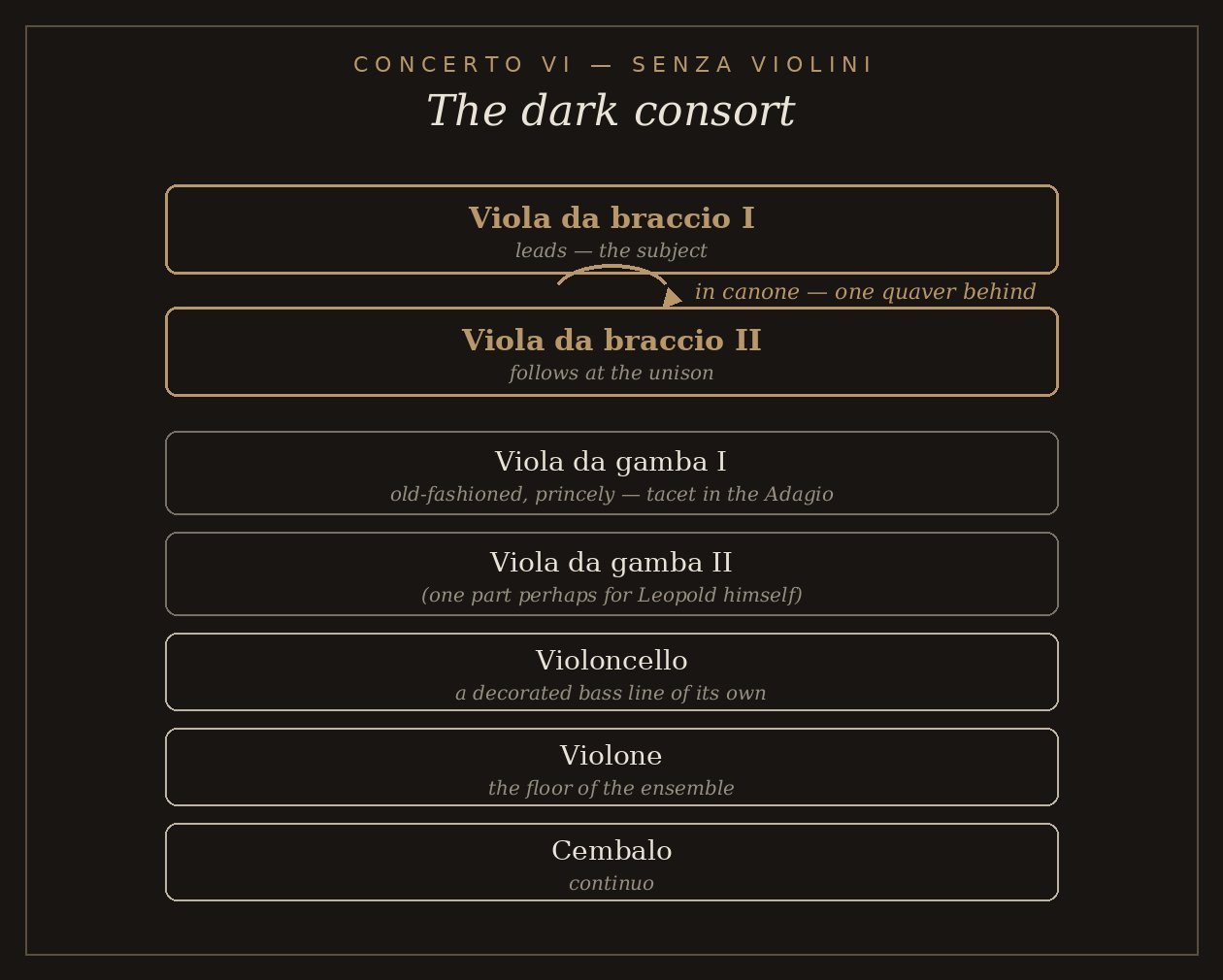
Concerto 6to à due Viole da Braccio, due Viole da Gamba, Violoncello, Violone e Cembalo. Read the inventory twice and the absence registers: no violins. In 1721 this was nearly unthinkable — the violin was the orchestra's voice, its top line, its light — and Bach had attempted the blackout only once before, in the Weimar cantata BWV 18. The Sixth is built entirely from the middle of the string family downward: two viole da braccio (the ordinary 'arm' violas, here promoted to leading roles for possibly the first time in concerto history), two viole da gamba (the fretted, aristocratic 'leg' viols of the old consort tradition, already antiques in 1721), cello, violone, harpsichord. The sonority is unique in Bach and very nearly unique in music: burnished, grainy, lit from below, a painting executed without white. Commentators have long heard in the pairing a deliberate dialogue of musical generations — the modern violin family and the dying consort viols sharing one room, the future and the past bowing to each other — and the work's key of B-flat, warmest and least brilliant of the set, seals the chiaroscuro.
The casting is also a social document. The gamba parts are conspicuously less taxing than the viola parts — long stretches of accompanying figuration, complete silence in the slow movement — which fits like a glove the old supposition that one of them was meant for Prince Leopold himself, gamba under his princely arm, seated inside his Kapellmeister's music while two salaried violists do the heavy lifting above him. Harnoncourt pushed the thought one provocative step further: by composing a concerto in which the prince plays the easy part while the servants carry the argument, Bach quietly upends the room's hierarchy — and Harnoncourt speculated that such gestures were the reflex of a Kapellmeister already feeling for the exit. Whatever the intent, the texture enacts the inversion from the first beat: the two violas open in a vigorous close canon at the unison, the second voice shadowing the first at a single quaver's distance (the diagram below traces the chase), the strictest of learned devices delivered with the swing of a street dance, over a bass that throbs in even quavers like a ground. Strict canon that sounds like swagger: there is no better four-word summary of this composer. Beneath the chase the gambas lay soft off-beat chords and the bass walks in even quavers — the antique instruments assigned the modern accompanist's role, the past politely shown to the future's seats.
The Adagio ma non tanto dismisses the gambas entirely and becomes a trio sonata in E-flat for the two violas over a walking bass — the cello unbraiding its own ornamented strand of the continuo line, a fourth voice hiding inside the third — chamber music of inward, almost Brahmsian warmth (Brahms, not coincidentally, adored dark violas), closing not with a resolution but on an expectant half-close that tips straight into the finale. And the finale is, once again, a gigue: a 12/8 romp whose returning refrain makes it the sibling of the Fifth's, the two violas still inseparable, the collection that began with horns in a field ending with viols in a dark room, dancing. Concerto Italiano give the work 15:12 of unforced eloquence, the gambas' silver grain audible against the violas' bronze as it almost never is when modern string sections play this piece. The two violists in particular play the opening canon as a conversation rather than a stunt — one quaver apart and audibly listening to each other — If any single concerto justifies the one-per-part wager, it is this one.
Who could play them — and did anyone?
The romantic version — the Margrave's band too feeble, the score shelved unread — rests, as Malcolm Boyd showed, on an absence: the concertos are not itemised by name in the inventory taken at Christian Ludwig's death in 1734. From that silence the nineteenth century spun a whole novella of neglect; but estate inventories lump music into bundles as a matter of routine, the bundles in this case demonstrably contained concertos by the dozen, and Boyd's common-sense objection lands hard — he finds it »unlikely that Bach would have sent him six concertos totally unsuitable« for the Margrave's players. Berlin in the 1720s, moreover, was full of freelance virtuosi a prince could engage by the evening, clarino trumpeters included; the idea that a Hohenzollern could not assemble thirteen competent musicians for an afternoon belongs to fiction. On the other side stands Besseler's elegant arithmetic matching the set (minus the First) to Köthen's seventeen, with named players for named parts — and against that stands Wolff's flat rejoinder that the collection mirrors no specific ensemble at all, neither the Margrave's nor the Prince's, and is best read as a survey of ideal orchestras. The honest summary: we do not know whether Christian Ludwig ever heard his concertos, and the confident certainty of generations of programme notes was manufactured from silence. One consequence reaches the present day: every modern liner note must choose between the romance and the audit, and the romance, being better copy, usually wins — this essay's opening legend included. What the quarrel changes for the listener is the work's social temperature — portfolio of an imagined orchestra, or love-letter to a real one? Alessandrini's one-per-part Romans, incidentally, sound like the second while agnostic about the first.What is a fiauto d'echo?
The Fourth Concerto's mystery instruments have generated a small library. The case for ordinary alto recorders is strong and pragmatic — the parts lie perfectly under recorder fingers, the compass fits, and 'echo' may simply describe the pair's answering role in the Andante. Thurston Dart's flageolet theory, fashionable in the mid-twentieth century, would brighten the sound an octave and has the charm of period English advertisements behind it; the double-recorder hypothesis points to surviving twinned instruments — two bores, one player — that can genuinely echo themselves; and Harnoncourt's offstage placement reads the word as stagecraft rather than organology, an instruction about where rather than what. Recordings have tried all four answers, and the piece changes identity with each: chamber pastoral, silvery toy-box, acoustic illusion. Alessandrini's choice of close, conversational altos is the scholarly mainstream — but hear any 'spatial' recording afterwards and the same notes become a different work, which is perhaps the deepest lesson the debate teaches. (Practicalities, meanwhile, have voted with the mainstream: the parts sit so gratefully under alto-recorder fingers that most performers treat the puzzle as solved in practice, whatever remains open in principle.)Theology in the seating plan
The most consequential modern reading is Michael Marissen's Princeton monograph of 1995, which argues — from the scorings themselves, the promotions and demotions we have traced concerto by concerto — that the set systematically challenges rather than reflects the era's musical and social hierarchies: the huntsman-horns seated among courtiers in the First, the nine equals of the Third, the solo violin demoted to bass beneath two flutes in the Fourth, the continuo servant seizing the Fifth, the prince's antique gamba outplayed by mere violas in the Sixth. Marissen's deeper claim is specifically Lutheran: in the world to come, earthly rank dissolves — the last shall be first — and music can model that dissolution truthfully without preaching revolt in this one; the concertos teach the ear a theology the court calendar could never speak aloud. Critics reply that a fertile musical imagination needs no doctrine to explain it — Bach upended scorings the way he upended counterpoint and key-schemes, because invention was his element; and they note the irony of finding sermons in the one repertoire a Calvinist court paid him not to preach in. The reading remains unprovable and unforgettable; once heard, the Fifth's cadenza never again sounds politically innocent, and even sceptics concede that no other explanation accounts so economically for the systematic character of the experiments. The book's influence, notably, has been strongest among performers: the one-per-part movement, this recording included, is in part Marissen's argument made audible — if every line is an individual, the social drama plays itself.Dates, drafts and a chamber ghost
Finally, the philology — because 24 March 1721 is when the parcel was wrapped, not when the music was made. The First Concerto's core demonstrably predates 1713 (the Hunt Cantata sinfonia, BWV 1046.1, lacking piccolo violin, third movement and Polacca); the Fifth is tied to the Mietke instrument fetched in 1719, its early version BWV 1050.1 — six parts, no independent cello, and that terse eighteen-bar cadenza — dating from the late 1710s; the Sixth's archaic gambas and the Third's consort-like equality have tempted scholars toward earlier layers still, while the Second and Fourth sit most comfortably in Köthen itself. Boyd and Wolff map the territory differently bar by bar, and the safest formulation remains the dedication's own: pieces composed over several years, gathered, revised and re-tailored in the winter of 1720–21 by a composer auditioning a decade of himself. To which recent research has added the reconstructed chamber double of the Second, BWV 1047R — a reminder that beneath the six 'orchestral' façades may lie a whole shadow-archive of Weimar and Köthen chamber music, lost except where a later arrangement happens to preserve its outline. The Brandenburgs we possess are, in the strictest sense, a fair copy of an invisible library. Where does this recording stand on the four battlefields? Squarely, and legibly: mainstream alto recorders for the echo question; the doorway reading of the Third's two chords, answered from the harpsichord bench; one player to a part, with Köthen's payroll as warrant; and on tempo, the Italian liberty the closing chapter defends. Few albums let you hear a bibliography so clearly — and fewer still make the footnotes this much fun. A coda on method: every position above is reversible by a single archival find — a Berlin performance bill, a Köthen part-set, a dated copy — and Bach studies turns such finds up still. Read the quarrels, then, not as stalemates but as standing invitations; a manuscript that survived a burning train can survive our certainties too.The fate of a manuscript
Now the afterlife — and first, the legends, because the legends are themselves a historical artefact. Version one: at the Margrave's death in 1734 the score was valued among job-lots of music at 24 groschen, the price of a good dinner. Version two, still circulating in respectable places: the manuscript mouldered in an attic until a servant, clearing it out in 1849, chanced upon the treasure. Both stories are repeated endlessly; neither survives contact with the documents, and recent reference works have quietly dropped the 24-groschen figure altogether. They are best understood as Romantic-era furniture — the nineteenth century, rediscovering Bach as a misunderstood titan, needed the world to have scorned him, and priced the scorn accordingly, down to the invented small change. That the famous figure of 24 groschen cannot be traced to any surviving document has done nothing to slow its circulation; legends, unlike manuscripts, never go missing.
What the paper trail actually shows is less cinematic and more interesting. The concertos go unnamed in the 1734 estate inventory — bundled, presumably, among the concerto stacks the clerks counted by the dozen — and the trail then runs blank for a stretch before the score surfaces in the hands of Johann Philipp Kirnberger, Bach's own pupil, by then theorist at the Berlin court of Princess Anna Amalia of Prussia, the king's sister: composer, collector, and builder of one of the great private music libraries of the age. From Kirnberger the manuscript passed into that library — its very shelf-mark today, Am.B 78, still spells Amalien-Bibliothek — which went by bequest to the Joachimsthal Gymnasium in 1788; the school's collection was transferred in 1914 to the Royal, today State, Library in Berlin, where the manuscript rests now. In other words: for most of its 'lost' century the score sat, perfectly catalogued, in one of Europe's great music collections, a few streets from where it had first been delivered, waiting not to be found but to be wanted. Even the word 'rediscovery', so flattering to the rediscoverers, deserves its asterisk: nothing was hidden; the age simply had no use for six orchestras that no longer existed.
The wanting arrived in 1849, when the scholar Siegfried Wilhelm Dehn, working through Amalia's collection, recognised what Am.B 78 contained — and Dehn was no passing browser but the custodian of the royal library's music collections, so the 'discovery' was really an act of professional attention, a librarian finally reading his own shelves — and arranged its publication — the first ever — in 1850, the centenary of Bach's death. The timing was no accident: the Bach revival was cresting, Mendelssohn's resurrection of the Matthew Passion twenty-one years behind it, the Bach-Gesellschaft's monumental complete edition launching that very year. Yet even then the concertos did not leap into concert life: print is not performance, and the orchestras of 1850 had no violini piccoli, no gambas, no clarino players. What performances occurred were refitted to modern forces — a state of affairs that persisted, astonishingly, deep into the twentieth century, and to which we turn next. The manuscript itself, meanwhile, had one last adventure to survive, the kind no novelist would dare invent.
Scholarship, characteristically, arrived a generation before the public did: Philipp Spitta's monumental Bach biography (1873–80) and the Bach-Gesellschaft's edition gave the concertos their full scholarly dignity while concert audiences still barely knew them — a monument on paper, admired by the few dozen people who read monuments. The gap between the work's textual fame and its sounding absence is the strangest stretch of its biography, and it set up the twentieth-century twist to which we now turn.
A repertoire made by the gramophone
Here is the genuinely strange fact about the Brandenburgs' fame: it is younger than the aeroplane. After Bach's death only the Fifth circulated at all, riding the fashion for keyboard concertos; the 1850 edition, as we saw, changed remarkably little; and through the entire nineteenth century these works that now define 'Baroque orchestra' in the public ear were a scholars' curiosity — known well enough for Max Reger to arrange the whole set for piano four hands, almost never heard as Bach scored it, because no orchestra possessed the instruments. There were no violini piccoli in 1880, no echo flutes, no gamba players outside antiquarian circles, and above all no clarino trumpeters; performances meant arrangements, and arrangements meant the experiments — the entire point of the collection — were precisely what got smoothed away. The concertos' conquest of the canon happened on shellac and vinyl, not in concert halls, and it can be dated: the first complete recording, directed by the violinist Adolf Busch with his hand-picked chamber players, appeared in 1936 — an exile's project, recorded as Europe darkened — and it was the gramophone's repeatability, the same six unrepeatable orchestras available on demand in any parlour, that finally taught general audiences what Bach's scoring experiments actually sound like. It is a nice question whether any other canonical masterpiece owes a medium so much: the gramophone did not merely spread the Brandenburgs, it constituted them as a public experience, much as print had once constituted the novel — and the familiar nickname itself, be it said, is a nineteenth-century convenience, not Bach's own title. The work and the medium were made for each other: a collection that requires six different bands is a nightmare for a concert promoter and a gift to a record label.
The discography since then is a seismograph of the entire performance-practice century, and the table below walks its fault lines. First the humane chamber style of Busch and, later, Casals's craggy Marlboro evenings; then the post-war monuments — Karajan's upholstered Berlin glamour, Karl Richter's granite Munich discipline (the version that went to the stars). Then the rupture: Nikolaus Harnoncourt's Concentus Musicus set of 1964, the first on period instruments, scrawny, astringent and epoch-making — the sound of a door opening onto weather. Leonhardt's all-star consort of pioneers deepened the claim in the seventies; Trevor Pinnock's 1982 Archiv set made period style mainstream and beautiful; Reinhard Goebel's Cologne recording of 1986 weaponised it, at tempi so ferocious they remain a scandal and a thrill four decades on; and Wendy Carlos's Moog realisations, lest we forget, had meanwhile carried the Third Concerto into millions of homes that owned no other Bach at all. By the nineties the centre of gravity was drifting south — Il Giardino Armonico's theatrical Italians — and the scholarly one-player-per-part hypothesis was migrating from the journals into the studio. Which is the world into which, in 2005, Concerto Italiano's recording arrived: not a novelty, but a thesis statement in a long argument — and, many would say, the argument's most persuasive Italian sentence.
Two further currents deserve their lines in this story. Alongside the period revolution, a humane modern-instrument tradition never surrendered — chamber-scaled, singerly, allergic to both upholstery and asceticism — and its recordings (Casals's craggy Marlboro evenings above all) remain the conscience of the discography. And below all of it ran sheer ubiquity: by the seventies the set was a stereo demonstration staple, a film-cue quarry, a Sunday-morning fixture — familiarity that bred elevator ghosts and adverts, and against which the period movement's true gift was to make the music strange again. Every generation, it turns out, must re-estrange the Brandenburgs to hear them; Alessandrini's Romans are simply the estrangement our century earned.
Busch's pioneering set carries its own quiet politics: the violinist had turned his back on Nazi Germany in 1933, and his Brandenburgs — German music recorded by an exile with a hand-picked band of friends — made the collection, at the moment of its recorded birth, an emblem of the other Germany. The work's modern life thus began exactly as its first life had in 1721: as a parcel sent across a border.
Rinaldo Alessandrini: the Italian thesis in the Hall of Hercules
Rinaldo Alessandrini came to Bach the long way round — through Monteverdi. The Roman harpsichordist founded Concerto Italiano in 1984, announcing the new ensemble with Cavalli's La Calisto in his home city, and its first decades were a sustained act of repatriation: Italian madrigals, Italian opera, Vivaldi played not as sewing-machine brilliance but as rhetoric, speech, theatre. The Monteverdi madrigal recordings collected a string of Gramophone Awards and quietly rewired international expectations of how this music breathes — where the great Northern ensembles had treated Italian Baroque as an exquisite sound-object, Alessandrini's singers and players treated it as conversation, with all of conversation's accelerations, interruptions and raised eyebrows. By the time he turned to German repertoire he carried a fully formed conviction, stated in interviews and liner essays with cheerful bluntness: that the high-Baroque lingua franca was Italian; that Bach learned the concerto by copying Vivaldi until the idiom lived in his hands; and that the Brandenburgs are therefore — beneath the Saxon counterpoint — Italian music, with Italian phrase-shapes, Italian impatience and Italian pleasure in the sound of argument. A Guardian critic, reviewing this very album, conceded the point in five words: of the concertos' Italian origins, »those origins never disappeared entirely«.
The thesis dictates the forces. Concerto Italiano recorded the set one player per part — the scholarly OPPP hypothesis taken at its word — so that every line in Bach's most line-conscious scores belongs to a nameable individual, and balance becomes conversation rather than engineering: eleven musicians at full strength, fewer in the chamber-scaled Fifth and Sixth, a band the size of Leopold's payroll pages. It dictates the direction, too: Alessandrini leads from the continuo harpsichord, exactly as the Kapellmeister of 1721 would have, shaping phrases with the bass line rather than a baton, and stepping forward as soloist only where Bach himself does — in the Fifth's coup and the Third's doorway cadence. And it dictates the temperament: tempi on the daring side, ornaments tossed off rather than displayed, slow movements sung like chamber arias, finales driven like dances that someone might actually dance, and an almost complete absence of the devotional hush Northern Bach tradition treats as default. Hush, Alessandrini might say, is for churches; Köthen had none that wanted this music. None of this is neutral. It is a reading with a thesis, and theses make enemies — as we are about to hear.
The venue is half the sound. The Salone d'Ercole of the Palazzo Farnese — the High-Renaissance palace whose upper storeys bear Michelangelo's hand, and which since 1874 has housed the French Embassy, a pleasing rhyme for a French record label — is a state hall on a double-height plan, its coffered wooden ceiling hanging eighteen metres above the floor, its name a memory of the colossal Farnese Hercules that once stood here before emigrating to Naples. Around eleven solo instruments that volume behaves like a twelfth member of the ensemble: the naïve engineers caught a sound that is intimate in detail and palatial in bloom, every plucked continuo note given a halo of Roman stone, and the one-per-part textures are exactly what such a room rewards — a full section would swim, a single voice sings. The 45-minute bonus DVD shows the sessions in progress, the players grouped close on the marble, Alessandrini reflecting in fluent French on the music's Vivaldian bloodlines; it is as close as the catalogue comes to time-travel footage of a Kapellmeister rehearsing his consort. And here the collection's allegorical ghost takes its bow — if Pickett was right that the Second Concerto salutes the Margrave as Hercules, then the most famous trumpet part in music was recorded, by pure serendipity, in the Hall of Hercules. Bach, lover of emblems, would have filed the coincidence with satisfaction.
The release itself was generous in the old style: two discs totalling 99:16, the six concertos plus two philological encores. The early eighteen-bar cadenza of the Fifth stands as a separate track, as we saw; and closing the first disc comes the Sinfonia of Cantata BWV 174 — the Third Concerto's opening movement as Leipzig heard it in 1729, horns and oboe band grafted onto the nine strings, five and a half minutes of Bach remixing himself. It is the perfect emblem of the album's argument — the Italian-style concerto recycled into German church music before your ears, the thesis demonstrated in sound — and it sends the listener straight back to the original with new ears. The reception was emphatic: Gramophone made the set an Editor's Choice in November 2005, its reviewer Lindsay Kemp seizing on exactly the virtue the one-per-part wager had promised — the clarity that lets Bach's inner voices step out of the blend and argue.
A word, finally, about the label and the moment. naïve, the adventurous French house, had made Concerto Italiano a pillar of its monumental Vivaldi Edition — the band arrived at the Brandenburg sessions, in other words, with Vivaldi literally in their fingers, hundreds of hours of the very idiom Bach had transcribed in Weimar (no other Brandenburg ensemble on record has arrived with anything like that depth of Vivaldian mileage) — and the label's design culture (of which more in a moment, antlers and all) packaged the result not as heritage but as a contemporary object. For Concerto Italiano this was the first large-scale German statement of their career: a Roman ensemble walking into the most German of repertoires through the Italian door, and finding, to nobody's surprise and everybody's delight, that the door had been unlocked since 1721.

clarity of texture is one of this recording's most glorious virtues
The quarrel about the tempi — both sides of it
BBC Music Magazine chose the set as a Disc of the Month the same season, later saluting the sheer expansive generosity of the playing; the recording entered the Gramophone guide as a fixture and collected a perfect score from ClassicsToday. But honesty requires the counter-chorus, because it exists, it is articulate, and it is not stupid. In the long-running forums where Bach recordings are dissected bar by bar, this album became a battlefield over tempo: detractors heard the fast finales — above all the Fourth's Presto and the Third's closing Allegro — as wilfulness shading into distortion, articulation smearing at speed, ornament swallowed by velocity; one camp dismissed the approach as paradoxically tame — fast, yet without the danger fast playing is supposed to buy — while another simply declared such speeds unmusical on their face. These are real costs, honestly incurred: at Alessandrini's pulses a listener raised on Pinnock will, for a movement or two, hear blur where memory expects lattice.
The defence answers with philology and with ears. With philology: the Neue Bach-Ausgabe's own Presto marking for the Fourth's finale leaves the upper bound genuinely open, and the era's lexicons counsel humility about what such words meant — Johann Gottfried Walther's musical dictionary of 1732 glosses the family of fast markings as simply fast, geschwind, not as the superlative extreme later centuries read into them; Italian prestezza, the quickness of speech and wit, is a historical option, not an anachronism, and an Italian band claiming it for Italianate music is at minimum consistent. And with ears: at one player to a part, Alessandrini's speeds expose rather than blur — every semiquaver belongs to someone with a name — and the recording's most quoted virtue, that glorious clarity, is precisely what reckless tempi could not survive. Velocity here is articulacy, not display; the dances are fast because dances are. Nor is the speed uniform: the slow movements breathe at full width, the Fifth's Affettuoso unhurried to the point of tenderness — the controversy, like most controversies, generalises from four finales. The listener may adjudicate from the evidence — the relevant tracks take four minutes of anyone's life — and the present writer's verdict is that the scandal, like Goebel's in 1986, is ageing into a benchmark. Twenty years on, it largely has. (History tends to side with the accelerators: tempi that scandalised one decade read as mainstream in the next, and several ensembles since have driven harder than Alessandrini without drawing blood.)
What no party disputes is the larger achievement: a reading in which the six concertos sound less like monuments visited and more like conversations joined — Italian conversations, in the very city whose Corelli first taught Europe how a concerto converses. The circle the music travelled, Rome to Weimar to Köthen to Berlin and back to a Roman palace, closes with an audible click.
For the listener who wants to adjudicate quickly, three minutes suffice. Cue the finale of the Fourth and the closing Allegro of the Third here, then the same movements in Pinnock's classic set: where the Englishmen build a beautiful machine, the Romans run a conversation at the speed of wit, and which you call 'right' will tell you — pleasantly, harmlessly — which century's idea of Bach you carry. The disc, in this sense, reviews its listeners.
Hearing the album: a listener's path
A suggested itinerary through these two discs, for a first evening with them. Begin where the engine is most exposed: the Third Concerto — one track for the opening Allegro, one for the doorway-Adagio and the racing finale together — and listen for the moment authority passes from violins to violas to cellos and back. Then go straight to the album's cleverest trick: the Sinfonia of BWV 174, the same movement eight years later in its Leipzig festival dress, horns blazing over the identical string argument. Hearing the two back to back is a masterclass in what 'arrangement' meant to Bach — and an A/B test no other Brandenburg recording offers so pointedly. Next the Fifth: the long first movement for the full drama of the harpsichord's coup, then — out of sequence, deliberately — the bonus track with the early eighteen-bar cadenza, to hear the revolution in draft form. From there to the Second for the trumpet (sparing a thought for the copy of this music currently leaving the solar system), the Fourth for the echo-flutes and the high-wire Presto, and the First for the hunt — counting off the seven tracks of the closing Menuet-carousel as they revolve. End in the dark: the Sixth, late at night, at modest volume, the gambas' silver grain against the violas' bronze. The DVD is dessert, not homework. Total running time, 99 minutes and 16 seconds; total distance covered, Rome to Köthen and back, via 1721.
A second evening, for the historically minded: travel the set in the rough order of its layers' births — begin with the First's 1713-rooted hunt and end with the newborn Fifth — and hear a decade learning its own strength. Headphones flatter the gambas' grain; loudspeakers flatter the hall. Either way, resist the shuffle button: Bach sequenced these keys and scorings as deliberately as chapters, and the album, rare among Brandenburg recordings, is built to be read in order.
However you route the evening, give the continuo ten minutes of foreground attention at least once: follow only the harpsichord's right hand through one fast movement, and the album's whole aesthetic — direction as accompaniment, accompaniment as commentary — explains itself better than any essay, this one included. And do not skip the one-bar Adagio of the Third out of efficiency; those few seconds are the collection's keyhole, and this recording polishes them like one.
The Margrave's parcel was never lost; only our attention was. Bach addressed it, with that extravagant bow, to anyone who would one day take the trouble to open it — and Alessandrini's Romans, two hundred and eighty-four years later, opened it the way you open a letter from home: recognising the handwriting at once. Somewhere beyond the heliosphere, meanwhile, the Second Concerto's trumpet is still climbing its F major staircase into the dark, the furthest-travelled phrase our species has ever uttered. Press play on the First Concerto's hunting calls and the seal breaks again, every single time. Some gifts are simply too large to be received in one century.
A note when a new essay or travelogue appears. No noise, unsubscribe in one click.