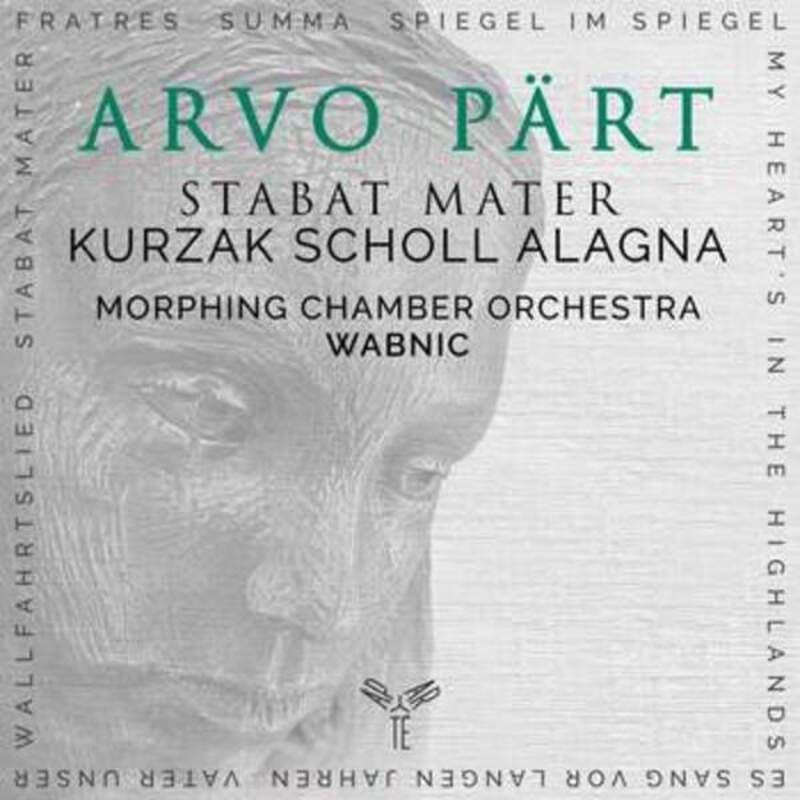
A bell tolls, a triad hovers, three voices that should not belong together find a common stillness. This Aparté release gathers eight of Arvo Pärt's tintinnabuli meditations around a world-premiere arrangement of the Stabat Mater for soprano, countertenor, tenor and string orchestra.
"Pärt's music is precisely about bringing together what seems distant — translating something very human into sound that crosses borders."Tomasz Wabnic, after Kerri Kotta (booklet, Vienna 2022)
Pärt — The bell that learnt to wait
Arvo Pärt (b. 1935, Paide) belongs to that small company of twentieth-century composers whose biography is inseparable from their grammar. Trained at the Tallinn Conservatory under Heino Eller, he emerged in the late 1950s as Estonia's first serial composer, writing music whose dissonance was as much a political posture as an aesthetic one. The Soviet cultural apparatus was unimpressed; works such as Nekrolog (1960) and Credo (1968) — the latter openly setting a Latin sacred text — drew official censure. By the early 1970s Pärt had effectively stopped publishing.
What followed was one of the most consequential silences in modern music. For nearly eight years he immersed himself in plainchant, in the Notre-Dame organum of Pérotin, in Josquin and Machaut, listening rather than writing. When he resurfaced in 1976–77 with Für Alina, Fratres, Tabula rasa, Cantus in Memoriam Benjamin Britten and Summa, the change was complete. He had abandoned the modernist machinery for what he called tintinnabuli — from the Latin tintinnabulum, a small bell. The principle is austere: a melodic voice moves stepwise around a central pitch, while a second voice intones the notes of a single triad. Two voices, one harmony, infinite consequence.
Emigration came in 1980. Pärt left Tallinn first for Vienna, then settled in West Berlin, where Manfred Eicher's ECM label began to disseminate his music to a wide listening public. The 1984 album Tabula rasa — with Gidon Kremer, Keith Jarrett and the Hilliard Ensemble — opened a path that few living composers have travelled: Pärt's works are now among the most performed of any composer born after 1900, embraced equally by liturgical communities, choreographers, filmmakers and concert halls.
Yet the public image of a serene mystic underplays the discipline beneath. Pärt's scores are mathematically rigorous; the apparent simplicity of Summa or Spiegel im Spiegel conceals strict permutational rules governing every pitch and rhythmic value. As the musicologist Kerri Kotta has observed — and as Tomasz Wabnic quotes in this booklet — Pärt is "able to translate something very human into sound that crosses the borders normally separating people". The universality is engineered as much as it is felt.
After three decades abroad, Pärt and his family returned to Estonia. The Arvo Pärt Centre in Laulasmaa, opened in 2018, now houses his archive in a building of forested quiet — a place that resembles, perhaps inevitably, the sound of his own music. Awarded the Vatican's Ratzinger Prize in 2017, recipient of countless honorary doctorates, Pärt remains, in his ninth decade, a composer who insists that music's task is simply, in the phrase of Juhan Liiv he likes to quote, to make the soul ring.
Eight pieces, one tolling — anatomy of a programme
The disc is built as a slow procession around a central liturgical monument. Seven shorter works prepare the ear for the Stabat Mater, which arrives at the end in a newly authorised arrangement and accounts for nearly half the playing time. The architecture is more than convenient: it allows the listener to encounter the tintinnabuli principle in progressively wider acoustic frames before its full deployment in the closing work.
Fratres (1977, here in the 1983 version for string orchestra and percussion) opens the programme. A drone in the bass, a few strokes of claves and bass drum punctuating sections like the tolling of monastic hours, and above it a melodic-harmonic process unfolding through nine variations on a fixed pitch material. Pärt himself has spoken of the piece as an instant of "eternity arrested"; the percussion is not ornament but punctuation, marking the door between one cycle and the next.
My Heart's in the Highlands (2000, here in the 2013 arrangement for countertenor, string trio and piano) sets Robert Burns to a vocal line of almost defiant immobility — most of the text is intoned on a single repeated pitch — while piano and strings cycle through slow harmonic arcs. The vocal stasis is the point: the heart is there, in the hills, and refuses to be moved by anything around it.
Vater Unser (2005/2013), brief and intimate, was written for Pope Benedict XVI and gives the German Lord's Prayer in a setting whose syllabic clarity recalls Lutheran chorale even as the harmony breathes within a single mode. Spiegel im Spiegel (1978) follows: probably Pärt's most recorded work, and the one most often misread as mere atmosphere. Heard within this sequence its formal severity becomes audible — the symmetrical melodic line opening outwards from A and folding back to it, vibrato withheld until the final note "signals the final return home" (Fenyves).
Es sang vor langen Jahren (1984) is, as the booklet notes, "one of the few tintinnabuli works not set to a religious text". Clemens Brentano's Spinnerin Nachtlied — a spinning maiden mourning her absent lover — receives a setting for countertenor, violin and viola of chamber-music intimacy, the spinning wheel audible in the gently turning string figures.
Ein Wallfahrtslied (1984, here in the 2021 arrangement for countertenor and string orchestra, again by Wabnic) sets Psalm 121. The strings open with a sombre fugato that climbs by semitones; the voice, when it enters, holds a single pitch while the instruments descend beneath it. Pärt makes time and timelessness audible simultaneously — a chamber music of vertical and horizontal motion superimposed. Summa (1977/1991), the most strictly constructed piece on the programme, sets the Latin Credo in a code dense enough to evade Soviet censorship while remaining transparent to the ear.
The Stabat Mater (1985) was commissioned by the Alban Berg Foundation for the centenary of Berg's birth and originally scored for vocal trio and string trio — a deliberate echo of Berg's Lyric Suite instrumentation. Pärt's setting threads the thirteenth-century sequence through a vast palindromic architecture: instrumental ritornellos frame the vocal stanzas, modal cells migrate between voices and strings, and the closing Amen answers the opening one across twenty-four minutes of sustained attention. Tomasz Wabnic's 2021 adaptation, authorised by the composer and Universal Edition, retains every note of the vocal writing but rescores the string trio for full ensemble, with the three soloists — soprano, countertenor, tenor — emerging from and returning to the orchestral fabric. The work's drama of pain and consolation gains breadth without losing the intimacy of its chamber-music origin.
Morphing — the meeting of unlike voices
The Morphing Chamber Orchestra was founded in 2006 at the Gaude Mater Festival in Częstochowa by the Polish-born violist Tomasz Wabnic, who continues to serve as its artistic director. The ensemble's name encodes its ethos: a "morphing" of repertoires, generations and aesthetic provenances, drawing players principally from Vienna's musical institutions but refusing the corporate identity of a permanent orchestra. The roster on this disc — concertmaster Yuuki Wong, cellist Tomasz Daroch, pianist Marek Ruszczynski, percussionist Ruben Ramirez and others — reflects that flexible identity, with Christian Erny conducting the Stabat Mater.
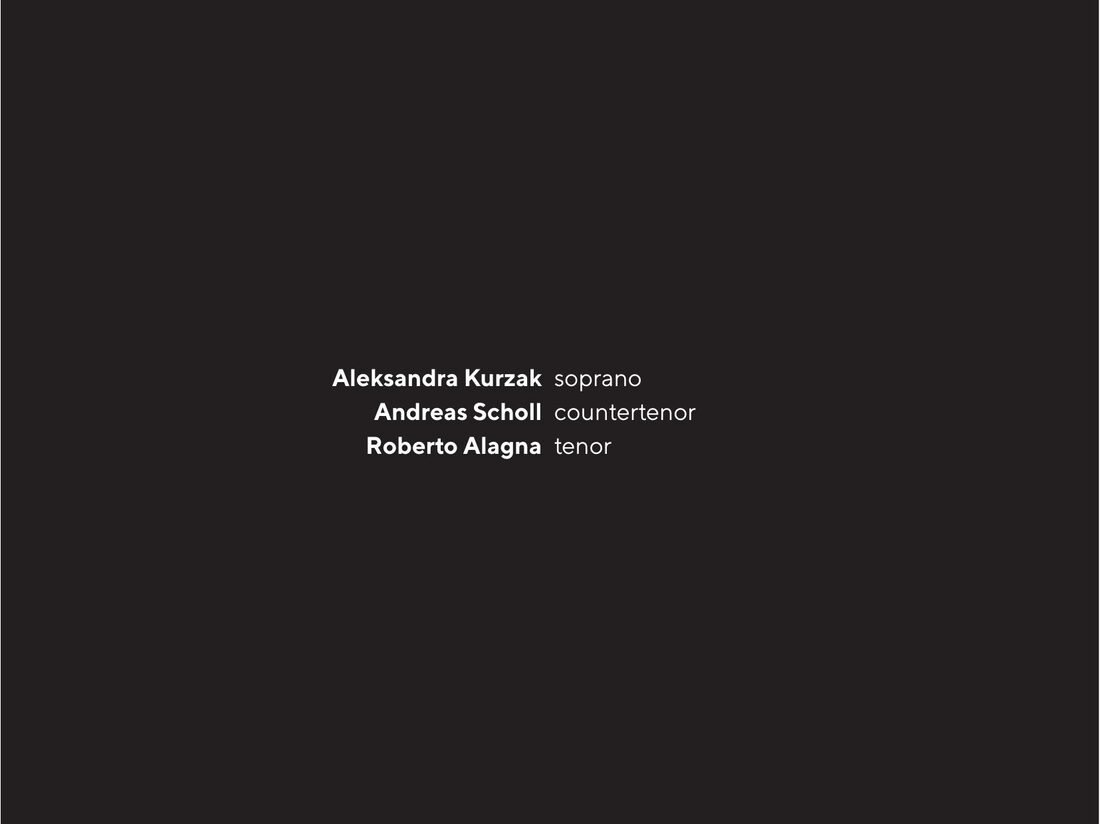
The vocal trio is the album's most audacious wager. Andreas Scholl, one of the defining countertenors of his generation and a long-time interpreter of Pärt (he gave the Australian premiere of the Vater Unser in its string-quintet version), is the natural centre of gravity. His instrument has the cool, vibrato-light purity that tintinnabuli writing requires, and he is heard on every vocal track of the programme.
Aleksandra Kurzak and Roberto Alagna — both established opera singers and married since 2015 — make their first recording in this repertoire here. The choice is not without risk: their voices are formed for Verdi, Puccini, Massenet, and their natural expressive grammar lies far from Pärt's restraint. Wabnic's wager, as the booklet preface makes clear, is precisely that this distance becomes meaning. In the Stabat Mater, Kurzak's soprano carries an unmistakable operatic weight; Alagna's tenor preserves its Mediterranean warmth even when held to long-breathed legato. The result is a Stabat Mater that sounds neither monastic nor concertante but dramatically human — three persons standing, like Mary herself, at the foot of a particular cross.
Vienna, September 2021 — sessions and provenance
The recording was made at the Casino Baumgarten in Vienna's 14th district between 12 and 16 September 2021, in five days of intensive sessions. Casino Baumgarten — a former late-Habsburg ballroom converted into a recording venue — has become one of the preferred spaces for Viennese chamber-music production thanks to its generous acoustic and relative isolation from urban noise.
Little Tribeca, the Paris-based production house behind the Aparté label, took charge of artistic direction and engineering: Nicolas Bartholomée and Hugo Scremin handled the recording itself, assisted by Kristaps Andris Austers of the Viennese firm Tonzauber, with editing, mixing and mastering by Émilie Ruby. The format is 24-bit / 96 kHz throughout. Roberto Alagna and Aleksandra Kurzak appear courtesy of Sony Classical, indicating the contractual cooperation that the project required.
Two of the works were heard for the first time in the arrangements presented here. Wabnic's 2021 adaptation of the Stabat Mater for three solo voices and string orchestra (Universal Edition, 2021) and his 2021 arrangement of Ein Wallfahrtslied for countertenor and string orchestra (Universal Edition, 2021) were both authorised by the publisher and constitute world-premiere recordings. The album was released by Aparté (catalogue AP277) in 2022, with a sleeve sculpture by David and Frederico Alagna and cover design by Stella Vitchénian. The booklet, with annotations by Arabella Fenyves and a preface by Wabnic dated Vienna, 27 April 2022, appears in English, German and French; the Stabat Mater text is given in Latin alongside Edward Caswall's 1849 English verse translation and Heinrich Bone's 1847 German rhymed paraphrase.


Arvo Pärt: Stabat Mater & Other Works · AP277
43 pages · the original release booklet — complete programme notes and credits, exactly as issued.
- Arvo Pärt (b. 1935)
- Christian Erny (track 8); Tomasz Wabnic, artistic direction
- Complete booklet · programme notes & credits
Further listening and reading
- Arvo Pärt Centre, Laulasmaa — official site and archive
- Aparté Music — album page (AP277)
- Morphing Chamber Orchestra — official site
- Universal Edition — Pärt catalogue
- Tomasz Wabnic — biographical profile
Pärt's silences are not empty: they listen back. In this recording, three very different voices learn to share that listening.
A note when a new essay or travelogue appears. No noise, unsubscribe in one click.