VOCES8's After Silence is a double album in four chapters — Remembrance, Devotion, Redemption, Elemental — recorded across three English chapels and released to mark the British octet's fifteenth anniversary in 2020. Across thirty-three tracks the ensemble traces a single arc from Orthodox chant to Tudor polyphony, from Bach's earliest cantata to Mahler's farewell, organising the programme as a continuous meditation on the silence from which music emerges and into which it returns. The album's title is borrowed from Aldous Huxley; its method is closer to Arvo Pärt.
After silence, that which comes nearest to expressing the inexpressible is music.Aldous Huxley · Music at Night and Other Essays, 1931
An Album That Could Only Have Happened Then
Conceived in the long stillness of 2020 and released to mark VOCES8's fifteenth anniversary, After Silence — A Cartography of Stillness is the British octet's most ambitious recorded statement. It is a self-released double album — two CDs, thirty-three tracks, just under two hours — that converts the isolation of lockdown into ceremony. Across four meditative chapters titled Remembrance, Devotion, Redemption, and Elemental, the ensemble traces a single arc from Orthodox chant to Tudor polyphony, from Bach's earliest extant cantata to Mahler's farewell to the world, from Monteverdi's grief over a dead pupil to Britten's wartime hymn for Saint Cecilia. The result is not a compilation but a single composed silence, broken only when it must speak.
The album's title is borrowed from Aldous Huxley's 1931 essay The Rest is Silence, in which the writer argues that music is the closest mortal approximation to the inexpressible. VOCES8's reading of that sentence is literal. The programme is built not around what music says but around the silences from which sound emerges and into which it returns — the breath between Tudor cadences, the fermatas in Bach chorales, the held emptiness at the end of a Pärt phrase. The ensemble's approach is to treat silence not as the absence of music but as its element.
The album was released across the strangest concert season in living memory. The first chapter, Remembrance, appeared in March 2020, in the week European concert halls began to close. The second, Devotion, followed in April; Redemption in May; Elemental in June. By the time the complete double album was issued in July, the British concert calendar had been suspended for four months and VOCES8 had launched Live from London, a paid online vocal festival that would run across the summer and autumn and turn out to be one of the few sustained sources of income for British a cappella ensembles during the pandemic. After Silence is, in that sense, twice a lockdown work: produced before lockdown, released into it, and re-made by the calendar that received it.
VOCES8 — Eight Voices, One Architecture
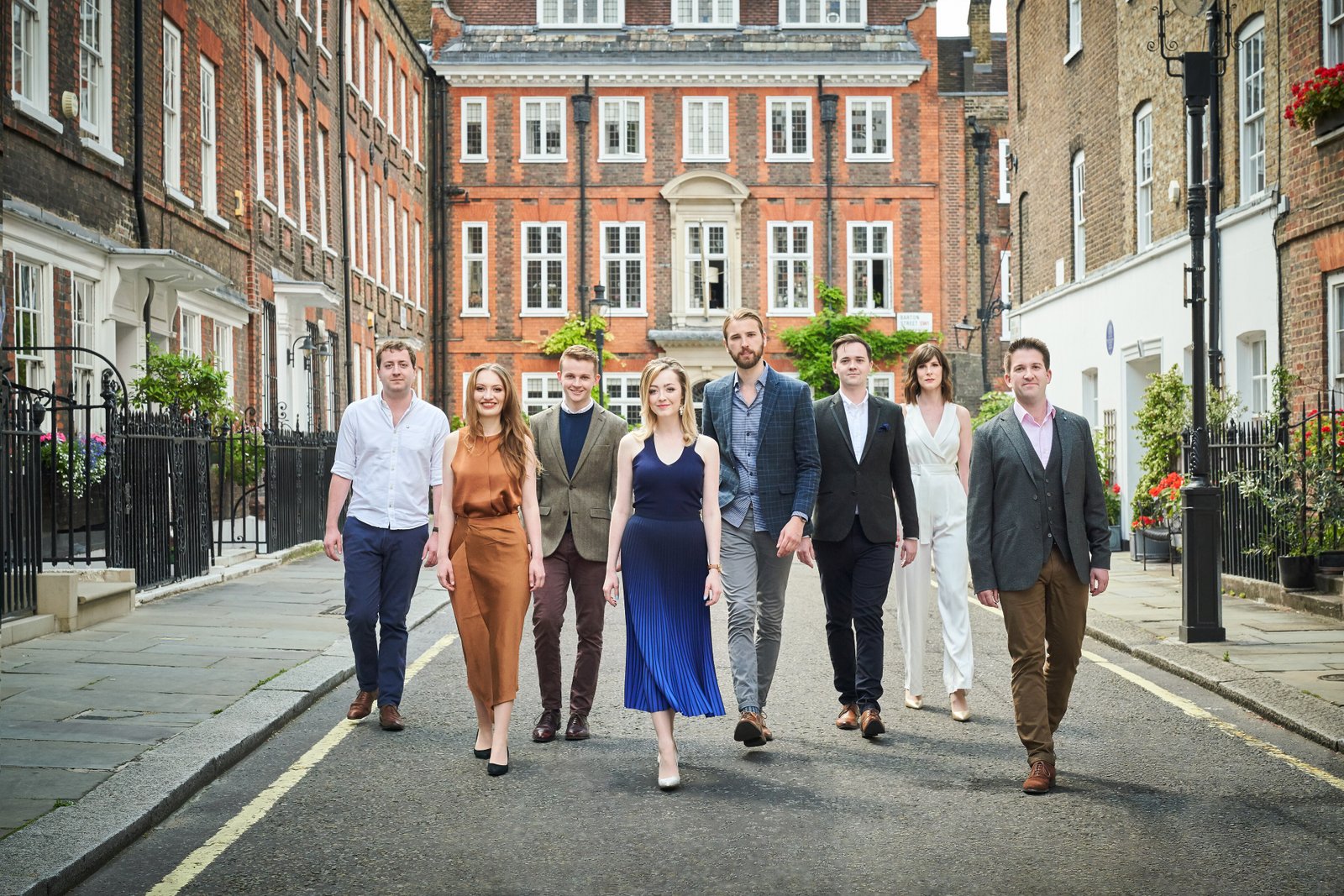
VOCES8 was founded in 2005 by brothers Paul and Barnaby Smith, both former choristers of Westminster Abbey, with five fellow alumni of the King's College and Trinity College Cambridge choral traditions. Their formation coincided with — and helped define — a renaissance of small-ensemble British a cappella singing alongside The Sixteen, Stile Antico, and Tenebrae. What distinguishes VOCES8 is range: where Stile Antico holds rigorously to Renaissance polyphony and The Sixteen centres on the English baroque, VOCES8 moves freely from Tallis to Whitacre, from Bach motets to jazz arrangements, without losing the Anglican choral tone — the breath, the tuning, the discipline of restraint — that is the British cathedral tradition's most exportable inheritance.
The eight singers who recorded After Silence are sopranos Andrea Haynes and Eleonore Cockerham, altos Katie Jeffries-Harris and Barnaby Smith (counter-tenor), tenors Blake Morgan and Euan Williamson, and basses Christopher Moore and Jonathan Pacey. The artistic direction throughout the album is Barnaby Smith's; the production is Adrian Peacock's — a longtime collaborator with The Sixteen and one of the most discerning sacred-music engineers working in Britain. The recording sessions were spread across three buildings: Trinity College Chapel in Cambridge, St George's Church in Chesterton, and the parish church of St John the Evangelist in Islington — each chosen for an acoustic signature that lets eight voices read as one architecture. The VOCES8 Centre, the ensemble's own venue and educational headquarters at St Anne and St Agnes in the City of London, served as the project's home base.
By 2020 VOCES8 had been a touring fixture for fifteen years, with two previous decades of growing presence on recordings and at festivals. After Silence arrived as both anniversary statement and self-portrait. The decision to issue the album on the ensemble's own label, VOCES8 Records, was unusual for a project of this scale; the decision to release it as four sequential chapters across the spring of 2020, then collected as a double album in summer, was unprecedented. The chapter model — borrowed from the literary novel — let the music breathe across a calendar rather than a concert programme. Listeners during lockdown received it in instalments, in the cadence of a serial.
How can one fill the time with notes worthy of the preceding silence?
Cage at the Maverick
The pivot is John Cage's 4′33″, premiered at the Maverick Concert Hall in Woodstock on 29 August 1952 by the pianist David Tudor. Tudor sat at the piano for three movements totalling four minutes and thirty-three seconds, opening and closing the keyboard lid to mark the divisions, and played nothing. The audience — restive, finally walking out — was Cage's instrument. "They missed the point," he said afterwards. "There's no such thing as silence. What they thought was silence, because they didn't know how to listen, was full of accidental sounds. You could hear the wind stirring outside during the first movement. During the second, raindrops began pattering the roof, and during the third the people themselves made all kinds of interesting sounds as they talked or walked out." 4′33″ had two sources. The first was Robert Rauschenberg's White Paintings of 1951 — large monochrome canvases that appeared blank but registered, with extraordinary subtlety, the shifting light and shadow of the rooms in which they hung. Cage saw these in 1951 and later wrote: "To Whom It May Concern: The white paintings came first; my silent piece came later." The second was a visit to the anechoic chamber at Harvard University, where Cage expected to encounter absolute silence and instead heard two sounds — one high, one low — which the engineer told him were the ringing of his own nervous system and the circulation of his blood. From that experience Cage drew the conviction that silence, as an acoustic condition, does not exist; what we call silence is merely unintended sound, ambient and uncomposed.Two strands after Cage
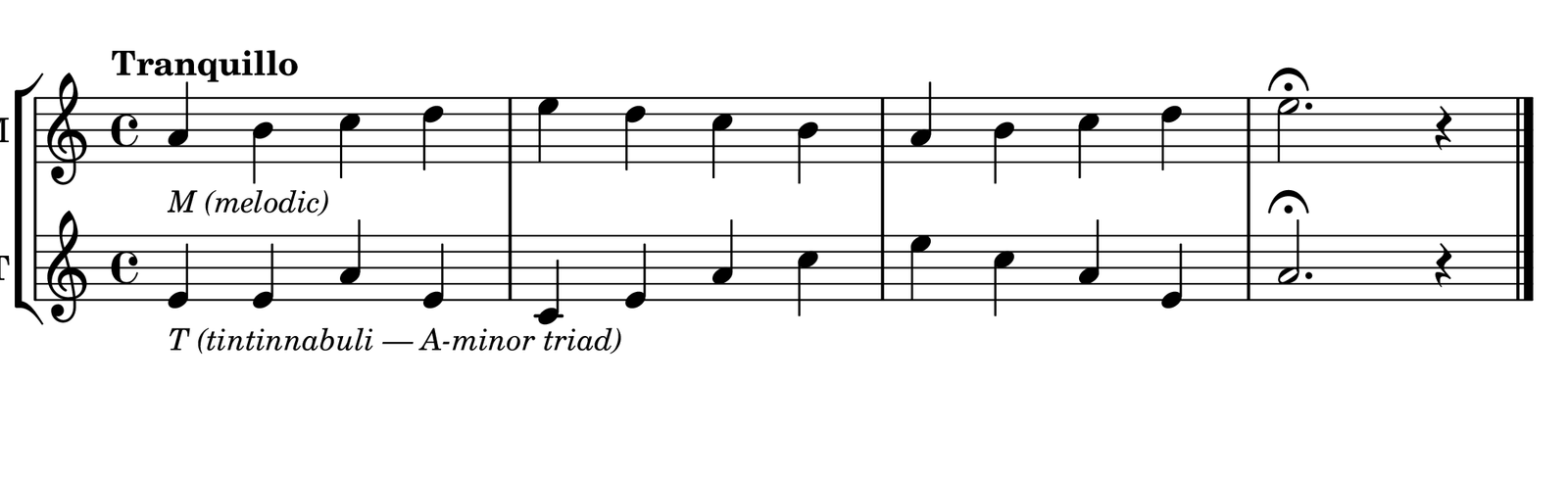
After Cage, the meaning of silence in Western art music split into two strands. One strand — call it the experimental — treats silence as equality with sound. The Wandelweiser collective, Morton Feldman in his late works (the four-hour String Quartet II, the Rothko Chapel), Salvatore Sciarrino's breath-music, and Helmut Lachenmann's musique concrète instrumentale all extend Cage's premise: every sound that arises during a performance is part of the piece, including the silences that contain them. The composition is the frame placed around listening; the music is attention. Anton Webern's late miniatures — twelve-tone movements of thirty seconds in which a single chord, a single rest, carries more weight than a Mahler symphony — had prepared this ground in the 1930s, two decades before Cage. The other strand — call it the contemplative — treats silence as ground, the medium against which sound becomes meaningful. Arvo Pärt is its emblem. After his eight-year compositional crisis between 1968 and 1976, during which he wrote almost nothing and studied Gregorian chant, Notre Dame polyphony, and the Russian Orthodox liturgy, Pärt emerged with the technique he named tintinnabuli (Latin: little bells). The method is austerely simple: a melodic voice moving diatonically around a central pitch, paired with a tintinnabuli voice that outlines only the tonic triad. The procedure is mechanical; the result is luminous. "For me," Pärt told the Estonian musicologist Leo Normet in 1988, "'silent' means the 'nothing' from which God created the world. Ideally, a silent pause is something sacred." When the German producer Manfred Eicher first heard Tabula Rasa on the radio in 1980, he pulled his car off the autobahn to listen. The ECM New Series began as a vehicle for Pärt's silence.Pärt's two wings
Pärt's silence is doubled — it is at once outside (the held rest between notes) and inside (the inner stillness the music asks of the listener). "Silence," he has said, "has two wings. On the one hand, silence is like fertile soil, which, as it were, awaits our creative act, our seed. On the other hand, silence must be approached with a feeling of awe." The contemplative strand has antecedents older than modernism. Renaissance polyphony — the music from which the Anglican choral tradition descends — is built on the principle of breath as structure. The caesura between phrases in a Byrd motet, the fermata over the final chord of a Bach chorale, the held silence at the end of the Crucifixus in the B-minor Mass: these are not absences but architecture. The Russian Orthodox liturgy — which the album quotes through Pavel Chesnokov's Spaseniye sodelal of 1912 — codifies silence as an essential element of worship; the Spaseniye is sung in silence, from silence, toward silence. Susan Sontag, in her 1969 essay The Aesthetics of Silence — an essay nominally about Cage, Beckett, and Duchamp — articulates the principle from the other side: "The artist who creates silence or emptiness must produce something dialectical: a full void, an enriching emptiness, a resonating or eloquent silence."Where this album sits
After Silence sits firmly in the contemplative strand. VOCES8 is not interested in Cage's irreverence or in Wandelweiser's procedural restraint. The ensemble is interested in what Pärt calls fertile soil — the readied attention that lets a Tudor cadence, a Bach modulation, a Monteverdi suspension land on the ear as if heard for the first time. The album's silences are compositional. They are written into the spaces between Tallis's clauses and Bach's fugue entries; they are realised by the engineer Adrian Peacock's decision to record in spaces with long reverberance and to leave room around each track; they are reinforced by the chapter structure, which permits the listener to put the disc down and let what has been heard settle. The album's claim, in the end, is one Cage would have understood from a different angle: silence is not the opposite of music. Silence is the condition that makes music audible.The artist who creates silence or emptiness must produce something dialectical: a full void, an enriching emptiness, a resonating or eloquent silence.
Chapter I — Remembrance
The album opens not with a famous work but with a question. Orlando Gibbons's Drop, Drop, Slow Tears — a setting of Phineas Fletcher's metrical paraphrase of the Song of Songs published in 1623, four years after the composer's death — falls into VOCES8's acoustic like a stone into still water. The opening chord, a held E minor, is sung at the threshold of audibility; the lower voices enter so subtly that the listener can lose the precise moment of attack. This is not an accident. Remembrance — the chapter's title — begins as the act of straining to hear what was never quite said.
The chapter assembles eight centuries of mourning. Gibbons (1583–1625) was the youngest and shortest-lived of the great Tudor composers, dying of apoplexy at forty-one while accompanying King Charles I to meet his French bride at Canterbury. Arvo Pärt (b. 1935) is alive and, at the time of this writing in his ninetieth year, the most-performed living composer in the world. Between them stand William Byrd (c. 1540–1623), Gibbons's older contemporary and a recusant Catholic in Protestant England, and William H. Harris (1883–1973), organist of St George's Chapel Windsor, whose 1959 setting of a John Donne sermon closes the chapter. Four composers, four faiths, one grief.
Pärt — The Deer's Cry (2007)
Pärt's The Deer's Cry is a setting of the closing verses of Saint Patrick's Breastplate, a Christian lorica (Latin: breastplate) traditionally attributed to the fifth-century Irish apostle but dated by modern scholarship to the early eighth century. The full prayer is a long invocation of protection — I arise today through the strength of heaven, light of sun, radiance of moon — but Pärt sets only the final litany, a chain of nineteen clauses that pivot on a single word: Christ with me, Christ before me, Christ behind me, Christ in me, Christ beneath me, Christ above me. The setting was commissioned in 2007 by the Louth Contemporary Music Society in Ireland and premiered on 13 February 2008 in Drogheda's St Peter's Church.
The motet's title rewards a moment's attention. The medieval Liber Hymnorum reports that Saint Patrick recited the prayer while crossing land where King Loegaire's men lay in ambush — at the moment of recitation the ambushers saw not Patrick and his monks but a herd of deer with a fawn. The medieval editor glosses the prayer's Old Irish name fáeth fiada as Deer's Cry; modern philology suggests the phrase more accurately meant mist of concealment. Both readings — the transfiguration into deer and the cloak of mist — survive in the work's atmosphere. Pärt's setting is concealment rendered as harmony.
Technically, The Deer's Cry stands slightly apart from strict tintinnabuli. The harmony is rooted in A minor, but the work moves through chains of consonant triads — A minor, F major, C major, E minor — without modulation in the traditional sense. Each clause of the prayer is set to a single chord, sustained for the duration of the text, then yielding to the next chord on the next Christ. The effect is incantatory; the harmonies do not develop but accumulate, so that by the time the final Christ with me arrives the listener has heard the same idea spelled in eight or nine different keys, each presenting the same single thought in a slightly different light.
VOCES8's recording is unusually still. Where the State Choir Latvija's premiere (recorded 2008 on ECM New Series) is fuller and more processional, VOCES8 reduces dynamic range and slows the harmonic pulse. The work becomes almost a slow tolling. It is also one of the album's few works in modern English — the Christ with me is sung in the language of the listener, not in Latin or Old Irish, and the directness of address is part of the music.
Gibbons — Drop, Drop, Slow Tears (1623)
Orlando Gibbons set Phineas Fletcher's seven-line stanza as Hymn 47 in The Hymnes and Songs of the Church, the 1623 anthology compiled by George Wither — among the earliest English-language hymn collections published with composed music. The setting is in two strophes, sung consecutively, with minimal harmonic variance between them; what changes is only the text. Fletcher's lines reach for what is just beyond grief — the moment after weeping, before consolation:
*Drop, drop, slow tears, and bathe those beauteous feet Which brought from heaven the news and Prince of Peace.*
Gibbons's setting is restrained almost to the point of severity. The harmony moves in stepwise blocks; there is no melisma; the melody describes the smallest possible expressive arc consistent with the text remaining intelligible. The piece's stature in the Anglican repertoire — it is still sung at Evensong in every English cathedral and college chapel during Passiontide — rests on this exact restraint. Gibbons does not interpret Fletcher's grief; he provides a vessel for it. The voice doing the grieving is the listener's own.
Byrd — Ne irascaris Domine & Civitas sancti tui (1589)
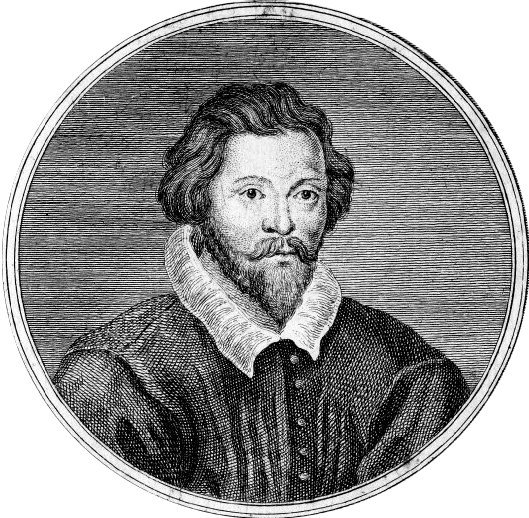
The two Byrd settings are halves of a single work, published together in the 1589 Cantiones Sacrae as a paired motet on Isaiah 64:9–10: Be not angry, O Lord, and do not remember our iniquity any longer. Behold, the city of thy sanctuary has become a desert; Zion has become a desert.
Byrd was a Catholic working under Elizabeth I's Protestant settlement, a position made tolerable only by the Queen's personal protection and his evident usefulness as Composer of the Chapel Royal. The Cantiones Sacrae — Latin motets published openly during the recusant decades — were double-coded. They were religious music in the universal language of the Roman church (which the Elizabethan state had outlawed for liturgical use), but they were also explicitly framed as music for private devotion at home, not for liturgical use. The texts Byrd chose for these motets are not random. Ne irascaris is sung by the prophet on behalf of a captured Jerusalem; Civitas sancti tui mourns Zion as a wilderness. Elizabethan Catholic listeners would have heard these lines as their city, their sanctuary. The grief is national. The political theology is encoded in the choice of psalm.
The risks of this work were real. Byrd's house in Stondon Massey, Essex, was searched repeatedly by the Elizabethan recusancy authorities. His name appears in the official lists of recusants — those refusing to attend Anglican services, fined twenty pounds a month, an enormous sum at the time — from at least 1577 onward. His wife Julian was indicted for recusancy multiple times. The patron of the Cantiones Sacrae, Edward Somerset, fourth Earl of Worcester, was the only openly Catholic peer at Elizabeth's court and one of the few aristocrats who could shelter Byrd from prosecution. The publication of Latin sacred music with such explicitly lamenting texts was, in this context, an act of careful provocation — visible to those who could read it, deniable to the censors.
Musically, the two motets are connected by a single subject — a falling six-note motif first heard on the word iniquitatis — that is varied, inverted, and finally resolved across the entire ten minutes of the paired motet. The harmony is dense, the false relations frequent, the cadences consistently postponed. Byrd grants no rest. The line Civitas sancti tui facta est deserta — the city of thy sanctuary has become a desert — is set as a slow descent through chromatic passing tones in five voices simultaneously. The desert is sonic. The young Henry Purcell, sixty years later, would call Byrd "the most learned man for music we have had in England."
William Harris — Bring us, O Lord God (1959)
William Henry Harris (1883–1973) was organist of St George's Chapel Windsor from 1933 to 1961, and one of the architects of the twentieth-century Anglican cathedral repertoire. Bring us, O Lord God — a setting of the closing prayer from a John Donne sermon preached in 1627 — was composed in 1959 and is now sung at funerals across the Anglican Communion. The text is one of the most extraordinary in English devotional prose:
Bring us, O Lord God, at our last awakening into the house and gate of heaven; to enter into that gate and dwell in that house, where there shall be no darkness nor dazzling, but one equal light; no noise nor silence, but one equal music...
Harris sets it for double choir, the two ensembles answering and echoing each other across a shifting harmonic field. The construction is masterly: the two choirs are written in close registral overlap so that the listener cannot quite tell which choir is sounding which line. The effect is of one ensemble shadowing another — exactly Donne's no noise nor silence, but one equal music.
The most sensitive musical instrument is the human soul. The next is the human voice.
Chapter II — Devotion
The second chapter is the album's gravitational centre. It opens with the seven movements of Bach's Cantata BWV 150 — possibly the earliest cantata Bach ever wrote — and proceeds through Mahler's farewell song Ich bin der Welt abhanden gekommen, Fauré's Pie Jesu, and closes with Bach's Jesu bleibet meine Freude from BWV 147. The arc moves from a young Bach in Mühlhausen to a dying Mahler in Toblach, from Lutheran psalm-setting to Catholic requiem, from the early eighteenth century to the early twentieth. What holds it together is the chapter's title: Devotion in the sense Bach himself used — Andacht, attentive prayer.
Bach — Cantata BWV 150, Nach dir, Herr, verlanget mich
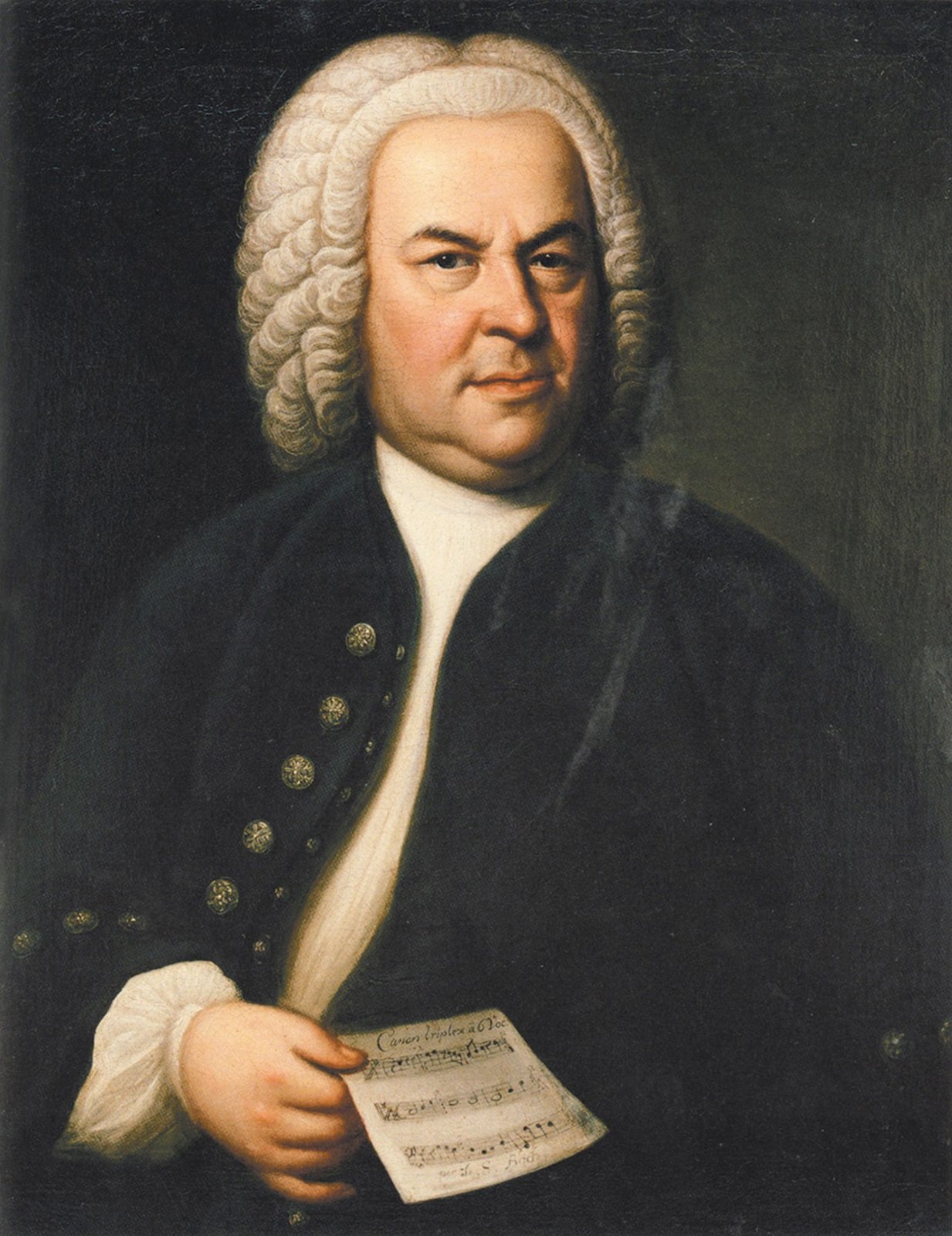
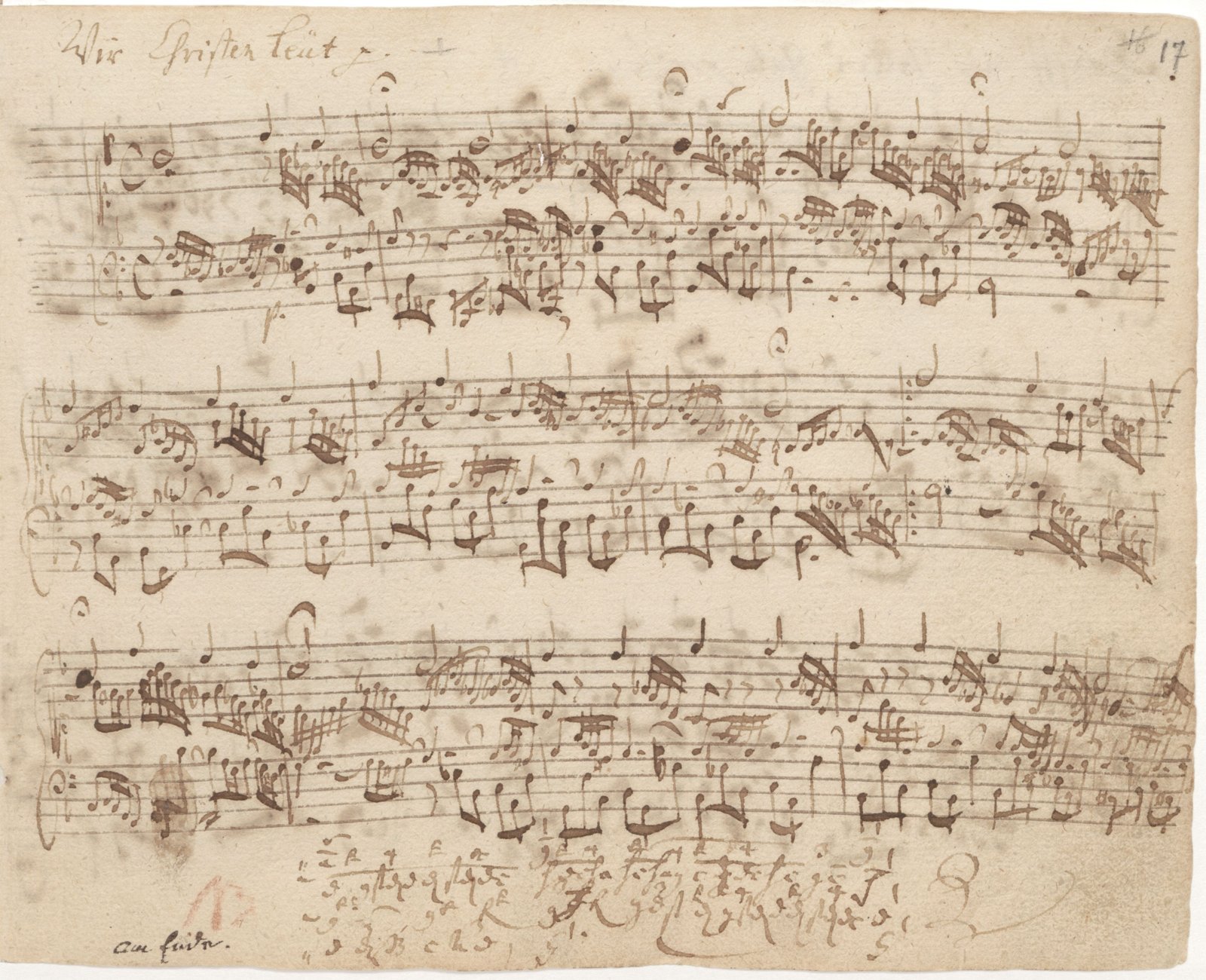
Nach dir, Herr, verlanget mich — For you, O Lord, do I long — is almost certainly the earliest surviving cantata by Johann Sebastian Bach. The dating is contested but the consensus points to 1707, the year of Bach's twenty-second birthday and of his move from Arnstadt to Mühlhausen to take up the post of organist at the church of Divi Blasii. He was probably writing the work as a test-piece or audition cantata; another reading, advanced by the German scholar Hans-Joachim Schulze in 2010, has the cantata composed for the seventieth birthday of Conrad Meckbach, the Mühlhausen councillor who had brought Bach into the city. Schulze's evidence is a hidden acrostic in the cantata's free-poetry movements (3, 5, 6 and 7): adjusting for transposition errors by the 1755 copyist C. F. Penzel, the initial letters of consecutive lines spell DOKTOR CONRAD MECKBACH. If Schulze is right — and the spelling is too exact for coincidence — the cantata is a birthday present from Bach to the man who hired him.
The road from Arnstadt
The Mühlhausen post came at the end of Bach's most turbulent year. He had been organist at Arnstadt since 1703, and in February 1705 he had been involved in one of the few well-documented incidents of his life: a sword-drawn confrontation in the marketplace with a bassoonist named Geyersbach, whose playing Bach had described as that of a Zippel Fagottist — a slang term roughly translating as nanny-goat bassoonist. The Arnstadt consistory had reprimanded Bach for both the insult and the brawl. Six months later he had absented himself for four months — supposedly for two weeks — to walk two hundred miles to Lübeck and hear Buxtehude play. He returned to Arnstadt, was reprimanded again, and within a year had departed for Mühlhausen. The cantata BWV 150 may be the first piece he wrote in his new post; it may also be the audition piece that won him the post. Either way, it is a young man's work — and the bassoon part contains, at bar 25 of the opening chorus, a technically demanding solo that some Bach scholars have wondered might be the passage Geyersbach was unable to play.
Seven movements
The work is in seven short movements and lasts a little under fifteen minutes:
1. Sinfonia — A purely instrumental opening for two violins, bassoon and continuo, in B minor, marked by a series of suspensions that resolve only at the entry of the chorus.
2. Coro: Nach dir, Herr, verlanget mich — The first sung movement, a tightly-built motet on Psalm 25:1–2. The chorus enters in close imitation; the word verlanget (do I long) is set to an ascending sixth that returns through every voice.
3. Aria (Soprano): Doch bin und bleibe ich vergnügt — The text begins with Doch (yet), the first letter of DOKTOR in Schulze's acrostic. A brief, attractive aria over a continuous bass line.
4. Coro: Leite mich in deiner Wahrheit — A second chorus, opening with a bold ascending scale handed between the voices in close stretto.
5. Aria (Trio: Alto, Tenor, Bass): Zedern müssen von den Winden — The earliest known vocal trio in Bach's output. The text — cedars must be uprooted by the winds — is illustrated by a moto perpetuo continuo line representing the howling tempests, while the three sustained vocal lines represent the steadfastness of the believer.
6. Coro: Meine Augen sehen stets zu dem Herrn — A short central chorus, in the major mode, framed by a brief instrumental prelude.
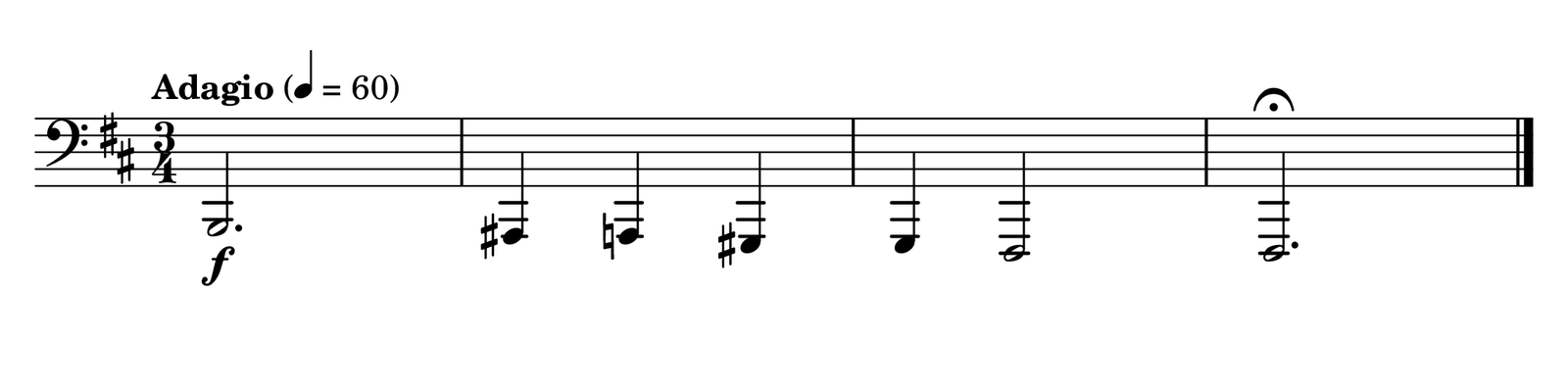
7. Coro (Ciaccona): Meine Tage in dem Leide — The cantata's masterpiece: a chaconne in B minor over a four-bar ground bass. The bass repeats fifteen times beneath choral variations of increasing complexity. The procedure looks back to Italian seventeenth-century practice (Frescobaldi, Buxtehude) and looks forward, astonishingly, to the Passacaglia and to a single later work that made this finale famous.
Brahms's homage
That later work is Brahms's Fourth Symphony. Brahms was one of the original subscribers to the Bach Gesellschaft edition and saw BWV 150 in the Cantatas volumes that began appearing in 1851. He was so taken with the ground bass of the final ciaccona that, four decades later, he reused its essential outline — a slowly rising chromatic line — as the bass of his own Passacaglia, the fourth movement of the Fourth Symphony, completed in 1885. Brahms wrote to the conductor Hans von Bülow: "What would you say to a symphonic movement written on a theme of this kind?" and quoted the Bach bass. Bülow, who knew his Bach as well as anyone in Europe, replied with enthusiasm. The Fourth Symphony's finale is the most ambitious symphonic passacaglia in the literature; its hidden ancestor is this twenty-two-year-old Bach's first surviving attempt at a cantata.
Bach — Jesu bleibet meine Freude (BWV 147)
The chorale that closes the chapter — and, with it, the album's central section — is the most famous Bach has written: the closing movement of Herz und Mund und Tat und Leben, BWV 147, composed for the Feast of the Visitation in Leipzig in 1723. Outside its sacred context the piece is universally known as Jesu, Joy of Man's Desiring, in the English translation by Robert Bridges. VOCES8 sing the original German text, Jesu bleibet meine Freude — Jesus remains my joy — and they do so almost exactly as it would have been heard in Leipzig's Thomaskirche, with the choral lines in close registral proximity and the famous tripleted accompaniment articulated by inner voices. The piece is so frequently abused — wedding processionals, advertising music, ringtone — that hearing it unaccompanied, on a slow tempo, in a Cambridge chapel acoustic, is something like a small miracle of restoration.
Mahler — Ich bin der Welt abhanden gekommen
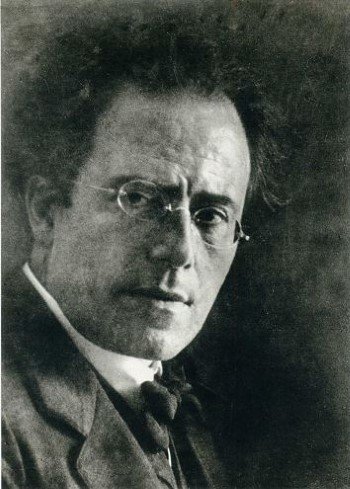
Ich bin der Welt abhanden gekommen — I am lost to the world — is the fourth of Gustav Mahler's five settings of poems by Friedrich Rückert, composed in the summer of 1901 at the lakeside villa in Maiernigg, on the Wörthersee in southern Austria, where Mahler did most of his composing during the years he was conducting the Vienna Court Opera (1897–1907). The summer of 1901 was particularly productive: Mahler completed his Fifth Symphony, set five Rückert poems and three Kindertotenlieder, and met his future wife Alma Schindler. The Rückert cycle as a whole is among the most intimate music he wrote, in a style consciously stripped down from the symphonic apparatus of his concurrent works. Rückert's poem — written in 1821, exactly eighty years before Mahler's setting — describes a withdrawal from the world that is neither death nor exile but something quieter, a settling into private existence:
*Ich bin gestorben dem Weltgetümmel Und ruh' in einem stillen Gebiet. Ich leb' allein in meinem Himmel, In meinem Lieben, in meinem Lied.*
I have died to the world's tumult / and rest in a still domain. / I live alone in my heaven, / in my love, in my song.
Mahler told the young Anton Webern, who attended the premiere, that the song was "my very self." What Mahler could not have known in 1901 — but what darkens every later performance of the song — is how literally true that statement would become. In 1907 his elder daughter Maria Anna died of scarlet fever at the age of four. Days later Mahler was diagnosed with the rheumatic heart disease that would kill him four years on. He resigned from the Vienna Opera the same year, sailed for New York, and the Rückert-Lieder — the Kindertotenlieder especially, but also Ich bin der Welt — became retroactively a music of withdrawal that had foretold its own occasion. The song now travels the concert repertoire as Mahler's anticipatory farewell.
It survives in an arrangement for chamber forces (originally for voice, English horn, harp and strings), and in this album the work has been newly arranged for eight voices a cappella, with the English horn's line carried by a counter-tenor. The transcription is hazardous: Mahler's orchestral colouring is famously specific, and removing the instrumental palette risks flattening the song. VOCES8's reading earns the transcription by treating the song's silences with the same care as its phrases. The long-held pauses in Mahler's score, where the harmony hangs without resolution, are exactly the silences this album was made for.
Fauré — Pie Jesu
Gabriel Fauré's Pie Jesu is the fourth movement of his Requiem in D minor, Op. 48, composed between 1887 and 1890 and revised in 1900. Fauré described the Requiem as "a lullaby of death", deliberately avoiding the Dies irae on which Verdi and Berlioz had built their requiem masses. The Pie Jesu — Merciful Jesus, grant them rest — is a single phrase sung by a solo soprano over the gentlest possible accompaniment. In the choral arrangement on this album, the soprano line is shared by all eight voices in unison and octave, with the harmony filled in by the lower parts. The setting is barely two minutes long. It is the album's shortest track and one of its most exposed.
Chapter III — Redemption
The third chapter is anchored by Monteverdi's Lagrime d'amante al sepolcro dell'amata — Tears of a lover at the tomb of his beloved — a six-movement madrigal cycle of 1610, the year that produced Monteverdi's Vespro della Beata Vergine. The other works of the chapter — Parry's There is an old belief, Stopford's Lully Lulla Lullay, and Whitacre's A Boy and a Girl — act as commentary on the Monteverdi, three readings of how mourning becomes acceptance.
Monteverdi — Lagrime d'amante al sepolcro dell'amata (1610)
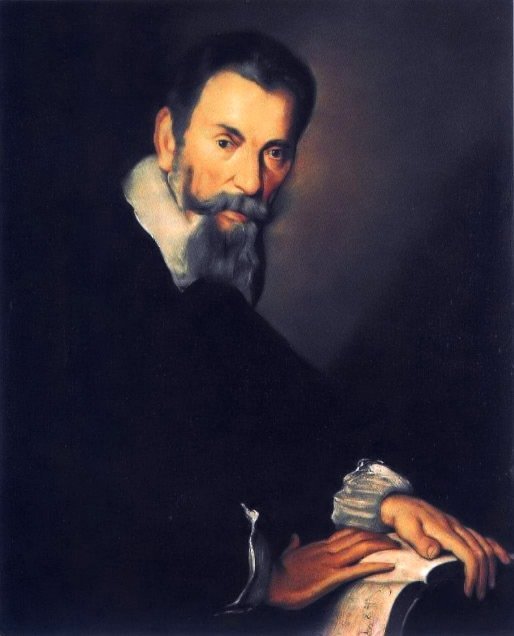
The period 1607–1610 was, for Claudio Monteverdi, the most concentrated personal crisis of any Italian composer of the early Baroque. He was forty in 1607 and at the height of his powers: Maestro della musica at the Gonzaga court of Mantua since 1601, composer of the recently-premiered Orfeo (24 February 1607), under contract to write a second opera for the celebrations of the Mantuan prince's wedding the following spring. His wife Claudia Cattaneo — a court singer he had married in 1599, with whom he had three children — died in September 1607 after a long illness, leaving Monteverdi a widower at forty.
The opera he was contracted to deliver was Arianna, on a libretto by Ottavio Rinuccini about Theseus's abandonment of Ariadne on Naxos. The leading role of Ariadne was to be sung by Monteverdi's seventeen-year-old pupil Caterina Martinelli — known as La Romanina, the little Roman, for whom Monteverdi had personally negotiated with the Gonzaga court when she was thirteen. She had been living in his Mantua household since 1603, raised almost as a daughter, and being groomed as the central voice for his most ambitious operatic project. In March 1608, with rehearsals already underway, Caterina contracted smallpox and died within days. She was seventeen. The role of Ariadne went to a substitute (Virginia Andreini, an actress brought in at the last minute), and the premiere took place on 28 May 1608 — but the entire score of Arianna, except for the famous Lamento d'Arianna that the prima donna sang at the moment of abandonment, was lost in subsequent decades. Only the Lamento survives, in a separate publication, and the Lamento alone is enough to suggest what was destroyed.
The grief of 1607–1608
Out of this double grief — wife in September 1607, almost-daughter in March 1608 — Monteverdi produced two works of mourning. The Lamento d'Arianna in its surviving form, and the cycle Lagrime d'amante al sepolcro dell'amata, set to a sestina written by the Mantuan court poet Scipione Agnelli specifically to commemorate Caterina. The poem stages the lover (a transparent figure for Monteverdi himself, or for the court that mourned with him) speaking at the dead girl's tomb. The six stanzas of the sestina rotate the same six end-words — terra, cielo, Glauco, ninfa, fonte, sole — through a strict Provençal pattern, so that the poem returns obsessively to the same vocabulary of earth and sky, the dead nymph and the indifferent sun.
Six madrigals, six modes
Monteverdi sets the sestina as six five-voice madrigals, each in a different mode, totalling about fifteen minutes of continuous music:
1. Incenerite spoglie — Ashes turned to ashes. The cycle opens with a held opening chord and a single voice intoning the first words; the texture thickens by accretion. The mode is C Phrygian — the most archaic of the church modes, associated with mourning.
2. Ditelo, o fiumi — Tell it, O rivers. The lover addresses the rivers and asks them to weep with him. Monteverdi sets piangete (weep) to a six-note descending chromatic line that moves through every voice in turn.
3. Darà la notte — The night will give back. A turn to imagined consolation; the harmony lightens briefly before returning to mourning.
4. Ma te raccoglie — But the earth receives thee. The acceptance movement; the harmony settles into D minor, the most conventional grief-key in late Renaissance practice.
5. O chiome d'or — O golden tresses. A direct address to the dead girl's hair, set with almost Petrarchan tenderness. The mode is F major, briefly major-mode.
6. Dunque, amate reliquie — Then, beloved relics. The closing benediction. Monteverdi returns to the opening mode and to the slowest possible harmonic motion. The cycle's last twenty bars are among the most extraordinary in Renaissance polyphony: a single sustained chord passed between voice-pairs, with no harmonic motion at all, until the final cadence.
Afterlife
The cycle was published in 1614 in the Sixth Book of Madrigals, four years after its composition and six years after Caterina's death. By then Monteverdi had left Mantua — having been dismissed by the new Duke after the death of the old in 1612 — and was maestro di cappella at the Basilica of San Marco in Venice, the most prestigious church musical post in Italy. He held the Venice position for the next thirty years; he died in 1643 at seventy-five. The cycle is not generally known. It is one of the masterworks of his middle period and is overshadowed by the Vespers, by the late Eighth Book of Madrigals, and by the surviving operas (Il ritorno d'Ulisse, L'incoronazione di Poppea). After Silence makes a strong case for the Lagrime as Monteverdi's most concentrated expression of personal grief — written, almost certainly, with Caterina's seventeen-year-old face in his mind.

Parry — There is an old belief
Hubert Parry's There is an old belief is the third of his six Songs of Farewell, the last completed work of his life, published in 1916 — two years before his death and four months before Britain's entry into the final phase of the First World War. The cycle is Parry's testament. The text, by the nineteenth-century Scottish poet John Gibson Lockhart (Sir Walter Scott's son-in-law and biographer), is a meditation on the consolation of the belief in resurrection — there is an old belief that on some solemn shore, / beyond the sphere of grief, dear friends shall meet once more. Parry's setting is in seven voices and uses a quietly chromatic harmony reminiscent of the Songs of Farewell's most famous number, My soul, there is a country. The lower three voices carry an almost continuous suspension figure; the upper four sing the text in close imitation. The piece's final chord — a long-held E major in pianissimo — has the quality of a question rather than an answer.
Philip Stopford — Lully, Lulla, Lullay
The Philip Stopford setting of Lully, Lulla, Lullay (also known as the Coventry Carol) draws on the famous late-medieval lullaby — sung by the women of Bethlehem to the infant Jesus, knowing the slaughter of the innocents is coming. The original text dates from the early sixteenth century and was sung as part of the Coventry mystery play The Pageant of the Shearmen and Tailors; the most familiar tune is from a 1591 transcription. Stopford, a British composer born in 1977 with strong roots in the cathedral tradition, retains the medieval text and the modal feeling but builds an extended harmonic palette beneath it. The carol is sung by the women of the ensemble — sopranos and alto — with the male voices providing a sustained drone in the lower register, like distant bells.
Ideally, a silent pause is something sacred.Arvo Pärt
Chapter IV — Elemental
The fourth chapter is the album's most varied. It opens with Britten's Hymn to St Cecilia — a 1942 setting of Auden's celebration of the patron saint of music, written during Britten's Atlantic voyage back to England from his self-imposed wartime exile in America — and proceeds through a sequence of contemporary works: Whitacre's Sleep and A Boy and a Girl, Esenvalds's The Long Road, Paulus's The Road Home, Ticheli's Earth Song, Dove's The Three Kings, Hawes's Vertue, and the Spaseniye sodelal of the Russian Orthodox composer Pavel Chesnokov, written in 1912. The chapter's name Elemental is Huxley's — from the same essay that gave the album its title — and signals music of the elements, returned to the basic materials of voice, breath, and silence.
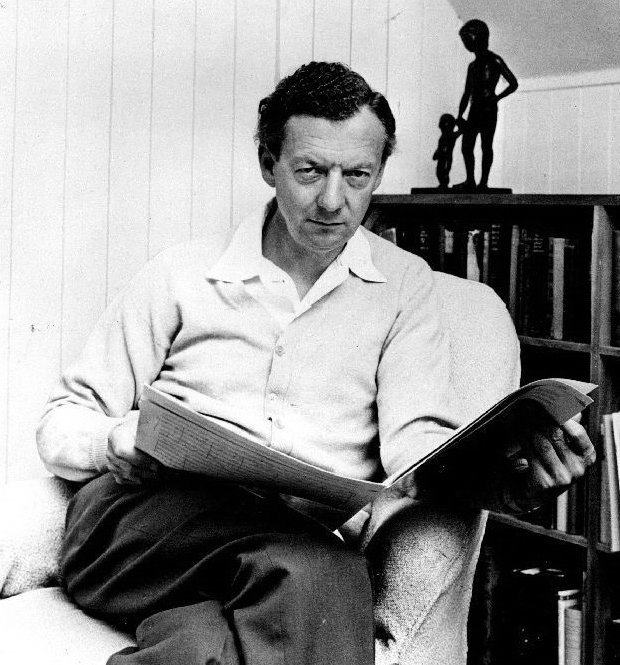
Britten — Hymn to St Cecilia, Op. 27 (1942)
Britten composed the Hymn to St Cecilia during the Atlantic crossing that took him from New York back to England in March and April 1942, ending his self-imposed exile of the previous three years. He had been living in America since 1939, partly to escape the war (he was a conscientious objector and faced national hostility), partly out of a sense that England had little use for him. W. H. Auden, his close friend and former collaborator on the operetta Paul Bunyan, had remained in America and would not return; the parting was permanent, both geographically and creatively. Auden had written the Hymn text specifically for Britten in 1940 — a long Audenesque meditation on Cecilia (the patron saint of music, traditionally martyred in third-century Rome) as figure for the artist's calling. Britten carried the text with him for two years before setting it on the boat. By the time he reached Liverpool in mid-April 1942 the work was finished. He was twenty-eight; the music is the closing statement of his apprenticeship and the opening statement of his maturity.
The work is in three sections, each addressing Saint Cecilia and asking her for a different kind of inspiration. Auden's text moves from invocation to interrogation: Translated daughter, come down and startle / Composing mortals with immortal fire. The middle section is a long scherzo on the child's question to the musician — what at first sight seems easy is not so — and the final section is an elegiac return to the saint, asking that she give back from death what music has given to life. Britten sets it for SATB chorus with light divisi; the textures are choral but the writing is virtuosic. Few works in the British repertoire ask so much of the upper voices and reward the asking so completely. The biographical irony — that Britten left Auden behind in America to write Auden's text on the way home — is part of the music. The Hymn is among other things a farewell, written at sea, between two friends who would never live in the same country again.
Whitacre — Sleep & A Boy and a Girl
Eric Whitacre (b. 1970) is the most-performed living American choral composer and, with Pärt, one of the very few classical composers to have built a substantial mainstream audience since the 1990s. His mature style — close-spaced clusters, slow-resolving suspensions, prolonged harmonic suspense before a major-key resolution — has been criticised as formulaic and praised as instantly recognisable; both readings are correct. The two settings on this album are characteristic. Sleep was commissioned in 2000 by the Master Chorale of Tampa Bay and originally set Robert Frost's Stopping by Woods on a Snowy Evening; when the Frost estate refused permission for performance, the poet Charles Anthony Silvestri wrote a new lyric to fit the existing music — a remarkable case of poetry written for music rather than the reverse. A Boy and a Girl is a 2002 setting of Octavio Paz, with Muriel Rukeyser's translation; the harmonic language is more austere than Sleep, the writing in five rather than seven voices. Whitacre called A Boy and a Girl *"the most personal piece I have ever written."*
Esenvalds, Paulus — voices from the New North
Ēriks Ešenvalds (b. 1977 in Priekule, Latvia) has emerged as one of the central figures of the post-Soviet Baltic choral renaissance — alongside Pēteris Vasks (Latvia), Veljo Tormis (Estonia), and Vytautas Miškinis (Lithuania). The Long Road, included here, sets a text by the Latvian poet Paulina Bārda about exile and return — a charged subject in a country with Latvia's twentieth-century history. The musical language is post-Pärtian: triadic, slow-moving, harmonically static, and built around long pedal points in the male voices.
Stephen Paulus (1949–2014) was an American composer based in Minnesota; The Road Home is his 2001 setting of an anonymous Appalachian folk text (Tell me, where is the road I can call my own?) to the old Sacred Harp tune Prospect. The arrangement, made just before Paulus's death from a stroke, is the composer's last significant choral work. It has become — in the decade since his death — one of the most-performed American anthems.
Ticheli, Dove, Hawes — closing fires
Frank Ticheli's Earth Song (2008) was written in response to the Iraq war and sets the composer's own text — Sing, be, live, see ... this dark stormy hour, the wind, it stirs — as a slow choral lament moving toward a sustained final D major. Ticheli is one of the most performed American wind band composers; Earth Song is his single most-performed choral work.
Jonathan Dove's The Three Kings (2000) sets a text by Dorothy L. Sayers — better known as the creator of Lord Peter Wimsey, but also a serious poet and translator of Dante — and was commissioned for the King's College Cambridge Festival of Nine Lessons and Carols. It is one of the very few twentieth-century carols to have entered the King's repertoire after the war. Dove's style is luminous, harmonically clear, and built around large open intervals in the upper voices.
Patrick Hawes's Vertue sets the metaphysical poet George Herbert's 1633 lyric — Sweet day, so cool, so calm, so bright — for which Vaughan Williams's setting (1911) is the more famous. Hawes (b. 1958) is in some sense the inheritor of the Anglican pastoral choral tradition; his Herbert is meditative, slow, and resolutely tonal.
There is no such thing as silence. What they thought was silence, because they didn't know how to listen, was full of accidental sounds.
What After Silence Achieves
Several British a cappella ensembles could have produced a recital of comparable repertoire; few could have produced a recital with this kind of editorial intelligence. After Silence is unusual not because of any individual performance — though several (the BWV 150, the Monteverdi, the Hymn to St Cecilia) are among the best on record — but because of the thinking behind the programme. Barnaby Smith and his colleagues have read the repertoire as if reading a long essay, and they have argued, through their sequencing, that what links Pärt's Lorica to Monteverdi's sestina to Britten's hymn is not a topic (sacred music, English choral) but a technique — the controlled deployment of silence as the medium against which sound becomes intelligible.
This claim has consequences. It puts VOCES8 in conversation with composers (Pärt, Webern, Feldman) rather than with their tradition (the Anglican cathedral, the British post-war revival). It treats the recital album as an essay rather than a sampler. It implies that the small a cappella ensemble is a serious instrument of thought — capable of saying things that the symphony orchestra, with its much larger apparatus, cannot quite say.
What emerges is not a compilation but a single composed silence, broken only when it must speak. Few recent recordings have so persuasively argued that an a cappella ensemble can be a cathedral.
Silence has two wings. One: silence is like fertile soil, awaiting our creative act. The other: silence must be approached with a feeling of awe.Arvo Pärt
Further Listening and Reading
Recordings
- VOCES8 — Infinity (VOCES8 Records, 2021). The album that immediately followed After Silence; same ensemble, different programme.
- The Sixteen — The Deer's Cry: Music of William Byrd and Arvo Pärt (CORO, 2016). A more direct juxtaposition of Pärt and Byrd than VOCES8's.
- Hilliard Ensemble — Arvo Pärt: Litany (ECM New Series 1592, 1996). The classic Hilliard Pärt recording.
- Stile Antico — Tune Thy Musicke to Thy Hart (Harmonia Mundi, 2012). For comparison with the Tudor repertoire on chapter I.
- The Sixteen — Renaissance: Music for Inner Peace (CORO, 2007). For comparison with the meditative framing of the present album.
- Concerto Italiano (Rinaldo Alessandrini) — Monteverdi Sixth Book of Madrigals (Naïve, 2003). The reference reading of the complete Lagrime d'amante.
Reading
- Aldous Huxley, The Rest is Silence (essay, in Music at Night and Other Essays, 1931). The source of the album's title.
- Susan Sontag, The Aesthetics of Silence (essay, in Styles of Radical Will, 1969). The locus classicus of the topic.
- The Cambridge Companion to Arvo Pärt, ed. Andrew Shenton (Cambridge UP, 2012). The standard scholarly volume.
- Paul Hillier, Arvo Pärt (Oxford Studies of Composers, Oxford UP, 1997). The first English-language monograph on the composer; still the best single-volume introduction.
- John Cage, Silence (Wesleyan UP, 1961). Cage's own essay collection, which contains the founding documents of the topic.
- Tim Carter, Monteverdi's Musical Theatre (Yale UP, 2002). The standard study of Monteverdi's middle period, including the Mantua crisis of 1607–1608.
Online
- VOCES8 official site
- VOCES8 Records on Presto Music
- Arvo Pärt Centre — comprehensive archive and resource on Pärt.
- Bach Digital — primary source materials for BWV 150.
What emerges from *After Silence* is not a compilation but a single composed silence, broken only when it must speak. Few recent recordings have so persuasively argued that an a cappella ensemble can be a cathedral.
A note when a new essay or travelogue appears. No noise, unsubscribe in one click.