Three orchestral works trace Adam Schoenberg's arc from Juilliard student to mature American voice — Finding Rothko (2006), American Symphony (2011), and Picture Studies (2012). Michael Stern's Kansas City Symphony delivers the first studio recording of a composer twice named among the United States' ten most-performed living symphonists — recorded by Professor Keith Johnson at the Kauffman Center, released by Reference Recordings on Trump's Inauguration Day, 2017.
My music is deceptively difficult; as a musician once told me, "it's perfectly off." It lives in a tonal world, but demands technical facility and emotional depth.Adam Schoenberg, booklet foreword
Adam Schoenberg — the other Schoenberg, a Californian fluency
Adam Schoenberg (born 15 November 1980) shares his surname with one of the towering figures of modernism, but the affinity is nominal only. His music belongs unambiguously to the post-minimalist, post-tonal-but-still-tonal American mainstream — a lineage running from Copland through John Adams and Christopher Rouse to his own immediate teachers, Robert Beaser and John Corigliano. Recently named one of the ten most-performed living classical composers by United States orchestras, he has emerged as a representative voice of his generation: pluralist, accessible without populism, technically rigorous without serialist anxiety.
The biographical outline is straightforward. Oberlin Conservatory of Music for the undergraduate degree, then Master's and Doctorate at Juilliard. The doctoral years under Corigliano were formative in ways Schoenberg has described with disarming candour. In the booklet foreword to this recording, he recounts how, during the composition of Finding Rothko in his second year, Corigliano deliberately withheld guidance: "I had 2-3 months of lessons that lasted only 15-20 minutes each. We would talk, I would express my frustrations, and he would then tell me to go home and figure it out. It wasn't until I completed a full draft that John began to weigh in. For four consecutive days, I spent hours in his studio while he asked me endless questions. We went over each measure linearly and vertically, and what I learned was immeasurable." That pedagogical restraint — withholding the answer until the student has discovered the question — bears comparison with Boulanger's celebrated method, and the results have been similarly enabling.
Schoenberg's catalogue grew swiftly. The Atlanta Symphony commissioned Up! and La Luna Azul; the Los Angeles Philharmonic and Aspen Music Festival commissioned Bounce; the Kansas City Symphony commissioned both American Symphony and Picture Studies — the two larger works on this disc. He has written concertos for Anne Akiko Meyers (violin) and for PROJECT Trio, and has cultivated a parallel film-scoring practice; he currently directs both the composition and film-scoring programmes at Occidental College in Los Angeles, where he lives with his wife, the screenwriter Janine Salinas Schoenberg.
The musical fingerprint is consistent across genres. Schoenberg favours layered orchestral textures — the first movement of American Symphony contains, by his own count, up to eight simultaneous strata. He cultivates what he calls "groove-oriented" writing, influenced by electronica and processed through traditional symphonic forces. He is committed to tonality, but in a modal, post-functional register where parallel thirds and quartal harmonies replace cadential machinery. And — perhaps most distinctively — he composes with visual art as a recurring catalyst: Finding Rothko, Picture Studies, and several later works begin from a painting or photograph and translate visual structure into temporal architecture.
His stated aesthetic creed is unfashionably direct. "My goal as a composer," he writes in the booklet foreword, "has always been to try and bring more beauty into our conflicted world. I want listeners to momentarily escape, and be transported to a place like no other, before returning to their everyday lives." In an era of compositional irony and theoretical encryption, such a confession is itself a stance. The music delivers on it without lapsing into Hollywood gesture — though Schoenberg's film-scoring instincts are everywhere audible in his command of pacing, timbral colour, and dramatic arrival.
A composer, in short, of his moment: technically secure, emotionally legible, formally adventurous, and unafraid to address the listener directly.
The Atlanta School of Composers
Schoenberg is the youngest member of what has come to be called the Atlanta School of Composers — a loose group of American symphonists championed by the conductor Robert Spano during his tenure as music director of the Atlanta Symphony Orchestra (2001–2021). Spano commissioned, performed and recorded the work of a cohort that included Jennifer Higdon (Pulitzer Prize 2010 for the Violin Concerto), Christopher Theofanidis (Rainbow Body, the most-performed contemporary American orchestral work of the 2000s), Michael Gandolfi (composer-in-residence at the Atlanta Symphony 2008–2014), and Osvaldo Golijov (Argentine-American, La Pasión según San Marcos).
What unites them is less an aesthetic than a commitment: lyrical, tonal-or-near-tonal, accessible without being condescending, written for and trusting a general orchestral audience. Spano's Atlanta seasons proved that such music could fill halls, drive recording sales (the Atlanta Symphony Telarc series), and command serious critical respect. Schoenberg's two Atlanta commissions, Up! and La Luna Azul, were premiered as part of this larger project; his voice fits comfortably within it without being defined by it.
Rothko's Color Field — Four Paintings, One Symphonic Arc
Mark Rothko's mature work — the colour-field paintings produced from 1949 until his suicide in 1970 — sought what he called the elimination of all obstacles between the painting and the viewer. Rectangular blocks of luminous colour, edges softened to a vapour, scale almost always overwhelming the spectator: Art to me is an anecdote of the spirit, he wrote, and the only means of making concrete the purpose of its varied quickness and stillness.
Schoenberg encountered the paintings at MoMA in February 2006 and felt, by his own account, a visceral response. After months of study he settled on four specific canvases, each chosen as much for its location as for its colour:
Orange — Untitled (Violet, Black, Orange, Yellow on White and Red), 1949, held at the Guggenheim in New York, where Schoenberg was then living. The musical movement that opens the work is "a reflective moment yet to be fully realized."
Yellow — No. 5/No. 22, 1949, at MoMA. "The realization of that moment" — a brighter, more affirmative companion to Orange, with which it shares 1949 as its year of birth: the moment Rothko crystallised his mature idiom.
Red — No. 301 (Reds and Violet over Red / Red and Blue over Red), 1959, at the Los Angeles Museum of Contemporary Art. The musical climax of the entire work: "the enormity and brilliance of Red struck me, and I knew this would be the musical climax of the entire composition."
Wine — No. 9 (White and Black on Wine), 1958, held at the newly-built and then-still-private Glenstone Museum in Potomac, Maryland. The painting Schoenberg could not see without locating it through "considerable detective work"; the proprietors arranged a private viewing for him in September 2006. "Wine represents some of the most beautiful music I've ever written," he later wrote — and it is, indeed, an Adagietto of unusual gravity, the four-minute culmination of an arc that began as a Guggenheim impulse seven months earlier.
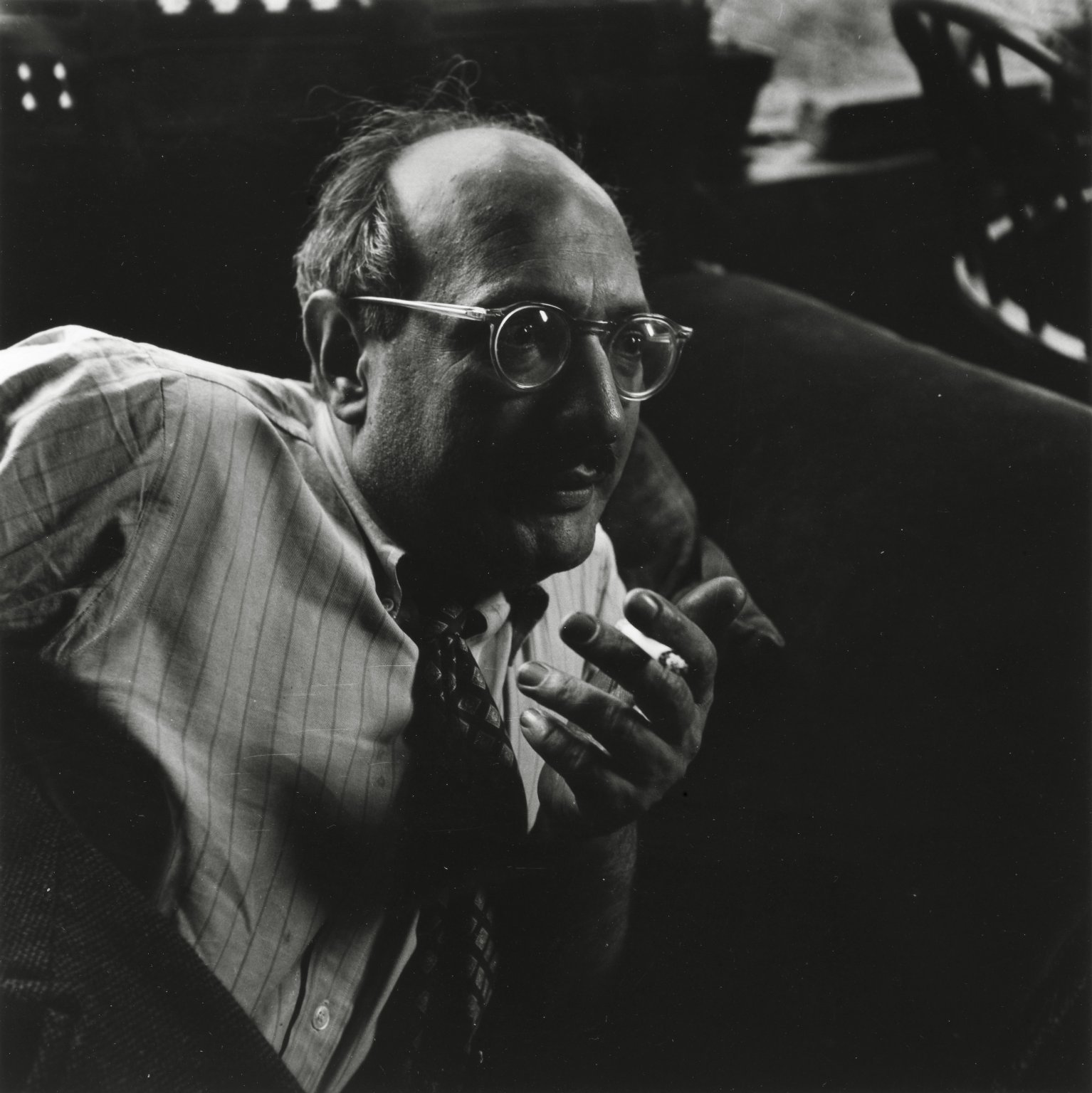
2008 — a Symphony of Hope
The 2008 American presidential election occurred on 4 November of that year — fifteen days before Schoenberg's twenty-eighth birthday. The economy had collapsed two months earlier with the failure of Lehman Brothers; Barack Obama campaigned on hope and change and was elected with 365 electoral votes. Both parties asked the people to embrace change and make a difference, Schoenberg later recalled. I was excited about ushering in this new era in our nation's history, and for the first time, I truly understood what it meant to be American.
The five movements of American Symphony trace the emotional arc of that moment. Fanfare is the bright opening salvo, built on major and minor thirds in parallel motion, constantly modulating upward — an upbeat to the symphonic argument that will follow. White on Blue is the symphony's nocturne: a chromatic-but-tonal flute solo above held pedal tones in the strings, a chorale heard three times, the slow building of the symphony's harmonic vocabulary. Rondo is the conscious populist gesture: Schoenberg calls it "happy music," influenced by electronica and the club-beat aesthetic of the 2000s, a textbook ABACADA built on major triads.
Prayer — the symphony's emotional core, an Adagio in homage to Barber and Gershwin, with oboe and clarinet solos — is dedicated to those lost in 9/11, Katrina, and all victims of violence and war. The chorale heard in the second movement returns here as the principal material. Stars, Stripes, and Celebration is the longest movement — its B-sections, Schoenberg notes, are "a classical interpretation of electronic dance music in 30 seconds," with quartal and quintal harmonies and aggressive sixteenth-note arpeggios. The symphony ends suspended in mid-air — Schoenberg's own description — to remind us that even though we are making positive strides to being a better America, we are still searching. It was completed three years before Trayvon Martin, four before Sandy Hook, six before Ferguson.
Copland's Third — the American Symphonic Mode
Aaron Copland's Symphony No. 3, completed in 1946 on a Koussevitzky Foundation commission and premiered by the Boston Symphony in October of that year, is the post-war American symphony par excellence. Its finale incorporates and develops the Fanfare for the Common Man (1942), itself written for Eugene Goossens and the Cincinnati Symphony as part of an Office of War Information series; in Copland's hands the fanfare became, by 1946, an elegy and an affirmation at once. Leonard Bernstein, who conducted the symphony often, called it the great American symphony; Michael Tilson Thomas has called it the closest thing we have to a national orchestral monument.
Schoenberg heard Copland's Third in November 2008, three nights after the presidential election. The parallel he drew is exact: in 1946 Copland wrote to bring beauty and peace into the world during a time of great turmoil, and in 2008 the financial crisis had imposed analogous conditions on the American republic. I set out to write a modern American symphony, Schoenberg wrote, that paid homage to our past and looked forward to a brighter future.
The musical inheritance is audible from the opening bar. Copland's open fifths, his fanfare-derived motivic economy, his fondness for parallel triads moving in stepwise modal lines — all are present in Schoenberg's score, refracted through a thirty-year-old's contemporary ear. The first-movement Fanfare is the most explicit homage; the fourth-movement Prayer the most personal extension of Copland's slow-movement vocabulary.
The Logic Pro Turn — Improvisation as Compositional Method
American Symphony marked Schoenberg's first sustained use of digital audio workstation technology as a primary compositional tool. I love to improvise, he has said. I began using a MIDI-sequencing program called Logic Pro while working on this piece. I improvised movements I and III into Logic, and played every single line on the keyboard that you'll hear in the orchestra. Once the movement felt complete within Logic, I then orchestrated it in Finale.
The procedure is unusual in concert composition — and revealing. Most twentieth-century American composers have worked at the piano with paper, the tradition descending through Copland from Boulanger and through Boulanger from the French academy. Schoenberg's generation has different tools: a personal MacBook, Logic Pro X, Finale, a set of audio sample libraries that allow the composer to hear an approximation of the full orchestra at any moment. The danger is obvious — sample-library textures can crowd into the score. The opportunity, for a composer with Schoenberg's improviser's instincts, is the recovery of spontaneity that traditional score-paper composing makes very hard to achieve.
The audible effect is the groove-orientation Schoenberg himself emphasises in the Rondo and parts of the Celebration: rhythmic continuities not unlike those a jazz pianist or a club DJ might generate at the keyboard, then transcribed and orchestrated for full symphony. The compositional decision is not merely technological; it is aesthetic. Schoenberg's music sounds, very specifically, like the music of a composer who grew up with Radiohead and Aphex Twin alongside Copland and Corigliano.
Picture Studies — Mussorgsky for the Nelson-atkins
In November 2011 the Kansas City Symphony and the Nelson-Atkins Museum jointly commissioned Schoenberg to write a 21st-century Pictures at an Exhibition. The phrasing is consequential. Modest Mussorgsky's 1874 cycle for solo piano — written as a memorial to his friend, the architect and painter Viktor Hartmann, and structured around ten Hartmann works on display in a memorial exhibition — is the founding text of musical ekphrasis: music describing visual art. Ravel's 1922 orchestration made it canonical; the Promenade between movements has entered the cultural unconscious.
Schoenberg accepted the commission and altered Mussorgsky's protocol in two significant ways. First, where Mussorgsky took a single artist (Hartmann), Schoenberg chose ten separate works by ten artists — "eight seemingly disparate works of art," he writes, though the actual count is ten. Second, he replaced Mussorgsky's Promenade with a piano-led ghostly Intro that recurs as an Interlude, "using the piano to pay respect to Mussorgsky."
The ten works span four paintings, three photographs, one sculpture and two framing piano gestures. II. Three Pierrots (Albert Bloch, Die Drei Pierrots Nr. 2): a triad turned upside down, on its side, twisted every way. III. Repetition (Kurt Baasch photograph): four figures walking, an ostinato; "change the scenery with a shutter click." IV. Olive Orchard (van Gogh): "extended impressionism, colourful, full of love." V. Kandinsky (Rose with Gray): the fastest and most aggressive music Schoenberg has written; "a battleground." VI. Calder's World (untitled mobile, 1937): time stopped; "quasi-aleatoric gestures, perhaps improvised." VII. Miró (Women at Sunrise): a virtuosic E-flat clarinet solo, "child-like yet delirious." IX. Cliffs of Moher (Hiroshi Sugimoto photograph): an ocean ostinato in pianissimo. X. Pigeons in Flight (Francis Blake photograph): the longest and most expansive movement; "fly away."


Three studies in seeing — the disc's arc
Three works, three stages of a compositional life. Finding Rothko (2006) belongs to Schoenberg's Juilliard apprenticeship under John Corigliano; American Symphony (2011) marks his first post-graduate orchestral statement; Picture Studies (2012) — his largest score to date at the time of recording — synthesises every idiom he had been testing. The disc's running order respects this chronology and so reads as a Bildungsroman in three chapters.
Finding Rothko — colour as form
The four movements take their titles from canvases Schoenberg sought out in person: Orange at the Guggenheim, Yellow at MoMA, Red at the LA MOCA, and the elusive Wine (No. 9, White and Black on Wine, 1958) which the composer eventually located in private hands at the then-unopened Glenstone Museum in Potomac. A recurring "Rothko's theme" announces each panel — a structural device borrowed, knowingly or not, from Mussorgsky's Promenade. The third movement employs graphic notation almost throughout; Schoenberg writes that it represents "an improvisation, as if Rothko himself were spattering the vibrant red paint onto the canvas for the first time, before turning it into his signature multi-form style." Wine, the closing panel, is the "Rothko theme" fully developed — and, in the composer's own assessment, "some of the most beautiful music I've ever written." This is atmospheric music in the strict sense: a study in luminosity, where colour rather than counterpoint is the generative principle.
American Symphony — Copland's heir, after Obama
The genesis is unusually specific. Schoenberg heard Copland's Third Symphony three nights after Barack Obama's 2008 election. "Quite serendipitously," he writes, "seeing that our country and world had needs similar to those of Copland's time, I was inspired to make a difference." The result is a five-movement, twenty-five-minute symphony in which "fanfare," "white on blue," "rondo," "prayer," and "stars, stripes, and celebration" form an arc from invocation through lament to qualified affirmation.
The construction repays close listening. Movement I is built on major and minor thirds in parallel motion, modulating perpetually upward — a Romantic device used here with an electronic-music sense of escalation. Movement II features a chromatic flute solo over pedal tones, then introduces an eight-chord chorale that resurfaces, fully developed, as the Prayer (Movement IV) — dedicated to "those lost in 9/11, Katrina, and all victims of violence and war." Movement III is the disc's clearest manifesto of Schoenberg's "groove-oriented" idiom: rondo form (ABACADA), club-beat pulse, "happy music." The finale's tripartite structure (Stars, Stripes, Celebration) culminates in a deliberately unresolved gesture — "suspended in mid-air to remind us that even though we are making positive strides to being a better America, we are still searching."
Picture Studies — a twenty-first-century Pictures
Commissioned jointly by the Kansas City Symphony and the Nelson-Atkins Museum of Art, the work is, Schoenberg writes, "a 21st-century Pictures at an Exhibition." Unlike Mussorgsky's homogeneous Hartmann gallery, the source material here spans four paintings (Bloch, Van Gogh, Kandinsky, Miró), three photographs (Baasch, Sugimoto, Blake) and one Calder sculpture. Four of the ten movements were conceived as piano études and only later orchestrated, a deliberate homage to Mussorgsky's original solo-piano scoring.
The composer's working notes — preserved in the booklet — read like an annotated catalogue: Three Pierrots ("comedic, naive, excited," a triad turned "upside down, on its side"); Kandinsky ("geometrically fierce, angular, sharp, jagged, violent... a battleground"); Calder's World ("dangling metal, atmospheric, yet dark... gradually fade to niente"); Miró with its E-flat clarinet solo, "spontaneous, bouncy, tribal, and raw." Pigeons in Flight, the closer, is "the longest and most expansive movement. Fly away."
This is music that, as Schoenberg puts it, "is deceptively difficult... it's perfectly off." On paper modal and tonal, in execution it demands what he calls "technical facility and emotional depth" in equal measure — an idiom for which Stern and the Kansas City forces have become exemplary advocates.
Michael Stern — champion, not premiere-conductor
Michael Stern's tenure as Music Director of the Kansas City Symphony, by the time of this 2014 session, had entered its second decade. Under his direction the orchestra had moved into the acoustically remarkable Helzberg Hall (2011), built an ongoing partnership with Reference Recordings, and assumed a profile far exceeding its mid-continental geography. Stern is the son of Isaac Stern, but his pedigree is independently solid: a Curtis graduate under Max Rudolf — whose textbook The Grammar of Conducting he later co-edited — and a 1981 alumnus of Harvard in American history.
He is also founding artistic director of the IRIS Orchestra in Tennessee, which commissioned and premiered Finding Rothko in January 2007. He is therefore not merely the conductor of Schoenberg's music on this disc but, in the composer's own words, "the first conductor to champion my music. He understands it, embraces it, and gives it an emotional dimension that would otherwise not exist."
The Kansas City Symphony — founded by R. Crosby Kemper, Jr. in 1982 from the remains of the older Kansas City Philharmonic (1933) — emerges here as a virtuoso ensemble of unsentimental commitment. The principal players audible on this recording include Boris Allakhverdyan (E-flat clarinet, Miró), Michael Gordon (flute), and concertmaster Noah Geller. The wind and brass principals — Suarez, Oyster, Bilderback, Santos, Schutza — bring soloistic personality to passages that demand it without breaking ensemble.
Stern's reading of these scores is notable for its refusal to treat new music as either museum object or ephemeral premiere. Phrasing breathes; rhythmic ostinati never become mechanical; the soft endings — Wine, Calder's World, the suspended close of American Symphony — are shaped with the same care a Brucknerian would give to a coda. This is precisely the discipline Schoenberg's "perfectly off" idiom requires.
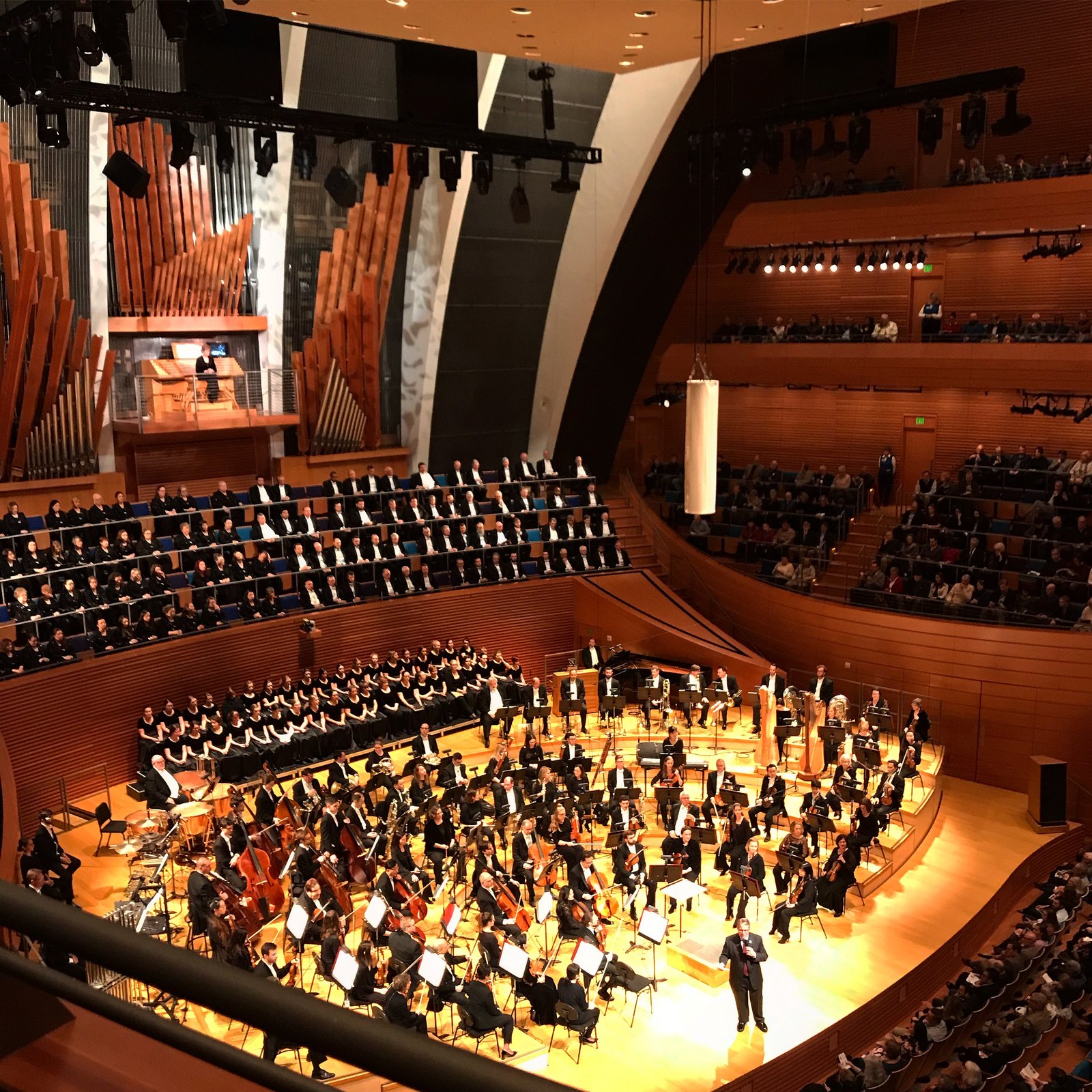
Helzberg Hall, June 2014 — sessions and signal path
The sessions took place on 20 and 21 June 2014 in Helzberg Hall, the 1,600-seat acoustic centrepiece of Kansas City's Kauffman Center for the Performing Arts, opened in 2011. Helzberg's reputation for clarity and natural decay had by then made it one of the favoured American halls for orchestral recording, and the Kansas City Symphony's residency there underpins the entire Reference Recordings series with this ensemble.
Production was led by David Frost, then a thirteen-time (now fourteen-time) Grammy winner including four awards as Classical Producer of the Year, and a veteran of nearly a decade as RCA Red Seal staff producer. Recording and mastering — including the surround mastering for the SACD release — were the work of Keith O. Johnson ('Prof' Johnson), co-founder of Reference Recordings and co-inventor (with Michael Pflaumer) of the HDCD encoding process honoured on the cover. Johnson received the Audio Engineering Society Silver Medal in 2008, placing him in the company of Ray Dolby, Paul Klipsch, Robert Moog and Willi Studer. He had already won a 2011 Grammy for Best Surround Sound Album for the Kansas City Symphony's Britten's Orchestra on this same label, shared with Frost.
Sean Royce Martin handled the on-site recording; Graemme Brown of Zen Mastering managed the DSD transfer and SACD authoring. Executive producers were J. Tamblyn Henderson, Jr. and Marcia Gordon Martin. The Kansas City Symphony acknowledges Joan Horan's sponsorship of the recording in the booklet. Catalogue number RR-139; released in HDCD and SACD formats.

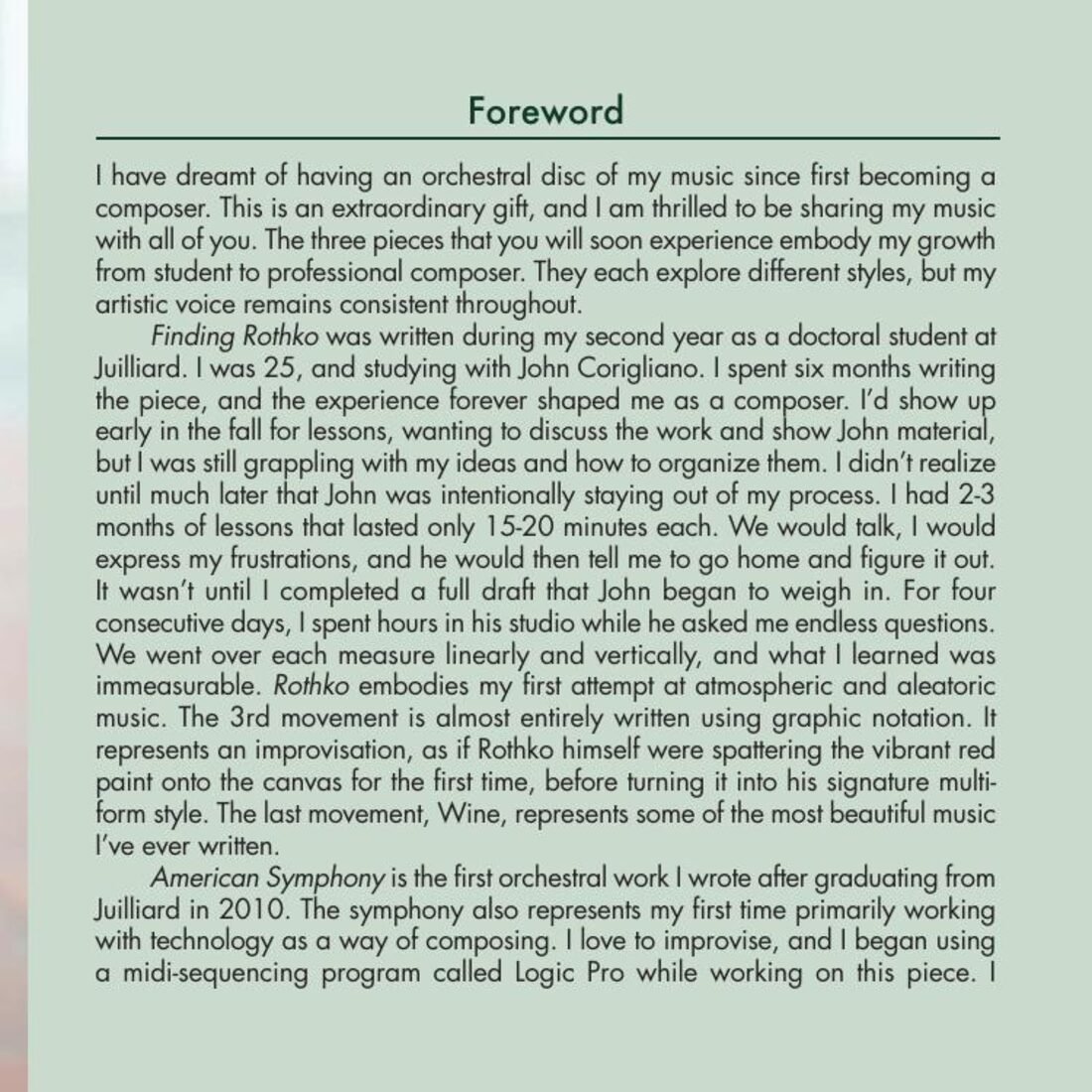


Adam Schoenberg: American Symphony · RR-139
24 pages · the original release booklet — complete programme notes and credits, exactly as issued.
- Adam Schoenberg (b. 1980)
- Michael Stern · Kansas City Symphony
- Complete booklet · programme notes & credits
Further listening and reading
- Reference Recordings — RR-139 catalogue page
- Adam Schoenberg — official site
- Kansas City Symphony — Michael Stern
- Nelson-Atkins Museum of Art — co-commissioner, Picture Studies
- IRIS Orchestra — commissioner, Finding Rothko
A document of an American composer mid-stride, captured by engineers and players who treat new music with the seriousness usually reserved for the canon. The result rewards repeated hearing, layer by layer.
A note when a new essay or travelogue appears. No noise, unsubscribe in one click.